Kirjojen hintavertailu. Mukana 11 342 296 kirjaa ja 12 kauppaa.

Kirjahaku

Etsi kirjoja tekijän nimen, kirjan nimen tai ISBN:n perusteella.

1000 tulosta hakusanalla Donna M. Orange

Nourishing the Inner Life of Clinicians and Humanitarians
Winner of the Clinical catergory of the American Board & Academy of Psychoanalysis Book Prize for best books published in 2016Nourishing the Inner Life of Clinicians and Humanitarians: The Ethical Turn in Psychoanalysis, demonstrates the demanding, clinical and humanitarian work that psychotherapists often undertake with fragile and devastated people, those degraded by violence and discrimination. In spite of this, Donna M. Orange argues that there is more to human nature than a relentlessly negative view. Drawing on psychoanalytic and philosophical resources, as well as stories from history and literature, she explores ethical narratives that ground hope in human goodness and shows how these voices, personal to each analyst, can become sources of courage, warning and support, of prophetic challenge and humility which can inform and guide their work. Over the course of a lifetime, the sources change, with new ones emerging into importance, others receding into the background. Donna Orange uses examples from ancient Rome (Marcus Aurelius), from twentieth century Europe (Primo Levi, Emmanuel Levinas, Dietrich Bonhoeffer), from South Africa (Nelson Mandela), and from nineteenth century Russia (Fyodor Dostoevsky). She shows how not only can their words and examples, like those of our personal mentors, inspire and warn us; but they also show us the daily discipline of spiritual self-care, although these examples rely heavily on the discipline of spiritual reading, other practitioners will find inspiration in music, visual arts, or elsewhere and replenish the resources regularly. Nourishing the Inner Life of Clinicians and Humanitarians will help psychoanalysts to develop a language with which to converse about ethics and the responsibility of the therapist/analyst. This is an exceptional contribution highly suitable for practitioners and students of psychoanalysis and psychotherapy.

Nourishing the Inner Life of Clinicians and Humanitarians
Winner of the Clinical catergory of the American Board & Academy of Psychoanalysis Book Prize for best books published in 2016Nourishing the Inner Life of Clinicians and Humanitarians: The Ethical Turn in Psychoanalysis, demonstrates the demanding, clinical and humanitarian work that psychotherapists often undertake with fragile and devastated people, those degraded by violence and discrimination. In spite of this, Donna M. Orange argues that there is more to human nature than a relentlessly negative view. Drawing on psychoanalytic and philosophical resources, as well as stories from history and literature, she explores ethical narratives that ground hope in human goodness and shows how these voices, personal to each analyst, can become sources of courage, warning and support, of prophetic challenge and humility which can inform and guide their work. Over the course of a lifetime, the sources change, with new ones emerging into importance, others receding into the background. Donna Orange uses examples from ancient Rome (Marcus Aurelius), from twentieth century Europe (Primo Levi, Emmanuel Levinas, Dietrich Bonhoeffer), from South Africa (Nelson Mandela), and from nineteenth century Russia (Fyodor Dostoevsky). She shows how not only can their words and examples, like those of our personal mentors, inspire and warn us; but they also show us the daily discipline of spiritual self-care, although these examples rely heavily on the discipline of spiritual reading, other practitioners will find inspiration in music, visual arts, or elsewhere and replenish the resources regularly. Nourishing the Inner Life of Clinicians and Humanitarians will help psychoanalysts to develop a language with which to converse about ethics and the responsibility of the therapist/analyst. This is an exceptional contribution highly suitable for practitioners and students of psychoanalysis and psychotherapy.

The Suffering Stranger

The Suffering Stranger

Donna M. Orange

Routledge
2011
sidottu
Winner of the 2012 Gradiva Award!Utilizing the hermeneutics of Hans-Georg Gadamer and the ethics of Emmanuel Lévinas, The Suffering Stranger invigorates the conversation between psychoanalysis and philosophy, demonstrating how each is informed by the other and how both are strengthened in unison. Orange turns her critical (and clinical) eye toward five major psychoanalytic thinkers – Sándor Ferenczi, Frieda Fromm-Reichmann, D. W. Winnicott, Heinz Kohut, and Bernard Brandchaft – investigating the hermeneutic approach of each and engaging these innovative thinkers precisely as interpreters, as those who have seen the face and heard the voice of the other in an ethical manner. In doing so, she provides the practicing clinician with insight into the methodology of interpretation that underpins the day-to-day activity of analysis, and broadens the scope of possibility for philosophical extensions of psychoanalytic theory.
The Suffering Stranger

The Suffering Stranger

Donna M. Orange

Routledge
2011
nidottu
Winner of the 2012 Gradiva Award!Utilizing the hermeneutics of Hans-Georg Gadamer and the ethics of Emmanuel Lévinas, The Suffering Stranger invigorates the conversation between psychoanalysis and philosophy, demonstrating how each is informed by the other and how both are strengthened in unison. Orange turns her critical (and clinical) eye toward five major psychoanalytic thinkers – Sándor Ferenczi, Frieda Fromm-Reichmann, D. W. Winnicott, Heinz Kohut, and Bernard Brandchaft – investigating the hermeneutic approach of each and engaging these innovative thinkers precisely as interpreters, as those who have seen the face and heard the voice of the other in an ethical manner. In doing so, she provides the practicing clinician with insight into the methodology of interpretation that underpins the day-to-day activity of analysis, and broadens the scope of possibility for philosophical extensions of psychoanalytic theory.
Thinking for Clinicians

Thinking for Clinicians

Donna M. Orange

Analytic Press,U.S.
2009
nidottu
Thinking for Clinicians provides analysts of all orientations with the tools and context for working critically within psychoanalytic theory and practice. It does this through detailed chapters on some of the philosophers whose work is especially relevant for contemporary theory and clinical writing: Emmanuel Levinas, Martin Buber, Ludwig Wittgenstein, Maurice Merleau-Ponty, and Hans-Georg Gadamer. Orange presents the historical background for their ideas, along with clinical vignettes to help contextualize their theories, further grounding them in real-world experience. With a hermeneutic sensibility firmly in mind, Thinking for Clinicians rewards as it challenges and will be a valuable reference for clinicians who seek a better understanding of the philosophical bases of contemporary psychoanalytic theory.
Climate Crisis, Psychoanalysis, and Radical Ethics
Psychoanalysis engages with the difficult subjects in life, but it has been slow to address climate change. Climate Crisis, Psychoanalysis, and Radical Ethics draws on the latest scientific evidence to set out the likely effects of climate change on politics, economics and society more generally, including impacts on psychoanalysts.Despite a tendency to avoid the warnings, times of crisis summon clinicians to emerge from comfortable consulting rooms. Daily engaged with human suffering, they now face the inextricably bound together crises of global warming and massive social injustices. After considering historical and emotional causes of climate unconsciousness and of compulsive consumerism, this book argues that only a radical ethics of responsibility to be "my other’s keeper" will truly wake us up to climate change and bring psychoanalysts to actively take on responsibilities, such as demanding change from governments, living more simply, flying less, and caring for the earth and its inhabitants everywhere.Linking climate justice to radical ethics by way of psychoanalysis, Donna Orange explores many relevant aspects of psychoanalytic expertise, referring to work on trauma, mourning, and the transformation of trouble into purpose. Orange makes practical suggestions for action in the psychoanalytic and psychotherapeutic communities: reducing air travel, consolidating organizations and conferences, better use of internet communication and education. This book includes both philosophical considerations of egoism (close to psychoanalytic narcissism) as problematic, together with work on shame and envy as motivating compulsive and conspicuous consumption.The interweaving of climate emergency and massive social injustice presents psychoanalysts and organized psychoanalysis with a radical ethical demand and an extraordinary opportunity for leadership. Climate Crisis, Psychoanalysis, and Radical Ethics will provide accessible and thought-provoking reading for psychoanalysts and psychotherapists, as well as philosophers, environmental studies scholars and students studying across these fields.
Climate Crisis, Psychoanalysis, and Radical Ethics
Psychoanalysis engages with the difficult subjects in life, but it has been slow to address climate change. Climate Crisis, Psychoanalysis, and Radical Ethics draws on the latest scientific evidence to set out the likely effects of climate change on politics, economics and society more generally, including impacts on psychoanalysts.Despite a tendency to avoid the warnings, times of crisis summon clinicians to emerge from comfortable consulting rooms. Daily engaged with human suffering, they now face the inextricably bound together crises of global warming and massive social injustices. After considering historical and emotional causes of climate unconsciousness and of compulsive consumerism, this book argues that only a radical ethics of responsibility to be "my other’s keeper" will truly wake us up to climate change and bring psychoanalysts to actively take on responsibilities, such as demanding change from governments, living more simply, flying less, and caring for the earth and its inhabitants everywhere.Linking climate justice to radical ethics by way of psychoanalysis, Donna Orange explores many relevant aspects of psychoanalytic expertise, referring to work on trauma, mourning, and the transformation of trouble into purpose. Orange makes practical suggestions for action in the psychoanalytic and psychotherapeutic communities: reducing air travel, consolidating organizations and conferences, better use of internet communication and education. This book includes both philosophical considerations of egoism (close to psychoanalytic narcissism) as problematic, together with work on shame and envy as motivating compulsive and conspicuous consumption.The interweaving of climate emergency and massive social injustice presents psychoanalysts and organized psychoanalysis with a radical ethical demand and an extraordinary opportunity for leadership. Climate Crisis, Psychoanalysis, and Radical Ethics will provide accessible and thought-provoking reading for psychoanalysts and psychotherapists, as well as philosophers, environmental studies scholars and students studying across these fields.
Emotional Understanding

Emotional Understanding

Donna M. Orange

Guilford Publications
1996
sidottu
With a unique blend of clinical compassion and philosophical reflection, Donna M. Orange explores the nature and process of psychoanalytic understanding within the intimate and healing context of treatment. Disputing the traditional psychoanalytic emphasis on verbalization, Orange highlights the [i]emotional[/i] nature of psychoanalytic understanding. Because much of emotional understanding is tacit understanding, it requires the analyst's empathic participation in the patient's emotional predicament, and attention to the kinds of memories that precede and extend beyond words. Delineating the philosophical underpinnings of emotional understanding/m-/and illuminating the epistemology of the therapeutic enterprise/m-/this book is enlightening reading for all mental health professionals interested in psychodynamic theory and treatment.
Emotionales Verständnis und Intersubjektivität

Emotionales Verständnis und Intersubjektivität

Donna M. Orange

Brandes + Apsel Verlag Gm
2003
sidottu
Donna M. Orange legt in ihrem Hauptwerk die Natur des psychoanalytischen Prozesses aus Sicht der Intersubjektivitätstheorie dar. Sie entfernt sich dabei konsequent von der psychoanalytischen Trieb- und Objektbeziehungstheorie hin zu einer Auffassung, die sie perspektivischen Realismus nennt. Danach ist der Schlüssel psychoanalytischer Arbeit die emotionale Heilung, die aus einem verbalen und non-verbalen Zusammenspiel zwischen Patient und Psychoanalytiker besteht. Beide Beteiligte am psychoanalytischen Prozess nehmen ihre eigene Beteiligung vor dem Hintergrund ihrer Lebensgeschichte wahr. Wenn der Dialog mit dem Psychoanalytiker auf diese Weise zu einer empathischen Teilnahme am Leiden des Patienten - wie dieser seine Erlebenswelt organisiert hat - führt, so kommt es zum emotionalen Verständnis innerhalb des intersubjektiven Feldes. In einer solch sicheren Bindung kann der Patient eine zweite Chance für eine gesündere Entwicklung und ein integriertes Selbst wahrnehmen. Donna M. Orange überbrückt nicht nur die Kluft zwischen Psychoanalyse und Philosophie, sondern macht die Philosophie auch für die Theoriebildung der Psychoanalyse nutzbar. Sie prüft - ausgehend von alten griechischen Vorstellungen bis in die zeitgenössische Hermeneutik hinein - neuere Vorstellungen, insbesondere von Georg Gadamer, daraufhin, ob sie für eine neue Sichtweise in der Psychoanalyse genutzt werden können. Sie plädiert für eine fallibilistische Haltung, die die einmal gewählte Theorie immer wieder auf den Prüfstand stellt und so in der Schwebe hält.
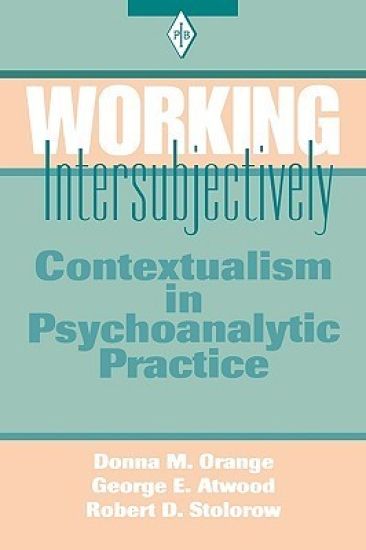
Working Intersubjectively

Working Intersubjectively

Donna M. Orange; George E. Atwood; Robert D. Stolorow

Analytic Press,U.S.
2001
nidottu
From an overview of the basic principles of intersubjectivity theory, Orange, Atwood, and Stolorow proceed to contextualist critiques of the concept of psychoanalytic technique and of the myth of analytic neutrality. They then examine the intersubjective contexts of extreme states of psychological disintegration, and conclude with an examination of what it means, philosophically and clinically, to think and work contextually. This lucidly written and cogently argued work is the next step in the development of intersubjectivity theory. In particular, it is a clinically grounded continuation of Stolorow and Atwood's Contexts of Being (TAP, 1992), which reconceptualized four foundational pillars of psychoanalytic theory -- the unconscious, mind-body relations, trauma, and fantasy -- from an intersubjective perspective. Working Intersubjectively expounds and illustrates the contextualist sensibility that grows out of this reconceptualization. Like preceding volumes in the Psychoanalytic Inquiry Book Series by Robert Stolorow and his colleagues, it will be theoretically challenging and clinically useful to a wide readership of psychoanalysts and psychoanalytically informed psychotherapists.
Working Intersubjectively

Working Intersubjectively

Donna M. Orange; George E. Atwood; Robert D. Stolorow

Routledge
2016
sidottu
From an overview of the basic principles of intersubjectivity theory, Orange, Atwood, and Stolorow proceed to contextualist critiques of the concept of psychoanalytic technique and of the myth of analytic neutrality. They then examine the intersubjective contexts of extreme states of psychological disintegration, and conclude with an examination of what it means, philosophically and clinically, to think and work contextually. This lucidly written and cogently argued work is the next step in the development of intersubjectivity theory. In particular, it is a clinically grounded continuation of Stolorow and Atwood's Contexts of Being (TAP, 1992), which reconceptualized four foundational pillars of psychoanalytic theory -- the unconscious, mind-body relations, trauma, and fantasy -- from an intersubjective perspective. Working Intersubjectively expounds and illustrates the contextualist sensibility that grows out of this reconceptualization. Like preceding volumes in the Psychoanalytic Inquiry Book Series by Robert Stolorow and his colleagues, it will be theoretically challenging and clinically useful to a wide readership of psychoanalysts and psychoanalytically informed psychotherapists.
Kissing the Virgin's Mouth

Kissing the Virgin's Mouth

Donna M. Gershten

HARPER PERENNIAL
2002
nidottu
Guadalupe Magdalena Molina V squez -- wife, scoundrel, courtesan, mother -- is full of contradictions: she believes in love but is suspicious of men; she rejects religion but admires the Virgin Mary; she respects tradition while breaking all the rules. Here, in the Golden Zone of Teat n, Mexico, Magda tells her extraordinary life story -- from a poor Mexican barrio to American affluence, from wide-eyed childhood to worldly courtesan life, from full-blooded youth to oncoming blindness -- and bewitchingly imparts the hard-earned wisdom she has gained through the years.
Biology for the Informed Citizen

Biology for the Informed Citizen

Donna M. Bozzone; Douglas S. Green

Oxford University Press
2014
nidottu
With Biology for the Informed Citizen, students connect the concepts of biology to the consequences of biology. Authors Donna M. Bozzone and Douglas S. Green teach the concepts of biology, evolution, and the process of science so that students can apply their knowledge as informed consumers and users of scientific information. Cases: An engaging biological issue opens every chapter and is revisited throughout Concepts: Foundational biological ideas are introduced within the context of important cultural and social issues Consequences: The concepts and consequences of biology are connected in order to help students make informed decisions about biological issues Biology for the Informed Citizen is available with or without chapters 11-15 on physiology. Both versions allow instructors to cover the chapters and topics in the order that they choose.
Archie and Amelie: Love and Madness in the Gilded Age

Archie and Amelie: Love and Madness in the Gilded Age

Donna M. Lucey

Crown Publishing Group (NY)
2007
nidottu
Filled with glamour, mystery, and madness, Archie and Am lie is the true story chronicling a tumultuous love affair in the Gilded Age. John Armstrong "Archie" Chanler was an heir to the Astor fortune, an eccentric, dashing, and handsome millionaire. Am lie Rives, Southern belle and the goddaughter of Robert E. Lee, was a daring author, a stunning temptress, and a woman ahead of her time. Archie and Am lie seemed made for each other--both were passionate, intense, and driven by emotion--but the very things that brought them together would soon tear them apart. Their marriage began with a "secret" wedding that found its way onto the front page of the New York Times, to the dismay of Archie's relatives and Am lie's many gentleman friends. To the world, the couple appeared charmed, rich, and famous; they moved in social circles that included Oscar Wilde, Teddy Roosevelt, and Stanford White. But although their love was undeniable, they tormented each other, and their private life was troubled from the start. They were the F. Scott and Zelda Fitzgerald of their day--a celebrated couple too dramatic and unconventional to last--but their tumultuous story has largely been forgotten. Now, Donna M. Lucey vividly brings to life these extraordinary lovers and their sweeping, tragic romance. "In the Virginia hunt country just outside of Charlottesville, where I live, the older people still tell stories of a strange couple who died some two generations ago. The stories involve ghosts, the mysterious burning of a church, a murder at a millionaire's house, a sensational lunacy trial, and a beautiful, scantily clad young woman prowling her gardens at night as if she were searching for something or someone--or trying to walk off the effects of the morphine that was deranging her. I was inclined to dismiss all of this as tall tales Virginians love to spin out; but when I looked into these yarns I found proof that they were true. . . ." --Donna M. Lucey on Archie and Am lie
Frozen Section Library: Gynecologic Pathology Intraoperative Consultation

Frozen Section Library: Gynecologic Pathology Intraoperative Consultation

Donna M. Coffey; Ibrahim Ramzy

Springer-Verlag New York Inc.
2011
nidottu
Frozen sections are performed while a patient is undergoing surgery as a basis for making an immediate diagnosis that will impact treatment decisions. Frozen section diagnosis is often a highly demanding situation for the pathologist who must render a diagnosis quickly, based on careful gross examination of specimens to select optimal areas for microscopic examination.The Frozen Section Library series will provide concise, user-friendly, site specific handbooks that are well illustrated and highlight the pitfalls, artifacts and differential diagnosis issues that arise in the hurried frozen section scenario.Donna M. Coffey, M.D., is Assistant Professor, Department of Pathology and Laboratory Medicine, The Methodist Hospital, Houston, Texas and Weill Medical College of Cornell University, New York, New York.Ibrahim Ramzy, M.D., is Professor of Pathology - Laboratory Medicine & Obstetrics-Gynecology, University of California, Irvine, California and Adjunct Professor of Pathology, Baylor College of Medicine, Houston, Texas.
Sargent's Women

Sargent's Women

Donna M. Lucey

WW Norton Co
2017
sidottu
With unprecedented access to newly discovered sources, Donna M. Lucey illuminates the lives of four women painted by the society portraitist John Singer Sargent. With uncanny clairvoyance, Sargent’s portraits hint at the mysteries, passions and tragedies that unfolded in his subjects’ lives. Elsie Palmer carried on a labyrinthine love life in a Rocky Mountain castle; Elizabeth Chanler stepped into a maze of infidelity with her best friend’s husband; as the veiled image of Sally Fairchild emerged on the canvas, her sister was lured into an ill-fated life in art; and shrewd Isabella Stewart Gardner collected both art and young men. Born to unimaginable wealth, these women lived on an operatic scale; their letters and diaries create a rich depiction of the Gilded Age and the painter whose canvases defined the era.
Sargent's Women

Sargent's Women

Donna M. Lucey

WW Norton Co
2018
nidottu
With unprecedented access to newly discovered sources, Donna M. Lucey illuminates the lives of four women painted by the society portraitist John Singer Sargent. With uncanny clairvoyance, Sargent’s portraits hint at the mysteries, passions and tragedies that unfolded in his subjects’ lives. Elsie Palmer carried on a labyrinthine love life in a Rocky Mountain castle; Elizabeth Chanler stepped into a maze of infidelity with her best friend’s husband; as the veiled image of Sally Fairchild emerged on the canvas, her sister was lured into an ill-fated life in art; and shrewd Isabella Stewart Gardner collected both art and young men. Born to unimaginable wealth, these women lived on an operatic scale; their letters and diaries create a rich depiction of the Gilded Age and the painter whose canvases defined the era.
Combining CBT and Medication

Combining CBT and Medication

Donna M. Sudak

John Wiley Sons Inc
2011
nidottu
Combining medication and cognitive behavioral therapy (CBT) can be challenging but can also enhance patient care. This book reviews the existing literature about the neurobiological and clinical basis in combining CBT and medication for non-psychiatrist mental health clinicians. Filled with case studies drawn from the author's extensive clinical and teaching experience, this book breaks new ground in bringing together the most current, proven protocols for using drugs and CBT to improve client care. Practitioners will find in this volume the tools to make informed recommendations to patients.
Content-Based Second Language Instruction

Content-Based Second Language Instruction

Donna M. Brinton; Marjorie Wesche; Ann Maguerite Snow

The University of Michigan Press
2003
nidottu
In the Michigan Classics Edition of Content-Based Second Language Instruction, the authors provide updates on the field of CBI in second language acquisition since 1989.While the core of the book remains the same, new features discuss important CBI-related research and modifications to the pedagogy in the past many years.Content-Based Second Language Instruction, Michigan Classics Edition, now includes: a new preface a glossary of key terms an updated bibliography an epilogue highlighting the major developments in the field since 1989.