Kirjojen hintavertailu. Mukana 11 244 527 kirjaa ja 12 kauppaa.

Kirjahaku

Etsi kirjoja tekijän nimen, kirjan nimen tai ISBN:n perusteella.

1000 tulosta hakusanalla Douglas Edward Leach

Flintlock and Tomahawk

Flintlock and Tomahawk

Douglas Edward Leach

Countryman Press Inc.
2009
nidottu
This classic account of King Philip’s War, first published in 1958, offers a bird’s-eye view of the conflict, from the Wampanoag sachem’s rise to his ultimate defeat. The battles, massacres, stratagems, and logistics of this war are all detailed, with the leaders of both sides figuring prominently in this tale of bloodshed, privation, and woe. The author weighs all the factors contributing to the Native Americans’ defeat and surveys the effects of the war on the lives of both Indians and colonists in the years to come. With insight, balance, and compassion, Leach portrays the tragedy of the war and points toward the future of the nascent American republic.

Roots of Conflict

Roots of Conflict

Leach Douglas Edward

The University of North Carolina Press
1989
nidottu
This lively book recounts the story of the antagonism between the American colonists and the British armed forces prior to the Revolution. Douglas Leach reveals certain Anglo-American attitudes and stereotypes that evolved before 1763 and became an important factor leading to the outbreak of the Revolutionary War. Using research from both England and the United States, Leach provides a comprehensive study of this complex historical relationship. British professional armed forces first were stationed in significant numbers in the colonies during the last quarter of the seventeenth century. During early clashes in Virginia in the 1670s and in Boston and New York in the late 1680s, the colonists began to perceive the British standing army as a repressive force. The colonists rarely identified with the British military and naval personnel and often came to dislike them as individuals and groups. Not suprisingly, these hostile feelings were reciprocated by the British soldiers, who viewed the colonists as people who had failed to succeed at home and had chosen a crude existence in the wilderness. These attitudes hardened, and by the mid-eighteenth century an atmosphere of distrust and suspicion prevailed on both sides. With the outbreak of the French and Indian War in 1754, greater numbers of British regulars came to America. Reaching uprecedented levels, the increased contact intensified the British military's difficulty in finding shelter and acquiring needed supplies and troops from the colonists. Aristocratic British officers considered the provincial officers crude amateurs -- incompetent, ineffective, and undisciplined -- leading slovenly, unreliable troops. Colonists, in general, hindered the British military by profiteering whenever possible, denouncing taxation for military purposes, and undermining recruiting efforts. Leach shows that these attitudes, formed over decades of tension-breeding contact, are an important development leading up to the American Revolution.
Dilpomatic Relations

Dilpomatic Relations

Douglas Edward Webb

Createspace Independent Publishing Platform
2012
nidottu
Ray stielo walks upright, proud and over confident across the bridge of the Ravanger, the newest ship built for the resistance on Rihese. Ray summons his lieutenant to his side. Lieutenant Rance he says softely,"We have a code blue aboard this ship". Lt.Rance looks square into his commanders eyes and states" I'll assemble the men at once sir".
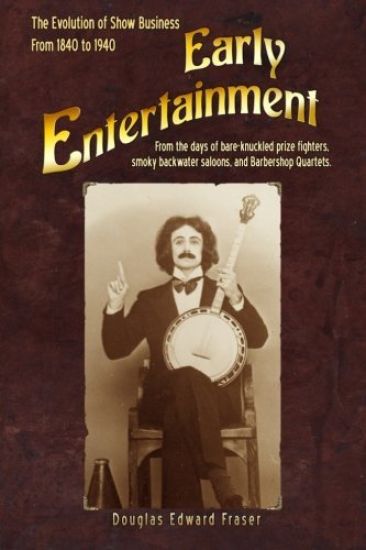
Early Entertainment: The Evolution of Show Business from 1840 to 1940. From the days of bare knuckled prize fighters, smoky back water salo
This book is filled with secrets, surprises, and delights. You will be introduced to, and become quite intimate with, the creation of everything that makes up entertainment and the activities that brought smiles to the faces of North America. Covering the roots of jazz, vaudeville, burlesque, big bands, silent movies, ragtime, television, bare-knuckle prize fights, minstrel shows, circus and carnivals, bebop, medicine shows, jug bands, bicycles, musicians' drugs, radio, Model Ts, paddlewheelers, roller- skates, the blues, barnstorming, gramophones, dancing, barbershop quartets, stage microphones, Tin Pan Alley, washboard bands, swing, wild west shows and more. Lots of photographs and insight to subjects that you thought you knew about. Douglas Edward Fraser is a musicologist with a lifetime of knowledge. He includes many personal and family stories that have been chronicled from the experiences of three generations of professional entertainers. This is a book like no other, and it has been written to entertain and enlighten the readers that enjoy the Old West, Victorian, Edwardian and jazz eras.
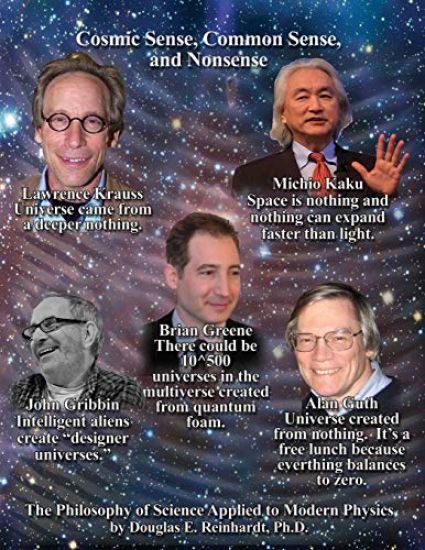
Cosmic Sense, Common Sense, and Nonsense

Cosmic Sense, Common Sense, and Nonsense

Douglas Edward Reinhardt

Independently Published
2018
nidottu
Cosmology borrows metaphysical and mystical baggage from quantum theory and relativity to explain large-scale, universal phenomena. The singularity in spacetime (a dimensionless point) is borrowed from General Relativity and is obviously a metaphysical construct since matter-energy cannot logically exist in non-space and non-time. The mystical idea of getting something from nothing is borrowed from quantum physicists who inform us that virtual particles can pop into existence out of the vacuum (which has zero-point energy) and can become real particles of matter under certain circumstances. This quantum foam, as it is called, gives a rationale for how the Big Bang could have banged into existence from nothing.The idea of space expansion comes from relativity which indicates that space is a flexible physical medium. However, the notion in cosmology, which contradicts relativity, is that space is expanding faster than light, moving galactic islands from each other at greater and greater distances. The patch for the faster-than-light space expansion contradiction is that matter is not moving faster than light because the matter in galaxies is at rest in space and is just being carried along at superluminal speeds. As Michio Kaku says: "Space is nothing and nothing can go faster than light." Of course, Kaku is missing the key ingredient in relativity, namely, that space is something that can be bent curved, warped, twisted, folded, stretched and contorted in many different ways.There is much contradiction in whether anything can escape a black hole. Initially, physicists told us that nothing, not even light or electromagnetic radiation, can escape a black hole. Then Hawking found a way that mass can be destroyed in a black hole, thus leading to its dissolution. He contends that anti-matter particles hatched with their matter twins in the quantum foam can be pulled into black holes and annihilate an equal amount of matter. However, we have found that matter is not destroyed in these matter-antimatter collisions - but is converted to radiation, which can be converted back to matter. Therefore, the radiation created from matter-antimatter collisions cannot escape from the hole if the original contention is true - that not even light can escape its clutches. Thus, there is still no explanation as to how radiation escapes and dissolves the black hole - if indeed it does.
Global Poverty, Human Rights and Development

Global Poverty, Human Rights and Development

Douglas Edward Reeve

hbmarianne831
2023
pokkari
How well does political philosophy deal with the big issues? Is our contemporary approach able to withstand Marx' challenge1, "The philosophers have only interpreted the world, in various ways; the point is to change it"? This thesis attempts to answer these questions by examining philosophical responses to one of the biggest problems facing the world today, that of global poverty. This blight on society has been widely recognised, for longer than many similar problems such as climate change and the threat of global pandemics. Consequently there exists a substantial body of philosophical work to consider. The focus is threefold: to evaluate how political philosophy has responded to global poverty, to identify opportunities for further progress, and to suggest how the role of political philosophers in general might evolve in the light of recent developments. This investigation concentrates on the two major approaches of recent years aimed at, amongst other objectives, reducing global poverty - the Human Rights Approach and the Human Development Approach.
Edward Douglas White, Sr., Governor of Louisiana, 1835-1839
This work has been selected by scholars as being culturally important and is part of the knowledge base of civilization as we know it.This work is in the public domain in the United States of America, and possibly other nations. Within the United States, you may freely copy and distribute this work, as no entity (individual or corporate) has a copyright on the body of the work.Scholars believe, and we concur, that this work is important enough to be preserved, reproduced, and made generally available to the public. To ensure a quality reading experience, this work has been proofread and republished using a format that seamlessly blends the original graphical elements with text in an easy-to-read typeface.We appreciate your support of the preservation process, and thank you for being an important part of keeping this knowledge alive and relevant.