
Kirjahaku
Etsi kirjoja tekijän nimen, kirjan nimen tai ISBN:n perusteella.
1000 tulosta hakusanalla Eduard Fraenkel
Eduard Fraenkel was one of the most influential classicists of the twentieth century. His Plautine Elements in Plautus (originally published in German in 1922) revolutionized the study of Roman comedy. It is still essential reading for students and scholars of Plautus. This translation makes it accessible to an English-speaking readership for the first time. All Latin and Greek is translated, thus making the work available to a wider audience consisting of all those interested in Roman drama. The book includes a translation of the Addenda to the Italian translation published in 1960. The English translation is prefaced by an essay which gives an introduction to developments in Plautine scholarship since 1960.
Frankel, E: Darlehen Und Die Irregulare Hinterlegung (1899)
Eduard Frankel
KESSINGER PUBLISHING, LLC
2010
nidottu

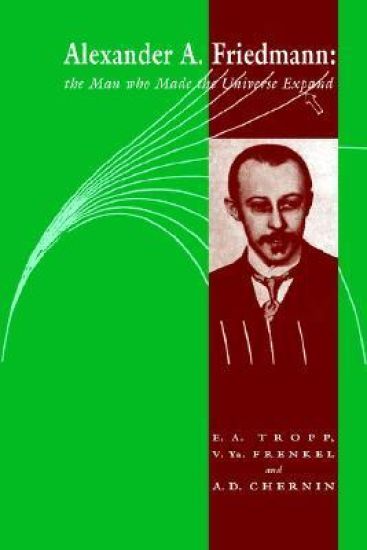
Alexander A Friedmann
Eduard A. Tropp; Viktor Ya. Frenkel; Artur D. Chernin
Cambridge University Press
2006
pokkari
Our universe can be described mathematically by a simple model developed in 1922 at Petrograd (St Petersburg) by Alexander Friedmann (1888–1925), who predicted that the whole universe would expand and evolve with time before there was any observational evidence. He was an outstanding Soviet physicist, and this vivid 1993 biography is set in a wide historical background. The book is a window on the school and university years, military service, teaching and research during a seminal period of Soviet history. The authors include unique archival material, such as Friedmann's letters from the Front, as well as contemporary records and reminiscences of colleagues. There is a detailed treatment of his work in Theoretical Cosmology (1922–1924), set in the context of the organization of Soviet science at the time.
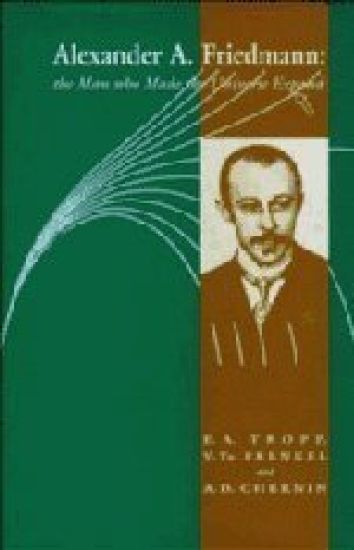
Alexander A Friedmann
Eduard A. Tropp; Viktor Ya. Frenkel; Artur D. Chernin
Cambridge University Press
1993
sidottu
Our universe can be described mathematically by a simple model developed in 1922 at Petrograd (St Petersburg) by Alexander Friedmann (1888–1925), who predicted that the whole universe would expand and evolve with time before there was any observational evidence. He was an outstanding Soviet physicist, and this vivid biography is set in a wide historical background. The book is a window on the school and university years, military service, teaching and research during a seminal period of Soviet history. The authors include unique archival material, such as Friedmann’s letters from the Front, as well as contemporary records and reminiscences of colleagues. There is a detailed treatment of his work in Theoretical Cosmology (1922–1924), set in the context of the organization of Soviet science at the time.
Leo B. Mittelman, Petitioner, V. United States. U.S. Supreme Court Transcript of Record with Supporting Pleadings
Osmond K Fraenkel; Archibald Cox; Edward M Garlock
Gale Ecco, U.S. Supreme Court Records
2011
pokkari
A New York Times Science BestsellerWhat if you had to take an art class in which you were only taught how to paint a fence? What if you were never shown the paintings of van Gogh and Picasso, weren't even told they existed? Alas, this is how math is taught, and so for most of us it becomes the intellectual equivalent of watching paint dry.In Love and Math , renowned mathematician Edward Frenkel reveals a side of math we've never seen, suffused with all the beauty and elegance of a work of art. In this heartfelt and passionate book, Frenkel shows that mathematics, far from occupying a specialist niche, goes to the heart of all matter, uniting us across cultures, time, and space. Love and Math tells two intertwined stories: of the wonders of mathematics and of one young man's journey learning and living it. Having braved a discriminatory educational system to become one of the twenty-first century's leading mathematicians, Frenkel now works on one of the biggest ideas to come out of math in the last 50 years: the Langlands Program. Considered by many to be a Grand Unified Theory of mathematics, the Langlands Program enables researchers to translate findings from one field to another so that they can solve problems, such as Fermat's last theorem, that had seemed intractable before.At its core, Love and Math is a story about accessing a new way of thinking, which can enrich our lives and empower us to better understand the world and our place in it. It is an invitation to discover the magic hidden universe of mathematics.

The Langlands Program was conceived initially as a bridge between Number Theory and Automorphic Representations, and has now expanded into such areas as Geometry and Quantum Field Theory, tying together seemingly unrelated disciplines into a web of tantalizing conjectures. A new chapter to this grand project is provided in this book. It develops the geometric Langlands Correspondence for Loop Groups, a new approach, from a unique perspective offered by affine Kac-Moody algebras. The theory offers fresh insights into the world of Langlands dualities, with many applications to Representation Theory of Infinite-dimensional Algebras, and Quantum Field Theory. This accessible text builds the theory from scratch, with all necessary concepts defined and the essential results proved along the way. Based on courses taught at Berkeley, the book provides many open problems which could form the basis for future research, and is accessible to advanced undergraduate students and beginning graduate students.
What if you had to take an art class in which you were only taught how to paint a fence? What if you were never shown the paintings of van Gogh and Picasso, weren't even told they existed? Alas, this is how math is taught, and so for most of us it becomes the intellectual equivalent of watching paint dry. In Love and Math, renowned mathematician Edward Frenkel reveals a side of math we've never seen, suffused with all the beauty and elegance of a work of art. In this heartfelt and passionate book, Frenkel shows that mathematics, far from occupying a specialist niche, goes to the heart of all matter, uniting us across cultures, time, and space. Love and Math tells two intertwined stories: of the wonders of mathematics and of one young man's journey learning and living it. Having braved a discriminatory educational system to become one of the twenty-first century's leading mathematicians, Frenkel now works on one of the biggest ideas to come out of math in the last 50 years: the Langlands Program. Considered by many to be a Grand Unified Theory of mathematics, the Langlands Program enables researchers to translate findings from one field to another so that they can solve problems, such as Fermat's last theorem, that had seemed intractable before. At its core, Love and Math is a story about accessing a new way of thinking, which can enrich our lives and empower us to better understand the world and our place in it. It is an invitation to discover the magic hidden universe of mathematics.
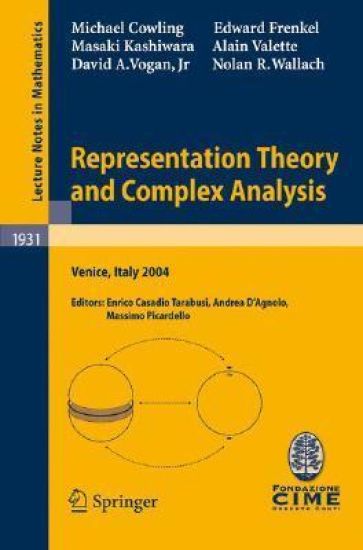
Representation Theory and Complex Analysis
Michael Cowling; Edward Frenkel; Masaki Kashiwara; Alain Valette; David A. Vogan; Nolan R. Wallach
Springer-Verlag Berlin and Heidelberg GmbH Co. K
2008
nidottu
Six leading experts lecture on a wide spectrum of recent results on the subject of the title, providing both a solid reference and deep insights on current research activity. Michael Cowling presents a survey of various interactions between representation theory and harmonic analysis on semisimple groups and symmetric spaces. Alain Valette recalls the concept of amenability and shows how it is used in the proof of rigidity results for lattices of semisimple Lie groups. Edward Frenkel describes the geometric Langlands correspondence for complex algebraic curves, concentrating on the ramified case where a finite number of regular singular points is allowed. Masaki Kashiwara studies the relationship between the representation theory of real semisimple Lie groups and the geometry of the flag manifolds associated with the corresponding complex algebraic groups. David Vogan deals with the problem of getting unitary representations out of those arising from complex analysis, such as minimal globalizations realized on Dolbeault cohomology with compact support. Nolan Wallach illustrates how representation theory is related to quantum computing, focusing on the study of qubit entanglement.
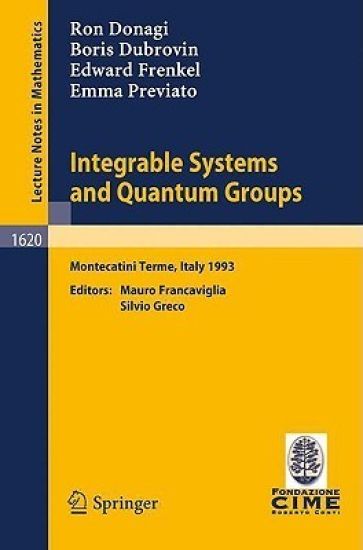
Integrable Systems and Quantum Groups
Ron Donagi; Boris Dubrovin; Edward Frenkel; Emma Previato
Springer-Verlag Berlin and Heidelberg GmbH Co. K
1995
nidottu
The aim of this CIME Session was to review the state of the art in the recent development of the theory of integrable systems and their relations with quantum groups. The purpose was to gather geometers and mathematical physicists to allow a broader and more complete view of these attractive and rapidly developing fields. The papers contained in this volume have at the same time the character of survey articles and of research papers, since they contain both a survey of current problems and a number of original contributions to the subject.

For Edward T. Scupper, life has been one long, lonely road. Born in the mid-eighteen-hundreds, for reasons unknown, he stops aging at eighteen. At first, it's exciting to live through the various decades while others succumb to time, but after a number of years, he finds that immortality is boring.Science proves to be the answer, or so he thinks. Edward-Ed-journeys from one city to another in the US in order to find an answer to his predicament. He doesn't wish for death. He only wishes to have a normal lifespan, like everyone else. After numerous searches, he winds up in Portland, Oregon, where he meets Doctor Farhan, a molecular biologist and geneticist who is working on using gene therapy to improve or cure various ailments, including blindness in his daughter, Diana.Ed tells Farhan of his desire to achieve mortality. Farhan promises to help him in return for the scientific knowledge, and a bargain of sorts is achieved. Initially, Ed and Diana don't get along. However, over time, they find themselves drawn to each other, as each of them seeks a cure for their problem, and only Doctor Farhan can provide it.Before long, though, the young couple finds themselves under attack, Doctor Farhan is killed, and the two teens are pursued by hitmen sent by Fester Norton, an elderly tycoon who wants what Ed has got-the secret of immortality-and will stop at nothing to get it
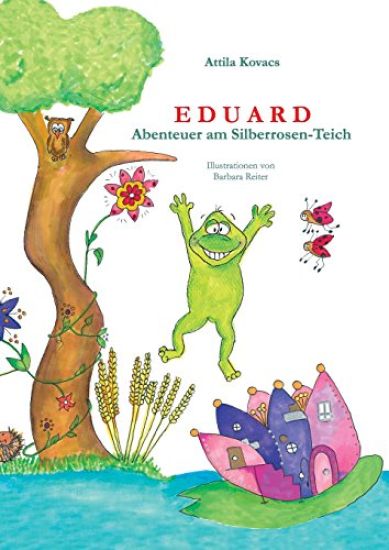
Eduard, der kleine Frosch, hat einen gro en Traum, der ihn von all den anderen Fr schen unterscheidet: Eduard w nscht sich n mlich nichts sehnlicher, als fliegen zu k nnen. Er wird deswegen oft bel chelt und manchmal als "Spinner" abgetan. Dennoch bleibt er seinem Traum treu, weil er tief im Herzen wei , dass er irgendwann fliegen wird. Um sein Ziel zu erreichen, begibt er sich - trotz aller Warnungen der Erwachsenen - an schaurige Orte und in gro e Gefahr. Eines Tages passiert etwas Unerwartetes, das sein Leben f r immer ver ndert.... Wird Eduards gr ter Wunsch in Erf llung gehen? Wenn Du es erfahren m chtest, begib Dich mit Eduard und seinen Freunden auf eine Abenteuerreise zum Silberrosen-Teich www.eduard-home.com
Eduard, der kleine Frosch, hat einen gro en Traum, der ihn von all den anderen Fr schen unterscheidet: Eduard w nscht sich n mlich nichts sehnlicher, als fliegen zu k nnen. Er wird deswegen oft bel chelt und manchmal als "Spinner" abgetan. Dennoch bleibt er seinem Traum treu, weil er tief im Herzen wei , dass er irgendwann fliegen wird. Um sein Ziel zu erreichen, begibt er sich - trotz aller Warnungen der Erwachsenen - an schaurige Orte und in gro e Gefahr. Eines Tages passiert etwas Unerwartetes, das sein Leben f r immer ver ndert.... Wird Eduards gr ter Wunsch in Erf llung gehen? Wenn Du es erfahren m chtest, begib Dich mit Eduard und seinen Freunden auf eine Abenteuerreise zum Silberrosen-Teich www.eduard-home.com

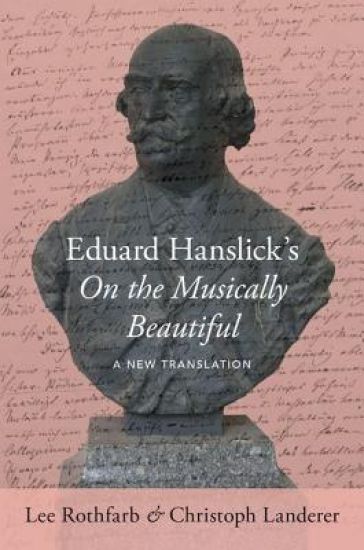
Eduard Hanslick's On the Musically Beautiful
Rothfarb Lee; Christoph Landerer
Oxford University Press Inc
2018
sidottu
Eduard Hanslick's On the Musically Beautiful (Vom Musikalisch-Schönen, 1854), written and published before the author turned 30, is a watershed document in the history of aesthetics, and of thought about music generally. The notion of "absolute music," which lies at the heart of the treatise, is now more than ever at the center of discussions about music, particularly that of the Classic and Romantic eras. Rothfarb and Landerer's translation includes three introductory essays offering fresh perspectives on Hanslick, and on the origins, publications, and translation history of his treatise, as well as its central concepts and philosophical underpinnings. The volume also includes thorough annotations, a readers' guide, a glossary of important terms and concepts, and an appendix, which comprises the original opening of Chapter 1, substantially rewritten in subsequent editions, as well as the original ending of the treatise that was excised by Hanslick in later editions. The book's ideas, cogently and often wittily expressed, are mandatory reading for anyone interested in eighteenth and nineteenth-century music and its cultural and intellectual background.
Originally published in 1957, this was the first biography and full account of Eduard Mörike’s works to appear in English. One of the greatest German lyric poets, Mörike is, according to some critics equal to Goethe as a lyricist. This book was the first attempt to analyse Mörike’s highly suggestive drawings, some of which are reproduced in the book. The contents of poems are summarized, so no prior knowledge of German is assumed, and a large number of poems are quoted in full.

Originally published in 1957, this was the first biography and full account of Eduard Mörike’s works to appear in English. One of the greatest German lyric poets, Mörike is, according to some critics equal to Goethe as a lyricist. This book was the first attempt to analyse Mörike’s highly suggestive drawings, some of which are reproduced in the book. The contents of poems are summarized, so no prior knowledge of German is assumed, and a large number of poems are quoted in full.
Gans ranks at the head of that important group of Hegelian thinkers that bridged the generations of Hegel and Marx. ! Yet there is a large gap between Gans 's historical importance and the scholarship on him. Despite a renewal of interest in Gans's work on the Continent,2 Gans remains almost completely unknown to English-Ianguage scholars, and almost none ofhis work has been 3 previously translated. His Prefaces to his posthumous editions of Hegel's writings are inaccessib1e to English speakers, despite the fact that they shed important light on the authenticity of the so-called Additions to those texts. His Preface to Hegel's Philosophy ofLaw has never been translated before, while his Preface to the Philosophy of History has been omitted from reprintings 4 for generations. Moreover, the recent scholarship on the Continent has focused on Gans 's political and philosophical rather than his legal writings. There is little dis cussion in any language ofhis system oflaw, which is the focus ofthe present study. Some of the reasons for the neglect of Gans are obvious. Gans cannot be a hero for most readers today. He accepted apostasy as a means to profes sional advancement. And though more liberal than Hegel, Gans nonetheless accommodated himself to the results of the Restoration and evaded political persecution that might have kindled the sympathy of later generations.