Mathematicians do not know in advance if their assertions are true, so they need to verify assertions with rigorous proofs or produce counterexamples, then attempt to salvage the assertions by transforming them into theorems. Extending the Frontiers of Mathematics: Inquiries into proof and argumentation invites students to experience this progression of mathematical discovery. Burger's informal, humorous writing style and intriguing puzzles engage students throughout the learning process. The innovative text offers a discovery-based approach that is ideally suited for use in a proofs course, a discrete math course, or any bridge course to more abstract mathematics.
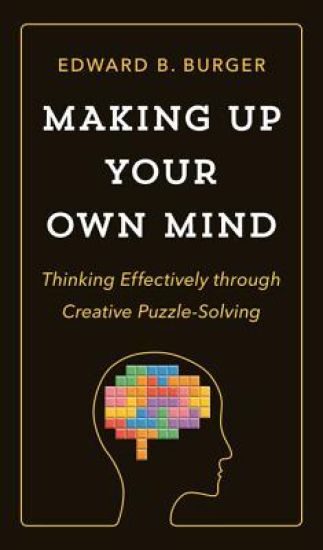
How you can become better at solving real-world problems by learning creative puzzle-solving skillsWe solve countless problems—big and small—every day. With so much practice, why do we often have trouble making simple decisions—much less arriving at optimal solutions to important questions? Are we doomed to this muddle—or is there a practical way to learn to think more effectively and creatively? In this enlightening, entertaining, and inspiring book, Edward Burger shows how we can become far better at solving real-world problems by learning creative puzzle-solving skills using simple, effective thinking techniques.Making Up Your Own Mind teaches these techniques—including how to ask good questions, fail and try again, and change your mind—and then helps you practice them with fun verbal and visual puzzles. The goal is not to quickly solve each challenge but to come up with as many different ways of thinking about it as possible. As you see the puzzles in ever-greater depth, your mind will change, helping you become a more imaginative and creative thinker in daily life. And learning how to be a better thinker pays off in incalculable ways for anyone—including students, businesspeople, professionals, athletes, artists, leaders, and lifelong learners.A book about changing your mind and creating an even better version of yourself through mental play, Making Up Your Own Mind will delight and reward anyone who wants to learn how to find better solutions to life’s innumerable puzzles.And the puzzles extend to the thought-provoking format of the book itself because one of the later short chapters is printed upside down while another is printed in mirror image, further challenging the reader to see the world through different perspectives and make new meaning.
How you can become better at solving real-world problems by learning creative puzzle-solving skillsWe solve countless problems--big and small--every day. With so much practice, why do we often have trouble making simple decisions--much less arriving at optimal solutions to important questions? Are we doomed to this muddle--or is there a practical way to learn to think more effectively and creatively? In this enlightening, entertaining, and inspiring book, Edward Burger shows how we can become far better at solving real-world problems by learning creative puzzle-solving skills using simple, effective thinking techniques.Making Up Your Own Mind teaches these techniques--including how to ask good questions, fail and try again, and change your mind--and then helps you practice them with fun verbal and visual puzzles. The goal is not to quickly solve each challenge but to come up with as many different ways of thinking about it as possible. As you see the puzzles in ever-greater depth, your mind will change, helping you become a more imaginative and creative thinker in daily life. And learning how to be a better thinker pays off in incalculable ways for anyone--including students, businesspeople, professionals, athletes, artists, leaders, and lifelong learners.A book about changing your mind and creating an even better version of yourself through mental play, Making Up Your Own Mind will delight and reward anyone who wants to learn how to find better solutions to life's innumerable puzzles.And the puzzles extend to the thought-provoking format of the book itself because one of the later short chapters is printed upside down while another is printed in mirror image, further challenging the reader to see the world through different perspectives and make new meaning.
Welcome to diophantine analysis - an area of number theory in which we attempt to discover hidden treasures and truths within the jungle of numbers by exploring rational numbers. Diophantine analysis comprises two different but interconnected domains - diophantine approximation and diophantine equations. This highly readable book brings to life the fundamental ideas and theorems from diophantine approximation, geometry of numbers, diophantine geometry and $p$-adic analysis. Through an engaging style, readers participate in a journey through these areas of number theory. Each mathematical theme is presented in a self-contained manner and is motivated by very basic notions. The reader becomes an active participant in the explorations, as each module includes a sequence of numbered questions to be answered and statements to be verified. Many hints and remarks are provided to be freely used and enjoyed.Each module then closes with a Big Picture Question that invites the reader to step back from all the technical details and take a panoramic view of how the ideas at hand fit into the larger mathematical landscape. This book enlists the reader to build intuition, develop ideas and prove results in a very user-friendly and enjoyable environment. Little background is required and a familiarity with number theory is not expected. All that is needed for most of the material is an understanding of calculus and basic linear algebra together with the desire and ability to prove theorems. The minimal background requirement combined with the author's fresh approach and engaging style make this book enjoyable and accessible to second-year undergraduates, and even advanced high school students. The author's refreshing new spin on more traditional discovery approaches makes this book appealing to any mathematician and/or fan of number theory.
Transform your mathematics course into an engaging and mind-opening experience for even your most math-phobic students. Now in its Fourth Edition, The Heart of Mathematics: An Invitation to Effective Thinking succeeds at reaching non-math, non-science-oriented majors, encouraging them to discover the mathematics inherent in the world around them. Infused with the authors' humor and enthusiasm throughout, The Heart of Mathematics introduces students to the most important and interesting ideas in mathematics while inspiring them to actively engage in mathematical thinking.
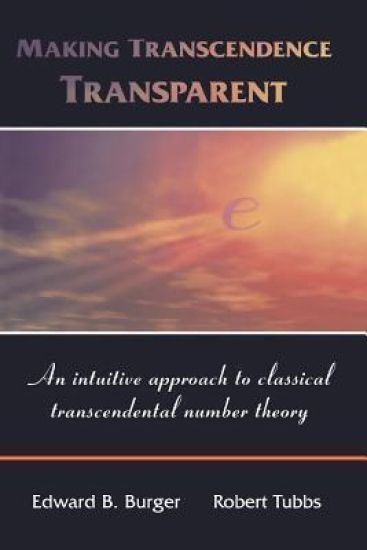
The Journey Ahead At the heart of transcendental number theory lies an intriguing paradox: While essen tially all numbers are transcendental, establishing the transcendence of a particular number is a monumental task. Thus transcendental numbers are an enigmatic species of number: We know they are all around us and yet it requires enormous effort to catch one. More often than not, they slip through our fingers and dissappear back into the dense jungle of numbers. Here we will venture to tame a few of these incredible creatures. In the pages ahead we offer an approach to transcendence that not only includes the intricate analysis but also the beautiful ideas behind the technical details. The phrase "classical transcendental number theory" in the title of this book refers to the most widely known results that were obtained in the nineteenth and early twentieth centuries. The reason for this focus is threefold. Firstly, this body of work requires only the mathematical techniques and tools familiar to advanced undergraduate mathematics students, and thus this area can be appreciated by a wide range of readers. Secondly, the ideas behind modem transcendence results are almost always an elaboration of the classical arguments we will explore here. And finally, and perhaps more importantly, this early work yields the transcendence of such admired and well-known numbers as e, rr, and even 2v'2.
An irreverent and accessible explanation of challenging puzzles within the world of mathematics considers such topics as the link between a pineapple's spirals and the famous Fibonacci numbers, the shape of the universe as reflected by a twisted strip of paper, and the parallels between the Lincoln and Kennedy assassinations. Reprint.
The 5 Elements of Effective Thinking presents practical, lively, and inspiring ways for you to become more successful through better thinking. The idea is simple: You can learn how to think far better by adopting specific strategies. Brilliant people aren't a special breed--they just use their minds differently. By using the straightforward and thought-provoking techniques in The 5 Elements of Effective Thinking, you will regularly find imaginative solutions to difficult challenges, and you will discover new ways of looking at your world and yourself--revealing previously hidden opportunities. The book offers real-life stories, explicit action items, and concrete methods that allow you to attain a deeper understanding of any issue, exploit the power of failure as a step toward success, develop a habit of creating probing questions, see the world of ideas as an ever-flowing stream of thought, and embrace the uplifting reality that we are all capable of change. No matter who you are, the practical mind-sets introduced in the book will empower you to realize any goal in a more creative, intelligent, and effective manner. Filled with engaging examples that unlock truths about thinking in every walk of life, The 5 Elements of Effective Thinking is written for all who want to reach their fullest potential--including students, parents, teachers, businesspeople, professionals, athletes, artists, leaders, and lifelong learners. Whenever you are stuck, need a new idea, or want to learn and grow, The 5 Elements of Effective Thinking will inspire and guide you on your way. To share thinking stories, go to: http://5elementsofthinking.wordpress.com
This book offers an engaging and mind-opening experience for even the most math-phobic users. It is written for non-math, non-science-oriented majors and encourages students to discover the mathematics inherent in the world around them. Infused throughout with the authors' humor and enthusiasm, "The Heart of Mathematics" introduces students to the most important and interesting ideas in mathematics while inspiring them to actively engage in mathematical thinking.
This text is an unbound, binder-ready edition.Transform your mathematics course into an engaging and mind-opening experience for even your most math-phobic students. Now in its Fourth Edition, The Heart of Mathematics: An Invitation to Effective Thinking succeeds at reaching non-math, non-science-oriented majors, encouraging them to discover the mathematics inherent in the world around them. Infused with the author's humor and enthusiasm throughout, The Heart of Mathematics introduces students to the most important and interesting ideas in mathematics while inspiring them to actively engage in mathematical thinking.
The Journey Ahead At the heart of transcendental number theory lies an intriguing paradox: While essen tially all numbers are transcendental, establishing the transcendence of a particular number is a monumental task. Thus transcendental numbers are an enigmatic species of number: We know they are all around us and yet it requires enormous effort to catch one. More often than not, they slip through our fingers and dissappear back into the dense jungle of numbers. Here we will venture to tame a few of these incredible creatures. In the pages ahead we offer an approach to transcendence that not only includes the intricate analysis but also the beautiful ideas behind the technical details. The phrase "classical transcendental number theory" in the title of this book refers to the most widely known results that were obtained in the nineteenth and early twentieth centuries. The reason for this focus is threefold. Firstly, this body of work requires only the mathematical techniques and tools familiar to advanced undergraduate mathematics students, and thus this area can be appreciated by a wide range of readers. Secondly, the ideas behind modem transcendence results are almost always an elaboration of the classical arguments we will explore here. And finally, and perhaps more importantly, this early work yields the transcendence of such admired and well-known numbers as e, rr, and even 2v'2.
Title: Bergens borgerbog, 1550-1751. Udgiven ... af N. Nicolaysen. (bd. 2. 1752-1865. Utgit av Bergens Historiske Forening ved B. E. Bendixen og A. M. Wiesener.).Publisher: British Library, Historical Print EditionsThe British Library is the national library of the United Kingdom. It is one of the world's largest research libraries holding over 150 million items in all known languages and formats: books, journals, newspapers, sound recordings, patents, maps, stamps, prints and much more. Its collections include around 14 million books, along with substantial additional collections of manuscripts and historical items dating back as far as 300 BC.The HISTORY OF EUROPE collection includes books from the British Library digitised by Microsoft. This collection includes works chronicling the development of Western civilisation to the modern age. Highlights include the development of language, political and educational systems, philosophy, science, and the arts. The selection documents periods of civil war, migration, shifts in power, Muslim expansion into Central Europe, complex feudal loyalties, the aristocracy of new nations, and European expansion into the New World. ++++The below data was compiled from various identification fields in the bibliographic record of this title. This data is provided as an additional tool in helping to insure edition identification: ++++ British Library Anonymous; Bendixen, Bendix Edvard Reutz; Nicolaysen, Nicolay; 1878, 1923. 2 bd.; 8 . 10280.eee.2.