Edward Everett Dale gives a first-hand account of the way pioneer families and cowboys of the frontier lived. Dr. Dale has lived in a sod house, and he once rode the range as cook to a group of cowboys. In this book he draws on his varied experiences to describe all aspects of frontier life-the building of a home, the problems of finding wood and water, the procuring and cooking of food, medical practices, and the cultural, social, and religious life of pioneer families. This edition is a digital facsimile of the 1959 edition.
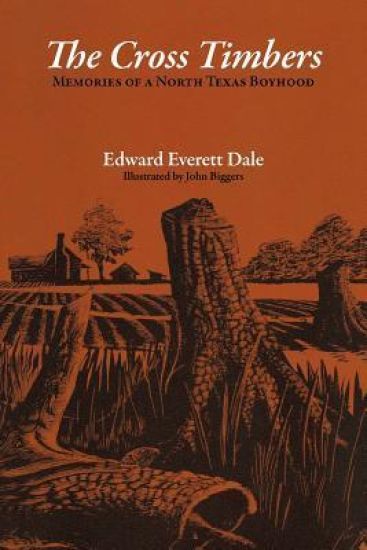
The activities of a young boy on a small farm in the Texas Cross Timbers during the 1880s seem especially distant today. No one can remember the adventure of a sixteen-and-a-half-mile journey, which consumed the greater part of a day; or hurried predawn dressing in a frosty cold loft while the fragrance of a hearty breakfast wafted upward through the floor cracks; or a two-room schoolhouse, where the last half of Friday afternoon was given over to “speaking pieces” or to spelling and ciphering matches. Through the recollections of Edward Everett Dale we are able to view a pattern of life in rural America now gone forever. For The Cross Timbers is a story which, with but a few minor variations, could have been told about a vast number of small boys on farms cleared from the virgin forests in the timbered regions of many states. After presenting a brief introduction to the members of the Dale family and the plant, animal, and bird life of the Lower Cross Timbers countryside, the author describes his boyhood of a past century. He tells of his home, its furnishings, and the food served there, as well as the neighbors and relatives who come to visit. We learn of the superstitions, the humorous homespun expressions, the mores of early rural Texans. We hunt and fish with young Master Dale in the thick woods and along the clear creeks. Pioneer life demanded much hard work, but not to the exclusion of a diverting social life-both of which included the youngsters, as the author so graphically relates. Dale tells us also of the religious and secular education of the era, showing the significance of the home in supplementing these two influences. Anyone reading this volume must be impressed by the great differences in the lifeways of rural children today and of those of the end of the nineteenth century.
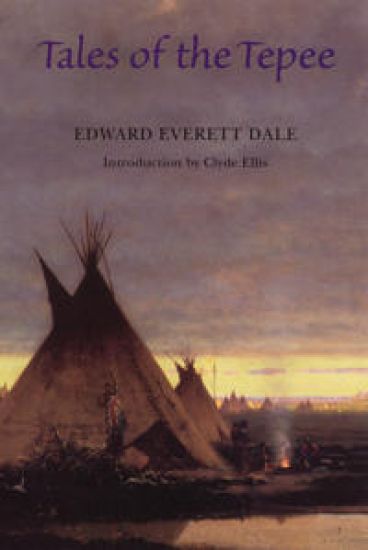
Tales of the Tepee grew out of Edward Everett Dale's close association with Indian tribes living in Oklahoma. During territorial days young Dale rode, hunted, and visited with the Kiowas, Comanches, and Wichitas. Later he taught many Cherokees, Choctaws, Creeks, Chickasaws, Sac and Fox, and Delawares at the state university. Near the beginning of his long and distinguished career as a historian, he gathered and recorded these stories. Originally published in 1920, Tales of the Tepee takes the reader to the lodge bonfires of the Cherokees, Wichitas, and Pawnees, where children stayed awake to hear about giant cannibals, magical transformations, mortal unions with celestial bodies, and journeys to the Spirit Land. Dale preserved these popular tales of danger and revenge, renewal and romance, and family life. They are populated with an ogress named Spearfinger, the monster Flint, the tragic Wynema, and the cyclic heroes Wild Boy, Stone Man, and Found-in-the-Grass. Here are animal people like the courageous Rabbit and the great bird Tlan-u-wa. And here are lovely explanations for matters mundane and cosmic: how strawberries came to be, and how the moon got its spots.
With the signing of the Treaty of Guadalupe Hidalgo in 1848 the United States became responsible for the administration of some 125,000 Indians in addition to those already within the national boundaries. The new tribes included many peoples known only to traders and trappers who had ventured into the trackless stretches of the West. This book considers the hundred-year record of federal relations with these Indians.The first two decades of United States control are seen as a period of large-scale humanitarian purpose, flawed in many cases by racial prejudice, official corruption, or outright cruelty and abuse. New policies, under Ulysses S. Grant, and an awakening of public conscience in the 1870s and 1880s brought a second major period, characterized by the system of reservations.Later chapters of the book deal with twentieth-century changes, particularly with agents, schools, and medical services, all carefully analyzed by the author, who was a member of the Meriam Commission in 1926-27. The record reveals in realistic detail the problems of the government and the tenacity of the tribes in resisting white settlement and retaining their own culture and way of life.
Grant Foreman: A Brief Biography is a book written by Edward Everett Dale that provides readers with a comprehensive look at the life and legacy of Grant Foreman. Foreman was a respected historian and author who made significant contributions to the field of Native American studies during the early 20th century. The book begins by exploring Foreman's early life, including his upbringing in a small town in Oklahoma and his education at the University of Oklahoma. It then delves into his career as a historian, detailing his research on various Native American tribes and his work as a curator at the Oklahoma Historical Society. Dale also examines Foreman's personal life, including his marriage to fellow historian Carolyn Thomas Foreman and his involvement in various civic and cultural organizations. The book concludes with a discussion of Foreman's lasting impact on the field of Native American studies and his contributions to Oklahoma's cultural heritage. Overall, Grant Foreman: A Brief Biography provides readers with a fascinating look at the life of a pioneering historian and author who helped shape our understanding of Native American history and culture.This scarce antiquarian book is a facsimile reprint of the old original and may contain some imperfections such as library marks and notations. Because we believe this work is culturally important, we have made it available as part of our commitment for protecting, preserving, and promoting the world's literature in affordable, high quality, modern editions, that are true to their original work.
The Lafayette Letters is a book written by Edward Everett Dale that provides a collection of letters written by the Marquis de Lafayette, a French aristocrat and military officer who fought in the American Revolutionary War. The book includes letters that Lafayette wrote to his family, friends, and colleagues during his time in America, as well as letters that he received from prominent figures such as George Washington and Thomas Jefferson. The letters offer a unique perspective on the American Revolution from the viewpoint of a foreigner who played a significant role in the war. They also provide insight into Lafayette's personal life and his relationships with the people he encountered during his time in America. The book is a valuable resource for historians and anyone interested in the American Revolution and Lafayette's role in it.This scarce antiquarian book is a facsimile reprint of the old original and may contain some imperfections such as library marks and notations. Because we believe this work is culturally important, we have made it available as part of our commitment for protecting, preserving, and promoting the world's literature in affordable, high quality, modern editions, that are true to their original work.
The two hundred letters which from the colorful mosaic of this story of the Cherokee tell for the first time, in the Indian's own words, of more than forty years in the history of the old Cherokee Nation. These letters, found in three great trunks in Oklahoma by Edward Everett Dale, and here brought together, in collaboration with Gaston Litton, in sequence and with the necessary annotation to make a connected story, are the correspondence of the Ridge-Watie-Boudinot family, the minority leaders in the Nation.The Cherokees, by the first decade of the nineteenth century, had made great progress in civilization. They had a constitutional form of government under which they were to live for three-quarters of a century in a tiny independent republic within the confines of the United States. Not a few were well educated. They had their own written language as evolved by Sequoyah and many had large plantations, cultivated by numerous slaves, and lived in beautiful homes as Southern planters, in the full tradition of the Southern cavalier.From the time of President Jefferson, however, they had been under urgent pressure to leave their traditional homes in the deep south and seek new ones in the great unoccupied lands of the Louisiana Purchase. In 1835 the minority group, headed by the Ridge-Watie-Boudinot family, signed at New Echota, Georgia, a treaty which provided that the entire tribe should remove to lands in Indian Territory already occupied by the Cherokees West. This group was henceforth known as the ""Treaty Party.""The treaty and the enforced removal three years later divided the Cherokee into two hostile factions and paved the way for thirty years of political turmoil and bloody strife within the Nation. In these letters, which center around the figure of the last Confederate General to surrender his sword - brigadier General Stand Watie - is told the story of the removal, the establishment of a new nation in the West, the divided loyalties of the tribe during the Civil War, and the tragic difficulties of the reconstruction. The picture is not alone that of life within the Nation. E. C. Boudinot, the Cherokee delegate to the Confederate congress, writes of war-torn Richmond during the Civil War. John Rollin Ridge, the poet and journalist, and several others who followed the Gold Rush to California tell of the mining camps during the days of forty-nine. General Albert Pike's official correspondence with General Watie is revealed.As only personal letters can reveal, here in intimacy are the lives and thoughts, the loves and hates, the philosophies and ambitions of these proud cavaliers of Cherokee blood. This book will be a revelation to those who have thought of this branch of Indian race as barbarous or semi-civilized.
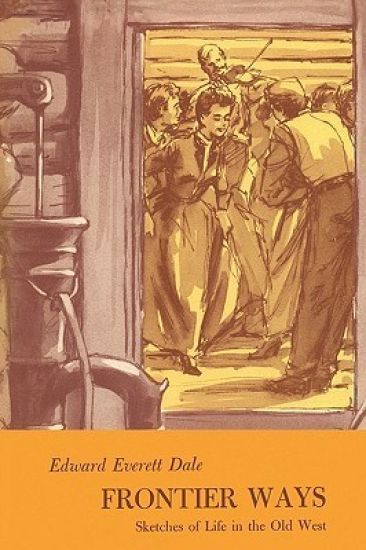
Frontier Ways: Sketches of Life in the Old West is a book written by Edward Everett Dale. This book is a collection of sketches that provides an insight into the life of the people who lived in the American West during the 19th century. The author has used his extensive research and knowledge to create a vivid picture of the people, their culture, and their way of life during this period.The book covers a wide range of topics, including the Native American tribes, cowboys, pioneers, and outlaws. It also includes stories about famous figures such as Davy Crockett and Buffalo Bill. The author has used a narrative style to bring these stories to life, making it an engaging read for anyone interested in the history of the American West.The book is divided into several chapters, each focusing on a different aspect of life in the Old West. The author has used primary sources such as diaries, letters, and newspaper articles to provide an accurate portrayal of the events and people of the time. The book also includes illustrations and photographs to help readers visualize the scenes and characters.Overall, Frontier Ways: Sketches of Life in the Old West is an informative and entertaining book that provides a glimpse into the history and culture of the American West. It is a must-read for anyone interested in this fascinating period of American history.This scarce antiquarian book is a facsimile reprint of the old original and may contain some imperfections such as library marks and notations. Because we believe this work is culturally important, we have made it available as part of our commitment for protecting, preserving, and promoting the world's literature in affordable, high quality, modern editions, that are true to their original work.
If Edward Everett is remembered at all today, it is as the orator who gave the other speech at Gettysburg, Pennsylvania on November 19, 1863. Ironically, Everett's oration, which was given wide coverage in contemporary newspapers, was recognized as both epideictic and argumentative. Everett defended the Union cause, whereas Lincoln's speech was strictly ceremonial. A second irony that attends Everett's oratorical career is that his countrymen believed him to be one of the great orators of the time, the undisputed master of ceremonial address. In this first new study of Edward Everett's oratory, author Ronald Reid addresses the historical and oratorical paradoxes that have influenced perceptions of Everett's career. Reid reconstitutes the role of epideictic rhetoric in the United States from the end of the Revolutionary War to the eve of the Civil War and reinstates Everett in the pantheon of great American orators. He demonstrates why Everett fell into virtual obscurity and treats the reader to a penetrating analysis of the role of public persuasion in the United States during a critical period in its history. In Edward Everett: Unionist Orator Reid effectively restores Everett to his rightful rostrum in the unfolding national drama from the 1820s to the 1860s, providing a sweeping story of America's golden age of oratory in the process.The book opens with a discussion of the influence of Everett's eighteenth-century heritage on his desire to save the Union at all costs. The author shows how the seeds of Everett's Unionism were starting to sprout in his literary and theological speeches and writings, and how he developed the rhetorical methods that he would use throughout his career. Next, Reid deals with Everett's oratory during his years of service, first as a congressman and then as governor of Massachusetts. Here he discusses Everett's increasing concern about the divisiveness of the partisan and sectional causes he espoused. Chapters three and four deal with Everett's modification of his earlier Unionist strategies in an effort to deal with increasing sectionalism and preserve the United States. In conclusion, Reid reviews Everett's oratory, speculating about the role of epideictic oratory in general in maintaining, or failing to maintain, social unity. Sample speeches complete the work, which include a partial text of one of Everett's congressional speeches, a 4th of July oration, his Character of Washington, and a partial text of Everett's Gettysburg address.