Kirjahaku
Etsi kirjoja tekijän nimen, kirjan nimen tai ISBN:n perusteella.
1000 tulosta hakusanalla Elias Canetti

Elias Canetti is a key thinker in the trend towards the renewal of social theory for the 21st century. He is increasingly being recognised in the social and political sciences for the seminal text, Crowds and Power (1960). While this work can sometimes be criticised for its alleged anti-historicity, anti-modernism, fixation on death, and a dark vision of humankind, Crowds and Power can, in fact, be interpreted as a study and a critique of the mono-dimensionality and the obsessiveness of power. In Canetti’s own words, it is an attempt ‘to find the weak spot of power’ and, ultimately, an invitation to recognise and explore the endless richness of human transformations. Elias Canetti and Social Theory argues that the alleged anti-modernism of Canetti actually makes him more contemporary than many contemporary social-political thinkers. It deals with key concepts within socio-political theory including: commands, increase, resistance, and commonality. Each of these ideas is connected with real, lived social realities making this book a compelling argument for Canetti's crucial relevance today.

Elias Canetti is a key thinker in the trend towards the renewal of social theory for the 21st century. He is increasingly being recognised in the social and political sciences for the seminal text, Crowds and Power (1960). While this work can sometimes be criticised for its alleged anti-historicity, anti-modernism, fixation on death, and a dark vision of humankind, Crowds and Power can, in fact, be interpreted as a study and a critique of the mono-dimensionality and the obsessiveness of power. In Canetti’s own words, it is an attempt ‘to find the weak spot of power’ and, ultimately, an invitation to recognise and explore the endless richness of human transformations. Elias Canetti and Social Theory argues that the alleged anti-modernism of Canetti actually makes him more contemporary than many contemporary social-political thinkers. It deals with key concepts within socio-political theory including: commands, increase, resistance, and commonality. Each of these ideas is connected with real, lived social realities making this book a compelling argument for Canetti's crucial relevance today.
Elias Canetti's Counter-Image of Society
Johann P. Arnason; David Roberts
Camden House Inc
2004
sidottu
Pursues the unresolved question of Canetti's place as a cultural and civilizational critic. The award of the Nobel Prize for literature in 1981 has seemingly assured Elias Canetti's place in literary history. But his significance as a cultural critic has not been adequately recognized. The present study redresses this situation in two ways: by mapping the counter-image of human existence, history, and society that informs Canetti's critique of the modern world and its sciences; and by opening up Canetti's hermetic oeuvre by tracing his cryptic and often concealed dialogue with major figures within the Western tradition such as Hobbes, Durkheim, and Freud and contemporaries such as Adorno, Arendt, and Elias. The authors ask how Canetti's alternative vision of man and society relates to important themes of twentieth-century social and civilizational thought even as it calls into question fundamental assumptions of the social and human sciences. In analyses of Auto da Fé, Crowds and Power, andthe aphorisms, the authors elucidate key aspects of Canetti's interrogation of human existence and human history across five thematic complexes: individual and social psychology, totalitarian politics, religion and politics, theories of society, and power and culture. They thus trace the movement of Canetti's thought from an apocalyptic sense of crisis to his search for cultural resources to set against the holocaust of European civilization. Johann P.Arnason teaches sociology at La Trobe University, Melbourne and David Roberts is Emeritus Professor of German at Monash University, Melbourne.
Elias Canetti - Die Blendung. Betrachtung von Büchern, Möbeln und Geld aus der Perspektive eines Masseverständnisses
Patrick Fonger
GRIN Verlag
2020
pokkari
Canettis ethnische Entsagung ist beachtenswert und stimmt darin mit der brüchigen Biografie eines Menschen überein, der zwischen die Gräben von Tradition, Assimilation und Konversion geraten ist. Die zu konstatierende Selbstleugnung, die das Jüdische betrifft, ist zum Teil in seiner Autobiografie nachweisbar, in der er die antisemitischen Tendenzen seiner Jugendzeit zu marginalisieren tendiert, und beispielhaft in seiner Schrift zu Masse und Macht, in der aus der Perspektive des Emigranten ein teils kapitalistisch-ökonomisches, teils demokratisch-politisches Feindbild beschworen wird. Die Studie zeigt auf, dass der Autor der Nachkriegsjahre ein simplifizierendes Geschichtsverständnis vertrat, dessen Symptome er in seinem Romanwerk (narrativ) noch als ideelle ‚Verblendung‘ ächtete.
Elias Canettis 'Die Blendung' - typische oesterreichische Nationalliteratur?
Marcus Puknatis
Grin Verlag
2007
nidottu
Elias Canettis poetologisches Konzept der akustischen Maske in seinen Dramen "Hochzeit", "Komödie der Eitelkeit" und "Die Befristeten"
Stephan Onken
Grin Publishing
2010
pokkari
Elias Canettis Konstitution von Geschlechterverhältnissen in "Komödie der Eitelkeit"
Selina Grund
GRIN Verlag
2017
nidottu
Elias Canettis Roman "Die Blendung". Vergleich der Verbalkomplexe von Original und der Übersetzung von Paule Arhex
René Dietzsch
GRIN Verlag
2019
nidottu
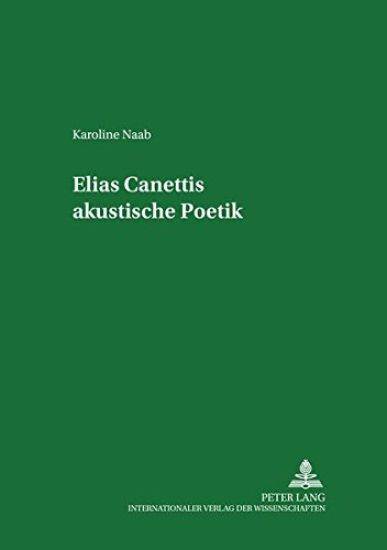
Elias Canettis Werk muss man hoeren: Der literarische Ruhm des vielsprachig aufgewachsenen Autors grundete sich schon im Wien der 1930er Jahre auf seine Vorlesekunst, in neuester Zeit wird sein Werk auf Hoerbuchern wieder entdeckt. Anhand Canettis autobiographischer Schriften, seiner Anthropologie und Dramentheorie sowie zahlreicher Interviews und Essays entwirft diese Arbeit eine "akustische Poetik" Canettis. Sie untersucht dabei die Bedeutung des Hoerens fur die Entwicklung des Dichters, geht einer Tradition der Mimesis gesprochener Sprache in der oesterreichischen Literatur nach und macht Vorschlage zur akustischen Rezeption von Canettis Werk. Im Anhang liefert ein Verzeichnis von Tondokumenten dazu Anregungen, eine Bibliographie gibt Hinweise auf das Arbeitsgebiet der akustischen Literatur.
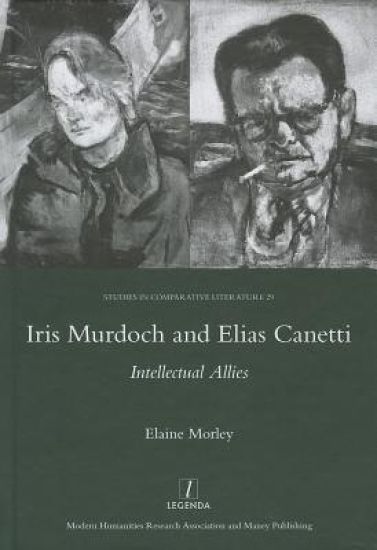
In this book, the author conducts a philological comparison of Iris Murdoch's and Elias Canetti's works, from their literary themes and theories to their idiosyncratic stylistic practices, proposing to understand the nature of their intellectual relationship through an examination of their works.
"Masse und Macht" von Elias Canetti. Ein Überblick über die ersten 30 Seiten
Janus Zudnik
GRIN Verlag
2017
nidottu
Die Darstellung der Beziehung Elias Canettis zu seinem Vater in Canettis Autobiographie "Die gerettete Zunge"
Lisa-Sophie Roth
GRIN Verlag
2020
nidottu

Masse und Individuum bei Elias Canettis "Die Blendung" und Roberts Musils "Der Mann ohne Eigenschaften"
Ina Bartels
Grin Publishing
2007
pokkari