Kirjojen hintavertailu. Mukana 11 342 296 kirjaa ja 12 kauppaa.

Kirjahaku

Etsi kirjoja tekijän nimen, kirjan nimen tai ISBN:n perusteella.

1000 tulosta hakusanalla Elizabeth A. C. Rushton

Science Education and Teacher Professional Development

Science Education and Teacher Professional Development

Elizabeth A. C. Rushton

Springer Nature Switzerland AG
2021
sidottu
This book presents a radical reconceptualization of subject-focused and research-led teacher professional development. Drawing on the experiences of more than 50 high school teachers and technicians who participated in science-based research with their students, the author examines how this enables teachers to develop a ‘Teacher Scientist’ model of professional identity. Through active participation in research, science teachers and technicians can implement socially just approaches to education, where students’ differences are valued and, through research, their social and academic development is supported. Central to the ‘Teacher Scientist’ identity is the development of, and sustained interaction with, complex and collaborative professional networks which include researchers, university-staff and teachers and students in other schools. In the context of persistent recruitment and retention challenges, the ‘Teacher Scientist’ model provides a research-led approach which may offer analternative to strategies focused on financial incentives.
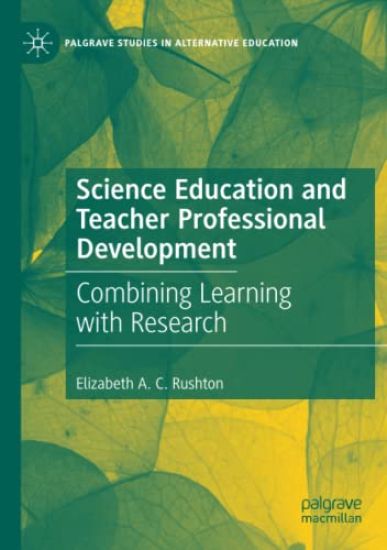
Science Education and Teacher Professional Development

Science Education and Teacher Professional Development

Elizabeth A. C. Rushton

Springer Nature Switzerland AG
2022
nidottu
This book presents a radical reconceptualization of subject-focused and research-led teacher professional development. Drawing on the experiences of more than 50 high school teachers and technicians who participated in science-based research with their students, the author examines how this enables teachers to develop a ‘Teacher Scientist’ model of professional identity. Through active participation in research, science teachers and technicians can implement socially just approaches to education, where students’ differences are valued and, through research, their social and academic development is supported. Central to the ‘Teacher Scientist’ identity is the development of, and sustained interaction with, complex and collaborative professional networks which include researchers, university-staff and teachers and students in other schools. In the context of persistent recruitment and retention challenges, the ‘Teacher Scientist’ model provides a research-led approach which may offer analternative to strategies focused on financial incentives.
Gaining A.C.C.E.S.S. to Lead Others: 14 Activities Critical to Continuous Evolution & Success for Self
Being a leader is a scary thought. You are responsible for individuals who are not related to you and whom you cannot control 100%. This group of people does not look like you, think like you, talk like you, or have the same interests as you. These people may not even like you. Yet, somehow, you have to get them to follow you. Most of these same statements hold true for your role when you are being led. There is someone responsible for leading you. You cannot control, speak, or even think like that person. How can we effectively survive to do and be our best every day?In this second book of the LEAP Series, Dr. Elizabeth A. Carter once again provides you access to information based on situations that have impacted her life. Gaining A.C.C.E.S.S. to Lead Others: 14 Activities Critical to Continuous Evolution & Success for Self shines a spotlight on the three elements that have helped, hindered, and heightened her journey in leadership: chemistry, confidence, and communication. Including motivational quotes from pioneers such as John Quincy Adams, Oscar Wilde, Plato, and Helen Keller, Dr. Carter expands her use of alliterations and acronyms to entertain and educate her readers with topics and phrases such as-First impressions: "First Flush Final"-Don't expect the hand you were dealt to change.-Overcoming obstacles: "No Not Never"-Response is temporary, not permanent.-Working with others: "Sometimes, you must DUMB it down" (Decode for Understanding and Maximizing Buy-in).-Leading volunteers: Accountability measures needed if "there is not a process of a review, raise, or reprimand."At the end of each section, there are reflection questions, and the last chapter helps you decide what actions you will take next. Get "access-smart" and let chemistry, confidence, and communication increase your effectiveness when leading others and being led.
Creating a Person-Centered Library

Creating a Person-Centered Library

Elizabeth A. Wahler; Sarah C. Johnson

BLOOMSBURY PUBLISHING PLC
2023
nidottu
Creating a Person-Centered Library provides a comprehensive overview of various services, programs, and collaborations to help libraries serve high-needs patrons as well as strategies for supporting staff working with these individuals.While public libraries are struggling to address growing numbers of high-needs patrons experiencing homelessness, food insecurity, mental health problems, substance abuse, and poverty-related needs, this book will help librarians build or contribute to library services that will best address patrons' psychosocial needs.The authors, experienced in both library and social work, begin by providing an overview of patrons' psychosocial needs, structural and societal reasons for the shift in these needs, and how these changes impact libraries and library staff. Chapters focus on best practices for libraries providing person-centered services and share lessons learned, including information about special considerations for certain patron populations that might be served by individual libraries. The book concludes with information about how library organizations can support public library staff.Librarians and library students who are concerned about both patrons and library staff will find the practical advice in this book invaluable.
The Makeover in Movies

The Makeover in Movies

Elizabeth A. Ford; Deborah C. Mitchell

McFarland Co Inc
2004
pokkari
The plots of many films pivot on the moment when a dowdy girl with bad hair, ill-fitting outdated clothing, and thick glasses is changed into an almost unrecognizable glamour girl. Makeover scenes such as these are examined beginning with 1942's Now, Voyager. The study examines whether the film makeover is voluntary or involuntary, whether it is always successful, how much screen time it takes up, where in the narrative structure it falls, and how the scene is actually filmed. Films with a Pygmalion theme, such as My Fair Lady, Vertigo, and Shampoo, are examined in terms of gender relations: whether the man is content with his creation and what sort of woman is the ideal. Some films' publicity capitalizes on a glamorous star's choice to play an unattractive character, as discussed in a chapter examining stars like Bette Davis, Meryl Streep, and Cameron Diaz. Topics also include folk literature's Cinderella tale, men as the inspiration for makeovers in teen flicks films like Clueless, She's All That, and Me, Natalie, and class repositioning in such movies as Working Girl, Pretty Woman, and Grease. Photographs are presented in a before/after format, showing the change in the madeover character.
Talking About Sex

Talking About Sex

Elizabeth A. Harkins Monaco; Thomas C. Gibbon; David F. Bateman

Rowman Littlefield
2018
sidottu
Key social and emotional milestones during adolescence are often directly related to the abilities to initiate and maintain intimate relationships, maintain physically maturing bodies, and manage personal sexuality. Most adolescents with developmental disabilities have particular difficulty expressing sexuality in satisfying ways, consequently facing issues such as limited intimate relationships, low self-esteem, increased social isolation, deregulated emotional maintenance, reduced sexual functioning, and limited sexual health. Appropriate sexual knowledge assists not only in achieving personal fulfillment, but protection from mistreatment, abuse, unplanned pregnancies, or sexually transmitted diseases (STDs). It also works to help solve problems of loneliness and problems with self-esteem. This book will address this but also much more. Issues of physical and cognitive development will be discussed, including appropriate sexual development/urges and brain development, and innate similarities and differences of sexuality that could occur between people with autism spectrum disorders and intellectual or developmental disabilities, including the complexities of physical disabilities. The authors will also consider special considerations for group homes and recreational facilities, and specifically focus on concepts of ethics and models of consent (medical, legal, social, and educational), as well as how to deal with uncertainty.
Talking About Sex

Talking About Sex

Elizabeth A. Harkins Monaco; Thomas C. Gibbon; David F. Bateman

Rowman Littlefield
2018
nidottu
Key social and emotional milestones during adolescence are often directly related to the abilities to initiate and maintain intimate relationships, maintain physically maturing bodies, and manage personal sexuality. Most adolescents with developmental disabilities have particular difficulty expressing sexuality in satisfying ways, consequently facing issues such as limited intimate relationships, low self-esteem, increased social isolation, deregulated emotional maintenance, reduced sexual functioning, and limited sexual health. Appropriate sexual knowledge assists not only in achieving personal fulfillment, but protection from mistreatment, abuse, unplanned pregnancies, or sexually transmitted diseases (STDs). It also works to help solve problems of loneliness and problems with self-esteem. This book will address this but also much more. Issues of physical and cognitive development will be discussed, including appropriate sexual development/urges and brain development, and innate similarities and differences of sexuality that could occur between people with autism spectrum disorders and intellectual or developmental disabilities, including the complexities of physical disabilities. The authors will also consider special considerations for group homes and recreational facilities, and specifically focus on concepts of ethics and models of consent (medical, legal, social, and educational), as well as how to deal with uncertainty.
Apocalyptic Visions in 21st Century Films

Apocalyptic Visions in 21st Century Films

Elizabeth A. Ford; Deborah C. Mitchell

McFarland Co Inc
2018
pokkari
The apocalypse on the big screen has expanded beyond the familiar end-of-the-world movies. Romantic comedies, teen adventures and even children's films frequently feature apocalyptic imagery--disintegrating cities, extreme weather events, extinctions, rogue military forces, epidemics, zombie armies and worlds colliding. Using sophisticated CGI effects, filmmakers are depicting the end of the world ever more stunningly. The authors explore the phenomenon of the cinematic apocalypse and its origins in both our anxieties and our real-world events, and they identify some flashes of hope in the desolate landscape.
Who's Who of Pulitzer Prize Winners

Who's Who of Pulitzer Prize Winners

Elizabeth A. Brennan; Elizabeth C. Clarage

Oryx Press Inc
1998
sidottu
Established in 1917 by publisher Joseph Pulitzer, the Pulitzer Prize is now awarded in 21 categories, including investigative reporting, news photography, drama, poetry, music, and others. It continues to be the most coveted honor in journalism. Yet while many publications have been written on the topic of the Pulitzer Prizes, none has provided basic factual information on all of the winners. This new reference tool profiles each of the more than 1,100 individuals who have received this honor from 1917 through 1998. Entries include the winner's name, year and category for the Pulitzer Prize(s) won, birthdate, family, education, career summary, other awards won, list of selected works, and where to locate additional information. Several entries also include photos of the winner.
Royal Portraits in Hollywood

Royal Portraits in Hollywood

Elizabeth A. Ford; Deborah C. Mitchell

The University Press of Kentucky
2009
sidottu
Few lives provide as much history or drama as those of monarchs. Filmmakers from the silent era to onward have displayed a deep fascination with the lives of royalty and with queens in particular. Still, the question remains: what do these films really tell us about the women beneath the crowns? Drawing on films from the 1930s to those of today, Royal Portraits in Hollywood: Filming the Lives of Queens investigates the ways in which these films reproduce history and represent women. Though hardly progressive in nature, many early films offered an acceptable, nonthreatening way to present strong female characters in an economic and social landscape run almost exclusively by men. Authors Elizabeth Ford and Deborah Mitchell track the evolution of queens on film, noting how depictions of prominent women have changed over the past several decades and calling attention to the ways in which films both reflect and dictate the social norms of their eras. By comparing historical records of monarchs such as Queen Christina of Sweden, Catherine the Great, Cleopatra, and Elizabeth I with their onscreen personas, and examining the biographical details of the actresses who portrayed these women, Ford and Mitchell present a fascinating inquiry into issues of historical accuracy and gender politics in film.
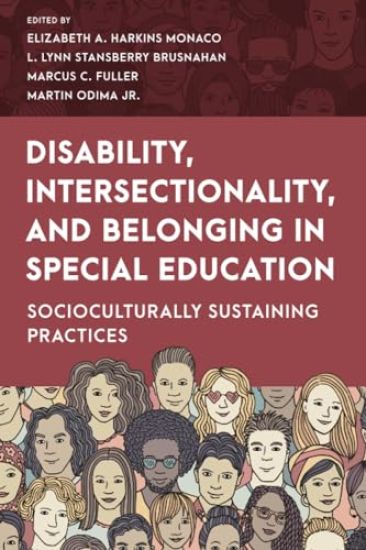
Disability, Intersectionality, and Belonging in Special Education

Disability, Intersectionality, and Belonging in Special Education

Elizabeth A. Harkins Monaco; L. Lynn Stansberry Brusnahan; Marcus C. Fuller; Martin O. Odima

BLOOMSBURY PUBLISHING PLC
2024
sidottu
This book focuses on preparing culturally competent educators who use culturally sustaining practices and culturally relevant curricula and instruction to reach and teach all students with disabilities, including those with multiple social identities, through a varied multi-cultural lens. Today’s diverse classrooms require that educators possess competencies for teaching all students. This book has two primary audiences: 1. Pre-service educators2. Special education practitioners and administrators First, this book will assist pre-service students learning about special education for students with disabilities. We fully expect this book could be a required reading for students majoring in special education, for school social work students, for school counselors, and for students majoring in vocational rehabilitation services as a part of their coursework for transition.Second, this book will assist special education practitioners and administrators to meet the needs of individuals with disabilities including those with multiple social identities. Understanding the full-range of needs relating to cultural sustaining practices is imperative to working with individuals with disabilities and their families and care-givers. Being able to understand and explain this complex issue to others is important and often very necessary. This book is incredibly timely. Recent contributors to social injustices are the COVID-19 pandemic and the continued issues around police brutality and people of color. Social injustice in special education is historical and systemic. Special education practitioners are typically unaware of the importance of intersectional differences (Gay & Howard, 2000; Owen, 2010). Historically, practitioners have only been prepared to address cultural perspectives during awareness days and or through specific units in curricula. Other times they discuss it diagnostically (Linton, 1998), such as part of an educational plan or a need to learn English as a second language. Other issues stem from the value system of the special education practitioners themselves; some are not willing to engage in these concepts (Darling-Hammond, 2002); some “define fairness and equity as treating all children the same; and [others identify being] ‘colorblind’ [as] valuing diversity” (Owen, 2010, p. 18). Even when special educator practitioners attempt to address injustices on behalf of their students, they tend to center only on the student’s disability which means they are ignoring or erasing other aspects of their students’ identities. These issues highlight the importance of building the cultural competence of our teaching force. This book will help practitioners build this competence in their own spheres of influence.
Disability, Intersectionality, and Belonging in Special Education

Disability, Intersectionality, and Belonging in Special Education

Elizabeth A. Harkins Monaco; L. Lynn Stansberry Brusnahan; Marcus C. Fuller; Martin O. Odima

BLOOMSBURY PUBLISHING PLC
2024
nidottu
This book focuses on preparing culturally competent educators who use culturally sustaining practices and culturally relevant curricula and instruction to reach and teach all students with disabilities, including those with multiple social identities, through a varied multi-cultural lens. Today’s diverse classrooms require that educators possess competencies for teaching all students. This book has two primary audiences: 1. Pre-service educators2. Special education practitioners and administrators First, this book will assist pre-service students learning about special education for students with disabilities. We fully expect this book could be a required reading for students majoring in special education, for school social work students, for school counselors, and for students majoring in vocational rehabilitation services as a part of their coursework for transition.Second, this book will assist special education practitioners and administrators to meet the needs of individuals with disabilities including those with multiple social identities. Understanding the full-range of needs relating to cultural sustaining practices is imperative to working with individuals with disabilities and their families and care-givers. Being able to understand and explain this complex issue to others is important and often very necessary. This book is incredibly timely. Recent contributors to social injustices are the COVID-19 pandemic and the continued issues around police brutality and people of color. Social injustice in special education is historical and systemic. Special education practitioners are typically unaware of the importance of intersectional differences (Gay & Howard, 2000; Owen, 2010). Historically, practitioners have only been prepared to address cultural perspectives during awareness days and or through specific units in curricula. Other times they discuss it diagnostically (Linton, 1998), such as part of an educational plan or a need to learn English as a second language. Other issues stem from the value system of the special education practitioners themselves; some are not willing to engage in these concepts (Darling-Hammond, 2002); some “define fairness and equity as treating all children the same; and [others identify being] ‘colorblind’ [as] valuing diversity” (Owen, 2010, p. 18). Even when special educator practitioners attempt to address injustices on behalf of their students, they tend to center only on the student’s disability which means they are ignoring or erasing other aspects of their students’ identities. These issues highlight the importance of building the cultural competence of our teaching force. This book will help practitioners build this competence in their own spheres of influence.
Evidence-Based Public Health

Evidence-Based Public Health

Ross C. Brownson; Elizabeth A. Baker; Anjali D. Deshpande; Kathleen N. Gillespie

Oxford University Press Inc
2017
nidottu
The acclaimed textbook for navigating the practice and challenges of public health, now updated and completely revised "It should be recommended or assigned to all students in public health." -American Journal of Epidemiology The practice of public health would be easier if all the decisions could just be based on science. The reality, of course, is that many choices have to account for short-term demands, meaning that some policies and programs are rooted in anecdotal evidence or limited resources. In these circumstances, an evidence-based approach -- emphasizing available data and analytics while leveraging individual skills and an optimized organizational climate -- is a public health practitioner's best tool for effective decision making. This fully revised and updated edition Evidence-Based Public Health offers an essential primer on how to choose, carry out, and evaluate evidence-based programs and policies in public health settings. It addresses not only how to locate and utilize scientific evidence, but also how to implement and evaluate interventions in a way that generates new evidence. Practical topics covered in this light include: · conducting community assessment · developing an initial statement of issue (and quantifying it) · using scientific literature and systematic reviews · creating an action plan and implementing interventions · evaluating programs and policies An indispensable volume for professionals, students, and researchers in the public health sciences and preventive medicine, this newly updated edition of the classic textbook empowers readers to identify and apply the most compelling evidence available.
Beyond Managed Care

Beyond Managed Care

Dean C. Coddington; Elizabeth A. Fischer; Keith D. Moore; Richard L. Clarke

Jossey-Bass Inc.,U.S.
2000
sidottu
Written for health care leaders at all levels, Beyond Managed Care identifies and assesses the key factors most likely to influence the future market for health care services-such as consumer empowerment through the Internet and the increasing demands of the aging baby boomer population-and shows providers what adjustments can be made in order to thrive in this emerging environment. The authors analyze the factors driving health care costs such as changing demographics, new medical technology, genetic and new drug research, and payment system models. The book clearly shows that organizations that are able to take organizations to the next value-added level--by providing quality, access, service, innovation, and lower costs--will be the winners.
Introduction to Linear Regression Analysis, 6e Solutions Manual

Introduction to Linear Regression Analysis, 6e Solutions Manual

Douglas C. Montgomery; Elizabeth A. Peck; G. Geoffrey Vining

Wiley-Blackwell
2022
nidottu
A comprehensive and current introduction to the fundamentals of regression analysis Introduction to Linear Regression Analysis, 6th Edition is the most comprehensive, fulsome, and current examination of the foundations of linear regression analysis. Fully updated in this new sixth edition, the distinguished authors have included new material on generalized regression techniques and new examples to help the reader understand retain the concepts taught in the book. The new edition focuses on four key areas of improvement over the fifth edition: New exercises and data setsNew material on generalized regression techniquesThe inclusion of JMP software in key areasCarefully condensing the text where possible Introduction to Linear Regression Analysis skillfully blends theory and application in both the conventional and less common uses of regression analysis in today's cutting-edge scientific research. The text equips readers to understand the basic principles needed to apply regression model-building techniques in various fields of study, including engineering, management, and the health sciences.
Introduction to Linear Regression Analysis

Introduction to Linear Regression Analysis

Douglas C. Montgomery; Elizabeth A. Peck; G. Geoffrey Vining

Wiley-Blackwell
2021
sidottu
INTRODUCTION TO LINEAR REGRESSION ANALYSIS A comprehensive and current introduction to the fundamentals of regression analysis Introduction to Linear Regression Analysis, 6th Edition is the most comprehensive, fulsome, and current examination of the foundations of linear regression analysis. Fully updated in this new sixth edition, the distinguished authors have included new material on generalized regression techniques and new examples to help the reader understand retain the concepts taught in the book. The new edition focuses on four key areas of improvement over the fifth edition: New exercises and data sets New material on generalized regression techniques The inclusion of JMP software in key areas Carefully condensing the text where possible Introduction to Linear Regression Analysis skillfully blends theory and application in both the conventional and less common uses of regression analysis in today’s cutting-edge scientific research. The text equips readers to understand the basic principles needed to apply regression model-building techniques in various fields of study, including engineering, management, and the health sciences.
Gangs in America's Communities

Gangs in America's Communities

James C. Howell; Elizabeth A. Griffiths

SAGE Publications Inc
2018
nidottu
"[Gangs in America's Communities] is one of the most comprehensive treatments of gangs in the marketplace. . . . I highly recommend its adoption as you will not be disappointed and, most importantly, neither will your students." —Elvira White-Lewis, Texas A&M University-Commerce Gangs in America's Communities, Third Edition blends theory with current research to help readers identify essential features associated with youth violence and gangs, as well as apply strategies for gang control and prevention. Authors Dr. James C. Howell and Dr. Elizabeth Griffiths introduce readers to theories of gang formation, illustrate various ways of defining and classifying gangs, and discuss national trends in gang presence and gang-related violence across American cities. They also offer evidence-based strategies for positioning communities to prevent, intervene, and address gang activity. New to the Third Edition: A series of new case studies document the evolution of numerous gangs in large cities, including the community aspect, evolutionary nature, and how cities influence levels of violence. New discussions highlighting the role of social media, insights into how gangs use it to recruit members, and the response from law enforcement. Current nationwide gang trends are discussed to encourage readers to analyze and interpret the most recent statistics for which representative data is available. Updated macro and micro gang theories enable readers to explore a recent encapsulation of leading developmental models. New discussions around female gang members offer readers potentially effective programs for discouraging females from joining gangs—along with highly regarded delinquency prevention and reduction programs that have the potency to be effective in reducing gang crimes among young women. A comprehensive gang prevention, intervention, and suppression program in Multnomah County, Oregon shows how theory was successfully applied to reduce gang activity in a local community. New research on "gang structures" and their rates of crime illustrate the connections between violent crimes and the amount of violent offenders within a gang. Additional discussion of distinguishing features (e.g., typologies) of major gangs, and numerous examples of gang symbols, tattoos, and graffiti has been added to help readers identify and differentiate various types of gangs.