Kirjojen hintavertailu. Mukana 11 627 067 kirjaa ja 12 kauppaa.

Kirjahaku

Etsi kirjoja tekijän nimen, kirjan nimen tai ISBN:n perusteella.

1000 tulosta hakusanalla Elizabeth Blackwell

A Curious Herbal, Containing Five Hundred Cuts, of the Most Useful Plants, ... By Elizabeth Blackwell. To Which is Added a Short Description of ye Plants; ... of 2; Volume 1
The 18th century was a wealth of knowledge, exploration and rapidly growing technology and expanding record-keeping made possible by advances in the printing press. In its determination to preserve the century of revolution, Gale initiated a revolution of its own: digitization of epic proportions to preserve these invaluable works in the largest archive of its kind. Now for the first time these high-quality digital copies of original 18th century manuscripts are available in print, making them highly accessible to libraries, undergraduate students, and independent scholars.Medical theory and practice of the 1700s developed rapidly, as is evidenced by the extensive collection, which includes descriptions of diseases, their conditions, and treatments. Books on science and technology, agriculture, military technology, natural philosophy, even cookbooks, are all contained here.++++The below data was compiled from various identification fields in the bibliographic record of this title. This data is provided as an additional tool in helping to insure edition identification: ++++National Library of ScotlandT151096Engraved throughout. With an index to each volume. Originally published in weekly instalments. A reissue of the 1737 edition with the imprints re-engraved and volume statements in roman numerals. Make-up of the preliminaries varies.London: printed for John Nourse, 1739. 2v., plates; 2
A Curious Herbal, Containing Five Hundred Cuts, of the Most Useful Plants, ... By Elizabeth Blackwell. To Which is Added a Short Description of ye Plants; ... of 2; Volume 2
The 18th century was a wealth of knowledge, exploration and rapidly growing technology and expanding record-keeping made possible by advances in the printing press. In its determination to preserve the century of revolution, Gale initiated a revolution of its own: digitization of epic proportions to preserve these invaluable works in the largest archive of its kind. Now for the first time these high-quality digital copies of original 18th century manuscripts are available in print, making them highly accessible to libraries, undergraduate students, and independent scholars.Medical theory and practice of the 1700s developed rapidly, as is evidenced by the extensive collection, which includes descriptions of diseases, their conditions, and treatments. Books on science and technology, agriculture, military technology, natural philosophy, even cookbooks, are all contained here.++++The below data was compiled from various identification fields in the bibliographic record of this title. This data is provided as an additional tool in helping to insure edition identification: ++++National Library of ScotlandT151096Engraved throughout. With an index to each volume. Originally published in weekly instalments. A reissue of the 1737 edition with the imprints re-engraved and volume statements in roman numerals. Make-up of the preliminaries varies.London: printed for John Nourse, 1739. 2v., plates; 2
A Curious Herbal, Containing Five Hundred Cuts, of the Most Useful Plants, Which are now Used in the Practice of Physick. Engraved on Folio Copper Plates, After Drawings Taken From the Life. By Elizabeth Blackwell. of 2; Volume 1
The 18th century was a wealth of knowledge, exploration and rapidly growing technology and expanding record-keeping made possible by advances in the printing press. In its determination to preserve the century of revolution, Gale initiated a revolution of its own: digitization of epic proportions to preserve these invaluable works in the largest archive of its kind. Now for the first time these high-quality digital copies of original 18th century manuscripts are available in print, making them highly accessible to libraries, undergraduate students, and independent scholars.Medical theory and practice of the 1700s developed rapidly, as is evidenced by the extensive collection, which includes descriptions of diseases, their conditions, and treatments. Books on science and technology, agriculture, military technology, natural philosophy, even cookbooks, are all contained here.++++The below data was compiled from various identification fields in the bibliographic record of this title. This data is provided as an additional tool in helping to insure edition identification: ++++British LibraryT083979With an index to each volume. Originally published in weekly instalments. Titlepage of vol.I printed from the copper-plate used in the 1751 edition, that in vol.II from the 1737 edition; both titlepages with a new imprint. Make-up of the preliminaries London: printed for C. Nourse, 1782. 2v., plates; 2
A Curious Herbal, Containing Five Hundred Cuts, of the Most Useful Plants, Which are now Used in the Practice of Physick Engraved on Folio Copper Plates, After Drawings, Taken From the Life By Elizabeth Blackwell v 1 of 2
The 18th century was a wealth of knowledge, exploration and rapidly growing technology and expanding record-keeping made possible by advances in the printing press. In its determination to preserve the century of revolution, Gale initiated a revolution of its own: digitization of epic proportions to preserve these invaluable works in the largest archive of its kind. Now for the first time these high-quality digital copies of original 18th century manuscripts are available in print, making them highly accessible to libraries, undergraduate students, and independent scholars.Medical theory and practice of the 1700s developed rapidly, as is evidenced by the extensive collection, which includes descriptions of diseases, their conditions, and treatments. Books on science and technology, agriculture, military technology, natural philosophy, even cookbooks, are all contained here.++++The below data was compiled from various identification fields in the bibliographic record of this title. This data is provided as an additional tool in helping to insure edition identification: ++++British LibraryT083977Engraved throughout. With an index to each volume. Originally published in weekly instalments.London: printed for Samuel Harding, 1737. 2v., plates; 2
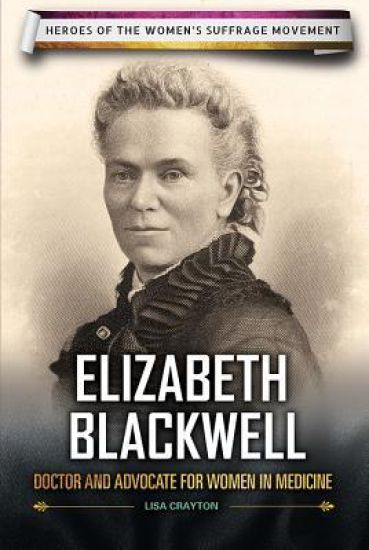
Elizabeth Blackwell: Doctor and Advocate for Women in Medicine
Born in England and raised by a progressive father, an abolitionist who also believed women were equal to men, Elizabeth Blackwell is famous for becoming America's first woman doctor. But her story is far more complex. Students will be interested to learn that Blackwell was denied the ability to practice medicine, simply because she was a woman. Her insistence on breaking barriers, as well as opening doors for other women, will teach students the importance of perseverance, and excerpts from primary sources, images, and sidebars will enrich the reader's experience.
The Curious Life of Elizabeth Blackwell

The Curious Life of Elizabeth Blackwell

Pamela Holmes

Open Road Media
2022
pokkari
An engrossing historical saga based on the life of the eighteenth-century woman who endured loss and betrayal—and dared to pursue her dreams. Her parents warned Elizabeth that Alexander Blackwell would not make a dependable husband, and only after eloping with him did she learn they may have been right . . . After their marriage, the couple finds lodgings in London. Alexander looks for work while Elizabeth learns engraving. Before long, though, Alexander is in the Marshalsea, the notorious debtors’ prison, and she is left to fend for herself. Alone and penniless, she has a few things going for her: a skill, an idea, and an acquaintance. Elizabeth embarks on a quest that earns her a small fortune and may allow her to buy her husband’s freedom. It seems like she may live happily ever after. But her extraordinary story isn’t over yet . . .Praise for Pamela Holmes “A genuinely original, utterly enchanting story.” —A. N. Wilson, author of Victoria: A Life “[A] lyrical novel that skillfully represents the constraints placed on middle-class women of the era.” —Historical Novel Society
The World’s First Women Doctors: Elizabeth Blackwell and Elizabeth Garrett Anderson
Build your child’s reading confidence at home with books at the right level Find out all about two ground breaking figures in medicine – Elizabeth Blackwell and Elizabeth Garret Anderson, two women who fought to become doctors in the early 1800s. What was life like for women in the early nineteenth century, what obstacles did both women come up against and ultimately how did they succeed? Sapphire/Band 16 books offer longer reads to develop children's sustained engagement with texts and are more complex syntactically.
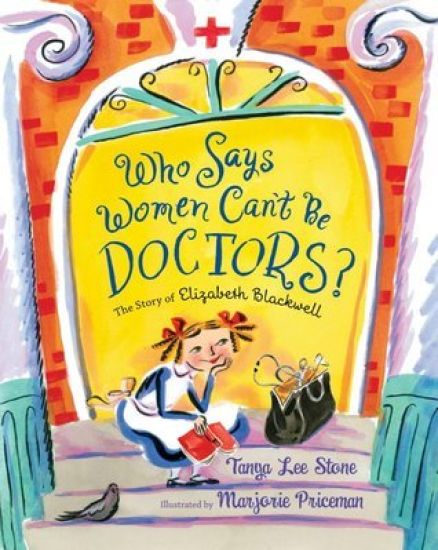
Who Says Women Can't Be Doctors?: The Story of Elizabeth Blackwell
In the 1830s, when a brave and curious girl named Elizabeth Blackwell was growing up, women were supposed to be wives and mothers. Some women could be teachers or seamstresses, but career options were few. Certainly no women were doctors. But Elizabeth refused to accept the common beliefs that women weren't smart enough to be doctors, or that they were too weak for such hard work. And she would not take no for an answer. Although she faced much opposition, she worked hard and finally--when she graduated from medical school and went on to have a brilliant career--proved her detractors wrong. This inspiring story of the first female doctor shows how one strong-willed woman opened the doors for all the female doctors to come. Who Says Women Can't Be Doctors? by Tanya Lee Stone is an NPR Best Book of 2013 This title has Common Core connections.