Kirjojen hintavertailu. Mukana 11 342 296 kirjaa ja 12 kauppaa.

Kirjahaku

Etsi kirjoja tekijän nimen, kirjan nimen tai ISBN:n perusteella.

1000 tulosta hakusanalla Elizabeth a Myers

Intertextual Borrowing between 1 Peter and Hebrews

Intertextual Borrowing between 1 Peter and Hebrews

Elizabeth a Myers

Pistos Ktistes Publishing LLC
2020
sidottu
OVERVIEW: The literary relationship between 1 Peter and Hebrews has long been a topic of interest in New Testament studies. The presence of numerous verbal and conceptual parallels between the two books has raised intriguing questions about the nature of the intertextual relationship. Can this phenomenon be explained as mere coincidence or as independent reflections of a common milieu? Or might this be a case of literary borrowing by one of the authors? If so, who borrowed from whom? Scholars largely have acknowledged that 1 Peter and Hebrews exhibit a remarkable degree of parallelism, and even that one of the writings may have been significantly influenced in some way by the other. Nonetheless, there has been little support for the idea that the literary parallels between 1 Peter and Hebrews are the result of intertextual borrowing. Most NT scholars attribute the similarities to indirect sources of influence. However, the research methods employed in the past have proved neither comprehensive nor systematic, and the results are inconclusive. In this book, Elizabeth Myers presents a comprehensive systematic analysis of the literary parallels between 1 Peter and Hebrews that not only rectifies methodological shortfalls of previous studies, but also reveals the probable nature of the intertextual relationship. Through the rigorous application of an innovative assessment methodology which applies probability theory to specific features of the parallel texts, Myers clearly demonstrates that literary dependence between 1 Peter and Hebrews is highly probable and that the author of Hebrews is far more likely to be the borrower of parallel material. Thus Myers concludes with high confidence that the author of Hebrews very likely knew and used 1 Peter while crafting the epistle to the Hebrews. Such a conclusion raises important new questions about these two NT books, the answers to which may have far-reaching implications for exegetical study of both documents. KEY FEATURES: This book presents a practical application of the assessment methodology defined in "Probability of Intertextual Borrowing: A Methodology for Determining the Likelihood of Literary Dependence and the Direction of Borrowing between New Testament Books" by Elizabeth A. Myers (Pistos Ktistes Publishing LLC, 2020). It includes a brief survey of the history of scholarly opinion regarding the literary relationship between Hebrews and 1 Peter. In preparation for analysis, Myers first identifies a comprehensive list of literary parallels between 1 Peter and Hebrews, each of which satisfies specific pre-defined selection criteria for inclusion in the probability analysis. The book then clearly explains the procedure for applying the methodology, walks through the probability analysis with each successive parallel, and ultimately demonstrates a high probability that the author of Hebrews used 1 Peter as a source. The result establishes a basis from which to launch further research in related areas of study pertaining to 1 Peter and Hebrews. It helps delimit the proper historical context with respect to the range of dates during which the books could have been written; it provides justification for interpreting parallel passages in light of one another, as Hebrews most likely reflects the author's interpretation of 1 Peter; and it raises intertextual borrowing as an important consideration for evaluating variant readings in the Greek manuscript traditions of 1 Peter and Hebrews, as well as for identifying the particular sources of common quotations from the Old Testament. The front matter includes a list of contents, a list of 63 figures, a list of 41 tables, and a list of abbreviations. The back matter includes appendices with tables of supporting data from the analysis, a list of works cited, an extensive index of Scripture and other ancient sources, and an index of modern authors.
Intertextual Borrowing between 1 Peter and Hebrews

Intertextual Borrowing between 1 Peter and Hebrews

Elizabeth a Myers

Pistos Ktistes Publishing LLC
2020
pokkari
OVERVIEW The literary relationship between 1 Peter and Hebrews has long been a topic of interest in New Testament studies. The presence of numerous verbal and conceptual parallels between the two books has raised intriguing questions about the nature of the intertextual relationship. Can this phenomenon be explained as mere coincidence or as independent reflections of a common milieu? Or might this be a case of literary borrowing by one of the authors? If so, who borrowed from whom? Scholars largely have acknowledged that 1 Peter and Hebrews exhibit a remarkable degree of parallelism, and even that one of the writings may have been significantly influenced in some way by the other. Nonetheless, there has been little support for the idea that the literary parallels between 1 Peter and Hebrews are the result of intertextual borrowing. Most NT scholars attribute the similarities to indirect sources of influence. However, the research methods employed in the past have proved neither comprehensive nor systematic, and the results are inconclusive. In this book, Elizabeth Myers presents a comprehensive systematic analysis of the literary parallels between 1 Peter and Hebrews that not only rectifies methodological shortfalls of previous studies, but also reveals the probable nature of the intertextual relationship. Through the rigorous application of an innovative assessment methodology which applies probability theory to specific features of the parallel texts, Myers clearly demonstrates that literary dependence between 1 Peter and Hebrews is highly probable and that the author of Hebrews is far more likely to be the borrower of parallel material. Thus Myers concludes with high confidence that the author of Hebrews very likely knew and used 1 Peter while crafting the epistle to the Hebrews. Such a conclusion raises important new questions about these two NT books, the answers to which may have far-reaching implications for exegetical study of both documents. KEY FEATURES This book presents a practical application of the assessment methodology defined in "Probability of Intertextual Borrowing: A Methodology for Determining the Likelihood of Literary Dependence and the Direction of Borrowing between New Testament Books" by Elizabeth A. Myers (Pistos Ktistes Publishing LLC, 2020). It includes a brief survey of the history of scholarly opinion regarding the literary relationship between Hebrews and 1 Peter. In preparation for analysis, Myers first identifies a comprehensive list of literary parallels between 1 Peter and Hebrews, each of which satisfies specific pre-defined selection criteria for inclusion in the probability analysis. The book then clearly explains the procedure for applying the methodology, walks through the probability analysis with each successive parallel, and ultimately demonstrates a high probability that the author of Hebrews used 1 Peter as a source. The result establishes a basis from which to launch further research in related areas of study pertaining to 1 Peter and Hebrews. It helps delimit the proper historical context with respect to the range of dates during which the books could have been written; it provides justification for interpreting parallel passages in light of one another, as Hebrews most likely reflects the author's interpretation of 1 Peter; and it raises intertextual borrowing as an important consideration for evaluating variant readings in the Greek manuscript traditions of 1 Peter and Hebrews, as well as for identifying the particular sources of common quotations from the Old Testament. The front matter includes a list of contents, a list of 63 figures, a list of 41 tables, and a list of abbreviations. The back matter includes appendices with tables of supporting data from the analysis, a list of works cited, an extensive index of Scripture and other ancient sources, and an index of modern authors.
Authorship of 1 Peter and Hebrews

Authorship of 1 Peter and Hebrews

Elizabeth a Myers

Pistos Ktistes Publishing LLC
2020
pokkari
OVERVIEW: Who wrote the books of the New Testament? Does it matter? Some might argue that the identity of the authors is irrelevant in light of divine inspiration that is believed to underlie the biblical writings. In truth, however, questions concerning authorship are vitally important for biblical studies today. Assumptions made about the human authors influence, not only the perceived authenticity and authority of the writings, but also interpretation of the texts. Historical-critical methods of NT interpretation rely largely on the historical context from which the author writes, which is difficult to ascertain for books of uncertain authorship. Conclusive answers to questions of authorship, however, often are elusive. Authorship of Hebrews, in fact, is one of the greatest mysteries of the NT, and although apostolic authorship of 1 Peter was largely uncontested throughout the Christian era, recent studies claiming pseudonymous authorship have posed serious challenges to the traditional view. In this book, Elizabeth Myers offers a fresh perspective on authorship of 1 Peter and Hebrews by taking a new approach that allows important new evidence to emerge. Myers first demonstrates that the author of Hebrews very likely knew and used the letter 1 Peter while crafting the epistle to the Hebrews. The matter of authorship then comes to light by examining the relationship between the Hebrews author and his/her sources. Focusing on why the author used 1 Peter as a source and how the author came to be acquainted with the letter, Myers discovers new evidence which not only shows that the author of Hebrews understands 1 Peter as having been authored by the apostle, but also reveals a striking portrait of the elusive Hebrews author which narrows the large field of proposed authors to just one credible candidate. KEY FEATURES: Authorship of 1 Peter is illuminated by focusing on why the Hebrews author chose to use 1 Peter as a source. Hebrews bears witness to the authorship of 1 Peter through a trail of literary clues about how the author regards his/her sources, which leads to the conclusion that the author most likely understands 1 Peter as authentically apostolic. Authorship of Hebrews is addressed by focusing on how the author came to be acquainted with 1 Peter. This includes testing the hypothesis that the author was among the original recipients of 1 Peter. Hypothesis testing involves the use of detailed multi-faceted profiles of the original receiving community of 1 Peter, the original receiving community of Hebrews, and the author of Hebrews. Analysis shows that the hypothesis is not only plausible, but very likely. The author's identity is illuminated through construction of an identity profile that considers his/her status as an original recipient of 1 Peter, as well as his/her understanding of appropriated sources. The identity profile reveals distinguishing features of the author's lifetime and lifespan, educational background, vocation, geographic location when defining events occurred, and community affiliation, as well as the agent responsible for the author's evangelization and some important restrictions. The identity profile is used to evaluate 15 proposed candidates for fitness to be the author of Hebrews. The outcome delimits the proper historical context for exegetical study of 1 Peter and Hebrews. It narrows the range of dates during which the books could have been written and identifies the likely provenance, intended destination, and original recipients of both books. The front matter includes a list of contents, a list of 21 figures, a list of 44 tables, and a list of abbreviations. The back matter includes appendices with tables of supporting data from the analyses, a list of works cited, an index of Scripture and other ancient sources, and an index of modern authors.

Pocket Wedding Planner

Pocket Wedding Planner

Elizabeth Catherine Myers; Elizabeth Myers

How To Books Ltd
2009
nidottu
You can have a wedding that you'll remember for ever - without breaking the bank. In this short, easy-to-read guide a professional wedding planner gives you the benefit of all her experience and advice on organising a fabulous wedding. Follow the checklists to find out how to deal with the hen and stag parties; the venue; drink and catering; cars and drivers; photographs; flowers; DJs; invitations; and - if you're the bride - The Dress! Use this book to plan your wedding and you will keep the romance in your very special day, without the stress and the costs spiralling out of control. In fact, you are likely to save hundreds if not thousands of pounds.Contents: 1. The hen or stag party; 2. Venue; 3. Catering; 4. Wedding Cake; 5. Car and chauffeur; 6. Photographer; 7. Invitations; 8. Decorations; 9. Flowers; 10. DJ and disco/entertainment; 11. Wedding dress and other clothing; 12. Task list for planning the wedding day; 13. Budget planner; 14. Liz's final tips for planning your wedding reception.
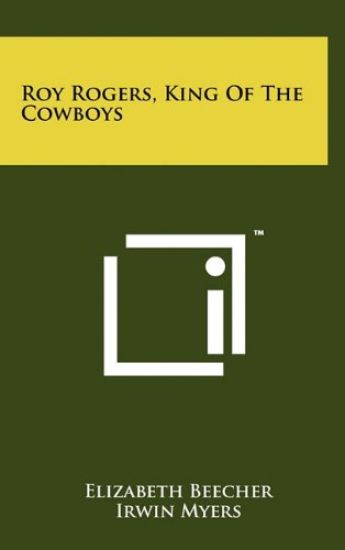
Roy Rogers, King of the Cowboys

Roy Rogers, King of the Cowboys

Elizabeth Beecher; Irwin Myers

Literary Licensing, LLC
2011
sidottu
""Roy Rogers, King of the Cowboys"" is a biography of the famous American film and television actor, singer, and cowboy Roy Rogers. Written by Elizabeth Beecher, the book tells the story of Rogers' life, from his humble beginnings in Ohio to his rise to fame as one of the most iconic figures of the golden age of Hollywood.The book explores Rogers' early years, including his childhood on a farm and his early interest in music and performing. It then follows his journey to Hollywood, where he became a popular leading man in Western films and eventually landed his own television show, ""The Roy Rogers Show.""Throughout the book, Beecher highlights Rogers' many achievements and contributions to American culture, including his role in popularizing the cowboy image and his work as a philanthropist and advocate for children's charities. She also delves into his personal life, including his marriage to fellow actor Dale Evans and his relationships with other Hollywood stars.With its engaging narrative and detailed research, ""Roy Rogers, King of the Cowboys"" offers a fascinating glimpse into the life and legacy of one of America's most beloved cultural icons.This scarce antiquarian book is a facsimile reprint of the old original and may contain some imperfections such as library marks and notations. Because we believe this work is culturally important, we have made it available as part of our commitment for protecting, preserving, and promoting the world's literature in affordable, high quality, modern editions, that are true to their original work.