Kirjojen hintavertailu. Mukana 11 213 693 kirjaa ja 11 kauppaa.

Kirjahaku

Etsi kirjoja tekijän nimen, kirjan nimen tai ISBN:n perusteella.

1000 tulosta hakusanalla Ellen B. Basso

The Last Cannibals

The Last Cannibals

Ellen B. Basso

University of Texas Press
1995
pokkari
An especially comprehensive study of Brazilian Amazonian Indian history, The Last Cannibals is the first attempt to understand, through indigenous discourse, the emergence of Upper Xingú society. Drawing on oral documents recorded directly from the native language, Ellen Basso transcribes and analyzes nine traditional Kalapalo stories to offer important insights into Kalapalo historical knowledge and the performance of historical narratives within their nonliterate society.This engaging book challenges the familiar view of biography as a strictly Western literary form. Of special interest are biographies of powerful warriors whose actions led to the emergence of a more recent social order based on restrained behaviors from an earlier time when people were said to be fierce and violent.From these stories, Basso explores how the Kalapalo remember and understand their past and what specific linguistic, psychological, and ideological materials they employ to construct their historical consciousness. Her book will be important reading in anthropology, folklore, linguistics, and South American studies.
A Musical View of the Universe

A Musical View of the Universe

Basso Ellen B.

UNIVERSITY OF PENNSYLVANIA PRESS
1985
sidottu
A Musical View of the Universe is a study of the relationships between spoken myth and musical ritual in a native Brazilian community, the Carib-speaking Kalpalo of the Upper Xingu Basin. The book focuses on the meanings created and expressed through performance of artistic processes in which sound symbols provide a unifying interpretive matrix. Through sound symbols, Kalpalo ideas about types of beings, their relationships, and activities of mind are conceived, represented, and rendered apparent. The book includes the first collection of South American Indian narratives translated directly from the original language from taped performances. Ellen B. Basso's translations take into account the interaction among participants in the storytelling situation and the qualities of narrative performance that result.
Classroom Dynamics

Classroom Dynamics

Ellen B. Mandinach; Hugh F. Cline

Routledge Member of the Taylor and Francis Group
1993
sidottu
This book reports an attempt to introduce change in schools using a computer-based curriculum innovation for teaching higher-order thinking skills to middle and high school students. One of the volume's themes is the extraordinary complexity and difficulty of facilitating such change in schools. A corollary of that theme is the fact that patience must be an integral part of the strategy when promoting or studying change in schools. In reporting the activities during the early years of a technological innovation and research project in which the emphasis thus far has been primarily on establishing the change, this book focuses on describing the move to a technology-based learning environment. As such, it details an ongoing process -- a fascinating process -- and one that is likely to be repeated in the near future in countless schools throughout the nation.
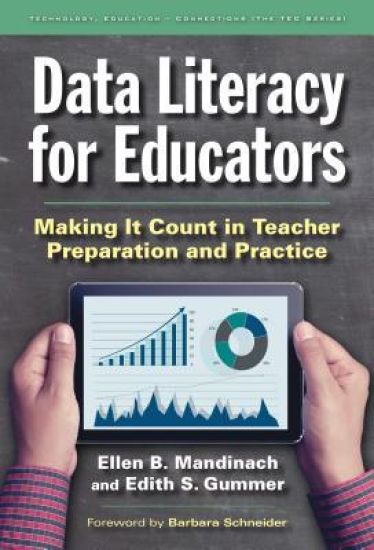
Data Literacy for Educators

Data Literacy for Educators

Ellen B. Mandinach; Edith S. Gummer; Barbara Schneider

Teachers' College Press
2016
nidottu
Data literacy has become an essential skill set for teachers as education becomes more of an evidence-based profession. Teachers in all stages of professional growth need to learn how to use data effectively and responsibly to inform their teaching practices. This groundbreaking resource describes data literacy for teaching, emphasizing the important relationship between data knowledge and skills and disciplinary and pedagogical content knowledge. Case studies of emerging programs in schools of education are used to illustrate the key components needed to integrate data-driven decisionmaking into the teaching curricula. The book offers a clear path for change while also addressing the inherent complexities associated with change. Data Literacy for Educators provides concrete strategies for schools of education, professional developers, and school districts.
Data Literacy for Educators

Data Literacy for Educators

Ellen B. Mandinach; Edith S. Gummer; Barbara Schneider

Teachers' College Press
2016
sidottu
Data literacy has become an essential skill set for teachers as education becomes more of an evidence-based profession. Teachers in all stages of professional growth need to learn how to use data effectively and responsibly to inform their teaching practices. This groundbreaking resource describes data literacy for teaching, emphasizing the important relationship between data knowledge and skills and disciplinary and pedagogical content knowledge. Case studies of emerging programs in schools of education are used to illustrate the key components needed to integrate data-driven decisionmaking into the teaching curricula. The book offers a clear path for change while also addressing the inherent complexities associated with change. Data Literacy for Educators provides concrete strategies for schools of education, professional developers, and school districts.
The Cone Sisters of Baltimore

The Cone Sisters of Baltimore

Ellen B. Hirschland; Nancy H. Ramage

Northwestern University Press
2008
sidottu
Over a period of thirty years, sisters Claribel and Etta Cone amassed one of the most acclaimed collections of twentieth-century art in America. Dr. Claribel and Miss Etta were two halves of an idiosyncratic team - Claribel bold and assertive and Etta reflective and sensitive - who used the fortunes of their German Jewish immigrant family to seek out works that inspired and pleased them, regardless of public opinion and without a background in art.This richly illustrated biography documents their lives from a unique perspective: that of their great-niece as told to their great-great-niece. Ellen Hirschland and her daughter Nancy Hirschland Ramage delve into Claribel and Etta's world, following the sisters through letters and personal stories as they travel to meet some of the artists whose work would turn their adjoining apartments into a gallery. They bought works of Manet, Gauguin, Seurat, Rodin, and Degas (among others) and struck up friendships with Picasso and Matisse. The sisters' experiences in Paris in the 1910s and 1920s provide an exceptional view of the bright artistic ferment in the city at that time. They were two Victorian women from Baltimore buying avant-garde art in the City of Lights, attending salons with friends Gertrude and Leo Stein, and building a collection that would initially puzzle the art world. Only with time would their keen eyes and unwavering taste for masterpieces prove indisputably fine.
Classroom Dynamics

Classroom Dynamics

Ellen B. Mandinach; Hugh F. Cline

Routledge
2016
nidottu
This book reports an attempt to introduce change in schools using a computer-based curriculum innovation for teaching higher-order thinking skills to middle and high school students. One of the volume's themes is the extraordinary complexity and difficulty of facilitating such change in schools. A corollary of that theme is the fact that patience must be an integral part of the strategy when promoting or studying change in schools. In reporting the activities during the early years of a technological innovation and research project in which the emphasis thus far has been primarily on establishing the change, this book focuses on describing the move to a technology-based learning environment. As such, it details an ongoing process -- a fascinating process -- and one that is likely to be repeated in the near future in countless schools throughout the nation.
Transforming Teaching and Learning Through Data-Driven Decision Making
Gathering data and using it to inform instruction is a requirement for many schools, yet educators are not necessarily formally trained in how to do it. This book helps bridge the gap between classroom practice and the principles of educational psychology. Teachers will find cutting-edge advances in research and theory on human learning and teaching in an easily understood and transferable format. The text's integrated model shows teachers, school leaders, and district administrators how to establish a data culture and transform quantitative and qualitative data into actionable knowledge based on: AssessmentStatisticsInstructional and differentiated psychologyClassroom managementData-driven decision making and data literacy skills are at the intersection of all of these areas, and the authors link them to show how to establish a vision and improve student learning. Included are vignettes that demonstrate the concepts in practice and tips for using technology to assist in the process.
Instructional Coaching in Action

Instructional Coaching in Action

Ellen B. Eisenberg; Bruce P. Eisenberg; Elliott A. Medrich; Ivan Charner

Association for Supervision Curriculum Development
2017
nidottu
Unlike ""fix-it"" strategies that targeted teachers are likely to resist, educator-centered instructional coaching—ECIC—offers respectful coaching for professionals within their schoolwide community. Evidence-based results across all content areas, authentic practices for data collection and analysis, along with nonevaluative, confidential collaboration offer a productive and promising path to teacher development. Coaches and teachers implement ECIC through a before-during-after—BDA—cycle that includes comprehensive planning between coach and teacher; classroom visitation and data collection; and debriefing and reflection.Drawing on their extensive experience with ECIC, authors Ellen B. Eisenberg, Bruce P. Eisenberg, Elliott A. Medrich, and Ivan Charner offer this detailed guidance for coaches and school leaders on how you and your school can:Create the conditions for an effective ECIC program.Get buy-in from teachers.Clearly define the role of coach.Roll out a coaching initiative.Ensure ongoing success with coaching.Filled with authentic advice from coaches, Instructional Coaching in Action provides valuable insight and demonstrates how educator-centered instructional coaching can make a difference in teacher learning, instructional practice, and student outcomes.
Delta Epiphany

Delta Epiphany

Ellen B. Meacham

University Press of Mississippi
2018
sidottu
In April 1967, a year before his run for president, Senator Robert F. Kennedy knelt in a crumbling shack in Mississippi trying to coax a response from a listless child. The toddler sat picking at dried rice and beans spilled over the dirt floor as Kennedy, former US attorney general and brother to a president, touched the boy's distended stomach and stroked his face and hair. After several minutes with little response, the senator walked out the back door, wiping away tears.In Delta Epiphany: Robert F. Kennedy in Mississippi, Ellen B. Meacham tells the story of Kennedy's visit to the Delta, while also examining the forces of history, economics, and politics that shaped the lives of the children he met in Mississippi in 1967 and the decades that followed. The book includes thirty-seven powerful photographs, a dozen published here for the first time. Kennedy's visit to the Mississippi Delta as part of a Senate subcommittee investigation of poverty programs lasted only a few hours, but Kennedy, the people he encountered, Mississippi, and the nation felt the impact of that journey for much longer. His visit and its aftermath crystallized many of the domestic issues that later moved Kennedy toward his candidacy for the presidency. Upon his return to Washington, Kennedy immediately began seeking ways to help the children he met on his visit; however, his efforts were frustrated by institutional obstacles and blocked by powerful men who were indifferent and, at times, hostile to the plight of poor black children.Sadly, we know what happened to Kennedy, but this book also introduces us to three of the children he met on his visit, including the baby on the floor, and finishes their stories. Kennedy talked about what he had seen in Mississippi for the remaining fourteen months of his life. His vision for America was shaped by the plight of the hungry children he encountered there.
Delta Epiphany

Delta Epiphany

Ellen B. Meacham

University Press of Mississippi
2020
pokkari
In April 1967, a year before his run for president, Senator Robert F. Kennedy knelt in a crumbling shack in Mississippi trying to coax a response from a listless child. The toddler sat picking at dried rice and beans spilled over the dirt floor as Kennedy, former US attorney general and brother to a president, touched the boy's distended stomach and stroked his face and hair. After several minutes with little response, the senator walked out the back door, wiping away tears.In Delta Epiphany: Robert F. Kennedy in Mississippi, Ellen B. Meacham tells the story of Kennedy's visit to the Delta, while also examining the forces of history, economics, and politics that shaped the lives of the children he met in Mississippi in 1967 and the decades that followed. The book includes thirty-seven powerful photographs, a dozen published here for the first time. Kennedy's visit to the Mississippi Delta as part of a Senate subcommittee investigation of poverty programs lasted only a few hours, but Kennedy, the people he encountered, Mississippi, and the nation felt the impact of that journey for much longer. His visit and its aftermath crystallized many of the domestic issues that later moved Kennedy toward his candidacy for the presidency. Upon his return to Washington, Kennedy immediately began seeking ways to help the children he met on his visit; however, his efforts were frustrated by institutional obstacles and blocked by powerful men who were indifferent and, at times, hostile to the plight of poor black children.Sadly, we know what happened to Kennedy, but this book also introduces us to three of the children he met on his visit, including the baby on the floor, and finishes their stories. Kennedy talked about what he had seen in Mississippi for the remaining fourteen months of his life. His vision for America was shaped by the plight of the hungry children he encountered there.