Kirjojen hintavertailu. Mukana 12 369 621 kirjaa ja 12 kauppaa.

Kirjahaku

Etsi kirjoja tekijän nimen, kirjan nimen tai ISBN:n perusteella.

1000 tulosta hakusanalla Emily Huddart Kennedy

Eco-Types

Eco-Types

Emily Huddart Kennedy

PRINCETON UNIVERSITY PRESS
2022
sidottu
Why acknowledging diverse eco-social relationships can help us overcome the political polarization that undermines our ability to protect the environmentWhen we picture the ideal environmentalist, we likely have in mind someone who dedicates herself to reducing her own environmental footprint through individual choices about consumption—driving a fuel-efficient car, for example, or eating less meat, or refusing plastic straws. This is a benchmark that many aspire to—and many others reject. In Eco-Types, Emily Huddart Kennedy shows that there is more than one way to care about the environment, outlining a spectrum of eco-social relationships that range from engagement to indifference.Drawing on three years of interviews and research, Kennedy describes five archetypal relationships with the environment: the Eco-Engaged, often politically liberal, who have an acute level of concern about the environment, a moral commitment to protect it, and the conviction that an individual can make a difference; the Self-Effacing, who share the Eco-Engaged’s concerns but not the belief in their own efficacy; the Optimists, often politically conservative, who are confident in their relationship with the environment, doubt the severity of environmental problems, and resent insinuations that they don’t care; the Fatalists, who are pessimistic about environmental decline and feel little responsibility to adopt environment-friendly habits; and the Indifferent, who have no affinity for any part of the environmental movement.Kennedy argues that when liberals feel they have a moral monopoly on environmental issues, polarization results. If we are serious about protecting the planet, we must acknowledge that we don’t all need to care about the environment in the same way.
Eco-Types

Eco-Types

Emily Huddart Kennedy

PRINCETON UNIVERSITY PRESS
2025
pokkari
Why acknowledging diverse eco-social relationships can help us overcome the political polarization that undermines our ability to protect the environmentWhen we picture the ideal environmentalist, we likely have in mind someone who dedicates herself to reducing her own environmental footprint through individual choices about consumption—driving a fuel-efficient car, for example, or eating less meat, or refusing plastic straws. This is a benchmark that many aspire to—and many others reject. In Eco-Types, Emily Huddart Kennedy shows that there is more than one way to care about the environment, outlining a spectrum of eco-social relationships that range from engagement to indifference.Drawing on three years of interviews and research, Kennedy describes five archetypal relationships with the environment: the Eco-Engaged, often politically liberal, who have an acute level of concern about the environment, a moral commitment to protect it, and the conviction that an individual can make a difference; the Self-Effacing, who share the Eco-Engaged’s concerns but not the belief in their own efficacy; the Optimists, often politically conservative, who are confident in their relationship with the environment, doubt the severity of environmental problems, and resent insinuations that they don’t care; the Fatalists, who are pessimistic about environmental decline and feel little responsibility to adopt environment-friendly habits; and the Indifferent, who have no affinity for any part of the environmental movement.Kennedy argues that when liberals feel they have a moral monopoly on environmental issues, polarization results. If we are serious about protecting the planet, we must acknowledge that we don’t all need to care about the environment in the same way.
Happy Meat

Happy Meat

Shyon Baumann; Emily Huddart Kennedy; Josee Johnston; Merin Oleschuk

STANFORD UNIVERSITY PRESS
2025
sidottu
North Americans love eating meat. Despite the increased awareness of the meat industry's harms–violence against animals, health problems, and associations with environmental degradation–the rate of meat eating hasn't changed significantly in recent years. Instead, what has emerged is an uncomfortable paradox: a need to square one's values with the behaviors that contradict those values. Using a large-scale, multidimensional, and original dataset, Happy Meat explores the thoughts and emotions that underpin our moral decision-making in this meat paradox. Conscientious meat-eaters turn to the notion of "happy meat" to make sense of their behaviors by consuming meat they see as more healthy, ethical, and sustainable. Happy meat might be labeled grass fed, free-range, antibiotic free, naturally raised, or humane. The people who produce and consume it, together, make up the complex landscape of conscientious meat-eating in modern Western societies. The discourse of happy meat ultimately may not be a sufficient response to all the critiques of meat eating, rife as it is with contradictions. However, it offers a powerful case for understanding how moral boundaries and notions of the 'good eater' are constructed through negotiations of values, identity, and status.
Happy Meat

Happy Meat

Shyon Baumann; Emily Huddart Kennedy; Josee Johnston; Merin Oleschuk

STANFORD UNIVERSITY PRESS
2025
pokkari
North Americans love eating meat. Despite the increased awareness of the meat industry's harms–violence against animals, health problems, and associations with environmental degradation–the rate of meat eating hasn't changed significantly in recent years. Instead, what has emerged is an uncomfortable paradox: a need to square one's values with the behaviors that contradict those values. Using a large-scale, multidimensional, and original dataset, Happy Meat explores the thoughts and emotions that underpin our moral decision-making in this meat paradox. Conscientious meat-eaters turn to the notion of "happy meat" to make sense of their behaviors by consuming meat they see as more healthy, ethical, and sustainable. Happy meat might be labeled grass fed, free-range, antibiotic free, naturally raised, or humane. The people who produce and consume it, together, make up the complex landscape of conscientious meat-eating in modern Western societies. The discourse of happy meat ultimately may not be a sufficient response to all the critiques of meat eating, rife as it is with contradictions. However, it offers a powerful case for understanding how moral boundaries and notions of the 'good eater' are constructed through negotiations of values, identity, and status.
Emily

Emily

Harrod-Eagles Cynthia

PAN MACMILLAN
1993
pokkari
Emily Paget, poor relation of an earl, shocks her family with her determination to earn her own living rather than suffer the tedium of a respectable marriage. Whisked off to St Petersburg by her Russian grandmother, Emily finds the freedom she has craved. She also falls in love.
Emily

Emily

Jilly Cooper

Transworld Publishers Ltd
2005
pokkari
If Emily hadn't gone to Annie Richmond's party, she would never have met the impossible irresistible Rory Balniel - never have married him and been carried off to the wild Scottish island of Irasa to live in his ancestral home along with his eccentric mother, Coco, and the dog, Walter Scott.
Emily

Emily

Val Wood

TRANSWORLD PUBLISHERS LTD
2010
pokkari
Emily was only five years old when she was sent away from her ma and pa and her brother Joe to go and live with old Granny Edwards. A loving and hard-working child, she goes into service when she is twelve at the house of Roger Francis, whose connections with Emily's own family prove to be closer than she could ever have guessed. Roger's daughter Deborah takes a great fancy to Emily, and when Emily has moved to another household in Hull she finds that her new employer's son Hugo is to marry Deborah. But Hugo, too, has taken a fancy to Emily, and dishonours and then betrays her to such an extent that she is imprisoned, tried and deported to Australia. But just when her fortunes seem to be at their lowest ebb, Emily is reunited with the one man who can save her from her miserable existence and bring her wealth and happiness.
Emily

Emily

Matthew Elstran

M. Elstran
2017
nidottu
Emily possessed an inexhaustible treasure of facial expression and her expressions were genuine. She had lively, thin, dark, eyebrows, arched above eyes that could shift from a placid softness to a razor sharp glare with an astonishing suddenness. Her mouth and lips formed into a vast array of configurations that were expressive of even the most subtle mood change. Tim felt as if he were peering directly at a soul unmasked, a soul that had grown to maturity without being tarnished by the sarcasm, the skepticism, the cynicism, and all the other ism's and asm's that plague civilization. A soul that had clung tenaciously to the childlike wonder, optimism, hope, that is so often lost. Indeed, it was the loss of these that Tim lamented and their re-turn that he longed for, though, this was as yet, unclear to him.
Emily

Emily

Mirabelle Maslin

Augur Press
2008
pokkari
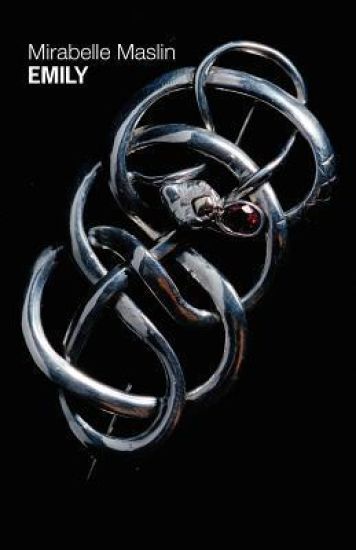
Orphaned by the age of ten, Emily lives with her Aunt Jane. While preparing to move house, they come across an old diary of Jane's, and she shows Emily some intriguing spiral patterns that appeared in it just before she, Emily, was born.
Emily

Emily

Freddy Henríquez

Lulu Press Editorial
2024
pokkari
Segunda parte de la Trilog a Serie Adictos. Secuela de Dominick.Adicto a ti. Libro 2.La continuaci n m s esperada del a o, al fin est aqu . C mo empez todo? Cu l es el precio a pagar por saberlo? Dominick tiene su ltima oportunidad para descubrirlo, ahora que sabe la realidad de su vida, tendr que descubrir d nde y cu ndo comenz todo el mal. Todos quieren contar su versi n, todos tienen la culpa de algo de lo que hoy se averg enzan. La pesadilla del final de la segunda parte de esta impactante historia trae un desenlace que te dejar sin aliento. T , de qu lado est s?