Kirjojen hintavertailu. Mukana 11 244 527 kirjaa ja 12 kauppaa.

Kirjahaku

Etsi kirjoja tekijän nimen, kirjan nimen tai ISBN:n perusteella.

136 tulosta hakusanalla Empson Edward Middleton

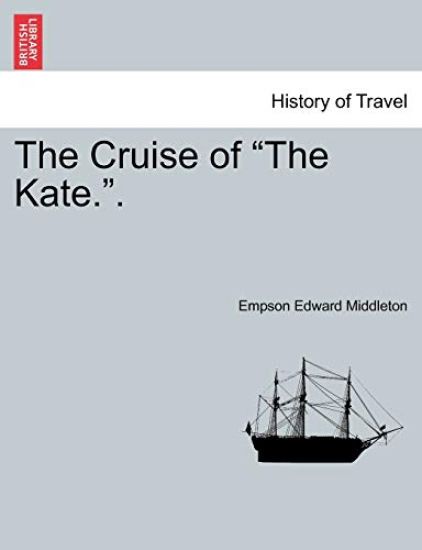
The Cruise of the Kate..

The Cruise of the Kate..

Empson Edward Middleton

British Library, Historical Print Editions
2011
pokkari
Title: The Cruise of "The Kate.."Publisher: British Library, Historical Print EditionsThe British Library is the national library of the United Kingdom. It is one of the world's largest research libraries holding over 150 million items in all known languages and formats: books, journals, newspapers, sound recordings, patents, maps, stamps, prints and much more. Its collections include around 14 million books, along with substantial additional collections of manuscripts and historical items dating back as far as 300 BC.The HISTORY OF TRAVEL collection includes books from the British Library digitised by Microsoft. This collection contains personal narratives, travel guides and documentary accounts by Victorian travelers, male and female. Also included are pamphlets, travel guides, and personal narratives of trips to and around the Americas, the Indies, Europe, Africa and the Middle East. ++++The below data was compiled from various identification fields in the bibliographic record of this title. This data is provided as an additional tool in helping to insure edition identification: ++++ British Library Middleton, Empson Edward; 1870. x. 292 p.; 8 . 10358.bbb.42.
The Cruise of the Kate (Illustrated)

The Cruise of the Kate (Illustrated)

Empson Edward Middleton

Independently Published
2019
nidottu
In 1869, Empson Edward Middleton, an English ex-soldier and man of means, built himself a 23-foot sailboat and set about becoming the first man to single-handedly circumnavigate England. He chose the most difficult route he could think of, one of poorly charted sea lanes and powerful tides, and recorded his remarkable feat in this book, which served as his log and diary. The Cruise of the Kate is an incredible tale from the days when all a navigator had to steer by was the compass and the stars, along with the occasional landmark and passing vessels. Middleton's lively, detailed account of his daring but successful voyage brings to life the condition of solo ocean sailing more than a century ago.
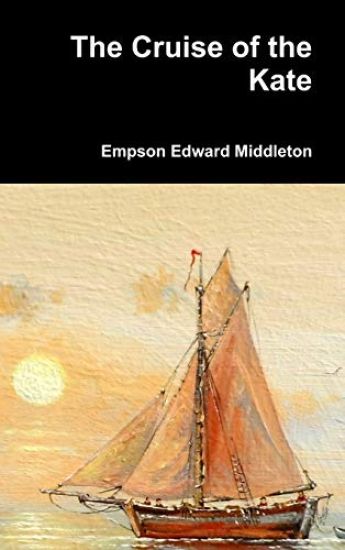
The Cruise of the Kate

The Cruise of the Kate

Empson Edward Middleton

Lulu.com
2019
nidottu
In 1869, Empson Edward Middleton, an English ex-soldier and man of means, built himself a 23-foot sailboat and set about becoming the first man to single-handedly circumnavigate England. He chose the most difficult route he could think of, one of poorly charted sea lanes and powerful tides, and recorded his remarkable feat in this book, which served as his log and diary.
The Cruise of the Kate

The Cruise of the Kate

Empson Edward Middleton

Lulu.com
2019
sidottu
In 1869, Empson Edward Middleton, an English ex-soldier and man of means, built himself a 23-foot sailboat and set about becoming the first man to single-handedly circumnavigate England. He chose the most difficult route he could think of, one of poorly charted sea lanes and powerful tides, and recorded his remarkable feat in this book, which served as his log and diary.
Steuerberechnung 1984 mit dem Epson HX-20

Steuerberechnung 1984 mit dem Epson HX-20

Eduard Sachtje

Vieweg+teubner Verlag
1985
nidottu
Durch die fortschreitende Entwicklung auf dem Gebiet der Taschenrechner und Hand­ held-Computer kommt der Wunsch sehr schnell, sich die Arbeit zu erleichtern. Während die Kapazität bei den ersten Rechnern für ein vollständiges Einkommen-bzw. Lohnsteuer-Programm nicht ausreichte, kann mit dem Epson HX-20 bereits ein anspre­ chendes Programm erstellt werden. Aber genauso, wie der Appetit beim Essen kommt, so möchte man auch bei der Erstellung eines Programmes alle Möglichkeiten bedenken und berücksichtigen. Dafür ist aber das Einkommenssteuerrecht zu umfangreich ge­ worden. Während man 1936 mit 4 Seiten für die gesamte Einkommenssteuererklärung auskam, hat heute bereits der Mantelbogen mit den allgemeinen Fragen diesen Umfang. Die An­ lagen umfassen bereits 14 Seiten, wenn alle Einkunftsarten angesprochen werden. Insofern konnten im vorliegenden Buch auch nur alle Einkunftsarten gestreift werden. Das Buch wurde im Manuskript auf einem Sharp-MZ 80K mit dem Textsystem Crowood geschrieben und auf einem Epson FX-80 gedruckt. Die Programme laufen alle in der Grundversion des Epson HX-20. Bei Speichererweiterungen kann das Einkommenssteuer­ Programm, daß für die Grundversion in 3 Blöcke geteilt wurde, aneinandergefügt werden. Für die Abschnitte 1.-9., sowie die Programme Ermittlung der Einnahmen aus Kapitalvermögen (Abschnitt 10.1), Einkünfte aus Vermietung und Verpachtung (Abschnitt 10.2), Ermittlung der Renteneinkünfte (Abschnitt 10.3), Ermittlung der Werbungskosten (Abschnitt 10.4) und Bausparprämie (Abschnitt 10.6) zeichnet Werner Grajewski verantwortlich. Diese Programme wurden auf einem Video­ Genie erstellt und auf den Epson HX·20 übertragen.
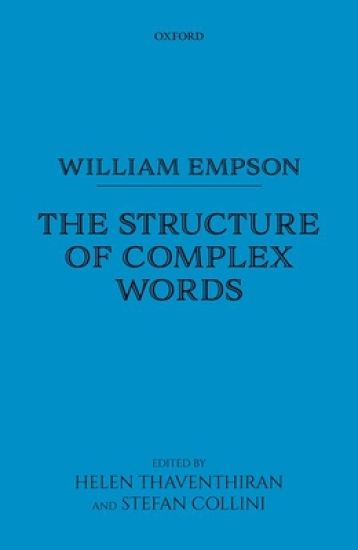
William Empson: The Structure of Complex Words

William Empson: The Structure of Complex Words

William Empson

Oxford University Press
2020
sidottu
This is the first scholarly edition of one of the classics of literary criticism. William Empson was among the two or three most important and influential literary critics and theorists of the twentieth century. He has long been celebrated as one of the most fertile (as well as one of the funniest) explorers of how meaning works in language, especially in poetry. The Structure of Complex Words (1951) was much his longest book and was intended as a major theoretical statement of his contribution to the subject. Since its publication, it has been constantly referred to, but usually from a respectful distance, since it can seem a forbidding and difficult work. This edition provides an extensive introduction together with full critical and explanatory notes. The editors trace the book's genesis and development in detail, beginning with Empson's collaboration with I. A. Richards in the early and mid-1930s, and concluding with the extensive writing and re-writing that Empson undertook while in Peking in 1947-50. This edition also reprints a selection of materials (including articles and letters) that illuminate Empson's thinking and contributed to the eventual book. The edition makes Empson's great work more intelligible to a range of readers and will immediately become the standard version of this celebrated text.
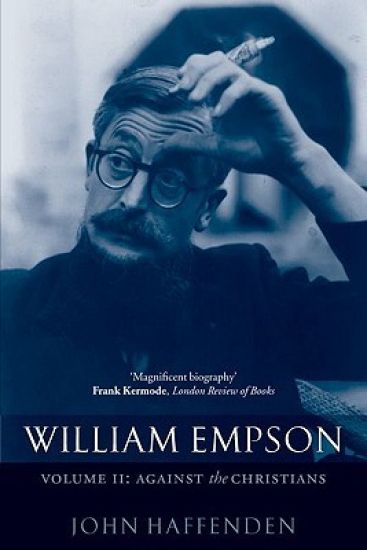
William Empson, Volume II

William Empson, Volume II

John Haffenden

Oxford University Press
2006
sidottu
Following the acclaimed first volume, Among the Mandarins, this is the second and concluding volume of the authorized biography of William Empson, one of the foremost poets and literary critics of the twentieth century. Against the Christians begins during the Second World War and follows Empson's turbulent years of writing wartime propaganda for the BBC. As Chinese Editor, he organised broadcasts to China and propaganda programmes for the Home Service, during which time his friends and colleagues included the prickly George Orwell. The effectiveness of Empson's work for the BBC provoked the Nazi propagandist Hans Fritzsche to call him a 'curly-headed Jew' -- a charge which gave him enormous satisfaction. In 1947 he returned to China, where he was caught up in the Communist siege of the Peking and witnessed Mao Tse-tung's triumphant entry. 'I was there for the honeymoon between the universities and the communists; we were being kept up to the mark rather firmly.' He saw 'the dragooning of independent thought and the hysteria of the confession meetings'. In the late 1940s he also taught in the USA, where he relished the irony of his situation. 'My position here really seems to me very dramatic; there can be few other people in the world who are receiving pay simultaneously and without secrecy from the Chinese Communists, the British Socialists, and the capitalist Rockefeller machine.' From 1953 to 1971 he held the Chair of English Literature at Sheffield, where he engaged more vigorously than ever before in public controversy, being driven by a desire to correct the wrong-headed orthodoxies of modern literary criticism -- most notably 'neo-Christianity'. He acquired massive publicity for his views on the wickedness of Christianity when he published Milton's God in 1961: 'The poem is wonderful because it is an awful warning. The effort of reconsidering Milton's God, who makes the poem so good just because he is so sickeningly bad, is a basic one for the European mind.' Haffenden presents a full account of the work on Milton, along with analyses of Empson's many other writings on subjects including Marlowe, Donne, Marvell, and Coleridge, and The Structure of Complex Words (1951). In a full and candid study of the public and private Empson, John Haffenden enables the reader to understand one of the most gifted, eccentric, witty, and controversial figures of our age -- a giant of modern literature and criticism.
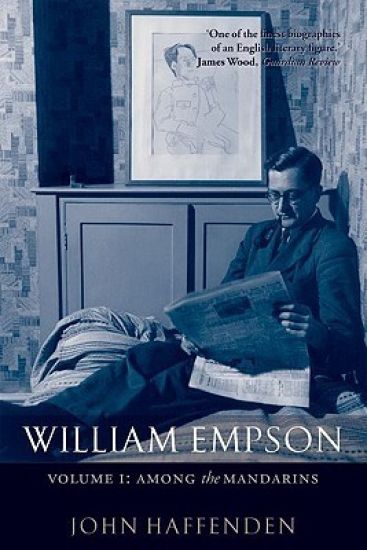
William Empson, Volume I

William Empson, Volume I

Haffenden

Oxford University Press
2009
nidottu
William Empson was the foremost English literary critic of the twentieth century. He was a man of huge energy and curiosity, and a genuine eccentric who remained imperturbable in the face of all the extraordinary circumstances in which he found himself. The discovery of contraceptives in his possession by a bedmaker at Cambridge University led to his being robbed of a promised Fellowship. Yet Seven Types of Ambiguity, drafted while he was still an undergraduate, promptly brought him world-wide fame. Empson invented modern literary criticism in English. He acted too as a cultural fifth-columnist, challenging received doctrine in life and literature. 'It is a very good thing for a poet . . . to be saying something which is considered very shocking at the time,' he maintained. 'To become morally independent of one's formative society . . . is the grandest theme of all literature, because it is the only means of moral progress.' His public life took him through many of the major political events of the modern world -- the rise of imperialism in Japan, the Sino-Japanese war in China, wartime propaganda for the BBC, and the Chinese civil war and Communist takeover of Peking in 1949. His friends and critical sparring partners included I. A. Richards, Kathleen Raine, J. B. S. Haldane, Humphrey Jennings, George Orwell, Robert Lowell, Dylan Thomas, Stephen Spender, Helen Gardner, and T. S. Eliot. 'It is of great importance now that writers should try to keep a certain world-mindedness,' he insisted. 'Without the literatures you cannot have a sense of history, and history is like the balancing-pole of the tightrope-walker . . . ; and nowadays we very much need the longer balancing-pole of not national but world history.' His passionate world-mindedness, and his humanism, combativeness, and wit, are fully in evidence in this, the first of two volumes exploring his remarkable life and work.
William Empson, Volume II

William Empson, Volume II

John Haffenden

Oxford University Press
2009
nidottu
Following the acclaimed first volume, Among the Mandarins , this is the second and concluding volume of the authorized biography of William Empson, one of the foremost poets and literary critics of the twentieth century. Against the Christians begins during the Second World War and follows Empson's turbulent years of writing wartime propaganda for the BBC. As Chinese Editor, he organised broadcasts to China and propaganda programmes for the Home Service, during which time his friends and colleagues included the prickly George Orwell. The effectiveness of Empson's work for the BBC provoked the Nazi propagandist Hans Fritzsche to call him a 'curly-headed Jew' -- a charge which gave him enormous satisfaction. In 1947 he returned to China, where he was caught up in the Communist siege of the Peking and witnessed Mao Tse-tung's triumphant entry. 'I was there for the honeymoon between the universities and the communists; we were being kept up to the mark rather firmly.' He saw 'the dragooning of independent thought and the hysteria of the confession meetings'. In the late 1940s he also taught in the USA, where he relished the irony of his situation. 'My position here really seems to me very dramatic; there can be few other people in the world who are receiving pay simultaneously and without secrecy from the Chinese Communists, the British Socialists, and the capitalist Rockefeller machine.' From 1953 to 1971 he held the Chair of English Literature at Sheffield, where he engaged more vigorously than ever before in public controversy, being driven by a desire to correct the wrong-headed orthodoxies of modern literary criticism -- most notably 'neo-Christianity'. He acquired massive publicity for his views on the wickedness of Christianity when he published Milton's God in 1961: 'The poem is wonderful because it is an awful warning. The effort of reconsidering Milton's God, who makes the poem so good just because he is so sickeningly bad, is a basic one for the European mind.' Haffenden presents a full account of the work on Milton, along with analyses of Empson's many other writings on subjects including Marlowe, Donne, Marvell, and Coleridge, and The Structure of Complex Words (1951). In a full and candid study of the public and private Empson, John Haffenden enables the reader to understand one of the most gifted, eccentric, witty, and controversial figures of our age -- a giant of modern literature and criticism.
William Empson: Some Versions of Pastoral

William Empson: Some Versions of Pastoral

William Empson

Oxford University Press
2020
sidottu
William Empson is, alongside T. S. Eliot, the greatest genius among twentieth-century critics, and Some Versions of Pastoral is widely recognised as one of the most extraordinary works of the golden age of English literary criticism. Ranging with astonishing virtuosity between works of several centuries and moving purposefully between cultures, William Empson has dazzling things to say here about Shakespeare and the Elizabethan theatre, the political poetry of Marvell, Milton's Paradise Lost, the complex satire of John Gay's Beggar's Opera, and the convoluted psychology at work in the Alice books of Lewis Carroll. The book is alert to questions of politics, psycho-analysis, and anthropology, and speaks to a wide range of contemporary concerns. Written in Empson's charismatically informal and wonderfully approachable voice, the book appeared in 1935 without footnotes or references. This edition is the first to identify the quotations and allusions, to explain the pertinence of his references, and to place the work within its Empsonian context. It is published with an appendix of other texts by Empson which illuminate the issues at work in the book.
William Empson

William Empson

Paul H. Fry

Routledge
1991
sidottu
William Empson: Prophet Against Sacrifice provides the most coherent account of Empson's diverse career to date. While exploring the richness of Empson's comic genius, Paul H. Fry serves to discredit the appropriation of his name in recent polemic by the conflicting parties of deconstruction and politicized cultural criticism. He argues that Empson is a larger, more important figure than the orthodox in either camp can acknowledge, deserving to be considered alongside such versatile critics as Walter Benjamin, Kenneth Burke and Roland Barthes.
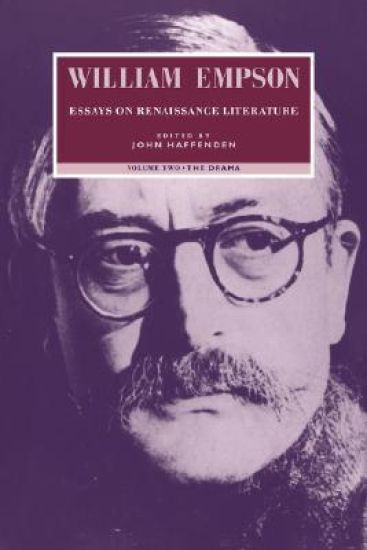
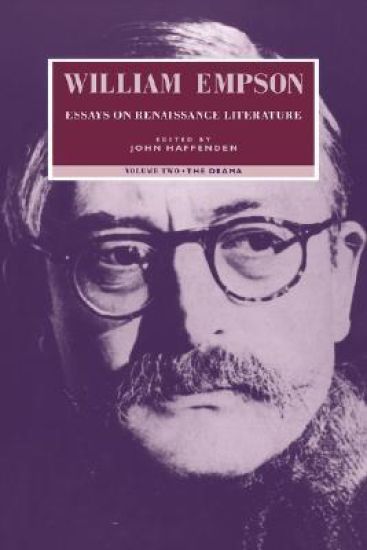
William Empson: Essays on Renaissance Literature: Volume 2, The Drama
This collection of William Empson's essays on Elizabethan and Jacobean drama is the second volume of his writings on Renaissance literature. Edited with an introduction by the leading Empson scholar John Haffenden, the contents range from famous essays on The Spanish Tragedy, Volpone, The Alchemist and The Duchess of Malfi to a sprightly piece on Elizabethan spirits. In addition, there are previously unpublished essays which revisit critical controversies, and a magnificent, provocative study of A Midsummer Night's Dream which ventures a major new reading of the play. 'I am attracted by the notion of a hearty indifference to one's own and other people's feelings, when a fragment of the truth is in question,' Empson stated. The incomparable Empson here fights his own critical corner with unequalled zest, intelligence and insight.
William Empson

William Empson

Cambridge University Press
2009
pokkari
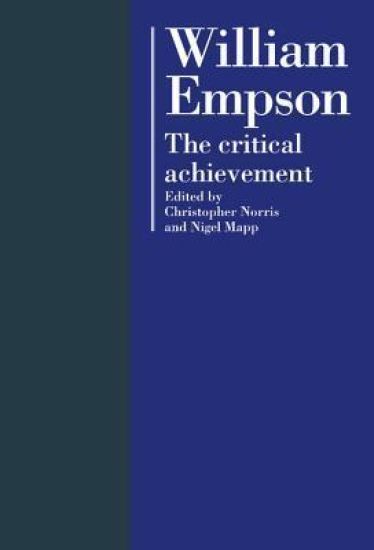
William Empson (1906–84) was one of the twentieth century's most distinctive critical voices, and left a profound mark upon Anglo-American literary culture. Published in 1993, this book was the first full study of Empson's literary criticism in its various aspects, taking account of recent developments in critical theory and of Empson's complex - at times deeply antagonistic - attitude towards those developments. In their diversity of viewpoint and critical approach the nine essays reflect this sturdy resistance to fashionable trends of 'Eng. Lit.' opinion. Topics include the relations between Empson and Derrida's approaches to the issue of textual 'undecidability', and Empson's prominent (if unwilling role) in the shaping of English as an academic discourse. Christopher Norris's extended introduction charts the ground and offers a major revaluation of Empson's place in the theoretical tradition.
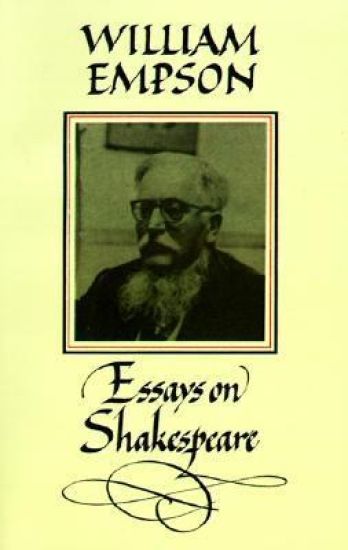
William Empson: Essays on Shakespeare

William Empson: Essays on Shakespeare

William Empson

Cambridge University Press
1986
pokkari
At the time of his death in 1984, the poet and critic William Empson was preparing and revising a collection of his essays on Shakespeare. This collection edited by David Pirie, is a book which the literary world has wanted for over half a century. Here, in a single volume, are major readings of Hamlet and Macbeth; a witty and sometimes impassioned defence of Falstaff, and a new piece on the architecture of the Globe theatre and other Renaissance playhouses, in which Empson explores the problems that the design of contemporary stages posed for a working playwright; there are also essays on the narrative poems, A Midsummer Night’s Dream and the last plays. The essays demonstrate the subtlety and agility of Empson’s mind, as well as his remarkable breadth of knowledge, while the almost racy wit of his informal prose style argues for a literary criticism which should never become solemn if it is to be truly serious.
William Empson

William Empson

Cambridge University Press
1993
sidottu
William Empson (1906–84) was one of the twentieth century's most distinctive critical voices, and left a profound mark upon Anglo-American literary culture. Published in 1993, this book was the first full study of Empson's literary criticism in its various aspects, taking account of recent developments in critical theory and of Empson's complex - at times deeply antagonistic - attitude towards those developments. In their diversity of viewpoint and critical approach the nine essays reflect this sturdy resistance to fashionable trends of 'Eng. Lit.' opinion. Topics include the relations between Empson and Derrida's approaches to the issue of textual 'undecidability', and Empson's prominent (if unwilling role) in the shaping of English as an academic discourse. Christopher Norris's extended introduction charts the ground and offers a major revaluation of Empson's place in the theoretical tradition.
William Empson: Essays on Renaissance Literature: Volume 2, The Drama
This collection of William Empson’s essays on Elizabethan and Jacobean drama is the second volume of his writings on Renaissance literature. Edited with an introduction by the leading Empson scholar John Haffenden, the contents range from famous essays on The Spanish Tragedy, Volpone, The Alchemist and The Duchess of Malfi to a sprightly piece on Elizabethan spirits. In addition, there are previously unpublished essays which revisit critical controversies, and a magnificent, provocative study of A Midsummer Night’s Dream which ventures a major new reading of the play. ‘I am attracted by the notion of a hearty indifference to one’s own and other people’s feelings, when a fragment of the truth is in question,’ Empson stated. The incomparable Empson here fights his own critical corner with unequalled zest, intelligence and insight.
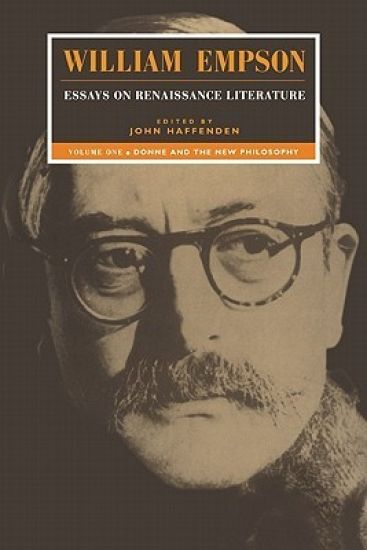
William Empson: Essays on Renaissance Literature: Volume 1, Donne and the New Philosophy
Following the success in paperback of William Empson’s Essays on Shakespeare (1986), this first volume of his Essays on Renaissance Literature (1993) now appears in an accessible format. The volume gathers Empson’s passionate and controversial essays on John Donne in the context of contemporary science, and includes previously unpublished pieces on some of the most influential Renaissance writers and scientists. Edited and introduced by leading Empson scholar John Haffenden, this is a book for anyone interested in the Renaissance, the history of science, and the history of literary criticism. ‘Some of these passages have a sweep as grand as Empson found in Donne.’ Eric Griffiths, The Times Literary Supplement ‘Empson’s achievement here as elsewhere comes from the generosity of spirit which made him consistently a great critic.’ The New York Review of Books
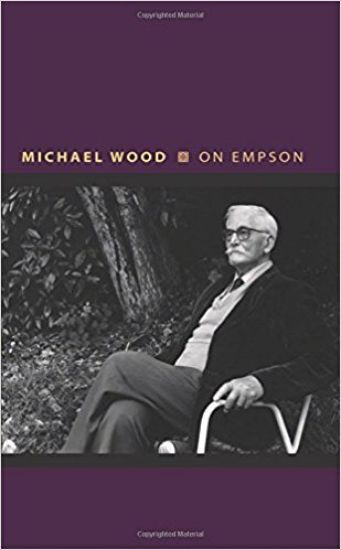
On Empson

On Empson

Michael Wood

PRINCETON UNIVERSITY PRESS
2017
sidottu
From one of today's most distinguished critics, a beautifully written exploration of one of the twentieth century's most important literary critics Are literary critics writers? As Michael Wood says, "Not all critics are writers--perhaps most of them are not--and some of them are better when they don't try to be." The British critic and poet William Empson (1906-84), one of the most important and influential critics of the twentieth century, was an exception--a critic who was not only a writer but also a great one. In this brief book, Wood, himself one of the most gifted writers among contemporary critics, explores Empson as a writer, a distinguished poet whose criticism is a brilliant literary performance--and proof that the act of reading can be an unforgettable adventure. Drawing out the singularity and strength of Empson's writing, including its unfailing wit, Wood traces the connections between Empson's poetry and criticism from his first and best-known critical works, Seven Types of Ambiguity and Some Versions of Pastoral, to later books such as Milton's God and The Structure of Complex Words. Wood shows why this pioneer of close reading was both more and less than the inventor of New Criticism--more because he was the greatest English critic since Coleridge, and didn't belong to any school; and less because he had severe differences with many contemporary critics, especially those who dismissed the importance of an author's intentions. Beautifully written and rich with insight, On Empson is an elegant introduction to a unique writer for whom literature was a nonstop form of living.