Kirjojen hintavertailu. Mukana 11 244 527 kirjaa ja 12 kauppaa.

Kirjahaku

Etsi kirjoja tekijän nimen, kirjan nimen tai ISBN:n perusteella.

1000 tulosta hakusanalla Eric S. Rabkin

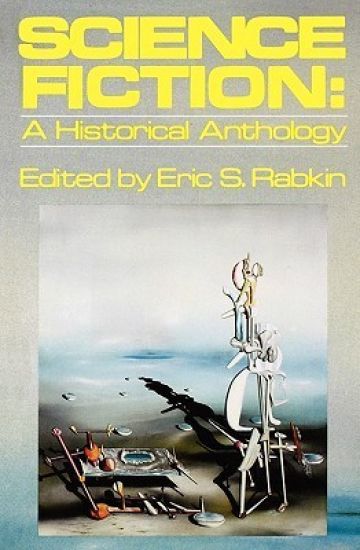
Science Fiction

Science Fiction

Eric S. Rabkin

Oxford University Press Inc
1983
nidottu
An invaluable contribution to the serious study of science fiction as well as a highly entertaining collection, Science Fiction contains 27 chronologically-arranged stories and excerpts, ranging from such early classic works as Swift's Gulliver's Travels and Shelley's Frankenstein to recent stories such as Harlan Ellison's "I Have No Mouth and I Must Scream" and Ursula K. Le Guin's "Vaster Than Empires and More Slow." Including brief general essays and a separate introduction to each individual story or excerpt, Rabkin's anthology greatly illuminates the evolution of the genre.
Mars

Mars

Eric S. Rabkin

Praeger Publishers Inc
2005
sidottu
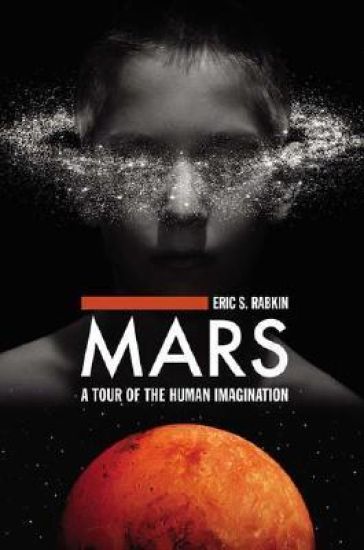
What is Mars? From the ancients to the present, we have imagined Mars repeatedly and studied it longingly. As scientific knowledge of Mars has changed, so has the cultural imagination of this celestial neighbors. The earth-centered beginnings of astronomy connected the blood-red planet with the God of War. The Copernican Revolution and a later, simple mistranslation from Italian supported fantastic visions of distant Mars as the abode of life variously bizarre, ideal, or malignant. In the work of H. G. Wells and Orson Welles, in books, films, radio, and television, Mars reflected not only eternal hopes and fears but then-current political realities. In recent years, NASA-fication has brought Mars home, imagining the Red Planet almost as an eighth continent of Earth, a candidate for exploration and exploitation both in fiction and in fact. Rabkin weaves a chronological tale of many threads, including mythology, astrology, astronomy, literary criticism, and cultural studies.
Narrative suspense

Narrative suspense

Eric S. Rabkin

The University of Michigan Press
1973
nidottu
"When Slim Turned Sideways . . ."—this is narrative suspense, and if well done propels the reader on into and through a novel, or folktale, or printed play, or epic poem. How does it work? Is it a matter of plot only? Why do some works rivet our attention from the first page, while others obviously do not? These are among the deceptively simple questions taken up in Eric Rabkin's seminal study of narrative suspense. Using the insights afforded by structuralism, linguistics, and modern criticism—and basing his discussion on close readings of many well-known works—Rabkin provides at once an original work in literary theory and a remarkably practical account of how successful narrative establishes and sustains interest on several levels. Suspense, Rabkin shows, is involved not only in the plot of a narrative, but in its thematic development, character development, and style as well. This broad understanding enables the author to develop a coherent theoretical description of suspense, using the terminology of rhetoric. The most startling result of this approach is a schematic representation for literary genres that, though arrived at theoretically, corresponds almost exactly to our intuitive categorization of literary works. Narrative Suspense can be read with ample profit by interested layman and professional critic alike. With wit and intelligence, the book clarifies an oft-perceived phenomenon—the fundamental importance of suspense, broadly defined, in all great works of literature.
The Fantastic in Literature

The Fantastic in Literature

Eric S. Rabkin

Princeton University Press
2015
pokkari
What exactly is the fantastic? In the twentieth-century world, our notions of what is impossible are assaulted every day. To define the nature of fantasy and the fantastic, Eric S. Rabkin considers its role in fairy tales, science fiction, detective stories, and religious allegory, as well as in traditional literature. The examples he studies range from Grimm's fairy tales to Agatha Christie, from Childhood's End to the novels of Henry James, from Voltaire to Robbe-Grillet to A Canticle for Leiboivitz. By analyzing different works of literature, the author shows that the fantastic depends on a reversal of the ground rules of a narrative world. This reversal signals most commonly a psychological escape, often from boredom, to an unknown world secretly yearned for, whose order, although reversed, bears a precise relation to reality. Originally published in 1976. The Princeton Legacy Library uses the latest print-on-demand technology to again make available previously out-of-print books from the distinguished backlist of Princeton University Press. These editions preserve the original texts of these important books while presenting them in durable paperback and hardcover editions. The goal of the Princeton Legacy Library is to vastly increase access to the rich scholarly heritage found in the thousands of books published by Princeton University Press since its founding in 1905.
The Fantastic in Literature

The Fantastic in Literature

Eric S. Rabkin

Princeton University Press
2016
sidottu
What exactly is the fantastic? In the twentieth-century world, our notions of what is impossible are assaulted every day. To define the nature of fantasy and the fantastic, Eric S. Rabkin considers its role in fairy tales, science fiction, detective stories, and religious allegory, as well as in traditional literature. The examples he studies range from Grimm's fairy tales to Agatha Christie, from Childhood's End to the novels of Henry James, from Voltaire to Robbe-Grillet to A Canticle for Leiboivitz. By analyzing different works of literature, the author shows that the fantastic depends on a reversal of the ground rules of a narrative world. This reversal signals most commonly a psychological escape, often from boredom, to an unknown world secretly yearned for, whose order, although reversed, bears a precise relation to reality. Originally published in 1976. The Princeton Legacy Library uses the latest print-on-demand technology to again make available previously out-of-print books from the distinguished backlist of Princeton University Press. These editions preserve the original texts of these important books while presenting them in durable paperback and hardcover editions. The goal of the Princeton Legacy Library is to vastly increase access to the rich scholarly heritage found in the thousands of books published by Princeton University Press since its founding in 1905.
Teaching Writing That Works

Teaching Writing That Works

Rabkin Eric S.

THE UNIVERSITY OF MICHIGAN PRESS
1990
nidottu
Expressing ourselves well in written communication is important to many areas of our lives, and essential in the working world. Many courses that seek to prepare students for professional writing, however, overlook the fact that most real-world writing is produced by and for people working within groups. Teaching Writing That Works offers composition instructors an alternative to the conventional composition course in which one individual (a student) writes in isolation for another isolated individual (the teacher). The result of Rabkin and Smith's innovative, non-hierarchical approach to composition learning is Practical English, a course developed at the University of Michigan. In this successful and popular course, the choice and execution of writing tasks are the responsibility of students working together in groups rather than working alone as individuals. The crucial rhetorical issues of audience and purpose are focused by having students use their writing to do real work, both within the classroom and beyond it. The writing that evolves from this collaboration is then edited and evaluated by the group. In this emphasis on students' authority over and responsibility for the learning process, Teaching Writing That Works reflects current pedagogical concerns and philosophy. The busy teacher looking for fresh approaches for the composition classroom but with no time to develop a whole new course from the bottom up will appreciate the book's full descriptions of the Michigan course. The authors provide an outline of the curriculum and thorough explanations of teaching techniques for the course, as well as a detailed discussion of the workshop practicum and its application. Much of the practical advice and theoretical discussion can be imported into existing courses as self-contained units. Selections from students' comments on the course enhance the text and offer glimpses into the reasons for the course's popularity among students-and teachers.
Mindscapes, the Geographies of Imagined Worlds

Mindscapes, the Geographies of Imagined Worlds

George Edgar Slusser; Eric S. Rabkin

Southern Illinois University Press
1989
sidottu
Eighteen essays plus four examples from the ninth annual J. Lloyd Eaton Conference on Science Fiction and Fantasy Literature at the University of California, Riverside. The concept of mindscape, Slusser and Rabkin explain, allows critics to focus on a single fundamental problem: The constant need for a relation between mind and some being external to mind. The essayists are Poul Anderson, Wendy Doniger O' Flaherty, Ronald J. Heckelman, David Brin, Frank McConnell, George E. Slusser, James Romm, Jack G. Voller, Peter Fitting, Michael R. Collings, Pascal J. Thomas, Reinhart Lutz, Joseph D. Miller, Gary Westfahl, Bill Lee, Max P. Belin, William Lomax, and Donald M. Hassler. The book concludes with four authors discussing examples of mindscape. The participants are Jean-Pierre Barricelli, Gregory Benford, Gary Kern, and David N. Samuelson.
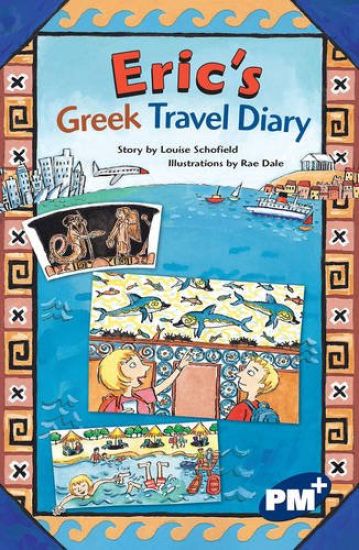
Eric's Greek Travel Diary

Eric's Greek Travel Diary

Louise Schofield

Cengage Learning Australia
2003
nidottu
Eric's off to Greece with his mother, but he would much rather be at his best friend Pete's birthday sleepover. However, as he visits ancient historical sites, and samples the local food and culture, Eric finds the trip is not so bad after all.
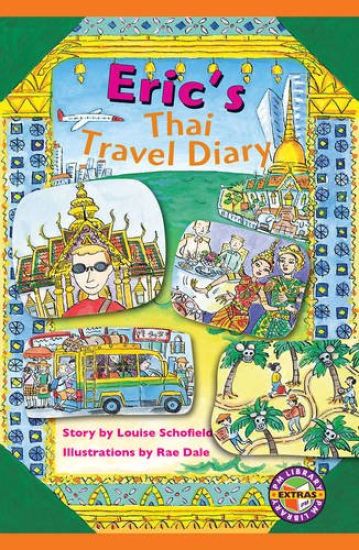
Eric's Thai Travel Diary

Eric's Thai Travel Diary

Louise Schofield

Cengage Learning Australia
2004
nidottu
Eric hasn't seen his father in three months. He has the opportunity to spend part of the holidays with him in Thailand. Although he's going to miss his best friend Pete, how can he refuse? Eric and his father explore exotic Thailand together. By the end of his trip, Eric has re-established his relationship with his father and learned a lot about the Thai people and culture.
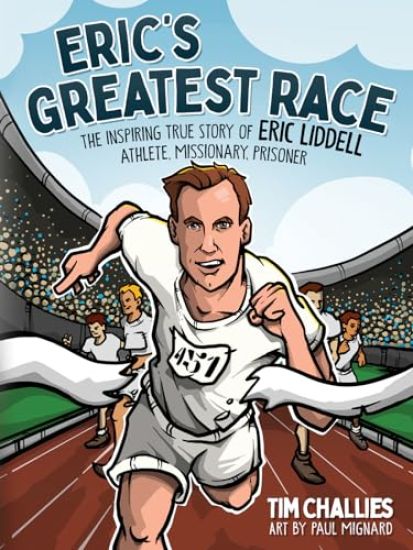
Eric's Greatest Race

Eric's Greatest Race

Tim Challies

HARVEST HOUSE PUBLISHERS,U.S.
2025
sidottu
This engaging, fully illustrated book tells young readers the story of famous Olympian Eric Liddell, whose steadfast courage and commitment to Christ has inspired generations of believers. Athlete. Missionary. Prisoner. Eric Liddell’s life was a series of remarkable twists and turns, from his refusal to run on a Sunday in the 1924 Olympics (as depicted in the Oscar-winning film Chariots of Fire) to his extensive missionary work, and finally to his imprisonment during World War II. Through it all, Eric never abandoned his faith in God. Written and illustrated as a graphic novel, Eric’s Greatest Race tells Eric Liddell’s entire life story and educates young readers about important historical events and concepts along the way. Children will encounter a real-life hero whose incredible impact on Christianity and the world lives on today.