Kirjojen hintavertailu. Mukana 11 244 527 kirjaa ja 12 kauppaa.

Kirjahaku

Etsi kirjoja tekijän nimen, kirjan nimen tai ISBN:n perusteella.

110 tulosta hakusanalla Ermanno Mendel

Giacomo Meyerbeer

Giacomo Meyerbeer

Ermanno Mendel

Antigonos Verlag
2025
pokkari
Ristampa immutata dell'edizione originale del 1869. La casa editrice Antigonos specializzata nella pubblicazione di ristampe di libri storici. Ci assicuriamo che queste opere siano messe a disposizione del pubblico in buone condizioni, al fine di preservare il patrimonio culturale.
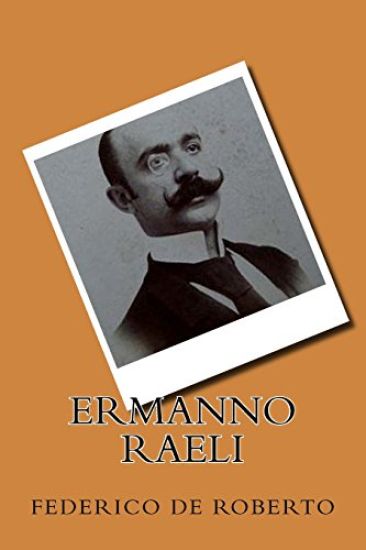
Ermanno Raeli (Italian Edition)

Ermanno Raeli (Italian Edition)

Federico De Roberto

Createspace Independent Publishing Platform
2018
nidottu
Se per un raffinato istinto di civetteria egli avesse voluto rafforzare la seduzione esercitata sul mio spirito, nessun artifizio gli sarebbe meglio riuscito. Pensai a lui, continuamente; ricordando certi segni caratteristici, ero sicuro di essermi imbattuto in un tipo eccezionale, la cui eccezionalit consisteva nello incontro molto raro di certe tendenze isolatamente frequenti--per ci stesso interessante a studiare.
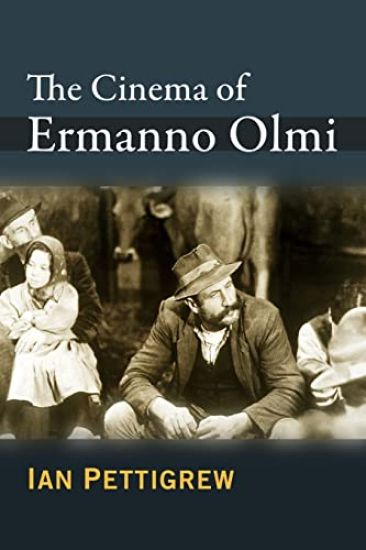
The Cinema of Ermanno Olmi

The Cinema of Ermanno Olmi

Ian Pettigrew

McFarland Co Inc
2020
nidottu
Ermanno Olmi is one of cinema's great, unsung filmmakers. With no formal filmmaking education, he drew upon his documentary roots to emerge onto the Italian art film scene, just as the last canonical neo-realist movies were released in the late 1950s and early 1960s. Though his films--including Il Posto (1961), The Tree of Wooden Clogs (1978) and The Legend of the Holy Drinker (1988) won top prizes at Cannes and Venice, the majority of his work has remained unappreciated in academic and cinephile circles, especially outside of Italy. This first English language book on Olmi explores the director's style and evolving environmentalism, from his early, institutional short films, made while working at an Italian energy company, to his 19 feature films.
Hegel's Dialectical Logic

Hegel's Dialectical Logic

Ermanno Bencivenga

Oxford University Press Inc
2000
sidottu
This clear, accessible account of Hegelian logic makes a case for its enormous seductiveness, its surprising presence in the collective consciousness, and the dangers associated therewith. Offering comprehensive coverage of Hegel's important works, Bencivenga avoids getting bogged down in short-lived scholarly debates to provide a work of permanent significance and usefulness.
Ethics Vindicated

Ethics Vindicated

Ermanno Bencivenga

Oxford University Press Inc
2006
sidottu
Can we regard ourselves as having free will? What is the place of values in a world of facts? What grounds the authority of moral injunctions, and why should we care about them? Unless we provide satisfactory answers to these questions, ethics has no credible status and is likely to be subsumed by psychology, history, or rational decision theory. According to Ermanno Bencivenga, this outcome is both common and regrettable. Bencivenga points to Immanuel Kant for the solution. Kant's philosophy is a sustained, bold, and successful effort aiming at offering us the answers we need. Ethics Vindicated is a clear and thorough account of this effort that builds on Bencivenga's previous interpretation of transcendental philosophy (as articulated in his Kant's Copernican Revolution) and draws on the entire Kantian corpus.
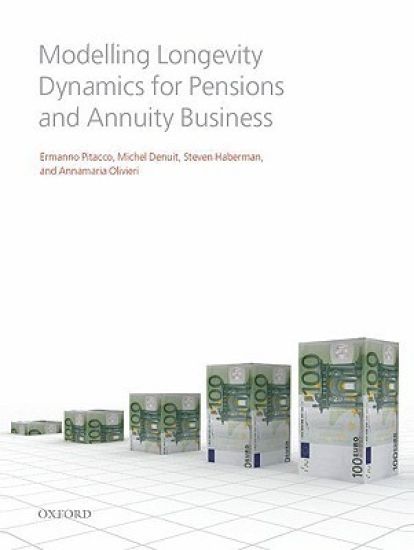
Modelling Longevity Dynamics for Pensions and Annuity Business

Modelling Longevity Dynamics for Pensions and Annuity Business

Ermanno Pitacco; Michel Denuit; Steven Haberman; Annamaria Olivieri

Oxford University Press
2009
sidottu
Mortality improvements, uncertainty in future mortality trends and the relevant impact on life annuities and pension plans constitute important topics in the field of actuarial mathematics and life insurance techniques. In particular, actuarial calculations concerning pensions, life annuities and other living benefits (provided, for example, by long-term care insurance products and whole life sickness covers) are based on survival probabilities which necessarily extend over a long time horizon. In order to avoid underestimation of the related liabilities, the insurance company (or the pension plan) must adopt an appropriate forecast of future mortality. Great attention is currently being devoted to the management of life annuity portfolios, both from a theoretical and a practical point of view, because of the growing importance of annuity benefits paid by private pension schemes. In particular, the progressive shift from defined benefit to defined contribution pension schemes has increased the interest in life annuities with a guaranteed annual amount. This book provides a comprehensive and detailed description of methods for projecting mortality, and an extensive introduction to some important issues concerning longevity risk in the area of life annuities and pension benefits. It relies on research work carried out by the authors, as well as on a wide teaching experience and in CPD (Continuing Professional Development) initiatives. The following topics are dealt with: life annuities in the framework of post-retirement income strategies; the basic mortality model; recent mortality trends that have been experienced; general features of projection models; discussion of stochastic projection models, with numerical illustrations; measuring and managing longevity risk.
Babbo Natale è uno di noi

Babbo Natale è uno di noi

Ermanno e Ruggero Marchesi

Lulu.com
2019
nidottu
Racconti umoristici, inventati ma vicini all'assurdo tutto intorno a noi, che parlano della vita e delle storie di un Babbo Natale contemporaneo... una tradizione famigliare divenuta un libro di racconti da condividere durante le feste...
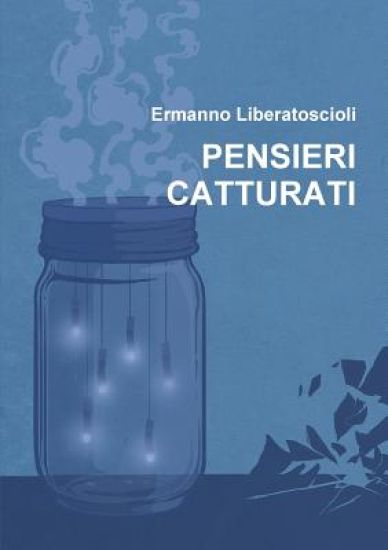
PENSIERI CATTURATI

PENSIERI CATTURATI

Ermanno Liberatoscioli

Lulu.com
2019
nidottu
"Far poesie e come far l'amore: non si sapra mai se la propria gioia e condivisa". Cosi Cesare Pavese sintetizza l'angoscia di chi si appresta a rendere pubbliche le proprie creazioni poetiche. Voler condividere la gioia della contemplazione poetica, questo e lo scopo della presente raccolta in cui si affrontano tutti i temi tipici della letteratura: tempo, morte, religiosita, bellezza, quotidianita. A livello linguistico-formale si evidenzia il recupero della rima cosi come quello del sonetto e il linguaggio di tipo classicheggiante, talora con movenze petrarchesche, altre volte con un afflato decadente se non crepuscolare. Non mancano nelle poesie l'ironia, talvolta velata di malinconia e la dimensione scherzosa e sarcastica. La raccolta si chiude con una selezione di haiku che mettono in luce tutta la sensibilita e spontaneita dell'autore, ma anche gli interrogativi sul senso della vita, della morte, della natura, della fugacita del tempo.
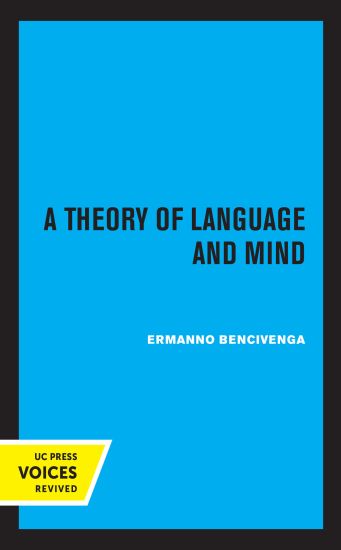
A Theory of Language and Mind

A Theory of Language and Mind

Ermanno Bencivenga

University of California Press
2020
pokkari
In his most recent book, Ermanno Bencivenga offers a stylistically and conceptually exciting investigation of the nature of language, mind, and personhood and the many ways the three connect. Bencivenga, one of the most iconoclastic voices to emerge in contemporary American philosophy, contests the basic assumptions of analytic (and also, to an extent, postmodern) approaches to these topics. His exploration leads through fascinating discussions of education, courage, pain, time and history, selfhood, subjectivity and objectivity, reality, facts, the empirical, power and transgression, silence, privacy and publicity, and play—all themes that are shown to be integral to our thinking about language. Relentessly bending the rules, Bencivenga frustrates our expectations of a "proper" theory of language. He invokes the transgressions of Nietzsche and Wittgenstein even as he appropriates the aphoristic style of Wittgenstein's Tractatus. Written in a philosophically playful and experimental mode, A Theory of Language and Mind draws the reader into a sense of continual surprise, therapeutic discomfort, and discovery. This title is part of UC Press's Voices Revived program, which commemorates University of California Press’s mission to seek out and cultivate the brightest minds and give them voice, reach, and impact. Drawing on a backlist dating to 1893, Voices Revived makes high-quality, peer-reviewed scholarship accessible once again using print-on-demand technology. This title was originally published in 1997.
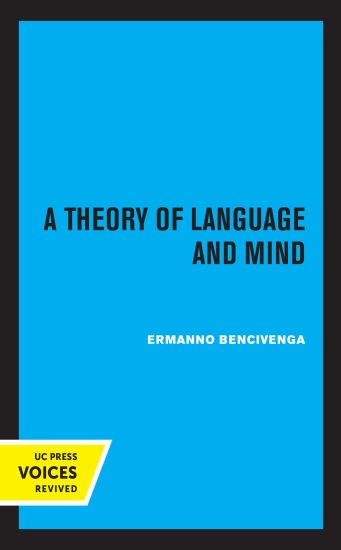
A Theory of Language and Mind

A Theory of Language and Mind

Ermanno Bencivenga

University of California Press
2021
sidottu
In his most recent book, Ermanno Bencivenga offers a stylistically and conceptually exciting investigation of the nature of language, mind, and personhood and the many ways the three connect. Bencivenga, one of the most iconoclastic voices to emerge in contemporary American philosophy, contests the basic assumptions of analytic (and also, to an extent, postmodern) approaches to these topics. His exploration leads through fascinating discussions of education, courage, pain, time and history, selfhood, subjectivity and objectivity, reality, facts, the empirical, power and transgression, silence, privacy and publicity, and play—all themes that are shown to be integral to our thinking about language. Relentessly bending the rules, Bencivenga frustrates our expectations of a "proper" theory of language. He invokes the transgressions of Nietzsche and Wittgenstein even as he appropriates the aphoristic style of Wittgenstein's Tractatus. Written in a philosophically playful and experimental mode, A Theory of Language and Mind draws the reader into a sense of continual surprise, therapeutic discomfort, and discovery. This title is part of UC Press's Voices Revived program, which commemorates University of California Press’s mission to seek out and cultivate the brightest minds and give them voice, reach, and impact. Drawing on a backlist dating to 1893, Voices Revived makes high-quality, peer-reviewed scholarship accessible once again using print-on-demand technology. This title was originally published in 1997.

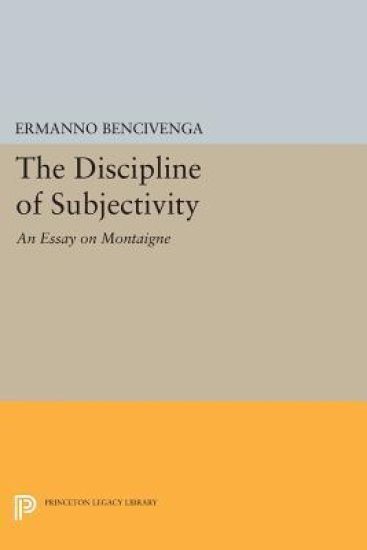
The Discipline of Subjectivity

The Discipline of Subjectivity

Ermanno Bencivenga

Princeton University Press
2014
pokkari
Through an interpretation of Montaigne's philosophical vision as expressed in his Essays, Ermanno Bencivenga contributes to the current debate about the "death of the subject" by developing a view of the self as a project of continuous construction rather than the source and foundation of knowledge. This latter, Cartesian conception of self-consciousness as a logical and epistemological starting point is, Bencivenga contends, delusive: the certainty it provides is more akin to faith than to a cognitive state. How then do we acquire knowledge of the self? Montaigne makes for a productive case study in this regard: he declares that he himself is the matter of his book, and that nothing but the constitution of his own self is his business. A study of Montaigne reveals that the fundamental category missing in the Cartesian conception of the self is that of practical effort. The self is not a ready-made entity, available for inspection and analysis, but something whose generation requires exercise, training, and discipline. It is the result of an operation that must be performed not just once, but, as in all training, over and over again until it becomes second nature. Bencivenga characterizes the particular training required by the project of constituting a subject as a revolutionary, transgressive, critical one, which shares with philosophical activity a profoundly playful irrelevance to the "ready to hand." Originally published in 1990. The Princeton Legacy Library uses the latest print-on-demand technology to again make available previously out-of-print books from the distinguished backlist of Princeton University Press. These editions preserve the original texts of these important books while presenting them in durable paperback and hardcover editions. The goal of the Princeton Legacy Library is to vastly increase access to the rich scholarly heritage found in the thousands of books published by Princeton University Press since its founding in 1905.
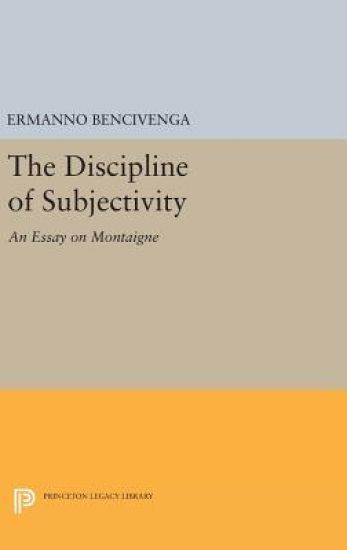
The Discipline of Subjectivity

The Discipline of Subjectivity

Ermanno Bencivenga

Princeton University Press
2016
sidottu
Through an interpretation of Montaigne's philosophical vision as expressed in his Essays, Ermanno Bencivenga contributes to the current debate about the "death of the subject" by developing a view of the self as a project of continuous construction rather than the source and foundation of knowledge. This latter, Cartesian conception of self-consciousness as a logical and epistemological starting point is, Bencivenga contends, delusive: the certainty it provides is more akin to faith than to a cognitive state. How then do we acquire knowledge of the self? Montaigne makes for a productive case study in this regard: he declares that he himself is the matter of his book, and that nothing but the constitution of his own self is his business. A study of Montaigne reveals that the fundamental category missing in the Cartesian conception of the self is that of practical effort. The self is not a ready-made entity, available for inspection and analysis, but something whose generation requires exercise, training, and discipline. It is the result of an operation that must be performed not just once, but, as in all training, over and over again until it becomes second nature. Bencivenga characterizes the particular training required by the project of constituting a subject as a revolutionary, transgressive, critical one, which shares with philosophical activity a profoundly playful irrelevance to the "ready to hand." Originally published in 1990. The Princeton Legacy Library uses the latest print-on-demand technology to again make available previously out-of-print books from the distinguished backlist of Princeton University Press. These editions preserve the original texts of these important books while presenting them in durable paperback and hardcover editions. The goal of the Princeton Legacy Library is to vastly increase access to the rich scholarly heritage found in the thousands of books published by Princeton University Press since its founding in 1905.