Kirjojen hintavertailu. Mukana 11 244 527 kirjaa ja 12 kauppaa.

Kirjahaku

Etsi kirjoja tekijän nimen, kirjan nimen tai ISBN:n perusteella.

1000 tulosta hakusanalla Ernest Bramah

The Secret of the League: The Story of a Social War. dystopian NOVEL by: Ernest Bramah
The Secret of the League is a 1907 dystopian novel by Ernest Bramah, which describes the overthrow of a democratically-elected British Labour Party Government through a carefully prepared plot by members of the upper classes, and depicts such an overthrow as being a positive and desirable outcome. George Orwell credited the book with having given a considerably accurate prediction of the rise of Fascism, and also with reflecting "the mentality of the middle classes" and the brutal measures which members of these classes might condone or actively support, should they feel threatened with a revolution -"even such a decent and kindly writer as Ernest Bramah", in Orwell's words The book was written in the aftermath of the 1906 elections in which the Labour Party, formed just seven years before, gained 29 seats - a meteoric rise from the bare two seats it held before - and for the first time emerged as a serious force in British politics. The prospect of Labour gaining a majority, though still far-off, was no longer impossible - a prospect which some Britons, evidently including Bramah, found highly disagreeable. All the more so as the period following the elections was full of intensive labour disputes and militant strikes.
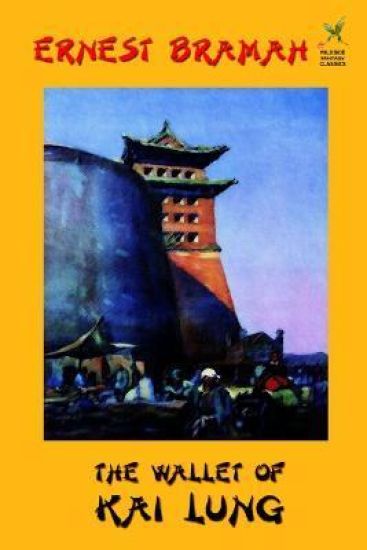
The Wallet of Kai Lung. by: Ernest Bramah ( include The Transmutation of Ling, A NOVELLA; and eight short stories. )
A collection of fantasy stories by Ernest Bramah, all but the last of which feature Kai Lung, an itinerant story-teller of ancient China. These include The Transmutation of Ling, a novella; and eight short stories. The Wallet of Kai Lung is a collection of fantasy stories by Ernest Bramah, all but the last of which feature Kai Lung, an itinerant story-teller of ancient China. It was first published in hardcover in London by Grant Richards in 1900, and there have been numerous editions since. Its initial tale, "The Transmutation of Ling", was also issued by the same publisher as a separate chapbook in 1911. The collection's importance in the history of fantasy literature was recognized by the anthologization of two of its tales in the celebrated I. The Transmutation of Ling II. The Story of Yung Chang III. The Probation of Sen Heng IV. The Experiment of the Mandarin Chan Hung V. The Confession of Kai Lung VI. The Vengeance of Tung Fel VII. The Career of the Charitable Quen-Ki-Tong VIII. The Vision of Yin, The Son of Yat Huang IX. The Ill-regulated Destiny of Kin Yen, the Picture-maker
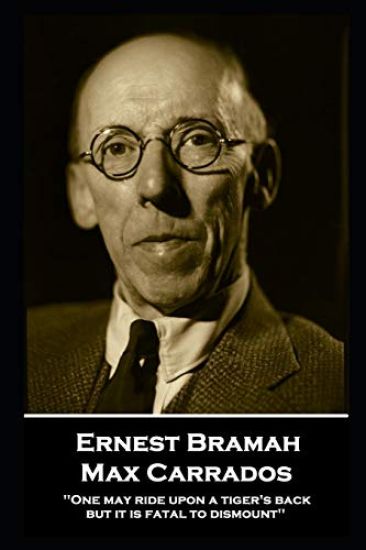
Ernest Bramah - Max Carrados: "One may ride upon a tiger's back but it is fatal to dismount''
Ernest Bramah was born on 20th March 1868. He was an intensely private man and very little about his life was ever released. Bramah dropped out of Manchester Grammar school at sixteen, in almost all his subjects he was close to the bottom of his class, and took a job at a farm. His father then invested substantial sums in setting him up with his own farm but Bramah's long term interests were elsewhere. In his spare time he would write vignettes on local subjects and send them to The Birmingham News for publication. In a now rather dramatic change of career he obtained the position of secretary to Jerome K Jerome and then to editing one of Jerome's magazines. Thereafter Bramah edited journals for a publishing firm that only ceased with its bankruptcy. He obtained success in his own right with the creation of the storyteller Kai Lung with humourous tales set in China, usually laced with fantasy elements. There seems to have been a certain vogue for stories with an oriental element at this time which Bramah was happy to take advantage of. His career blossomed across many genres; in humour, science-fiction, and supernatural he was ranked with the very best of the day. Even Orwell cited his work as an influence and as a predictor for the rise of Fascism and his own novel, 1984. At a time when the English Channel had yet to be crossed by an aeroplane, Bramah foresaw aerial express trains traveling at 10,000 feet, a nationwide wireless-telegraphy network, fax machines and cypher writing typewriters similar to the German Enigma machine. In 1914, Bramah created the blind detective Max Carrados. Despite the obvious obstacle to his deductive powers he was a literary and commercial success. Ernest Bramah died in Weston-Super-Mare on 27th June 1942 at the age of 74.
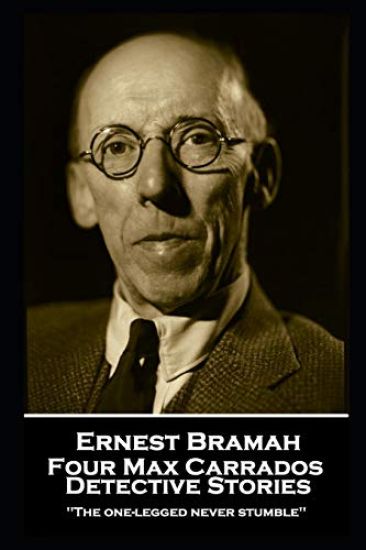
Ernest Bramah - Four Max Carrados Detective Stories: "The one-legged never stumble''
Ernest Bramah was born on 20th March 1868. He was an intensely private man and very little about his life was ever released. Bramah dropped out of Manchester Grammar school at sixteen, in almost all his subjects he was close to the bottom of his class, and took a job at a farm. His father then invested substantial sums in setting him up with his own farm but Bramah's long term interests were elsewhere. In his spare time he would write vignettes on local subjects and send them to The Birmingham News for publication. In a now rather dramatic change of career he obtained the position of secretary to Jerome K Jerome and then to editing one of Jerome's magazines. Thereafter Bramah edited journals for a publishing firm that only ceased with its bankruptcy. He obtained success in his own right with the creation of the storyteller Kai Lung with humourous tales set in China, usually laced with fantasy elements. There seems to have been a certain vogue for stories with an oriental element at this time which Bramah was happy to take advantage of. His career blossomed across many genres; in humour, science-fiction, and supernatural he was ranked with the very best of the day. Even Orwell cited his work as an influence and as a predictor for the rise of Fascism and his own novel, 1984. At a time when the English Channel had yet to be crossed by an aeroplane, Bramah foresaw aerial express trains traveling at 10,000 feet, a nationwide wireless-telegraphy network, fax machines and cypher writing typewriters similar to the German Enigma machine. In 1914, Bramah created the blind detective Max Carrados. Despite the obvious obstacle to his deductive powers he was a literary and commercial success. Ernest Bramah died in Weston-Super-Mare on 27th June 1942 at the age of 74.
Ernest Bramah - The Secret of the League: "The wise duck keeps his mouth shut when he smells frogs''
Ernest Bramah was born on 20th March 1868. He was an intensely private man and very little about his life was ever released. Bramah dropped out of Manchester Grammar school at sixteen, in almost all his subjects he was close to the bottom of his class, and took a job at a farm. His father then invested substantial sums in setting him up with his own farm but Bramah's long term interests were elsewhere. In his spare time he would write vignettes on local subjects and send them to The Birmingham News for publication. In a now rather dramatic change of career he obtained the position of secretary to Jerome K Jerome and then to editing one of Jerome's magazines. Thereafter Bramah edited journals for a publishing firm that only ceased with its bankruptcy. He obtained success in his own right with the creation of the storyteller Kai Lung with humourous tales set in China, usually laced with fantasy elements. There seems to have been a certain vogue for stories with an oriental element at this time which Bramah was happy to take advantage of. His career blossomed across many genres; in humour, science-fiction, and supernatural he was ranked with the very best of the day. Even Orwell cited his work as an influence and as a predictor for the rise of Fascism and his own novel, 1984. At a time when the English Channel had yet to be crossed by an aeroplane, Bramah foresaw aerial express trains traveling at 10,000 feet, a nationwide wireless-telegraphy network, fax machines and cypher writing typewriters similar to the German Enigma machine. In 1914, Bramah created the blind detective Max Carrados. Despite the obvious obstacle to his deductive powers he was a literary and commercial success. Ernest Bramah died in Weston-Super-Mare on 27th June 1942 at the age of 74.
Max Carrados Detective Stories Ernest Bramah Smith

Max Carrados Detective Stories Ernest Bramah Smith

Ernest Bramah Smith

Createspace Independent Publishing Platform
2017
nidottu
Max Carrados is a fictional blind detective in a series of mystery stories and books by Ernest Bramah, beginning in 1914. The Max Carrados stories appeared alongside Sherlock Holmes in the Strand Magazine, in which they often had top billing, and frequently outsold his eminent contemporary at the time, even if they failed to achieve the longevity of Holmes. George Orwell wrote that, together with those of Conan Doyle and R. Austin Freeman, Max Carrados and The Eyes of Max Carrados "are the only detective stories since Poe that are worth re-reading."
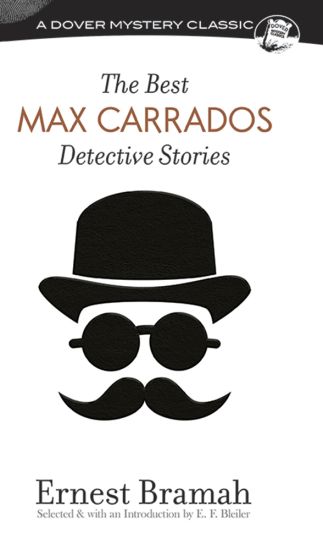
Best Max Carrados Detective Stories

Best Max Carrados Detective Stories

Ernest Bramah

Dover Publications Inc.
2017
nidottu
Sightless detective Max Carrados solved his first cases in Edwardian London, in the early days of the 20th century when the city was the beating heart of the vast British Empire. This collection contains the very best tales of the blind sleuth, 10 adventures that range from his first challenge, "The Coin of Dionysus," to mysteries set during the World War I era and the early 1920s. Like Sherlock Holmes, Max Carrados debuted in The Strand magazine, and his stories rivaled those of the Baker Street detective in popularity. Since then, compilation volumes of the frequently anthologized tales have long been out of print and hard to find. This collection offers an excellent introduction to the suave private investigator whose deductive skills are surpassed only by his perceptive powers, which enable him to hear a heartbeat from across the room. Carrados' creator, Ernest Bramah, was one of the few authors in the early days of detective fiction who could combine physical and intellectual thrills with imagination and stylistic brilliance. Brimming with charm and humor, these vintage stories are utterly unique in the field of detective literature.