Kirjojen hintavertailu. Mukana 11 417 157 kirjaa ja 12 kauppaa.

Kirjahaku

Etsi kirjoja tekijän nimen, kirjan nimen tai ISBN:n perusteella.

1000 tulosta hakusanalla Ernest Sosa

Ernest Sosa

Ernest Sosa

Blackwell Publishers
2004
sidottu
This is the first book devoted to the work of Ernest Sosa, one of the most influential contemporary epistemologists. Part of the acclaimed Philosophers and Their Critics series.The editor's introduction serves as an introduction to Sosa's epistemology.Contains critical essays by more than twenty of the most prominent epistemologists in the world, commenting on Sosa's work.Concludes with Sosa's own reply to his critics.
Ernest Sosa

Ernest Sosa

Blackwell Publishers
2004
nidottu
This is the first book devoted to the work of Ernest Sosa, one of the most influential contemporary epistemologists. Part of the acclaimed Philosophers and Their Critics series.The editor's introduction serves as an introduction to Sosa's epistemology.Contains critical essays by more than twenty of the most prominent epistemologists in the world, commenting on Sosa's work.Concludes with Sosa's own reply to his critics.
Ernest Sosa

Ernest Sosa

Springer International Publishing AG
2016
sidottu
This volume provides the reader with exclusive insights into Ernest Sosa’s latest ideas as well as main aspects of his philosophical work of the last 50 years. Ernest Sosa, one of the most distinguished contemporary philosophers, is best known for his ground-breaking work in epistemology, and has also contributed greatly to metaphysics, metaphilosophy and philosophy of language.This book, resulting from the 18th Münster Lectures in Philosophy, includes an original article by Sosa on his most recent work in epistemology, and seven critical papers that target a wide range of topics from Sosa’s oeuvre, as well as Sosa’s responses. As regards his epistemology, the issues discussed include his solution of the sceptical problem in his most recent work and the question of how to integrate a sensible account of testimony to Sosa’s virtue epistemology. The selected topics from his other fields of inquiry include his view on empirical challenges to human rationality, his defense of the scientific status of philosophy, his concept of causality as considered against the background of the current debate, his suggestion of a middle-way between existential relativism and absolutism and his externalistic internalism in the philosophy of mind and language.
Ernest Sosa

Ernest Sosa

Springer International Publishing AG
2018
nidottu
This volume provides the reader with exclusive insights into Ernest Sosa’s latest ideas as well as main aspects of his philosophical work of the last 50 years. Ernest Sosa, one of the most distinguished contemporary philosophers, is best known for his ground-breaking work in epistemology, and has also contributed greatly to metaphysics, metaphilosophy and philosophy of language.This book, resulting from the 18th Münster Lectures in Philosophy, includes an original article by Sosa on his most recent work in epistemology, and seven critical papers that target a wide range of topics from Sosa’s oeuvre, as well as Sosa’s responses. As regards his epistemology, the issues discussed include his solution of the sceptical problem in his most recent work and the question of how to integrate a sensible account of testimony to Sosa’s virtue epistemology. The selected topics from his other fields of inquiry include his view on empirical challenges to human rationality, his defense of the scientific status of philosophy, his concept of causality as considered against the background of the current debate, his suggestion of a middle-way between existential relativism and absolutism and his externalistic internalism in the philosophy of mind and language.
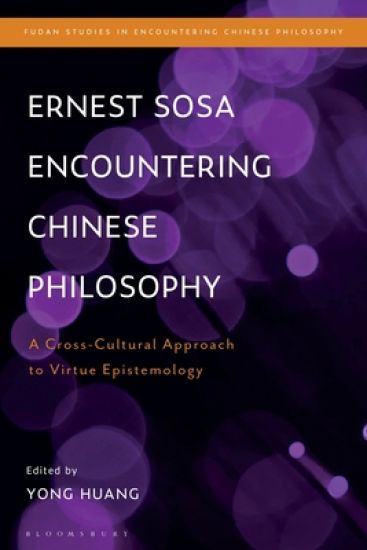
Ernest Sosa Encountering Chinese Philosophy
A major figure in the Anglo-American analytic tradition, Ernest Sosa is a pioneer of contemporary virtue epistemology. Engaging with his important work for the first time, a team of renowned scholars of Chinese philosophy bring Western analytic epistemology into dialogue with themes and issues in the history of the Chinese tradition in order to reveal multiple points of connection.Drawing on thinkers and texts from Confucianism, Daoism, and Chinese Buddhism, chapters explore issues central to virtue epistemology, such as the reliabilist and responsibilist divide, the distinction between virtues constitutive of knowledge and virtues auxiliary to knowledge, epistemic competence, and the role of testimony. Including Sosa’s constructive and systematic responses to each scholar’s interpretation of his work, this volume demonstrates the value of cross-cultural dialogue, advancing the field of virtue epistemology, and paving the way for further engagement between philosophical traditions.
Ernest Sosa Encountering Chinese Philosophy
A major figure in the Anglo-American analytic tradition, Ernest Sosa is a pioneer of contemporary virtue epistemology. Engaging with his important work for the first time, a team of renowned scholars of Chinese philosophy bring Western analytic epistemology into dialogue with themes and issues in the history of the Chinese tradition in order to reveal multiple points of connection.Drawing on thinkers and texts from Confucianism, Daoism, and Chinese Buddhism, chapters explore issues central to virtue epistemology, such as the reliabilist and responsibilist divide, the distinction between virtues constitutive of knowledge and virtues auxiliary to knowledge, epistemic competence, and the role of testimony. Including Sosa’s constructive and systematic responses to each scholar’s interpretation of his work, this volume demonstrates the value of cross-cultural dialogue, advancing the field of virtue epistemology, and paving the way for further engagement between philosophical traditions.
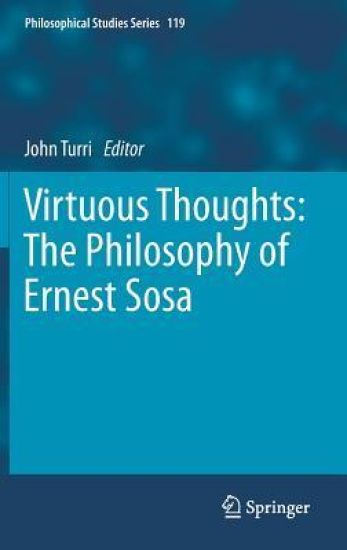
Virtuous Thoughts: The Philosophy of Ernest Sosa
This collection is a major contribution to the understanding and evaluation of Ernest Sosa’s profound and wide-ranging philosophy, in epistemology and beyond. A balanced, fair and critical volume, it offers a sensitive appreciation of his wide philosophical purview, a nuanced assessment of the detail of his thought, and a spur to exploring the linkages between the varied topics explored by the subtle mind of this great American scholar.The papers explore a wealth of Sosa’s academic interests, including his work on philosophical method, the philosophy of mind and language, metaphysics, and value theory, in addition to his output on epistemology itself. It offers, for example, a rebuttal of the counterarguments to Sosa’s reliabilist theory of introspective justification, which itself concludes with some objections to Sosa’s stated views on the ‘speckled hen’ problem. Other authors track the connections of his virtue theory to his advocacy of bi-level epistemology, provide reflections on Sosa’s views on the epistemological tradition, and examine the nexus of his beliefs on intuition and philosophical methodology. This volume is an insightful reckoning of Sosa’s academic account.
Virtuous Thoughts: The Philosophy of Ernest Sosa
This collection is a major contribution to the understanding and evaluation of Ernest Sosa’s profound and wide-ranging philosophy, in epistemology and beyond. A balanced, fair and critical volume, it offers a sensitive appreciation of his wide philosophical purview, a nuanced assessment of the detail of his thought, and a spur to exploring the linkages between the varied topics explored by the subtle mind of this great American scholar.The papers explore a wealth of Sosa’s academic interests, including his work on philosophical method, the philosophy of mind and language, metaphysics, and value theory, in addition to his output on epistemology itself. It offers, for example, a rebuttal of the counterarguments to Sosa’s reliabilist theory of introspective justification, which itself concludes with some objections to Sosa’s stated views on the ‘speckled hen’ problem. Other authors track the connections of his virtue theory to his advocacy of bi-level epistemology, provide reflections on Sosa’s views on the epistemological tradition, and examine the nexus of his beliefs on intuition and philosophical methodology. This volume is an insightful reckoning of Sosa’s academic account.
Judgment and Agency

Judgment and Agency

Ernest Sosa

Oxford University Press
2015
sidottu
Ernest Sosa extends his distinctive approach to epistemology, intertwining issues concerning the role of the will in judgment and belief with issues of epistemic evaluation. Questions about skepticism and the nature of knowledge are at the forefront. The answers defended are new in their explicit and sustained focus on judgment and epistemic agency. While noting that human knowledge trades on distinctive psychological capacities, Sosa also emphasizes the role of the social in human knowledge. Basic animal knowledge is supplemented by a level of reflective knowledge focused on judgment, and a level of 'knowing full well' that is distinctive of the animal that is rational.
Judgment and Agency

Judgment and Agency

Ernest Sosa

Oxford University Press
2017
nidottu
Ernest Sosa extends his distinctive approach to epistemology, intertwining issues concerning the role of the will in judgment and belief with issues of epistemic evaluation. Questions about skepticism and the nature of knowledge are at the forefront. The answers defended are new in their explicit and sustained focus on judgment and epistemic agency. While noting that human knowledge trades on distinctive psychological capacities, Sosa also emphasizes the role of the social in human knowledge. Basic animal knowledge is supplemented by a level of reflective knowledge focused on judgment, and a level of 'knowing full well' that is distinctive of the animal that is rational.
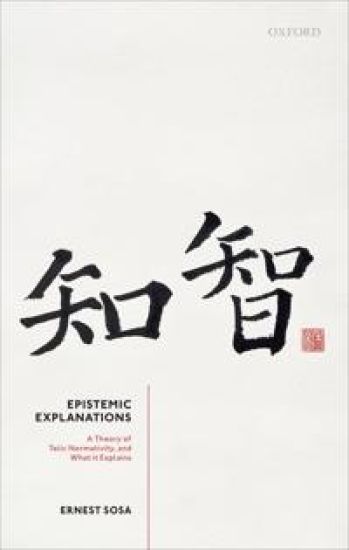
Epistemic Explanations

Epistemic Explanations

Ernest Sosa

Oxford University Press
2021
sidottu
Epistemic Explanations develops an improved virtue epistemology and uses it to explain several epistemic phenomena. Part I lays out a telic virtue epistemology that accommodates varieties of knowledge and understanding particularly pertinent to the humanities. Part II develops an epistemology of suspension of judgment, by relating it to degrees of confidence and to inquiry. Part III develops a substantially improved telic virtue epistemology by appeal to default assumptions important in domains of human performance generally, and in our intellectual lives as a special case. This reconfigures earlier virtue epistemology, which now seems a first approximation. This part also introduces a metaphysical hierarchy of epistemic categories and defends in particular a category of secure knowledge.
Epistemic Explanations

Epistemic Explanations

Ernest Sosa

Oxford University Press
2024
nidottu
Epistemic Explanations develops an improved virtue epistemology and uses it to explain several epistemic phenomena. Part I lays out a telic virtue epistemology that accommodates varieties of knowledge and understanding particularly pertinent to the humanities. Part II develops an epistemology of suspension of judgment, by relating it to degrees of confidence and to inquiry. Part III develops a substantially improved telic virtue epistemology by appeal to default assumptions important in domains of human performance generally, and in our intellectual lives as a special case. This reconfigures earlier virtue epistemology, which now seems a first approximation. This part also introduces a metaphysical hierarchy of epistemic categories and defends in particular a category of secure knowledge.
Reflective Knowledge

Reflective Knowledge

Ernest Sosa

Oxford University Press
2009
sidottu
Reflective Knowledge argues for a reflective virtue epistemology based on a kind of virtuous circularity that may be found explicitly or just below the surface in the epistemological writings of Descartes, Moore, and now Davidson, who on Sosa's reading also relies crucially on an assumption of virtuous circularity. Along the way various lines of objection are explored. In Part I Sosa considers historical alternatives to the view developed in Part II. He begins with G.E. Moore's legendary proof, and the epistemology that lies behind it. That leads to classical foundationalism, a more general position encompassing the indirect realism advocated by Moore. Next he turns to the quietist naturalism found in David Hume, Ludwig Wittgenstein, and P.F. Strawson. After that comes Thomas Reid's commonsense alternative. A quite different option is the subtle and complex epistemology developed by Wilfrid Sellars over the course of a long career. Finally, Part I concludes with a study of Donald Davidson's distinctive form of epistemology naturalized (as Sosa argues). The second part of the book presents an alternative beyond the historical positions of Part I, one that defends a virtue epistemology combined with epistemic circularity. This alternative retains elements of the earlier approaches, while discarding what was found wanting in them.
A Virtue Epistemology

A Virtue Epistemology

Ernest Sosa

Clarendon Press
2007
sidottu
A Virtue Epistemology presents a new approach to some of the oldest and most gripping problems of philosophy, those of knowledge and scepticism. Ernest Sosa argues for two levels of knowledge, the animal and the reflective, each viewed as a distinctive human accomplishment. By adopting a kind of virtue epistemology in line with the tradition found in Aristotle, Aquinas, Reid, and especially Descartes, he presents an account of knowledge which can be used to shed light on different varieties of scepticism, the nature and status of intuitions, and epistemic normativity.
A Virtue Epistemology

A Virtue Epistemology

Ernest Sosa

Oxford University Press
2009
nidottu
A Virtue Epistemology presents a new approach to some of the oldest and most gripping problems of philosophy, those of knowledge and scepticism. Ernest Sosa argues for two levels of knowledge, the animal and the reflective, each viewed as a distinctive human accomplishment. By adopting a kind of virtue epistemology in line with the tradition found in Aristotle, Aquinas, Reid, and especially Descartes, he presents an account of knowledge which can be used to shed light on different varieties of scepticism, the nature and status of intuitions, and epistemic normativity.
Reflective Knowledge

Reflective Knowledge

Ernest Sosa

Oxford University Press
2011
nidottu
Reflective Knowledge argues for a reflective virtue epistemology based on a kind of virtuous circularity that may be found explicitly or just below the surface in the epistemological writings of Descartes, Moore, and now Davidson, who on Sosa's reading also relies crucially on an assumption of virtuous circularity. Along the way various lines of objection are explored. In Part I Sosa considers historical alternatives to the view developed in Part II. He begins with G.E. Moore's legendary proof, and the epistemology that lies behind it. That leads to classical foundationalism, a more general position encompassing the indirect realism advocated by Moore. Next he turns to the quietist naturalism found in David Hume, Ludwig Wittgenstein, and P.F. Strawson. After that comes Thomas Reid's commonsense alternative. A quite different option is the subtle and complex epistemology developed by Wilfrid Sellars over the course of a long career. Finally, Part I concludes with a study of Donald Davidson's distinctive form of epistemology naturalized (as Sosa argues). The second part of the book presents an alternative beyond the historical positions of Part I, one that defends a virtue epistemology combined with epistemic circularity. This alternative retains elements of the earlier approaches, while discarding what was found wanting in them.
Knowledge in Perspective

Knowledge in Perspective

Ernest Sosa

Cambridge University Press
1991
pokkari
Ever since Plato, philosophers have faced one central question: what is the scope and nature of human knowledge? In this volume the distinguished philosopher Ernest Sosa collects essays on this subject written over a period of twenty-five years. All the major topics of contemporary epistemology are covered: the nature of propositional knowledge; externalism versus internalism; foundationalism versus coherentism; and the problem of the criterion. ‘Sosa is one of the most prominent and most important epistemologists on the current American scene.’ William P. Alston, Syracuse University
Knowing Full Well

Knowing Full Well

Ernest Sosa

Princeton University Press
2011
sidottu
In this book, Ernest Sosa explains the nature of knowledge through an approach originated by him years ago, known as virtue epistemology. Here he provides the first comprehensive account of his views on epistemic normativity as a form of performance normativity on two levels. On a first level is found the normativity of the apt performance, whose success manifests the performer's competence. On a higher level is found the normativity of the meta-apt performance, which manifests not necessarily first-order skill or competence but rather the reflective good judgment required for proper risk assessment. Sosa develops this bi-level account in multiple ways, by applying it to issues much disputed in recent epistemology: epistemic agency, how knowledge is normatively related to action, the knowledge norm of assertion, and the Meno problem as to how knowledge exceeds merely true belief. A full chapter is devoted to how experience should be understood if it is to figure in the epistemic competence that must be manifest in the truth of any belief apt enough to constitute knowledge. Another takes up the epistemology of testimony from the performance-theoretic perspective. Two other chapters are dedicated to comparisons with ostensibly rival views, such as classical internalist foundationalism, a knowledge-first view, and attributor contextualism. The book concludes with a defense of the epistemic circularity inherent in meta-aptness and thereby in the full aptness of knowing full well.
Epistemology

Epistemology

Ernest Sosa

Princeton University Press
2018
pokkari
One of the world's leading epistemologists provides a sophisticated, revisionist introduction to the subjectIn this concise book, one of the world’s leading epistemologists provides a sophisticated, revisionist introduction to the problem of knowledge in Western philosophy. Modern and contemporary accounts of epistemology tend to focus on limited questions of knowledge and skepticism, such as how we can know the external world, other minds, the past through memory, the future through induction, or the world’s depth and structure through inference. This book steps back for a better view of the more general issues posed by the ancient Greek Pyrrhonists. Returning to and illuminating this older, broader epistemological tradition, Ernest Sosa develops an original account of the subject, giving it substance not with Cartesian theology but with science and common sense. Descartes is a part of this ancient tradition, but he goes beyond it by considering not just whether knowledge is possible in the first place, but also how we can properly attain it. In Cartesian epistemology, Sosa finds a virtue-theoretic account, one that he extends beyond the Cartesian context. Once epistemology is viewed in this light, many of its problems can be solved or fall away. The result is an important reevaluation of epistemology that will be essential reading for students and teachers.
Epistemic Justification

Epistemic Justification

Laurence BonJour; Ernest Sosa

Blackwell Publishers
2003
sidottu
Ever since Plato it has been thought that one knows only if one's belief hits the mark of truth and does so with adequate justification. The issues debated by Laurence BonJour and Ernest Sosa concern mostly the nature and conditions of such epistemic justification, and its place in our understanding of human knowledge. Presents central issues pertaining to internalism vs. externalism and foundationalism vs. virtue epistemology in the form of a philosophical debate.Introduces students to fundamental questions within epistemology while engaging in contemporary debates.Written by two of today’s foremost epistemologists.Includes an extensive bibliography.