Das Marktverhalten der Unternehmung entscheidet über Gestalt, Ablauf und Bedeutung der Wirtschafti). Die betriebswirtschaftliche Theorie hat deshalb, um zutreffende und brauchbare Aussagen über die wirtschaft liche Wirklichkeit machen zu können, die Aufgabe, die tatsächlichen Ver haltensformen zu erforschen und zu erkläreni). Dieses Verhalten folgt aus der Eigengesetzlichkeit der Unternehmung als Organisation, ist bestimmt durch den Unternehmer und vor allem durch die Gegebenheiten des Mark tes und den Mittelbestand begrenzt. Zahlreiche Wissenschaften haben sich der Untersuchung des Verhaltens von Individuen, Gruppen und Organisa tionen zugewandt. Ihre Resultate haben zum Teil in der Betriebswirtschafts lehre noch keine ausreichende Beachtung gefunden. Eine isolierte Betrach tung aus rein ,wirtschaftlicher' Sicht ist jedoch bei der Interdependenz aller Lebensvorgänge und dem heutigen Entwicklungsstand wissenschaftlicher Forschung gefährlich, da sie zu einer falschen Interpretation führen kann. Es soll deshalb in dieser Arbeit der Versuch eines neuen Ansatzes der Theo rie des Marktverhaltens der Unternehmung unternommen werden, indem die Resultate der Nachbardisziplinen in einem speziellen Verhaltensmodell integriert werden. Dazu wird einleitend der Verhaltensbegriff geklärt und die Entwicklung der Theorie des Marktverhaltens in einem kurzen Abriß aufgezeigt. I. Zum Begriff des Verhaltens Verhalten ist die Gesamtheit der Lebensäußerungen und damit die Art der Daseinsbewältigungl) eines Verhaltensträgers. Leben ist dabei zugleich not wendige und hinreichende Bedingung des Verhaltens: alles Lebendige ver hält sich stets in irgendeiner Weise. Dieses Leben muß jedoch nicht selbst seiender Art - wie bei Mensch und Tier - sein, sondern kannauch in der Form bewirkten Daseins - wie bei der Unternehmung - erscheinen.
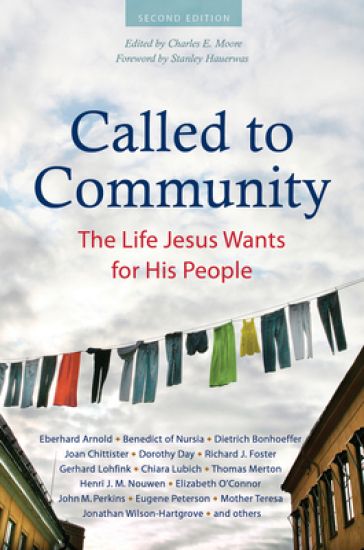
Eberhard Arnold; Dietrich Bonhoeffer; Joan Chittister; Dorothy Day; Fyodor Dostoyevsky; Richard J. Foster; Jonathan Wilson-Hartgrove; David Janzen; Søren Kierkegaard; C. S. Lewis; Chiara Lubich; Thomas Merton; Henri J. M. Nouwen; John M. Perkins; Eugene H. Peterson; Christine D. Pohl; Howard A. Snyder; Mother Teresa; Saint Benedict; Jeremiah Barker; Amy Carmichael; Hans Denck; Andreas Ehrenpreis; Thomas R Kelly; Penelope Lawson; Juan Mateos; Kathleen Norris; Thomas E Powers; Peter Riedemann; Christopher C Smith; Ulrich Stadler
Fifty-two readings on living in intentional Christian community to spark group discussion.Gold Medal Winner, 2017 Illumination Book Awards, Christian LivingSilver Medal Winner, 2017 Benjamin Franklin Award in Religion, Independent Book Publishers AssociationWhy, in an age of connectivity, are our lives more isolated and fragmented than ever? And what can be done about it? The answer lies in the hands of God’s people. Increasingly, today’s Christians want to be the church, to follow Christ together in daily life. From every corner of society, they are daring to step away from the status quo and respond to Christ’s call to share their lives more fully with one another and with others. As they take the plunge, they are discovering the rich, meaningful life that Jesus has in mind for all people, and pointing the church back to its original calling: to be a gathered, united community that demonstrates the transforming love of God.Of course, such a life together with others isn’t easy. The selections in this volume are, by and large, written by practitioners—people who have pioneered life in intentional community and have discovered in the nitty-gritty of daily life what it takes to establish, nurture, and sustain a Christian community over the long haul.Whether you have just begun thinking about communal living, are already embarking on sharing life with others, or have been part of a community for many years, the pieces in this collection will encourage, challenge, and strengthen you. The book’s fifty-two chapters can be read one a week to ignite meaningful group discussion.Contributors include: John F. Alexander, Eberhard Arnold, J. Heinrich Arnold, Johann Christoph Arnold, Alden Bass, Benedict of Nursia, Christoph Friedrich Blumhardt, Leonardo Boff, Dietrich Bonhoeffer, Joan Chittister, Stephen B. Clark, Andy Crouch, Dorothy Day, Anthony de Mello, Elizabeth Dede, Catherine de Hueck Doherty, Fyodor Dostoyevsky, Jenny Duckworth, Friedrich Foerster, Richard J. Foster, Jodi Garbison, Arthur G. Gish, Helmut Gollwitzer, Adele J Gonzalez, Stanley Hauerwas, Joseph H. Hellerman, Roy Hession, David Janzen, Rufus Jones, Emmanuel Katongole, Arthur Katz, Søren Kierkegaard, C. Norman Kraus, C.S. Lewis, Gerhard Lohfink, Ed Loring, Chiara Lubich, George MacDonald, Thomas Merton, Hal Miller, José P. Miranda, Jürgen Moltmann, Charles E. Moore, Henri J. M. Nouwen, Elizabeth O’Connor, John M. Perkins, Eugene H.Peterson, Christine D. Pohl, Chris Rice, Basilea Schlink, Howard A. Snyder, Mother Teresa, Thomas à Kempis, Elton Trueblood, and Jonathan Wilson-Hartgrove.
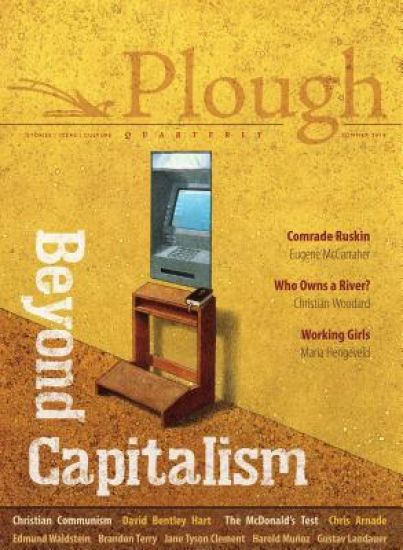
David Bentley Hart; Chris Arnade; Eugene McCarraher; Brandon M. Terry; Eberhard Arnold; G. K. Chesterton; Maria Hengeveld; John Rhodes; Harold Muñoz; Susannah Black; Jason Landsel
Is there a better way than capitalism? A much-cited recent poll found that more young Americans have a positive view of socialism than of capitalism. There’s a sense of newly opened possibilities: Might this be the moment for a mass movement of solidarity to overthrow the tyranny of concentrated power and wealth? But what exactly is this cause? Socialism’s champions know how to take effective whacks at capitalism, but diagnosis is not yet the cure. This issue of Plough springs from a conviction that there is a better answer beyond capitalism and socialism, a freely chosen life of sharing and caring that overcomes economic exploitation, a way of life that is both thoroughly practical and independent of the state. This vision is much older than Adam Smith and Karl Marx; it lies at the heart of Jesus’ Sermon on the Mount and throughout the New Testament, as well as in the writings of the Old Testament prophets. It is exemplified by the communal life of the first church in Jerusalem, in which “all who believed were together and had all things in common; they would sell their possessions and goods and distribute the proceeds to all, as any had need” (Acts 2:44–45). Also in this issue: poetry by Jane Tyson Clement; reviews of books by Jennifer Berry Hawes, Robert Macfarlane, Emily Bazelon, and John Connell; and art and photography by Wassily Kandinsky, N. C. Wyeth, Deborah Batt, Kari Nielsen, Chris Arnade, William Morris, Hilzías Salazar, Amedeo Modigliani, Benjamin Meader, Bianca Berends, Elise Palmigiani, and Danny Burrows. Plough Quarterly features stories, ideas, and culture for people eager to put their faith into action. Each issue brings you in-depth articles, interviews, poetry, book reviews, and art to help you put Jesus’ message into practice and find common cause with others.
With an introduction by Manfred Rehbinder.The Bibliographic Index EUGEN EHRLICH is a guide through available materials containing information about the life, scientific, educational, legislative and social activities of the Austrian lawyer and university professor in the period of 1896-1918. Eugen Ehrlich was the Dean in 1901-1902 and 1908-1909 and the Vice-Dean of the Faculty of Law in 1902-1903 and 1909-1910, the Vice-Rector in 1907-1908, and the Rector of Franz Joseph University in Czernowitz in 1906-1907 (now Ukrainian: Chernivtsi). Moreover, ex officio, he was a member of the local parliament. The Index includes the foreword of the compilers, an introductory article, a selected basic chronology with the dates of the life and work of Eugen Ehrlich, and the four main structural parts: "List of works by Eugen Ehrlich," "Eugen Ehrlich as editor," "Literature about Eugen Ehrlich's life and activity" and "Appendices: Documents from Chernivtsi University Scientific Library holdings." "List of works by Eugen Ehrlich," "Periodicals with Eugen Ehrlich's publications," "List of used periodicals," and "Name index" are all provided for the convenience of users. The "Name index" includes all the names recorded in the main text of the publication (numbers of bibliographic records of works devoted to individual persons are enclosed in parentheses). The book contains photographs of Eugen Ehrlich and photographs of materials linked to his life and activities. They have made the bibliographic index more attractive and more interesting for readers. The Index can help users find necessary documents and verify the accuracy of existing information, that it becomes a prerequisite for further research, and finally, it will be useful to all who are interested in Eugen Ehrlich's life journey and scientific legacy.