Kirjojen hintavertailu. Mukana 11 244 527 kirjaa ja 12 kauppaa.

Kirjahaku

Etsi kirjoja tekijän nimen, kirjan nimen tai ISBN:n perusteella.

1000 tulosta hakusanalla Felix Klein

Felix Klein

Felix Klein

Renate Tobies

Springer Nature Switzerland AG
2021
sidottu
About Felix Klein, the famous Greek mathematician Constantin Carathéodory once said: “It is only by illuminating him from all angles that one can come to understand his significance.” The author of this biography has done just this. A detailed study of original sources has made it possible to uncover new connections; to create a more precise representation of this important mathematician, scientific organizer, and educational reformer; and to identify misconceptions.Because of his edition of Julius Plücker’s work on line geometry and due to his own contributions to non-Euclidean geometry, Klein was already well known abroad before he received his first full professorship at the age of 23. By exchanging ideas with his most important cooperation partner, the Norwegian Sophus Lie, Klein formulated his Erlangen Program. Various other visionary programs followed, in which Klein involved mathematicians from Germany and abroad. Klein was the most active promoter of Riemann’s geometric-physical approach to function theory, but he also integrated the analytical approaches of the Weierstrass school into his arsenal of methods.Klein was a citizen of the world who repeatedly travelled to France, Great Britain, Italy, the United States, and elsewhere. Despite what has often been claimed, it must be emphasized that Klein expressly opposed national chauvinism. He promoted mathematically gifted individuals regardless of their nationality, religion, or gender. Many of his works have been translated into English, French, Italian, Russian, and other languages; more than 300 supporters from around the world made it possible for his portrait to be painted by the prominent impressionist Max Liebermann.Inspired by international developments, Klein paved the way for women to work in the field of mathematics. He was instrumental in reforming mathematical education, and he endorsed an understanding of mathematics that affirmed its cultural importance as well as itsfundamental significance to scientific and technological progress.
Felix Klein

Felix Klein

Renate Tobies

Springer Nature Switzerland AG
2022
nidottu
About Felix Klein, the famous Greek mathematician Constantin Carathéodory once said: “It is only by illuminating him from all angles that one can come to understand his significance.” The author of this biography has done just this. A detailed study of original sources has made it possible to uncover new connections; to create a more precise representation of this important mathematician, scientific organizer, and educational reformer; and to identify misconceptions.Because of his edition of Julius Plücker’s work on line geometry and due to his own contributions to non-Euclidean geometry, Klein was already well known abroad before he received his first full professorship at the age of 23. By exchanging ideas with his most important cooperation partner, the Norwegian Sophus Lie, Klein formulated his Erlangen Program. Various other visionary programs followed, in which Klein involved mathematicians from Germany and abroad. Klein was the most active promoter of Riemann’s geometric-physical approach to function theory, but he also integrated the analytical approaches of the Weierstrass school into his arsenal of methods.Klein was a citizen of the world who repeatedly travelled to France, Great Britain, Italy, the United States, and elsewhere. Despite what has often been claimed, it must be emphasized that Klein expressly opposed national chauvinism. He promoted mathematically gifted individuals regardless of their nationality, religion, or gender. Many of his works have been translated into English, French, Italian, Russian, and other languages; more than 300 supporters from around the world made it possible for his portrait to be painted by the prominent impressionist Max Liebermann.Inspired by international developments, Klein paved the way for women to work in the field of mathematics. He was instrumental in reforming mathematical education, and he endorsed an understanding of mathematics that affirmed its cultural importance as well as itsfundamental significance to scientific and technological progress.
Felix Klein

Felix Klein

David E. Rowe

BIRKHAUSER VERLAG AG
2025
sidottu
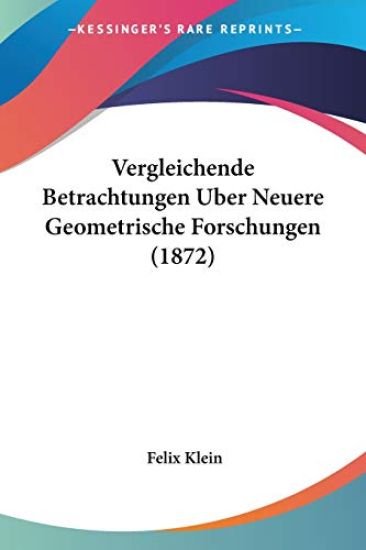
This book presents a historical account of Felix Klein's "Comparative Reflections on Recent Research in Geometry" (1872), better known as his "Erlangen Program.” Originally conceived and written when Klein was collaborating with Sophus Lie, this bold essay initially made little impression on contemporary researchers. Decades later, however, it eventually became a famous classic. Eminent mathematicians hailed Klein’s main message – the role of invariants of transformation groups in geometry – as presaging major developments in mathematics and physics. The first part of this book focuses on the prehistory surrounding Klein’s “Erlangen Program,” stressing the motivations that led Klein to write it. The core of the book (Part II) then presents a new translation of Klein's original text, followed by detailed textual analysis aimed at guiding the reader through its rather terse and opaque prose. Part III deals with its complicated reception history, treated in four periods spanning the years from 1872 to 1930. This culminated during Klein’s lifetime with his efforts to promote the "Erlangen Program” as a framework for interpreting Einstein’s theory of relativity. After his death in 1925, the viability of this framework became a contentious issue among leading differential geometers. Part IV looks back on the transformations in mathematics that led to a modernized interpretation of Klein’s message. The book also explores in depth how the growing fame of the “Erlangen Program” undermined Klein’s friendship with Sophus Lie, leading to a dramatic public break between them in 1893. Beyond the "Erlangen Program” itself, this book deals with many of Felix Klein’s other works. As an introduction to a largely forgotten world of ideas, this study will appeal not only to experts but also to graduate students and all those with a serious interest in the history of modern mathematics.
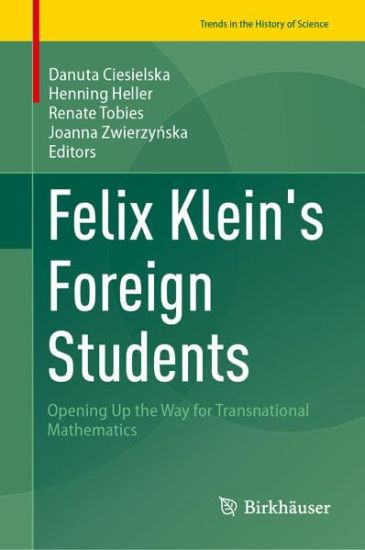
Felix Klein's Foreign Students
This volume explores the profound impact of Felix Klein on the evolution of mathematics beyond Germany, particularly in number theory, algebra, geometry, analysis, and the application of mathematics in scientific and technical fields, as well as mathematics education. The various essays in it highlight the often-overlooked contributions of mathematicians from diverse backgrounds, including Czech, Greek, Hungarian, Japanese, Polish, Russian, and Ukrainian scholars who studied under Klein. By examining the protocols of Klein's seminars from 1872 to 1912, this book uncovers how his teachings shaped their careers. Additionally, it explores Klein's collaborative efforts with David Hilbert and their influence on international mathematical communication. This volume is essential reading for historians of mathematics and researchers interested in the development of science and mathematics at the turn of the 20th century.
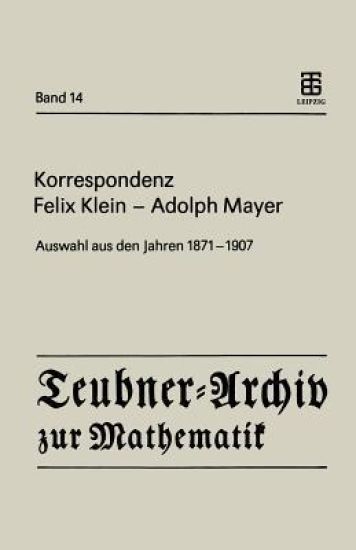
Korrespondenz Felix Klein — Adolph Mayer

Korrespondenz Felix Klein — Adolph Mayer

Felix Klein; Adolf Mayer

Springer Verlag GmbH
1991
nidottu
Briefe zwischen Gelehrten sind eine aufschlußreiche Quelle, um Hintergründe, Zusammenhänge und Motive wissenschaftlicher Arbeit aufzudecken. Der vorliegende Band enthält eine Auswahl aus der Korrespondenz zwischen den Mathematikern Felix Klein und Adolph Mayer. Wichtigster Gegenstand ihres gemeinsamen Interesses war die Herausgabe der "Mathematischen Annalen", die sich unter ihrer Leitung seit 1875 zu einer der bedeutendsten Fachzeitschriften entwickelten. Die Korrespondenz ermöglicht einen Einblick in wesentliche Bereiche der mathematischen Forschung jener Zeit. Diese Briefe, die hier zum ersten Male gedruckt vorliegen, werden durch eine ausführliche Einleitung sowie durch Fotos und zahlreiche Anmerkungen ergänzt.
Felix Klein und Georg Pick

Felix Klein und Georg Pick

Springer Fachmedien Wiesbaden
2023
sidottu
Das Buch enthält die Vorträge, die der aus jüdischem Elternhaus in Wien stammende Mathematiker Georg Pick in Felix Kleins Forschungsseminaren in Leipzig (1883/84 und 1884 ) hielt, sowie die Briefe und Karten, die Pick von 1884 bis 1898 an Klein schrieb. Diese Dokumente werden kommentiert und mit einer ausführlichen Einleitung versehen. Es wird erhellt, wie Klein mathematische Talente erkannte, forderte und förderte. Die Quellen beleuchten den von Klein ausgeübten kooperativen Stil mathematischen Arbeitens, der sich damals gerade erst herausbildete und an manchen Orten noch verpönt war. Die Vorträge und Briefe dokumentieren Georg Picks kreative mathematische Ideen, bieten neue Einsichten zur frühen Geschichte der elliptischen Modulfunktionen und verwandter Gebiete. Außerdem wird deutlich, mit welchem Engagement Klein die Karriere Georg Picks förderte - in einer Zeit des weit verbreiteten Antisemitismus. Das Buch ist nützlich für Lehrende und Forschende in Mathematik, Mathematikunterricht und Wissenschaftsgeschichte.
Felix Klein (1849–1925)

Felix Klein (1849–1925)

Renate Tobies

Springer Fachmedien Wiesbaden
2025
sidottu
Der Abituraufsatz zum Thema Des Lebens Mühe lehrt allein des Lebens Güter schätzen (Goethe) inspirierte den 16-jährigen Felix Klein zu der Aussage: „…ist ein Leben köstlich gewesen, so ist es Mühe und Arbeit gewesen“. Das wurde zum Lebensmotto. Die Biografie erhellt, wie Klein auf der Basis anerkannter mathematischer Ergebnisse zu einem Anziehungspunkt von Talenten aus aller Welt wurde, die er – unabhängig von Nationalität, Religion und Geschlecht – zu eigener Kreativität lenkte. Wir erfahren, dass seine Arbeiten nicht nur den Franzosen Charles Hermite und Albert Einstein zu begeisterten Ausrufen veranlassten. Es wird gezeigt, wie Klein den akademischen Lehrbetrieb reformierte; wie er agierte, sodass schon zu seinen Lebzeiten von Kleinscher Unterrichtsreform gesprochen wurde und welche neuen Ideen er in Göttingen umsetzte, sodass David Hilbert einen Tag nach Kleins Ableben am 23. Juni 1925 ausrufen konnte: „Alles, was Sie hier in Göttingen sehen, ist das Werk seiner Persönlichkeit […]. Das Geheimnis des Erfolges lag in seiner unbestechlichen Sachlichkeit. Grosse Ziele, nie kleinste persönliche Nebenzwecke […]“. Diese zweite Auflage der Biografie des Mathematikers, Unterrichtsreformers und Wissenschaftsorganisators präsentiert zahlreiche Aspekte neu und zum Teil neu angeordnet, sodass Kleins Handeln als Weltbürger noch stärker sichtbar wird.
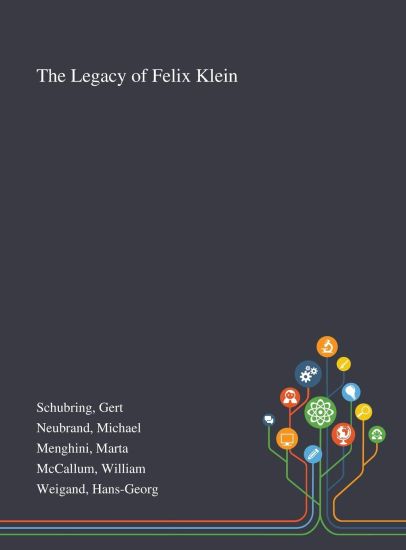
The Legacy of Felix Klein

The Legacy of Felix Klein

Gert Schubring; Michael Neubrand; Marta Menghini

Saint Philip Street Press
2020
pokkari
This open access book provides an overview of Felix Klein's ideas, highlighting developments in university teaching and school mathematics related to Klein's thoughts, stemming from the last century. It discusses the meaning, importance and the legacy of Klein's ideas today and in the future, within an international, global context. Presenting extended versions of the talks at the Thematic Afternoon at ICME-13, the book shows that many of Klein's ideas can be reinterpreted in the context of the current situation, and offers tips and advice for dealing with current problems in teacher education and teaching mathematics in secondary schools. It proves that old ideas are timeless, but that it takes competent, committed and assertive individuals to bring these ideas to life. Throughout his professional life, Felix Klein emphasised the importance of reflecting upon mathematics teaching and learning from both a mathematical and a psychological or educational point of view. He also strongly promoted the modernisation of mathematics in the classroom, and developed ideas on university lectures for student teachers, which he later consolidated at the beginning of the last century in the three books on elementary mathematics from a higher standpoint. This work was published by Saint Philip Street Press pursuant to a Creative Commons license permitting commercial use. All rights not granted by the work's license are retained by the author or authors.
The Legacy of Felix Klein

The Legacy of Felix Klein

Gert Schubring; Michael Neubrand; Marta Menghini

Saint Philip Street Press
2020
sidottu
This open access book provides an overview of Felix Klein's ideas, highlighting developments in university teaching and school mathematics related to Klein's thoughts, stemming from the last century. It discusses the meaning, importance and the legacy of Klein's ideas today and in the future, within an international, global context. Presenting extended versions of the talks at the Thematic Afternoon at ICME-13, the book shows that many of Klein's ideas can be reinterpreted in the context of the current situation, and offers tips and advice for dealing with current problems in teacher education and teaching mathematics in secondary schools. It proves that old ideas are timeless, but that it takes competent, committed and assertive individuals to bring these ideas to life. Throughout his professional life, Felix Klein emphasised the importance of reflecting upon mathematics teaching and learning from both a mathematical and a psychological or educational point of view. He also strongly promoted the modernisation of mathematics in the classroom, and developed ideas on university lectures for student teachers, which he later consolidated at the beginning of the last century in the three books on elementary mathematics from a higher standpoint. This work was published by Saint Philip Street Press pursuant to a Creative Commons license permitting commercial use. All rights not granted by the work's license are retained by the author or authors.
The Legacy of Felix Klein

The Legacy of Felix Klein

Springer International Publishing AG
2018
sidottu
This open access book provides an overview of Felix Klein’s ideas, highlighting developments in university teaching and school mathematics related to Klein’s thoughts, stemming from the last century. It discusses the meaning, importance and the legacy of Klein’s ideas today and in the future, within an international, global context. Presenting extended versions of the talks at the Thematic Afternoon at ICME-13, the book shows that many of Klein’s ideas can be reinterpreted in the context of the current situation, and offers tips and advice for dealing with current problems in teacher education and teaching mathematics in secondary schools. It proves that old ideas are timeless, but that it takes competent, committed and assertive individuals to bring these ideas to life. Throughout his professional life, Felix Klein emphasised the importance of reflecting upon mathematics teaching and learning from both a mathematical and a psychological or educational point ofview. He also strongly promoted the modernisation of mathematics in the classroom, and developed ideas on university lectures for student teachers, which he later consolidated at the beginning of the last century in the three books on elementary mathematics from a higher standpoint.