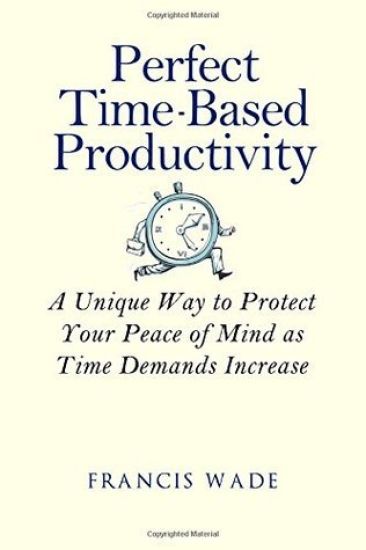
More demands on your time - that's just a fact of modern life. You may be doing the job of more than one person and facing an onslaught of information, only to realize that ubiquitous, 24-7 technology has only made things worse. How do you stay ahead of the expectation that you should be able to meet all your obligations, old and new? In the face of these increasing pressures, what do you need to do to maintain your peace of mind? This book is primarily written for productive professionals who have already found a way to achieve positive results. They aren't clueless - time is an important concern and they have been able to manage their affairs well enough to get through school, hold a job, keep a family and enjoy life's benefits. However, if you belong to this group, you may share a concern: how can you be successful in the future, given the hot pace of change you see around you every day? Doing more of the same seems an unlikely answer. So does the conventional wisdom around "time management" and the popular tactic of following one-size-fits-all solutions. While the book has lots of specific, practical suggestions for new behaviors, at its heart is a four step approach that preserves and builds on the advances that you, as a professional, have already made in your career: Step 1> Evaluate your current skills against best-in-class standards, discovering strengths and improvement opportunities. Step 2> Set realistic targets for new behaviors that meet your unique, evolving needs. Step 3> Create a personalized plan from these new targets that allow you enough time to succeed, by taking small steps. Step 4> Craft your own habit change support environment. By the end of the book you will have completed these steps many times, giving you an easy way to improve any skill that's important to your peace of mind. To complete these steps effectively, Perfect Time-Based Productivity takes you through a broad range of new ideas based on recent research and case studies in fields such as psychology, business process management, adult learning, brain science and industrial engineering. Part One - You discover the concepts needed to shift from attempting to manage or control time (which is impossible) to managing time demands - the "individual, internal commitments made to complete actions in the future." Once these ideas are understood, you discover that every person manipulates time demands in similar ways, subject to the limits of human capacity. However, your implementation is unique because in this area of life, humans are almost completely self-taught. Part Two - Using a number of forms provided in the book (and available for download) you perform an evaluation of 7 essential skills: Capturing, Emptying, Tossing, Acting Now, Storing, Listing and Scheduling. Each self-evaluation is the precursor to creating a mini-improvement plan which goes into a Master Plan, made up of small steps, that outlines your improvement journey. It's one that will change your habits, practices and rituals at a pace that preserves your peace of mind. Part Three - You'll learn about other advanced skills and perspectives needed to be effective in today's world. For example, Flowing - your capacity to be in the flow state defined by Mihaly Csikszentmihalyi - is an important skill to master given the pressure to multi-task and become distracted. Also, you'll learn why corporations are struggling with time-based productivity: they don't push for the right tools for their employees and have allowed individual effectiveness to become a matter of chance, versus policy. The book closes with additional resources for already-productive professionals such as Type A business-people, fans of productivity improvement, project managers and time advisers. Everyone who picks up this book will learn a new definition of "perfection": To improve is to change; to be perfect is to change often. Winston Churchill.
In 2017, Myanmar’s military launched a campaign of violence against the Rohingya minority that UN experts later said amounted to a genocide. More than seven hundred thousand civilians fled to Bangladesh in what became the most concentrated flight of refugees since the Rwanda genocide of 1994. The warning signs of impending catastrophe that had built over years were downplayed by Western backers of the political transition, and only when the exodus began did the world finally come to acknowledge a catastrophe that had been long in the making.In this updated edition of the book that foreshadowed a genocide, Francis Wade explores how the manipulation of identities by an anxious ruling elite laid the foundations for mass violence. It asks: who gets to define a nation? How can democratic rights be weaponised against a minority? And why, at a time when the majority of citizens in Myanmar had begun to experience freedoms unseen for half a century, did much-lauded civilian leaders like Aung San Suu Kyi become complicit in the most heinous of crimes?
More demands on your time - that's just a fact of modern life. At some point in the past you were confident of staying on top of all your commitments. All you had to do was keep working hard. Now, by choice or circumstance, you are doing the job of more than one person. Each day you face more information than your grandparents saw in a month. Working hard is a requirement - but you must also manage email, social networks and content platforms for work and entertainment. Plus, you have to decide what to manage everything with...Which combination of a smartphone, tablet and computer should you employ? Are you using the right set of apps, software and programs on these devices? Will today's choices stand the test of time? In the meantime, the standard expectation is that you will stay on top of all the demands on your time from every source: job, profession, family, personal life, community. How do you save your peace of mind from the onslaught? If any of this fits, this book is for you - an ambitious, creative person who routinely generates more stuff to do than time available. You aren't average - traditional time management has been a concern of yours for a long time and you have already put some things in place which work well for you. However, there are signs that your current system may need an upgrade. Maybe it's a few tasks you forgot, some late arrivals to meetings, a recent missed deadline or a general growing feeling of being overwhelmed. You wonder what you could do differently. In Perfect Time Based Productivity you will learn from the author and hundreds of researchers that the vast majority of things you are already doing are correct. The issues you are facing actually come from the 5-10% of habits, practices and apps which need to be upgraded. The question is, how do you uncover them? Most people waste a lot of time wandering around the Internet in search of these improvement opportunities. This book teaches you that the answer lies within, beginning with an expert self-diagnosis following the ETaPS formula. 1 - *E*valuate your current skills using the most recent academic research condensed into easy-to-use forms. Draw a comparison between your performance and that of the world's best-in-class professionals. 2 - *Ta*rget a new end-state by creating a specific vision of the changes you want to make by certain dates. 3 - *P*lan these changes in small baby steps over months and years. 4 - *S*upport your plan so that new behaviors turn into habits. Before the last page, you redo these steps many times, giving you an easy way to improve time-based productivity skills you already possess. To complete the cycle effectively, Perfect Time-Based Productivity takes you through a broad range of new ideas based on recent research and case studies in fields such as psychology, business process management, adult learning, brain science and industrial engineering. Part One - You discover the concepts needed to shift from attempting to manage or control time (which is impossible) to managing *time demands* - the "individual, internal commitments made to complete actions in the future." Part Two - Using a number of forms provided you perform an evaluation of 7 essential skills: Capturing, Emptying, Tossing, Acting Now, Storing, Listing and Scheduling. Each self-evaluation is the precursor to creating a mini-improvement plan which goes into a single Master Plan, made up of small steps, that outlines your journey. Part Three - Learn about other advanced skills and perspectives needed to be effective in today's world: Switching, Interrupting, Reviewing, Warning, Flowing and Habiting. Also, discover how corporations have allowed individual effectiveness to devolve into a matter of chance, versus policy. Winston Churchill said: "To improve is to change; to be perfect is to change often." It's the key to rescuing your peace of mind in today's evolving world.
Christian theology has lacked a tradition resembling Jewish midrash (""inquiring"" or ""expounding"") to explore beyond the literal texts of Scripture. Francis H. Wade fills that gap with Biblical Fracking: Midrash for the Modern Christian. As he writes in the introduction, ""Biblical fracking, in the spirit of its historical roots and its geological namesake, means reaching into the cracks and crevasses of the biblical narrative to extract the richness that lurks there."" All forms of fracking have potential for benefit as well as abuse. Wade leads us on the narrow path to where we can hear God's word in fresh ways. For example, he asks readers to consider how Sarah felt when Abraham left to sacrifice their only son, Isaac. What was it like to have the quixotic Peter as a husband, or to have a brother like Jesus? Was Judas Iscariot simply the venal betrayer, as commonly caricatured, or was he a devoted disciple who tried to force Jesus' hand? In these and other expositions, Wade reveals Scripture's celebrated and obscure figures with empathy, designed to enrich our understanding of the Bible's saints and sinners, people much like ourselves. ""Frank Wade has spent a lifetime with the foundational stories of Scripture, which makes him an agile guide to the cracks that open up at these deep layers of the Bible. Whether fracking strikes you as a good thing or a bad thing, here is a book that will open your mind."" --Barbara Brown Taylor, author of Holy Envy: Finding God in the Faith of Others ""Frank Wade provides fresh insight into biblical stories we have long read without giving them second thought. His interpretations are both original and sound. . . . Reflecting on Biblical Fracking will deepen our understanding and strengthen our faith."" --John C. Danforth, former United States Senator from Missouri ""This book is an invitation for an adventure in experiencing the Scriptures through a different lens--fresh, imaginative, and new."" --Samuel T. Lloyd, former Dean of the Washington National Cathedral ""For the readers of Biblical Fracking, the familiar people, words, and situations of the Bible take on new depth and meaning as the author probes familiar situations with respect, insight, and humor. Get acquainted with the Bible as newly alive."" --Bonnie Anderson, Episcopal Divinity School at Union Theological Seminary ""Frank Wade has written a little gem of a book that does wonderful things. With imaginative questions, a sparkling writing style, and much good humor, he offers an array of revelatory encounters with biblical characters both great and small--from Abraham to Zipporah."" --James P Wind, retired president of the Alban Institute, and author of Places of Worship Francis H. Wade is a graduate of The Citadel and Virginia Theological Seminary. He served congregations in his native West Virginia for seventeen years before twenty-two years at St. Alban's Parish on the grounds of the Washington National Cathedral. He has taught at two seminaries and twice served as chaplain to the General Convention of the Episcopal Church. Previous books include The Art of Being Together and Transforming Scripture, as well as several sermon anthologies.