

Kirjahaku
Etsi kirjoja tekijän nimen, kirjan nimen tai ISBN:n perusteella.
1000 tulosta hakusanalla Francois Chicoyneau

A Succinct Account Of The Plague At Marseilles
Francois Chicoyneau
KESSINGER PUBLISHING, LLC
2010
sidottu

Memoire Présenté Au Roy, Conseiller d'État Ordinaire, Premier Médecin de Sa Majesté
François Chicoyneau
Hachette Livre - BNF
2016
pokkari

A Succinct Account of the Plague at Marseilles
François Chicoyneau; Monsieur Soulier; Monsieur Active 1720-1721 Verny
Anson Street Press
2025
pokkari
A Succinct Account of the Plague at Marseilles; Its Symptoms and the Methods and Medicines Used for Curing It
François Chicoyneau Monsieur Soulier
ALPHA EDITION
2024
pokkari
A Succinct Account of the Plague at Marseilles; Its Symptoms and the Methods and Medicines Used for Curing It, stands as a beacon in the world of books, bridging the gap between past and present. Once considered among the old books, this classic work-like so many forgotten and ancient books-has shaped our understanding of culture and history. It's a remarkable example of history books that have influenced generations, and now, through the dedication of Alpha Editions-your trusted book publisher-it's reborn in a fresh, elegant format. We've carefully retyped, redesigned, and improved this book so it's much more than just another title to read. Now you can enjoy clear, easy-to-read pages without any blurry scans or faded text. By choosing this edition, you're investing in more than a book-you're safeguarding a legacy. Your support keeps a remarkable piece of human heritage alive, ensuring its lessons and inspirations continue to resonate well into the future.

Observation Sur La Maladie de M. Manot de Bergerat, Bourgeois Dans Le Diocèse de Conserans
Daniel Louis Vieussens; François Chicoyneau; Jean-Paul Bignon
Hachette Livre - BNF
2021
pokkari
Documents Relatifs À La Maladie de Louis XV À Metz, Août 1744. Observation Anonyme de Ladite Maladie
Claude de Rouvroy de Saint-Simon; Paul Dorveaux; François Chicoyneau
Hachette Livre - BNF
2018
pokkari
Nearing fifty, author Kyle Thomas Smith looks back on the days when he was a struggling young writer and hapless office temp. At the end of yet another workday when all he wanted was to go back to his little apartment, turn into a cockroach, and expire in a puddle of Raid, Kyle instead went out on the town and met a highly accomplished, globetrotting filmmaker named Fran ois. A romance ensued, but Fran ois flew out the next morning, leaving Kyle with nothing but a napkin on which he'd written his address in Paris.Kyle wondered if this napkin could hold the key to his future, and what would his life be worth if he were to lose the napkin?In this slice-of-life memoir, Kyle Thomas Smith meditates on how tightly we cling to our prospects when the real gold is buried deep inside the life we already have.

Journal de François, Bourgeois de Paris: 23 Décembre 1588-30 Avril 1589
François
Hachette Livre - BNF
2013
pokkari
Journal de Francois, bourgeois de Paris: 23 decembre 1588-30 avril 1589 / par Eugene SaulnierDate de l'edition originale: 1913Sujet de l'ouvrage: Paris (France) -- Histoire"Collection: Bibliotheque d'histoire de Paris; 4"Ce livre est la reproduction fidele d'une oeuvre publiee avant 1920 et fait partie d'une collection de livres reimprimes a la demande editee par Hachette Livre, dans le cadre d'un partenariat avec la Bibliotheque nationale de France, offrant l'opportunite d'acceder a des ouvrages anciens et souvent rares issus des fonds patrimoniaux de la BnF.Les oeuvres faisant partie de cette collection ont ete numerisees par la BnF et sont presentes sur Gallica, sa bibliotheque numerique.En entreprenant de redonner vie a ces ouvrages au travers d'une collection de livres reimprimes a la demande, nous leur donnons la possibilite de rencontrer un public elargi et participons a la transmission de connaissances et de savoirs parfois difficilement accessibles.Nous avons cherche a concilier la reproduction fidele d'un livre ancien a partir de sa version numerisee avec le souci d'un confort de lecture optimal. Nous esperons que les ouvrages de cette nouvelle collection vous apporteront entiere satisfaction.Pour plus d'informations, rendez-vous sur www.hachettebnf.fr
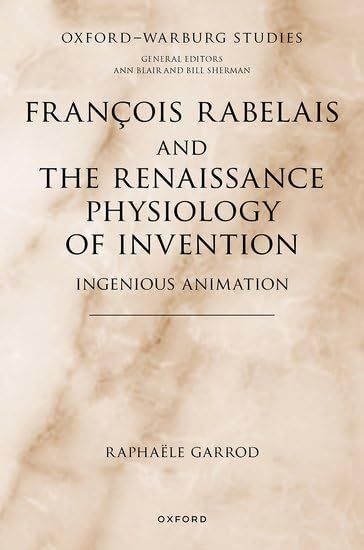
François Rabelais and the Renaissance Physiology of Invention
Raphaële Garrod
Oxford University Press
2025
sidottu
François Rabelais and the Renaissance Physiology of Invention: Ingenious Animation explores the medical poetics of inventive, embodied thinking or ingenuity instantiated in Rabelais' Gargantua and, mostly,in his Quart livre. It unsettles established dichotomies in Rabelaisian scholarship between Rabelais's 'lowly' laughter and his 'high', erudite message and reassesses the Rabelaisian grotesque by highlighting its debts to grotesque ornament, this marginal yet omnipresent Renaissance visual art. Bodily functions are a trademark of Rabelais's poetics. Scholarship has read them as signs of carnivalesque inversion, in line with the Bakhtinian grotesque, or of satirical degradation: in both instances, the 'lowly' is opposed to the 'high', the belly to the head. Yet for a physician like Rabelais, the 'head' or the brain as the site of cognition is not opposed to what is below it: the chest as the site of breathing, the belly and its nether regions as sites of nutrition and generation. In Renaissance medicine, these are integrated physiological systems whose products fuel each other's operations, including cognition. Read through this lens and alongside his diagnosis of the healthy or diseased culture of his time (rotting scholasticism, the humanist digestion of the classical heritage, or the schismatic convulsions shaking Christianity) Rabelais's fictions testify to his reflexive investigation into how culture results from physiological processes fuelling the inventive ability of the human animal, made manifest in pedagogical, artistic, mechanical, and spiritual 'inventions'. They display the life (rather than the truth) of culture stemming from human ingenia, that is, wits conditioned by biological natures. While these might be idiosyncratic, their animation is fuelled and shaped by the food one eats, the air one breathes, the places one inhabits, the company one keeps. In this respect Rabelaisian fiction is grotesque in a period sense. With its emphasis on hybrid forms capturing the metamorphic powers of animation, grotesque ornament reflexively commented on the embodied inventive processes underpinning Renaissance mimesis. Rabelais's fictions display a similar logic: they foreground the inventive powers of ingenious animation and articulate reflexive, often ironic alternatives to the humanist views they alter: a thoroughly embodied anthropology, a naturalist genealogy of cultural production and transmission, a phantastical account of artistic invention as uncanny liveliness.

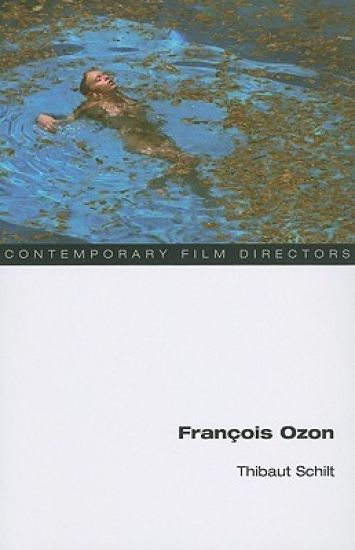
In just over a decade, François Ozon has earned an international reputation as a successful and provocative filmmaker. A student of Eric Rohmer and Jean Douchet at the prestigious Fémis, Ozon made a number of critically acclaimed shorts in the 1990s and released his first feature film Sitcom in 1998. Two additional shorts and eleven feature films have followed, including international successes 8 femmes and Swimming Pool and more recent releases such as Angel, Ricky, and Le refuge. Ozon's originality lies in his filmmaking style, which draws on familiar cinematic traditions (the crime thriller, the musical, the psychological drama, the comedy, the period piece) but simultaneously mixes these recognizable genres and renders them unfamiliar. Despite tremendous diversity in cinematic choices, Ozon's oeuvre is surprisingly consistent in its desire to blur the traditional frontiers between the masculine and the feminine, gay and straight, reality and fantasy, auteur and commercial cinema. Thibaut Schilt provides an overview of François Ozon's career to date, highlighting the director's unrestrained, voracious cinephilia, his recurrent collaborations with women screenwriters and actresses, and the trademarks of his cinema including music, dance, and the clothes that accompany these now typically Ozonian episodes. Schilt contextualizes Ozon's filmmaking within the larger fields of French filmmaking and international queer cinema, and he discusses several major themes running through Ozon's work, including obsessions with inadequate fathers, various types of mourning, and a recurring taste for "the foreign." The volume also includes an insightful interview with the director.
In just over a decade, François Ozon has earned an international reputation as a successful and provocative filmmaker. A student of Eric Rohmer and Jean Douchet at the prestigious Fémis, Ozon made a number of critically acclaimed shorts in the 1990s and released his first feature film Sitcom in 1998. Two additional shorts and eleven feature films have followed, including international successes 8 femmes and Swimming Pool and more recent releases such as Angel, Ricky, and Le refuge. Ozon's originality lies in his filmmaking style, which draws on familiar cinematic traditions (the crime thriller, the musical, the psychological drama, the comedy, the period piece) but simultaneously mixes these recognizable genres and renders them unfamiliar. Despite tremendous diversity in cinematic choices, Ozon's oeuvre is surprisingly consistent in its desire to blur the traditional frontiers between the masculine and the feminine, gay and straight, reality and fantasy, auteur and commercial cinema. Thibaut Schilt provides an overview of François Ozon's career to date, highlighting the director's unrestrained, voracious cinephilia, his recurrent collaborations with women screenwriters and actresses, and the trademarks of his cinema including music, dance, and the clothes that accompany these now typically Ozonian episodes. Schilt contextualizes Ozon's filmmaking within the larger fields of French filmmaking and international queer cinema, and he discusses several major themes running through Ozon's work, including obsessions with inadequate fathers, various types of mourning, and a recurring taste for "the foreign." The volume also includes an insightful interview with the director.
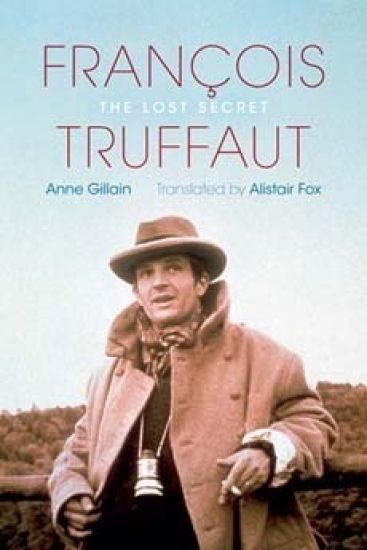
For François Truffaut, the lost secret of cinematic art is in the ability to generate emotion and reveal repressed fantasies through cinematic representation. Available in English for the first time, Anne Gillain's François Truffaut: The Lost Secret is considered by many to be the best book on the interpretation of Truffaut's films. Taking a psycho-biographical approach, Gillain shows how Truffaut's creative impulse was anchored in his personal experience of a traumatic childhood that left him lonely and emotionally deprived. In a series of brilliant, nuanced readings of each of his films, she demonstrates how involuntary memories arising from Truffaut's childhood not only furnish a succession of motifs that are repeated from film to film, but also govern every aspect of his mise en scène and cinematic technique.
For François Truffaut, the lost secret of cinematic art is in the ability to generate emotion and reveal repressed fantasies through cinematic representation. Available in English for the first time, Anne Gillain's François Truffaut: The Lost Secret is considered by many to be the best book on the interpretation of Truffaut's films. Taking a psycho-biographical approach, Gillain shows how Truffaut's creative impulse was anchored in his personal experience of a traumatic childhood that left him lonely and emotionally deprived. In a series of brilliant, nuanced readings of each of his films, she demonstrates how involuntary memories arising from Truffaut's childhood not only furnish a succession of motifs that are repeated from film to film, but also govern every aspect of his mise en scène and cinematic technique.

Les aventures de Télémaque, fils d'Ulysse; par Messire François de Salignac de la Motte Fénelon. Nouvelle édition, .. revu et corrigé .. par N. Wanostrocht, ...
François de Salignac de la Mo Fénelon
Wentworth Press
2018
pokkari
![Traité de la loi des fiefs. Qui a toujours été suivie en Canada ... Par François Joseph Cugnet, Ecuier, Seigneur de St. Etienne, &c. &c. [One line of Latin quotation]](/covers/9780274453061.jpg)
Traité de la loi des fiefs. Qui a toujours été suivie en Canada ... Par François Joseph Cugnet, Ecuier, Seigneur de St. Etienne, &c. &c. [One line of Latin quotation]
François Joseph Cugnet
Wentworth Press
2018
pokkari

This book traces the prepresidential career of the Socialist French president, covering his early years, his participation in the Vichy government, the Resistance and the governments of the Fourth Republic, and his 23 year march to the pinnacle of national power as leader of the French opposition during the first decades of the Fifth Republic. It is the story of a politician who built a solid majority starting from scratch in adopted political territory, a chaotic world of utopists, anarchists, purists, ideologues, and disciplined militants—in short, the French left. Baumann-Reynolds discusses the whats—Mitterrand's socialism, his republicanism, his Machiavellianism—and the hows—how he reacted to unpredictable events, how he took over the Socialist Party, and how he recuperated the communist vote. This is the first English-language biography by an American sensitive to the gaps in U.S. readers' knowledge of French politics.