Kirjojen hintavertailu. Mukana 11 342 296 kirjaa ja 12 kauppaa.

Kirjahaku

Etsi kirjoja tekijän nimen, kirjan nimen tai ISBN:n perusteella.

1000 tulosta hakusanalla Frederic R. Kellogg

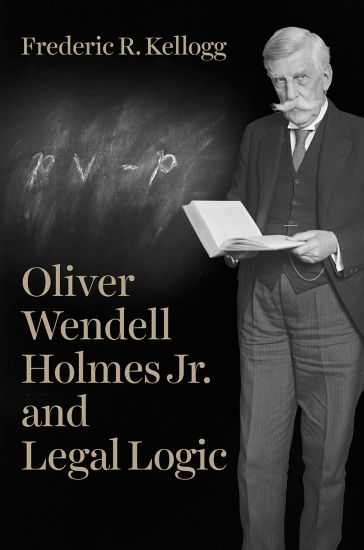
Oliver Wendell Holmes Jr. and Legal Logic

Oliver Wendell Holmes Jr. and Legal Logic

Frederic R. Kellogg

University of Chicago Press
2018
sidottu
With Oliver Wendell Holmes, Jr. and Legal Logic, Frederic R. Kellogg examines the early diaries, reading, and writings of Justice Oliver Wendell Holmes, Jr. (1841-1935) to assess his contribution to both legal logic and general logical theory. Through discussions with his mentor Chauncey Wright and others, Holmes derived his theory from Francis Bacon's empiricism, influenced by recent English debates over logic and scientific method, and Holmes's critical response to John Stuart Mill's 1843 A System of Logic. Conventional legal logic tends to focus on the role of judges in deciding cases. Holmes recognized input from outside the law--the importance of the social dimension of legal and logical induction: how opposing views of "many minds" may converge. Drawing on analogies from the natural sciences, Holmes came to understand law as an extended process of inquiry into recurring problems. Rather than vagueness or contradiction in the meaning or application of rules, Holmes focused on the relation of novel or unanticipated facts to an underlying and emergent social problem. Where the meaning and extension of legal terms are disputed by opposing views and practices, it is not strictly a legal uncertainty, and it is a mistake to expect that judges alone can immediately resolve the larger issue.
Oliver Wendell Holmes, Jr., Legal Theory, and Judicial Restraint

Oliver Wendell Holmes, Jr., Legal Theory, and Judicial Restraint

Frederic R. Kellogg

Cambridge University Press
2006
sidottu
Oliver Wendell Holmes, Jr, is considered by many to be the most influential American jurist. The voluminous literature devoted to his writings and legal thought, however, is diverse and inconsistent. In this study, Frederic R. Kellogg follows Holmes's intellectual path from his early writings through his judicial career. He offers a fresh perspective that addresses the views of Holmes's leading critics and explains his relevance to the controversy over judicial activism and restraint. Holmes is shown to be an original legal theorist who reconceived common law as a theory of social inquiry and who applied his insights to constitutional law. From his empirical and naturalist perspective on law, with its roots in American pragmatism, emerged Holmes's distinctive judicial and constitutional restraint. Kellogg distinguishes Holmes from analytical legal positivism and contrasts him with a range of thinkers.
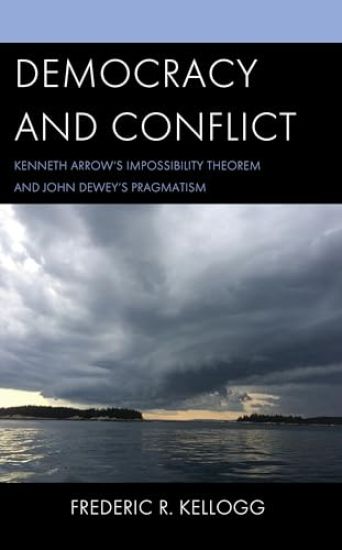
Democracy and Conflict

Democracy and Conflict

Frederic R. Kellogg

BLOOMSBURY PUBLISHING PLC
2023
sidottu
The economist Kenneth Arrow proved in 1951 that a society of diverse individual preferences could only by ordered by dictatorship. His impossibility theorem is still an axiom of contemporary welfare economics and has never been seriously challenged. The American philosopher John Dewey, who died in 1952, had claimed that voting and electoral mechanisms do not define democratic self-government. His broad conception of social conflict addresses preference diversity and resolves Arrow’s impossibility. Since the 1980s, political scientists have focused on decision through democratic “deliberation.” Dewey saw that conversation alone is inadequate for resolution of conflicts in a democracy. Conflict is accompanied by discourse, but preferences are grounded in habits. Social habits resist adjustment in response to discourse alone, but demonstrably adjust in the process of conflict resolution, Preference conflict is distinguished from Marxist and later models, as a discovery and transformation process. It advances an original, updated theory of social conflict in a democracy relevant to today's problematic situations from discrimination to climate change and political polarization.
Oliver Wendell Holmes, Jr., Legal Theory, and Judicial Restraint

Oliver Wendell Holmes, Jr., Legal Theory, and Judicial Restraint

Kellogg Frederic R.

Cambridge University Press
2011
pokkari
Oliver Wendell Holmes, Jr, is considered by many to be the most influential American jurist. The voluminous literature devoted to his writings and legal thought, however, is diverse and inconsistent. In this study, Frederic R. Kellogg follows Holmes's intellectual path from his early writings through his judicial career. He offers a fresh perspective that addresses the views of Holmes's leading critics and explains his relevance to the controversy over judicial activism and restraint. Holmes is shown to be an original legal theorist who reconceived common law as a theory of social inquiry and who applied his insights to constitutional law. From his empirical and naturalist perspective on law, with its roots in American pragmatism, emerged Holmes's distinctive judicial and constitutional restraint. Kellogg distinguishes Holmes from analytical legal positivism and contrasts him with a range of thinkers.
Nine O'Clock Talks

Nine O'Clock Talks

Frederic B Kellogg

ALPHA EDITION
2023
pokkari
Nine O'Clock Talks, has been regarded as significant work throughout human history, and in order to ensure that this work is never lost, we have taken steps to ensure its preservation by republishing this book in a contemporary format for both current and future generations. This entire book has been retyped, redesigned, and reformatted. Since these books are not made from scanned copies, the text is readable and clear.
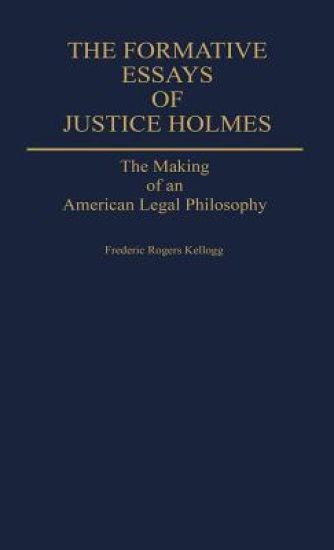
The Formative Essays of Justice Holmes

The Formative Essays of Justice Holmes

Frederic Kellogg

Praeger Publishers Inc
1984
sidottu
Although The Common Law, the seminal work by Oliver Wendell Holmes, Jr., clearly represents the culmination of an intellectual journey, the development of Holmes' thought has not been easily deciphered. Frederic Rogers Kellogg traces Holmes' intellectual path, and asks: why did Holmes write The Common Law? what did he mean by his message that the law has evolved away from moral and toward external standards of liability? how did he arrive at this conclusion? The answers, Dr. Kellogg maintains, are to be found in a series of nine essays that originally appeared in The American Law Review. They show that Holmes was obsessed with elemental questions of pure legal theory and link him closely to the philosophic method of his friend Charles Sanders Peirce. Taken together with Holmes' later work, and viewed in light of American philosophy, these essays establish Holmes as the founder of a distinct approach to jurisprudence and reveal the implications of that approach for Holmes' later contributions to constitutional law.
Pragmatism, Logic, and Law

Pragmatism, Logic, and Law

Frederic Kellogg

Rowman Littlefield
2020
sidottu
Pragmatism, Logic and Law offers a view of legal pragmatism consistent with pragmatism writ large, tracing it from origins in late 19th century America to the present, covering various issues, legal cases, personalities, and relevant intellectual movements within and outside law. It addresses pragmatism’s relation to legal liberalism, legal positivism, natural law, critical legal studies (CLS), and post-Rorty “neopragmatism.” It views legal pragmatism as an exemplar of pragmatism’s general contribution to logical theory, which bears two connections to the western philosophical tradition: first, it extends Francis Bacon’s empiricism into contemporary aspects of scientific and legal experience, and second, it is an explicitly social reconstruction of logical induction. Both notions were articulated by John Dewey, and both emphasize the social or corporate element of human inquiry. Empiricism is informed by social as well as individual experience (which includes the problems of conflict and consensus). Rather than following the Aristotelian model of induction as immediate inference from particulars to generals, a model that assumes a consensual objective viewpoint, pragmatism explores the actual, and extended, process of corporate inference from particular experience to generalization, in law as in science. This includes the necessary process of resolving disagreement and finding similarity among relevant particulars.
Pragmatism, Logic, and Law

Pragmatism, Logic, and Law

Frederic Kellogg

BLOOMSBURY PUBLISHING PLC
2022
nidottu
Pragmatism, Logic and Law offers a view of legal pragmatism consistent with pragmatism writ large, tracing it from origins in late 19th century America to the present, covering various issues, legal cases, personalities, and relevant intellectual movements within and outside law. It addresses pragmatism’s relation to legal liberalism, legal positivism, natural law, critical legal studies (CLS), and post-Rorty “neopragmatism.” It views legal pragmatism as an exemplar of pragmatism’s general contribution to logical theory, which bears two connections to the western philosophical tradition: first, it extends Francis Bacon’s empiricism into contemporary aspects of scientific and legal experience, and second, it is an explicitly social reconstruction of logical induction. Both notions were articulated by John Dewey, and both emphasize the social or corporate element of human inquiry. Empiricism is informed by social as well as individual experience (which includes the problems of conflict and consensus). Rather than following the Aristotelian model of induction as immediate inference from particulars to generals, a model that assumes a consensual objective viewpoint, pragmatism explores the actual, and extended, process of corporate inference from particular experience to generalization, in law as in science. This includes the necessary process of resolving disagreement and finding similarity among relevant particulars.
Défense de Louis-Napoléon

Défense de Louis-Napoléon

Frédéric R

Hachette Livre - BNF
2013
pokkari
Defense de Louis-Napoleon, par M. Frederic R...Date de l'edition originale: 1848Sujet de l'ouvrage: France (1848-1852, 2e Republique)Ce livre est la reproduction fidele d'une oeuvre publiee avant 1920 et fait partie d'une collection de livres reimprimes a la demande editee par Hachette Livre, dans le cadre d'un partenariat avec la Bibliotheque nationale de France, offrant l'opportunite d'acceder a des ouvrages anciens et souvent rares issus des fonds patrimoniaux de la BnF.Les oeuvres faisant partie de cette collection ont ete numerisees par la BnF et sont presentes sur Gallica, sa bibliotheque numerique.En entreprenant de redonner vie a ces ouvrages au travers d'une collection de livres reimprimes a la demande, nous leur donnons la possibilite de rencontrer un public elargi et participons a la transmission de connaissances et de savoirs parfois difficilement accessibles.Nous avons cherche a concilier la reproduction fidele d'un livre ancien a partir de sa version numerisee avec le souci d'un confort de lecture optimal. Nous esperons que les ouvrages de cette nouvelle collection vous apporteront entiere satisfaction.Pour plus d'informations, rendez-vous sur www.hachettebnf.fr
The Power and Beauty of Electromagnetic Fields

The Power and Beauty of Electromagnetic Fields

Frederic R. Morgenthaler

John Wiley Sons Inc
2011
sidottu
Unique, multi-level textbook is adaptable to introductory, intermediate, and advanced levels This revolutionary textbook takes a unique approach to electromagnetic theory, comparing both conventional and modern theories. It explores both the Maxwell-Poynting representation as well as the Alternate representation, which the author demonstrates is generally simpler and more suitable for analyzing modern electromagnetic environments. Throughout the text, students and researchers have the opportunity to examine both of these theories and discover how each one can be applied to solve problems. The text is divided into four parts: Part I: Basic Electromagnetic Theory includes Maxwell's equations, quasistatics, power and energy, stress and momentum, and electromagnetic wave theorems and principles Part II: Four-Dimensional Electromagnetism includes four-dimensional vectors and tensors and energy-momentum tensors Part III: Electromagnetic Examples includes statics and quasistatics, accelerating charges, plane waves, transmission lines, waveguides, antennas and diffraction, and ferrites Part IV: Backmatter includes a summary, appendices, and references Designed to accommodate a broad range of interests and backgrounds, the text's companion DVD enables readers to reconfigure the material as an introductory-, intermediate-, or advanced-level text. Moreover, the text and its DVD offer a broad range of features that make it possible for readers to quickly grasp new concepts and apply them in practice: Practice problems provide the opportunity to solve real-world problems using electromagnetic theory Forty animations illustrate electric and magnetic field transients Line drawings and computer-generated mathematical figures clarify complex concepts and procedures. Maxima, a powerful symbolic mathematics program, helps readers explore four-dimensional electromagnetic theory as well as perform numerical and graphical analyses Adaptable to multiple levels, this text can be used for both undergraduate and graduate coursework. It is also recommended as a reference for researchers in such fields as electrical engineering, laser physics, materials science, and biomedical engineering.