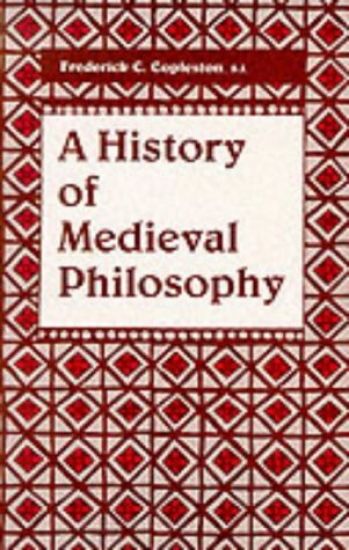
In this classic work, Frederick C. Copleston, S.J., outlines the development of philosophical reflection in Christian, Islamic, and Jewish thought from the ancient world to the late medieval period. A History of Medieval Philosophy is an invaluable general introduction that also includes longer treatments of such leading thinkers as Aquinas, Scotus, and Ockham.
In this classic work, Frederick C. Copleston, S.J., outlines the development of philosophical reflection in Christian, Islamic, and Jewish thought from the ancient world to the late medieval period. A History of Medieval Philosophy is an invaluable general introduction that also includes longer treatments of such leading thinkers as Aquinas, Scotus, and Ockham.
This work has been selected by scholars as being culturally important and is part of the knowledge base of civilization as we know it.This work is in the public domain in the United States of America, and possibly other nations. Within the United States, you may freely copy and distribute this work, as no entity (individual or corporate) has a copyright on the body of the work.Scholars believe, and we concur, that this work is important enough to be preserved, reproduced, and made generally available to the public. To ensure a quality reading experience, this work has been proofread and republished using a format that seamlessly blends the original graphical elements with text in an easy-to-read typeface.We appreciate your support of the preservation process, and thank you for being an important part of keeping this knowledge alive and relevant.
This work has been selected by scholars as being culturally important and is part of the knowledge base of civilization as we know it.This work is in the public domain in the United States of America, and possibly other nations. Within the United States, you may freely copy and distribute this work, as no entity (individual or corporate) has a copyright on the body of the work.Scholars believe, and we concur, that this work is important enough to be preserved, reproduced, and made generally available to the public. To ensure a quality reading experience, this work has been proofread and republished using a format that seamlessly blends the original graphical elements with text in an easy-to-read typeface.We appreciate your support of the preservation process, and thank you for being an important part of keeping this knowledge alive and relevant.
Theories of one ultimate reality exist in philosophies of both the East and the West, and in both traditions such theories are commonly connected with religion. In Religion and the One, Frederick Copleston explores the approach that different philosophies have taken to the question of divine reality, with a special focus on the metaphysics of the One.In the first part of the book, Copleston looks at the features of different traditions, discussing Taoist philosophy, the Vedanta schools of thought in India, the development of philosophy in the Islamic world, and a number of movements from the Western tradition. The second part questions why people form such theories, exploring factors such as the nature of the self and the cognitive value of mysticism.Writing with all his hallmark learning and lucidity, the author also discusses the consequences of the metaphysics of the One for ethical ideals and social activism. Approaching the issues in an open-minded and unprejudiced fashion, he does not pretend to have answers to all the questions he raises. However, unlike many theologians and philosophers, he is not prepared to dismiss metaphysics as being inherently irreligious.
Copleston, an Oxford Jesuit and specialist in the history of philosophy, first created his history as an introduction for Catholic ecclesiastical seminaries. However, since its first publication (the last volume appearing in the mid-1970s) the series has become the classic account for all philosophy scholars and students. The 11-volume series gives an accessible account of each philosopher's work, but also explains their relationship to the work of other philosophers.
Copleston, in the second volume of A History of Philosophy, deals with the reconciliation of philosophy and theology of the early Christian period to the thirteenth century.Frederick Copleston was Professor of the History of Philosophy and Dean of the Faculty of Theology at London University. This eleven-volume work is one of the most remarkable single-handed scholarly enterprises of modern times. Volume 2 covers Anselm of Canterbury, Thomas Aquinas, Augustine of Hippo, Averroes, Avicenna, Boethius, Bonaventure, Maimonides and Duns Scotus.The book covers the Patristic period, including the work of Augustine, and then considers the Carolingian renaissance, Islamic and Jewish philosophy, before finally going into extensive detail on the thought of Aquinas and Scotus.Brimming with detail and enthusiasm, A History of Philosophy gives an accessible account of philosophers from all eras and explains their works in relation to other philosophers. Each volume is an ideal guide for students studying specific eras and as a set offers a complete and unrivalled overview of the entire western philosophical tradition.
Copleston, an Oxford Jesuit and specialist in the history of philosophy, first created his history as an introduction for Catholic ecclesiastical seminaries. However, since its first publication (the last volume appearing in the mid-1970s) the series has become the classic account for all philosophy scholars and students. The 11-volume series gives an accessible account of each philosopher's work, but also explains their relationship to the work of other philosophers.
Copleston, an Oxford Jesuit and specialist in the history of philosophy, first created his history as an introduction for Catholic ecclesiastical seminaries. However, since its first publication (the last volume appearing in the mid-1970s) the series has become the classic account for all philosophy scholars and students. The 11-volume series gives an accessible account of each philosopher's work, but also explains their relationship to the work of other philosophers.
This volume of Copleston’s A History of Philosophy looks at the British philosophers of the seventeenth and eighteenth centuries. In particular, it deals with the political philosophies of Hobbes and Locke that developed in response to the English Civil War, and with Hume’s empiricism.Frederick Copleston was Professor of the History of Philosophy and Dean of the Faculty of Theology at London University. This eleven-volume work is one of the most remarkable single-handed scholarly enterprises of modern times. Volume 5 covers George Berkeley, Joseph Butler, Thomas Hobbes, David Hume and John Locke.Brimming with detail and enthusiasm, A History of Philosophy gives an accessible account of philosophers from all eras and explains their works in relation to other philosophers. Each volume is an ideal guide for students studying specific eras and as a set offers a complete and unrivalled overview of the entire western philosophical tradition.
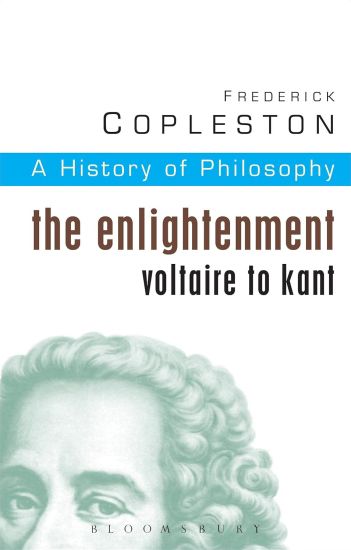
In the sixth volume of his A History of Philosophy, Copleston examines the Enlightenment in France and Germany.Frederick Copleston was Professor of the History of Philosophy and Dean of the Faculty of Theology at London University. This eleven-volume work is one of the most remarkable single-handed scholarly enterprises of modern times. Volume 6 covers Johann Gottfried von Herder, Immanuel Kant, Gotthold Ephraim Lessing, Jean-Jacques Rousseau, Giambattista Vico, Voltaire and Christian Wolff.The influence of the Enlightenment has been long argued over to the point where some have rejected its claims for rational thought. Copleston discusses the work of major figures such as Rousseau, Lessing, Herder and Voltaire. He also looks in fascinating detail at the philosophy of Kant, so vital to an understanding of the development of nineteenth-, twentieth- and twenty-first-century philosophy. This volume is the ideal companion not only to the Enlightenment but also to the contemporary debates it has provoked.Brimming with detail and enthusiasm, A History of Philosophy gives an accessible account of philosophers from all eras and explains their works in relation to other philosophers. Each volume is an ideal guide for students studying specific eras and as a set offers a complete and unrivalled overview of the entire western philosophical tradition.
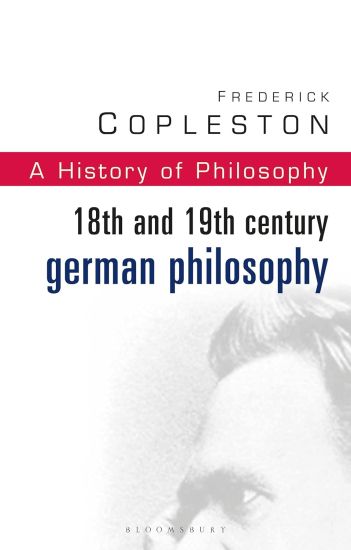
This volume of Copleston’s A History of Philosophy looks at the idealist philosophies, and the reactions against them, that developed mainly in Germany in the nineteenth century.Frederick Copleston was Professor of the History of Philosophy and Dean of the Faculty of Theology at London University. This eleven-volume work is one of the most remarkable single-handed scholarly enterprises of modern times. Volume 7 covers Johann Gottlieb Fichte, Georg Wilhelm Friedrich Hegel, Søren Aabye Kierkegaard, Karl Marx, Friedrich Nietzsche, Friedrich Wilhelm, Joseph von Schelling, Friedrich Schleiermacher and Arthur Schopenhauer.Copleston guides the reader through the work of the Post-Kantian idealists such as Schelling and Hegel, moving on to their various opponents such as Schopenhauer, Marx and Kierkegaard. He also discusses the Neo-Kantians and the influential work of Nietzsche.Brimming with detail and enthusiasm, A History of Philosophy gives an accessible account of philosophers from all eras and explains their works in relation to other philosophers. Each volume is an ideal guide for students studying specific eras and as a set offers a complete and unrivalled overview of the entire western philosophical tradition.
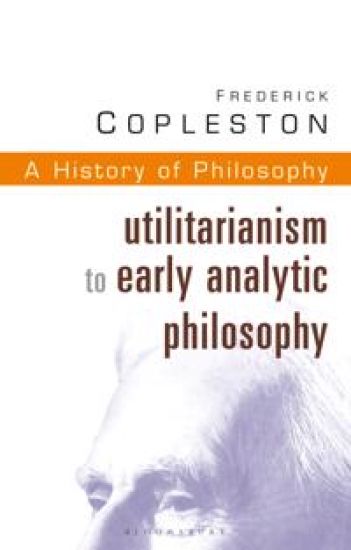
The eighth volume of Copleston’s A History of Philosophy opens with an examination of the turn to empiricism in nineteenth-century Britain, analysing the important work of utilitarian thinkers such as Bentham and Mill.Frederick Copleston was Professor of the History of Philosophy and Dean of the Faculty of Theology at London University. This eleven-volume work is one of the most remarkable single-handed scholarly enterprises of modern times. Volume 8 covers Jeremy Bentham, Francis Herbert Bradley, John Dewey, William James, John Stuart Mill, George Edward Moore, Charles Sanders Peirce, Josiah Royce, Bertrand Arthur William Russell and Herbert Spencer.This volume details the development of idealism in both Britain and America as well as the revolt against it represented by the work of Moore and Russell in the twentieth century. There is also an invaluable section on Peirce’s and Dewey’s pragmatism.Brimming with detail and enthusiasm, A History of Philosophy gives an accessible account of philosophers from all eras and explains their works in relation to other philosophers. Each volume is an ideal guide for students studying specific eras and as a set offers a complete and unrivalled overview of the entire western philosophical tradition.
Copleston’s ninth volume of his A History of Philosophy masterfully takes in over 150 years of French thought from the French Revolution to the mid-twentieth century.Frederick Copleston was Professor of the History of Philosophy and Dean of the Faculty of Theology at London University. This eleven-volume work is one of the most remarkable single-handed scholarly enterprises of modern times. Volume 9 covers Henri Bergson, Albert Camus, Auguste Comte, Maine de Biran, Claude Lévi-Strauss and Jean-Paul Sartre.This volume includes history from the ideologists, to positivists such as Comte, to the singular work of Bergson, to philosophers of science, religion and politics, to Sartre’s existentialism, and finally to the beginning of the dramatic and controversial changes that developed in French post-war philosophy with phenomenology and structuralism.Brimming with detail and enthusiasm, A History of Philosophy gives an accessible account of philosophers from all eras and explains their works in relation to other philosophers. Each volume is an ideal guide for students studying specific eras and as a set offers a complete and unrivalled overview of the entire western philosophical tradition.
This addition to Copleston’s covers Russian thought from the eighteenth century to Lenin and the post-Stalin period. Frederick Copleston was Professor of the History of Philosophy and Dean of the Faculty of Theology at London University. This eleven-volume work is one of the most remarkable single-handed scholarly enterprises of modern times. Volume 10 covers Mikhail Bakunin, Nikolai Bukharin, Fyodor Dostoevsky, Alexander Herzen, Vladimir Lenin, George Plekhanov and Leo Tolstoy.In the course of tracing the evolution of philosophical thought in Russia from the time of Catherine the Great into the present century, the author devotes careful analysis to radical thinkers, Marxists and the relevant ideas of the great Russian writers. He also includes a discussion on Russian thinkers in exile. Brimming with detail and enthusiasm, A History of Philosophy gives an accessible account of philosophers from all eras and explains their works in relation to other philosophers. Each volume is an ideal guide for students studying specific eras and as a set offers a complete and unrivalled overview of the entire western philosophical tradition.
In this additional volume of A History of Philosophy Copleston provides a detailed and objective introduction to Logical Positivism and Existentialism - two highly controversial areas of recent thought.Frederick Copleston was Professor of the History of Philosophy and Dean of the Faculty of Theology at London University. This eleven-volume work is one of the most remarkable single-handed scholarly enterprises of modern times. Volume 11 covers A.J. Ayer, Albert Camus, Martin Heidegger, Karl Jasper, Søren Kierkegaard, Gabriel Marcel, Jean-Paul Sartre and Ludwig Wittgenstein.Between them, the movements of Logical Positivism and Existentialism dominated philosophy in Europe for much of the last century, and the influence they exerted can still be felt today. This book explores the work of many of the most important thinkers of the twentieth century.Brimming with detail and enthusiasm, A History of Philosophy gives an accessible account of philosophers from all eras and explains their works in relation to other philosophers. Each volume is an ideal guide for students studying specific eras and as a set offers a complete and unrivalled overview of the entire western philosophical tradition.
Copleston, an Oxford Jesuit and specialist in the history of philosophy, first created his history as an introduction for Catholic ecclesiastical seminaries. However, since its first publication (the last volume appearing in the mid-1970s) the series has become the classic account for all philosophy scholars and students. The 11-volume series gives an accessible account of each philosopher's work, but also explains their relationship to the work of other philosophers.