

Kirjahaku
Etsi kirjoja tekijän nimen, kirjan nimen tai ISBN:n perusteella.
1000 tulosta hakusanalla Frederick Davis Greene

The Armenian Crisis in Turkey
Frederick Davis Greene
British Library, Historical Print Editions
2011
pokkari


An Account of Two Voyages to New-England, Made During the Years 1638, 1663 (Edition1)
Frederick Davis Greene
Alpha Editions
2024
nidottu

On 24 August 1867, the remains of eight-year-old Fanny Adams were discovered in a hop field close to her home in Alton, Hampshire. She had been decapitated and horribly mutilated; her limbs and internal organs were scattered over a wide area. It was butchery on a truly colossal scale. Local solicitor's clerk Frederick Baker was quickly apprehended and committed for trial at the winter assizes in Winchester. Few people doubted that he was solely responsible for the murder of little Fanny Adams. Baker was a decidedly odd character, often seen skulking around town exhibiting a range of morbid and eccentric behaviours. His corpse-white complexion and black top hat composed his trademark appearance. This book charts his upbringing, his family life and career, and his depraved emotional and sexual impulses, fully exploring his progression from a weak and sensitive child to a swaggering, intemperate monster. Legal opinion was divided: was Baker mentally deranged, or was he a cunning, cold-blooded and wicked individual fully in command of his faculties? These issues would be examined in the courtroom, and in a sense, medical science itself, with its new ideas about psychological disease, homicidal mania and criminal responsibility, was also on trial. The defence offered a confusing and contradictory double plea of Not Guilty but also Guilty and Insane. The jury rejected both defences, and Baker was hanged outside Winchester prison on Christmas Eve in front of a large crowd. Baker has received remarkably little attention in the extensive literature on Victorian crime. Drawing on Home Office files and making use of a wide selection of local history materials, Trial of Frederick Baker tells for the first time the full story of the murder of Fanny Adams and the trial and conviction of one of Britain's most appalling villains.

On 24 August 1867, the remains of eight-year-old Fanny Adams were discovered in a hop field close to her home in Alton, Hampshire. She had been decapitated and horribly mutilated; her limbs and internal organs were scattered over a wide area. It was butchery on a truly colossal scale. Local solicitor's clerk Frederick Baker was quickly apprehended and committed for trial at the winter assizes in Winchester. Few people doubted that he was solely responsible for the murder of little Fanny Adams. Baker was a decidedly odd character, often seen skulking around town exhibiting a range of morbid and eccentric behaviours. His corpse-white complexion and black top hat composed his trademark appearance. This book charts his upbringing, his family life and career, and his depraved emotional and sexual impulses, fully exploring his progression from a weak and sensitive child to a swaggering, intemperate monster. Legal opinion was divided: was Baker mentally deranged, or was he a cunning, cold-blooded and wicked individual fully in command of his faculties? These issues would be examined in the courtroom, and in a sense, medical science itself, with its new ideas about psychological disease, homicidal mania and criminal responsibility, was also on trial. The defence offered a confusing and contradictory double plea of Not Guilty but also Guilty and Insane. The jury rejected both defences, and Baker was hanged outside Winchester prison on Christmas Eve in front of a large crowd. Baker has received remarkably little attention in the extensive literature on Victorian crime. Drawing on Home Office files and making use of a wide selection of local history materials, Trial of Frederick Baker tells for the first time the full story of the murder of Fanny Adams and the trial and conviction of one of Britain's most appalling villains.
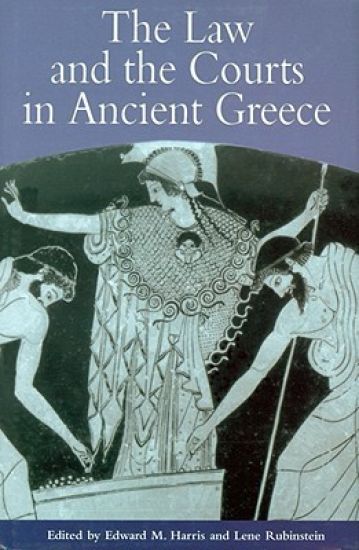
The Law and the Courts in Ancient Greece
Christopher Carey; Angelos Chaniotis; Michael Gagarin; Edward Harris; Adriaan Lanni; David Mirhady; Frederick Naiden; Robert Parker; Peter Rhodes; James Sickinger
Bristol Classical Press
2004
sidottu
How successful were the Athenians and other Greeks in bringing about the rule of law? What did the Greeks recognise as 'law' both in the 'polis' and internationally? How did the courts attempt to implement this ideal, and how successful were they? This collection of essays sets out to answer these questions, concentrating on the following themes: law, religion and the sources of legitimacy; substance and procedure; legal arguments in court; documents and witnesses; and law in an international context. There is much here to interest not only specialists in Greek law, but also those concerned more generally with both Greek history and the history of law.

Ancient Education and Its Meaning to Us: Our Debt to Greece and Rome
John Frederic Dobson; George Depue Hadzsits; David Moore Robinson
Literary Licensing, LLC
2012
sidottu
Ancient Education And Its Meaning To Us: Our Debt To Greece And Rome by John Frederic Dobson is a comprehensive exploration of the educational systems of ancient Greece and Rome and their lasting impact on modern education. The author delves into the philosophical and cultural underpinnings of ancient education, examining the role of teachers, students, and the curriculum in shaping the intellectual and moral character of individuals and societies.Dobson argues that the ancient Greeks and Romans were pioneers in the development of education as a means of cultivating the mind and character of individuals, and that their ideas and practices continue to influence modern educational systems. He discusses the importance of classical languages and literature, mathematics, philosophy, and physical education in ancient education, and shows how these subjects continue to be relevant today.The book also examines the social and political context of ancient education, including the role of education in maintaining social order and promoting citizenship. Dobson highlights the ways in which ancient education was shaped by the values and beliefs of the societies in which it was practiced, and how these values and beliefs continue to shape modern education.Overall, Ancient Education And Its Meaning To Us: Our Debt To Greece And Rome is a fascinating and insightful exploration of the history and legacy of ancient education, and its ongoing relevance to modern education. It is a must-read for anyone interested in the history of education, classical studies, or the philosophy of education.This scarce antiquarian book is a facsimile reprint of the old original and may contain some imperfections such as library marks and notations. Because we believe this work is culturally important, we have made it available as part of our commitment for protecting, preserving, and promoting the world's literature in affordable, high quality, modern editions, that are true to their original work.

Ancient Education and Its Meaning to Us: Our Debt to Greece and Rome
John Frederic Dobson; George Depue Hadzsits; David Moore Robinson
Literary Licensing, LLC
2012
nidottu

Dangerous but Not Omnipotent
Frederic Wehrey; David E Thaler; Nora Bensahel; Kim Cragin; Jerrold D Green
RAND
2009
pokkari
In an analysis grounded in the observation that although Iranian power projection is marked by strengths, it also has serious liabilities and limitations, this report surveys the nature of both in four critical areas and offers a new U.S. policy paradigm that seeks to manage the challenges Iran presents through the exploitation of regional barriers to its power and sources of caution in the regime's strategic calculus.

Discover Your Painting Success: Your Complete Step-by-Step Guide to Starting a House Painting Business - Thrive by Unleashing Your Creativity, Transforming SpacesAre you sick of working 9 to 5 and longing for financial independence? There is no need to look any further In today's economy, starting your own house painting business is the key to realizing your entrepreneurial dreams.A fresh coat of paint is the secret ingredient to boosting a property's appeal in the ever-changing real estate market. And, because the home improvement industry is recession-proof, there has never been a better time to enter the world of professional painting.This book will guide you through the transformation from aspiring painter to successful business owner.

![The History of Luton, with Its Hamlets, Etc. [With Plates.]](/covers/9781241604073.jpg)
The History of Luton, with Its Hamlets, Etc. [With Plates.]
Frederick Davis
British Library, Historical Print Editions
2011
pokkari
Title: The History of Luton, with its Hamlets, etc. With plates.]Publisher: British Library, Historical Print EditionsThe British Library is the national library of the United Kingdom. It is one of the world's largest research libraries holding over 150 million items in all known languages and formats: books, journals, newspapers, sound recordings, patents, maps, stamps, prints and much more. Its collections include around 14 million books, along with substantial additional collections of manuscripts and historical items dating back as far as 300 BC.The GENERAL HISTORICAL collection includes books from the British Library digitised by Microsoft. This varied collection includes material that gives readers a 19th century view of the world. Topics include health, education, economics, agriculture, environment, technology, culture, politics, labour and industry, mining, penal policy, and social order. ++++The below data was compiled from various identification fields in the bibliographic record of this title. This data is provided as an additional tool in helping to insure edition identification: ++++ British Library Davis, Frederick; 1855. vii. 207 p.; 8 . 10352.d.18.


The History Of Luton: With Its Hamlets, Etc. (1855)
Frederick Davis
KESSINGER PUBLISHING, LLC
2008
nidottu

The History Of Luton: With Its Hamlets, Etc. (1855)
Frederick Davis
KESSINGER PUBLISHING, LLC
2008
sidottu


History of Bouvet Island, a Lecture, The Secret of Bouvet Island. A History Deep beneath the South Atlantic, the Bouvet Island is described as one of the most isolated locations on the Earth and the nearest land mass is Antarctica. It is over 1,700 km further down south and no one has inhabited the island and as plant life does not seem to be sustainable there, it is unlikely of anyone ever going there. But a British expedition which arrived from South Africa in 1964 discovered an abandoned lifeboat in a lagoon on the island and not far from the boat were oars, wood, a drum and a copper tank. The boat did not seem to have any identification marks on it and so could not be traced to any nation or shipping company