Kirjojen hintavertailu. Mukana 11 213 693 kirjaa ja 11 kauppaa.

Kirjahaku

Etsi kirjoja tekijän nimen, kirjan nimen tai ISBN:n perusteella.

1000 tulosta hakusanalla Fritz Barth

Fritz Barth

Fritz Barth

Thomas Hettche; Amber Sayah; Gerhart Schröder

Edition Axel Menges
2010
sidottu
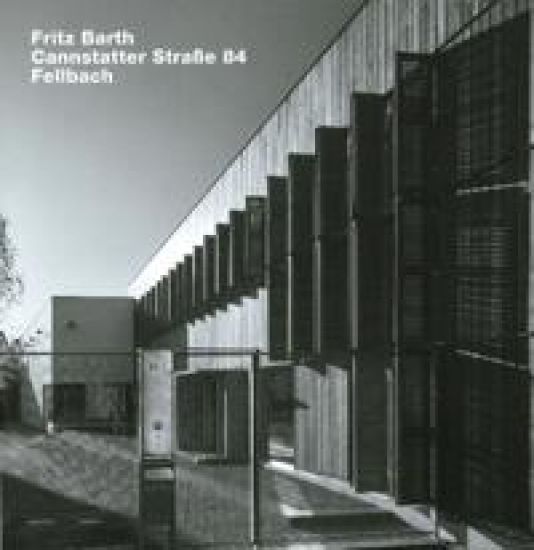
Text in English & German. Heroic 20th-century Modernism saw the private home as a place to first test out utopian theories -- a place for free play and experimentation where new approaches could be put into action, on a small scale but no less radical. Here, where architecture and life are most closely interwoven, Frank Lloyd Wright, Gerrit Rietveld, Le Corbusier and even Konstantin Melnikov found the suitable space to give their visionary concepts a plastic reality. The house built by the architect Fritz Barth for his own use in his home town of Fellbach places itself in an ironic, possibly melancholic distance from this kind of heroic pathos, but still has this tradition as its background. So it is considered by his builder as an experiment to determine the state of architecture at the start of the 21st century -- not to apply whatever offers itself to expand the architectonic repertoire (an approach that Barth considers to be a questionable, increasingly rhetoricised form of a somewhat naïve belief in the future), but to find out what possibilities are still open to architecture and how far architecture still permits a concept of 'dwelling' in the sense the word was used by Heidegger. The result is not a backward-looking homeliness, but a structure that, as a commitment to architecture in and of itself, stands his ground like few others in its time and place. This is not least because its complexity its multi-layered, opulent fabric of allusions, references and quotations, only reveals itself gradually and with close observation behind a simple appearance targeted on the immediacy of experience and architecture. Despite the somewhat polemical intentions of its builder and inhabitant, the house is not experienced as an ideological manifesto in bricks and mortar. It is and here lies its radicality, devoted to the immediate experience of 'dwelling' in so far as it does not allow, as Thomas Hettche writes in his essay, any distinction between surface and function, life and experience.

Villa Lante, Bagnia

Villa Lante, Bagnia

Fritz Barth

Edition Axel Menges
2002
sidottu
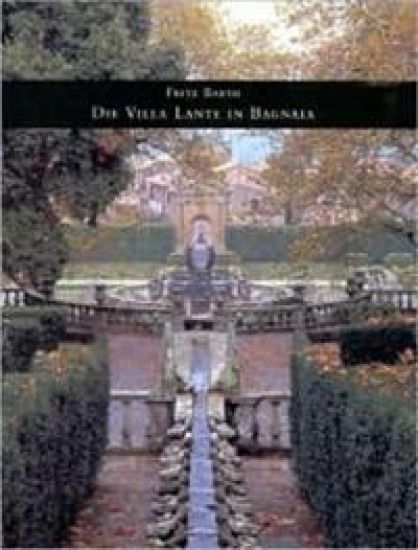
Text in German. The Villa Lante in Bagnaia near Viterbo is outstanding among 16th-century Italian gardens. It is not particularly large, but it is the undisputed highlight of this epoch, the heyday of Italian horticulture, not just because it is outstandingly well maintained, but also because of its unique formal qualities and its extremely complex iconographic programme. The present monograph attempts to establish what triggers the intense sense of beauty with which visitors to the gardens are confronted. It is immediately clear that it is essential to analyse the form of the garden -- here the extremely precise treatment of central perspective as a device is of considerable interest -- but close attention has also to be paid to the significance of the individual elements and the connections between them. This examination brings an elaborate accumulation of various sign systems to light, which seem to have the astonishing characteristic of not being entirely reconcilable, indeed they appear to build in contradictions as a basic constant. From this develops a panorama of the late 16th century, presenting the tangled pathways of perception of the gardens in all their complex relations, from the various late Renaissance garden types, via philosophy, the response to antiquity, perception of nature, perspective, harmony, literature, theatre and religion, and on to models of time and the forms it takes. Against this background the garden of the Villa Lante, which belonged to the scholarly cardinal and inquisitor Francesco Gambara, proves to be a difficult -- and perhaps not entirely successful -- balancing act between Renaissance traditions and the thrust of the Counter-Reformation, but showing at the same time, as a kind of 'apotheosis of the artwork', a surprising affinity with the present day.
Konstantin Melnikov and his House

Konstantin Melnikov and his House

Fritz Barth

Edition Axel Menges
2015
sidottu
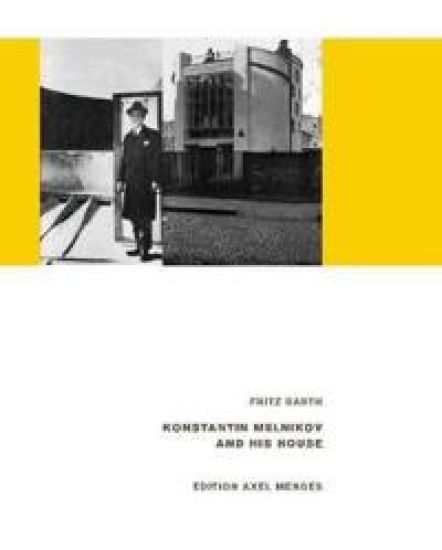
Konstantin Melnikov (18901974) is unquestionably one of the outstanding architects of the 20th century in spite of the fact that he fell silent early, leaving behind only limited work that was insufficiently publicized, and restricted almost exclusively to Moscow, the city of his birth in which he spent nearly his entire life and which did not appreciate him. He was raised in humble circumstances, but enjoyed an excellent education. Beginning in the mid-1920s, after the turmoil that followed the war, revolution and civil war, his career soared at almost meteoric speed as he took the lead in the young Soviet architecture movement with completely autonomous, highly artistic buildings that were free from dogmatism of any kind. Even more rapid than his rise to fame was his downfall: Treated with general hostility, he was unable to defend himself against the accusation of formalism when Stalin put an end to architectural ventures and experiments around the mid-1930s. He was expelled from the architects' association and was banned from practicing as an architect for the remaining four decades of his life. In the late 1920s, at the peak of his career, he had the opportunity to build a house for himself and his family in Moscow, in which he was then able to live until the end of his life. This house, a memorable symbiosis of almost peasant-like simplicity and extreme radicalness, is one of the most impressive, surprising and probably most enigmatic works produced by 20th-century architecture. Its simplicity is only outward; in reality this is a highly complex work which links together the elements of architecture explicitly and inextricably, which takes a clear and completely autonomous stand and which, in a way that little else has done, raises the question as to the nature of genuinely architectonic thinking. In essayistic form the book attempts to follow the paths laid out in the architect's work from the perspective of an architect.
Francesco di Giorgio Martini's Fortress Complexes

Francesco di Giorgio Martini's Fortress Complexes

Fritz Barth; Olaf Metzel

Edition Axel Menges
2011
sidottu
Text in English & German. Francesco di Giorgio Martini's fortress complexes, created at the end of the Quattrocento, continue to look experimental and highly speculative half a millennium later by their semiotic character. They represent an extreme of European architectural history, occupying a position where architecture and sculpture cannot be sharply distinguished any longer. The alien-looking creations represented in this book have their origins in a particular historic situation: the emergence of firearms in the 14th century and their spread in the 15th century had shifted the balance of warfare in favour of the attacking side, against which the defensive structure had not yet found a remedy. Enter Francesco di Giorgio Martini (1439 to 1502) at this point, a native of Siena and one of the Quattrocento's highly versatile artists. He worked mainly in Federico da Montefeltro's Urbino, and left behind a body of work that included painting -- the three famous prospects of ideal cities in Berlin, Baltimore and Urbino are attributed to him -- sculpture -- primarily his imposing reliefs -- and architecture -- here he was definitely the outstanding figure between Alberti and Bramante. His achievements as an engineer are equally impressive, and his elaborate designs for machines strongly influenced those of Leonardo da Vinci. He was a true Renaissance uomo universale, though, despite of his voluminous and influential theoretical work, less in the sense of a humanist homme de lettres than as an all-round artist. Francesco's sacred and secular structures are classicist and austere in nature, yet his fortress structures look as if, moving beyond all functional concerns, he is exploiting the newness of the task, the lack of any tried and tested technical solutions and the removal of all typological boundaries to give his architectonic fantasies free rein, resulting in an apotheosis of the new, the unfamiliar and the alien. This book is an attempt to understand the strangely grandiose semiotic character of these structures. In doing so, it poses the question of what strategies can be used when seeking a shape for buildings for which there is no precedent.
There Is an Art to Breathing: A Training Course in Conscious Rhythmic Breathing

There Is an Art to Breathing: A Training Course in Conscious Rhythmic Breathing

Virginia Zoros Barth; Fritz Alseth

Literary Licensing, LLC
2011
sidottu
""There Is An Art To Breathing"" is a comprehensive guidebook written by Virginia Zoros Barth that offers a training course in conscious rhythmic breathing. The book provides a step-by-step approach to breathing techniques that can help individuals improve their physical, mental, and emotional well-being. The author emphasizes the importance of proper breathing techniques in reducing stress, anxiety, and other health-related issues. The book includes a variety of exercises and practices that help readers develop their breathing skills and improve their overall health. It covers topics such as the anatomy of breathing, the benefits of proper breathing, and the different techniques that can be used to improve breathing. The book is suitable for beginners as well as experienced practitioners and can be used as a reference guide for those looking to deepen their understanding of conscious rhythmic breathing. Overall, ""There Is An Art To Breathing"" is a valuable resource for anyone looking to improve their breathing skills and enhance their overall well-being.This scarce antiquarian book is a facsimile reprint of the old original and may contain some imperfections such as library marks and notations. Because we believe this work is culturally important, we have made it available as part of our commitment for protecting, preserving, and promoting the world's literature in affordable, high quality, modern editions, that are true to their original work.
Politikevaluation

Politikevaluation

Fritz Sager; Susanne Hadorn; Andreas Balthasar; Céline Mavrot

Springer Fachmedien Wiesbaden
2021
muu
Dieses Lehrbuch führt in die Grundlagen der Politikevaluation ein. Es zeigt deren Begrifflichkeiten, Entstehung, Theorien und die heute gültigen Konzepte sowie die empirischen Methoden für die Wirkungsanalyse öffentlicher Politik. Die Einführung ist didaktisch ausgerichtet und anwendungsorientiert mit realen Beispielen und praxisnahen Aufgaben und Lösungen versehen. Das Buch richtet sich an Studierende an höheren Bildungsinstitutionen, welche die Grundlagen der Evaluation kennenlernen möchten. Ebenso dient das Buch aber auch Akteur*innen, die sich mit der Aufgabe konfrontiert sehen, Evaluationen in einem politischen Kontext in Auftrag zu geben, zu erstellen, zu beurteilen oder zu nutzen. Dies betrifft die öffentliche Verwaltung, Nicht-Regierungsorganisationen, Verbände, sowie Mitglieder der Legislative und der Exekutive, die Policy-Entscheidungen treffen. Zusätzliche Fragen per App: Laden Sie die Springer Nature Flashcards-App kostenlos herunter und nutzen Sie exklusivesZusatzmaterial, um Ihr Wissen zu prüfen.
Fritz

Fritz

Franz Hoffmann

Palala Press
2018
pokkari
This work has been selected by scholars as being culturally important, and is part of the knowledge base of civilization as we know it. This work was reproduced from the original artifact, and remains as true to the original work as possible. Therefore, you will see the original copyright references, library stamps (as most of these works have been housed in our most important libraries around the world), and other notations in the work.This work is in the public domain in the United States of America, and possibly other nations. Within the United States, you may freely copy and distribute this work, as no entity (individual or corporate) has a copyright on the body of the work.As a reproduction of a historical artifact, this work may contain missing or blurred pages, poor pictures, errant marks, etc. Scholars believe, and we concur, that this work is important enough to be preserved, reproduced, and made generally available to the public. We appreciate your support of the preservation process, and thank you for being an important part of keeping this knowledge alive and relevant.
Fritz

Fritz

Rodney Wetzel

Archway Publishing
2017
pokkari
It is 1987 in the college town of Parksville. Professor Phillip Parker is doing his best to muddle through what has become a very mundane life. But as he dismisses his class for another day, Parker has no idea that his childhood friend and local police captain, Kip Gillmore, is witnessing a scene unlike anything he has ever seen in his fifteen years in law enforcement.Two high school students have sadly become victims of a satanic sacrifice inside the gates of the Parksville cemetery. Soon, Gillmore and Parker decide to partner to investigate the crime and confront an evil entity that has made its home in Parksville. With help from a priest and a student--both connected to the town through long heritage--they work to banish the evil. But as voices urge a psychopath to continue killing, the men realize that Parkville's past may hide too many dark secrets. While the body count and danger continue to grow, Parker and Gillmore cannot help but wonder if they are too late to stop an evil one with an unrelenting need to feed.In this terrifying tale of horror, a police captain and college professor work together to eliminate an evil presence from their town before it murders more innocent victims.
Fritz

Fritz

Robert Livingston

Sweetspire Literature Management LLC
2023
pokkari
Most fans know that Jackie Robinson ended the ban against blacks playing professional baseball in 1947. However, almost all football fans do not know the name of the man who tried to end a similar ban against black players in the NFL. His name was Fritz Pollard and his place on the football field and in America's racial history has all but been forgotten. Who was the man who was inducted into the Collegiate Hall of Fame in 1954, and into the National Football Hall of Fame in 2005? Who was the man who was inducted into the Rose Bowl Hall of Fame in 2015, and into the National Black Hall of Fame in 1973? Who was the man who inspired the Fritz Pollard Alliance established to champion coaching diversity in the NFL? Unfortunately, as is often the case with black athletes, their talents and achievements were often shunted aside in the past and seldom remembered in the present. This story is about a Brown University athlete who was the first black football player in the NFL, as well as its first black head coach during the league's formative years. It is also the story of one man's struggle to end discrimination on the gridiron, while seeking social justice for blacks in other avenues of American life. It is a story worth knowing.