Kirjojen hintavertailu. Mukana 11 244 527 kirjaa ja 12 kauppaa.

Kirjahaku

Etsi kirjoja tekijän nimen, kirjan nimen tai ISBN:n perusteella.

225 tulosta hakusanalla Fumiko Hayashi

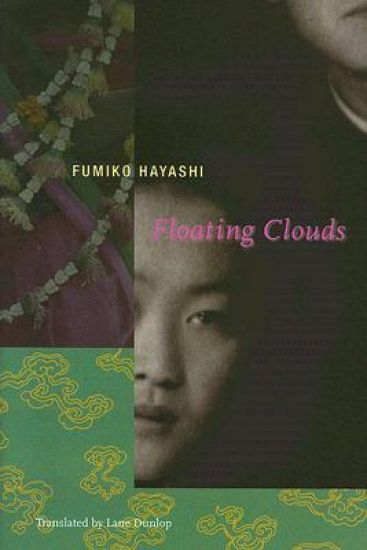
Floating Clouds

Floating Clouds

Fumiko Hayashi

Columbia University Press
2006
sidottu
In this groundbreaking novel, Fumiko Hayashi tells the powerful story of tormented love and one woman's struggle to navigate the cruel realities of postwar Japan. The novel's characters, particularly its resilient heroine Koda Yukiko, find themselves trapped in their own drifting, unable to break out of the morass of indecisiveness. Set in the years during and after World War II, their lives and damaged psyches reflect the confusion of the times in which they live. Floating Clouds follows Yukiko as she moves from the physically lush and beautiful surroundings of Japanese-occupied French Indochina to the desolation and chaos of postwar Japan. Hayashi's spare, affecting novel presents a rare portrait of Japanese colonialism and the harshness of Japan's postwar experience from the perspective of a woman. Its rich cast of characters, drawn from the back alleys of urban Japan and the low rungs of society, offers an unforgettable portrait of Japanese society after the war. The tortured relationship between Yukiko and Tomioka, a minor official with the Department of Agriculture and Forestry, provides the dramatic center of the novel. Yukiko meets Tomioka while working as a typist for the Japanese ministry in Indochina, where they begin their affair. After the war, Tomioka returns to his wife but remains emotionally inscrutable to Yukiko, refusing to break off their relationship. Meanwhile, Yukiko must find her way in a radically changed postwar Japan. When Yukiko and Tomioka's lives once again cross, the two set down a path shaped by their passion and sense of desperation. First published in 1951, Floating Clouds is a classic of modern Japanese literature and was later made into a film by legendary Japanese director Mikio Naruse.

Floating Clouds

Floating Clouds

Fumiko Hayashi

Columbia University Press
2012
pokkari
In this groundbreaking novel, Fumiko Hayashi tells the powerful story of tormented love and one woman's struggle to navigate the cruel realities of postwar Japan. The novel's characters, particularly its resilient heroine Koda Yukiko, find themselves trapped in their own drifting, unable to break out of the morass of indecisiveness. Set in the years during and after World War II, their lives and damaged psyches reflect the confusion of the times in which they live. Floating Clouds follows Yukiko as she moves from the physically lush and beautiful surroundings of Japanese-occupied French Indochina to the desolation and chaos of postwar Japan. Hayashi's spare, affecting novel presents a rare portrait of Japanese colonialism and the harshness of Japan's postwar experience from the perspective of a woman. Its rich cast of characters, drawn from the back alleys of urban Japan and the low rungs of society, offers an unforgettable portrait of Japanese society after the war. The tortured relationship between Yukiko and Tomioka, a minor official with the Department of Agriculture and Forestry, provides the dramatic center of the novel. Yukiko meets Tomioka while working as a typist for the Japanese ministry in Indochina, where they begin their affair. After the war, Tomioka returns to his wife but remains emotionally inscrutable to Yukiko, refusing to break off their relationship. Meanwhile, Yukiko must find her way in a radically changed postwar Japan. When Yukiko and Tomioka's lives once again cross, the two set down a path shaped by their passion and sense of desperation. First published in 1951, Floating Clouds is a classic of modern Japanese literature and was later made into a film by legendary Japanese director Mikio Naruse.
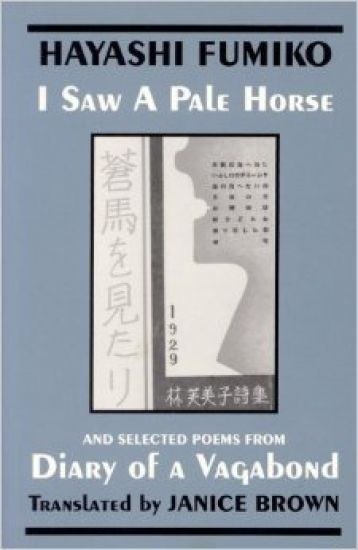
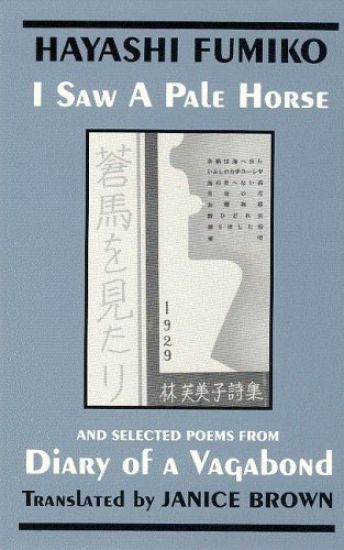
"I Saw a Pale Horse" and Selected Poems from "Diary of a Vagabond"

"I Saw a Pale Horse" and Selected Poems from "Diary of a Vagabond"

Fumiko Hayashi

Cornell University East Asia Program
2010
sidottu
Hayashi Fumiko, one of the most popular prose writers of the Showa era, began writing as a down-and-out poet wandering the streets of 1920s Tokyo. In these translations of her first poetry collection, I Saw a Pale Horse (Aouma wo mitari) and Selected Poems from Diary of a Vagabond (Horoki), Fumiko's literary origins are colorfully revealed. Little known in the west, these early poetic texts focus on Fumiko's unconventional early life, and her construction of a female subject that would challenge, with gusto and panache, accepted notions not only of class, family, and gender but also of female poetic practice.
"I Saw a Pale Horse" and Selected Poems from "Diary of a Vagabond"

"I Saw a Pale Horse" and Selected Poems from "Diary of a Vagabond"

Fumiko Hayashi

Cornell University East Asia Program
2011
pokkari
Hayashi Fumiko, one of the most popular prose writers of the Showa era, began writing as a down-and-out poet wandering the streets of 1920s Tokyo. In these translations of her first poetry collection, I Saw a Pale Horse (Aouma wo mitari) and Selected Poems from Diary of a Vagabond (Horoki), Fumiko's literary origins are colorfully revealed. Little known in the west, these early poetic texts focus on Fumiko's unconventional early life, and her construction of a female subject that would challenge, with gusto and panache, accepted notions not only of class, family, and gender but also of female poetic practice.
Shest rasskazov

Shest rasskazov

Fumiko Hayashi

Giperion
2023
sidottu
Japonskaja pisatelnitsa Fumiko Khajasi (1903-1951) khorosho izvestna u sebja na rodine, no pochti neznakoma rossijskomu chitatelju. V detstve ona zhila v krajnej nischete, povzroslev, mnogo let skitalas po strane. Tjagoty ne slomili devushku, ona uporno uchilas, mnogo rabotala i dobilas uspekha - ee pervyj avtobiograficheskij roman "Dnevnik brodjagi" (1930) stal bestsellerom. Za svoju nedolguju zhizn Fumiko Khajasi napisala neskolko romanov, mnozhestvo rasskazov i kinostsenariev, posylala v gazety reportazhi s teatrov voennykh dejstvij v Jugo-Vostochnoj Azii, pobyvala v Kitae i Evrope. Ona poluchila neskolko prestizhnykh premij, ee proizvedenija neodnokratno ekranizirovalis. Posle smerti v dome pisatelnitsy byl otkryt muzej, a v gorode, gde ona provela detstvo, ustanovlen bronzovyj pamjatnik.Predlagaemaja vnimaniju chitatelej kniga vpervye vyshla na russkom jazyke v 1960 g. i s tekh por ni razu ne pereizdavalas. Vkhodjaschie v nee rasskazy dajut naibolee polnoe predstavlenie o tvorchestve pisatelnitsy.
Lausgjengar

Lausgjengar

Fumiko Hayashi

Skald
2021
sidottu
Eg var berre ein liten svart katt, og verda glodde mistruisk på meg og hysja, hysja, hysja på meg. «Lausgjengar» skildrar det turbulente livet til ei ung omstreifande kvinne i Japan på 1920-talet. Ho går frå jobb til jobb, alltid kortvarige, aldri godt betalte. Ho er alltid blakk, opplever vonbrot etter vonbrot, men gir aldri opp. Av lengten - etter mat, ein stad å bu, pengar og kjærleik - skaper forfattaren ein ny og djerv litteratur frå undersida av det japanske samfunnet. Hayashis debutverk kan lesast som eit opprør mot den klassiske japanske dagboktradisjonen, der aristokratiske kvinner skreiv vakre dagbøker fylte av dikt om ulukkeleg kjærleik. Inspirert mellom anna av Knut Hamsuns Sult, skreiv Hayashi med utgangspunkt i sitt eige liv, rått, upolert og direkte, men òg med stor humor og poesi. Då boka kom ut, vart ho straks ein suksess og er i dag eit av dei mest vesentlege verka i Japans litteraturkanon.Skalds klassikarar er ein serie av vellagra, handplukka verk i ny, frisk og nynorsk språkdrakt som skal gi leseglede til folket.
Kiertolainen

Kiertolainen

Fumiko Hayashi

Reiwa Suomi Japani Oy
2026
nidottu
Japanilaisen kirjallisuuden klassikko Horoki ilmestyy nyt ensimmäistä kertaa suomeksi nimellä Kiertolainen. Teos kuvaa nuoren naisen elämää vuosisadan alun Japanissa, aikana, jolloin kaupungit kasvoivat ja yhteiskunta muuttui, mutta monen arki oli epävarmaa ja tilapäistä. Fumiko Hayashin omaelämäkerrallinen romaani seuraa naista, joka kulkee kaupungista toiseen, majatalosta seuraavaan, etsien työtä, rakkautta, ruokaa ja paikkaa maailmassa. Hän ei ole sankari, vaan tarkkailija, arkisen elämän kiertolainen, joka havainnoi ympäröivää todellisuutta terävästi ja lämpimästi. Fumiko Hayashi (1903-1951) oli yksi 1900-luvun merkittävimmistä japanilaisista kirjailijoista. Hän nousi tunnetuksi omaelämäkerrallisilla teoksillaan, joissa kuvataan köyhyyttä, naisen asemaa ja elämän arkea vuosisadan alun Japanissa. Hayashin tyyli yhdistää tarkkanäköisyyttä ja runollista herkkyyttä. Kiertolainen on hänen tunnetuin teoksensa ja japanilaisen modernin kirjallisuuden klassikko. Kirjan kääntänyt Antti Valkama tunnetaan muun muassa kehutuista Haruki Murakami käännöksistään. Imo-kustannus on japanilaiseen laatukirjallisuuteen erikoistunut kustantamo.
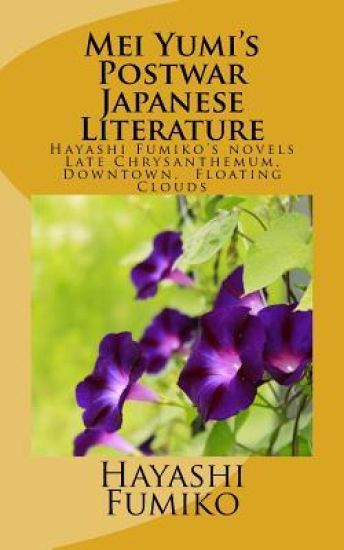
Mei Yumi's Postwar Japanese Literature: Hayashi Fumiko's novels, Late Chrysanthemum, Downtown, Floating Clouds
The postwar Japanese strived, unsteadily as if about to fall, to live everyday lives and to restore Japan, while suffering from the survivor's guilt. The early postwar novels of Hayashi Fumiko. Three novels of Hayashi Fumiko translated here are related to the early postwar period in Japan. Late Chrysanthemum - Ban'Giku "Late Chrysanthemum" is an ex-geisha's one night story after the war. The main character Kin had a strong will to survive. An ex-geisha had a visitor, who was her ex-lover sometime in the prewar years and desperately needed money. He intrigued to get money from his ex., even by slaughter. How did the ex-geisha rid out of the crisis? Her quick wit worked, which suggests us how to manage a risk in a daily life. In November 1948, 23 Showa, "Late Chrysanthemum" appeared in an extra issue of a literary magazine, the Bungei'Shunju. This is the most important work of Hayashi Fumiko, which is praised for its highly qualified perfection and elaborate description. Downtown - Shita'machi "Downtown" is a two week story of a female peddler and an ex-soldier after the war. Their relationship finished all of sudden. "Downtown" appeared in April 1949, 24 Showa in an extra issue of a literary magazine, Shosetsu'Shincho. The literary magazine has been published monthly since September 1947 from The Shinchosha Publishing Co, Ltd. which was founded in 1896. Floating clouds - Uki'gumo "Floating Clouds" is mainly a five year story. The storyline, however, extends from 1939 in Japan, during the years since 1943 in French Indochina, and the postwar period in 1945 to 1949 in Japan. The author describes changes in people's feelings after the war, while following the trajectories of men and women before and after the war. This novel can be seen as Hayashi Fumiko's compilation. "Floating clouds" is compiled in a book and published in April 1951, 26 Showa, which is considered to be the last novel of Hayashi Fumiko. The author died suddenly of heart attack at home at about 11:00 pm, June 28 in 1951, 26 Showa, at the age of 48. Enjoy
Days & Nights

Days & Nights

Hayashi Fumiko

Arigatai Books
2021
pokkari
Women authors have played an important role in Japanese literature for centuries, for example Murasaki Shikibu who wrote "The Tale of Genji" over 1000 years ago, which is considered to be the world's first novel. The last few decades have seen compelling works by authors such as Banana Yoshimoto, Yoko Ogawa, and Mieko Kawakami.A few decades earlier we find another group of influential women authors, with Hayashi Fumiko--said to be one of the most important twentieth-century Japanese woman authors--a key representative of this group. Living a life of poverty until her breakthrough as an author, Hayashi Fumiko was known for her realistic depictions of urban working-class life, especially impoverished women. Her works typically address themes such as fate, troubled relationships, and the repercussions of war.These nine stories are all connected in some way by the overarching theme of human relationships. Stories from a variety of genres are included: a tale of a woman's gradual downfall in the big city, a couple's struggle to find happiness, a fairy tale about an estranged crane family, a comical look at a traveler enamored by a maid, and a man wandering through the remnants of post-war Tokyo.
Econometrics

Econometrics

Fumio Hayashi

PRINCETON UNIVERSITY PRESS
2000
sidottu
Hayashi's Econometrics promises to be the next great synthesis of modern econometrics. It introduces first year Ph.D. students to standard graduate econometrics material from a modern perspective. It covers all the standard material necessary for understanding the principal techniques of econometrics from ordinary least squares through cointegration. The book is also distinctive in developing both time-series and cross-section analysis fully, giving the reader a unified framework for understanding and integrating results. Econometrics has many useful features and covers all the important topics in econometrics in a succinct manner. All the estimation techniques that could possibly be taught in a first-year graduate course, except maximum likelihood, are treated as special cases of GMM (generalized methods of moments). Maximum likelihood estimators for a variety of models (such as probit and tobit) are collected in a separate chapter. This arrangement enables students to learn various estimation techniques in an efficient manner. Eight of the ten chapters include a serious empirical application drawn from labor economics, industrial organization, domestic and international finance, and macroeconomics. These empirical exercises at the end of each chapter provide students a hands-on experience applying the techniques covered in the chapter. The exposition is rigorous yet accessible to students who have a working knowledge of very basic linear algebra and probability theory. All the results are stated as propositions, so that students can see the points of the discussion and also the conditions under which those results hold. Most propositions are proved in the text. For those who intend to write a thesis on applied topics, the empirical applications of the book are a good way to learn how to conduct empirical research. For the theoretically inclined, the no-compromise treatment of the basic techniques is a good preparation for more advanced theory courses.
Fumiko and the Finicky Nestmate
She could make a mess of everything. Especially him. The Junzi-also known as the Four Gentlemen-are a set of ancient weapons fashioned from remnants. Dragons refer to them as the Four Storms, and Hisoka Twineshaft believes they will make a difference in the hunt for the rogue. But someone else is interested in gathering up these crystal masterpieces. The so-called Gentleman Bandit is responsible for two thefts already, and Hisoka is concerned for the Bamboo Stave. So he deploys an elite taskforce to guard the treasure. And to catch a thief.Juuyu Farroost and his teammates regroup at a safehouse tucked under the boughs of one of the oldest-and most heavily fortified-orphan trees in the Americas. Fumiko and her tree-twin have enough rooms for all of them. If they can shift enough of the woman's clutter to set up their equipment. Juuyu's expertise is essential to the success of their mission, but he can barely focus thanks to Fumiko, her messes, and Akira, who apparently owes Boon a favor.
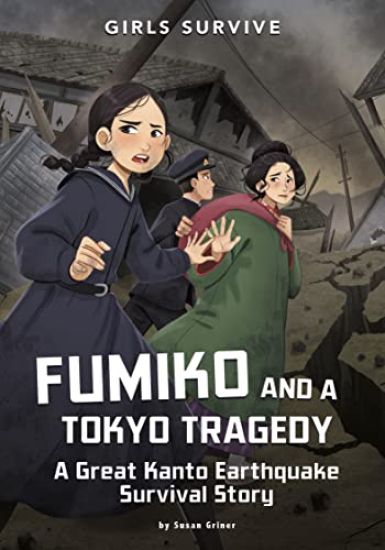
Fumiko and a Tokyo Tragedy: A Great Kanto Earthquake Survival Story
12-year-old Fumiko is fascinated by the Moga girls, modern young women with short hair and casual dresses who are making their way in 1920s Tokyo. Her parents, however, expect a traditional life for her. But none of that matters when the Great Kanto Earthquake strikes the city on September 1, 1923. Can Fumiko withstand the fires and confusion that follow the shaking earth, and how will the tragedy change her future? Readers can learn the real story of the Great Kanto Earthquake from the nonfiction back matter in this Girls Survive story. A glossary, discussion questions, and writing prompts are also provided.
Fumiko and a Tokyo Tragedy: A Great Kanto Earthquake Survival Story
12-year-old Fumiko is fascinated by the Moga girls, modern young women with short hair and casual dresses who are making their way in 1920s Tokyo. Her parents, however, expect a traditional life for her. But none of that matters when the Great Kanto Earthquake strikes the city on September 1, 1923. Can Fumiko withstand the fires and confusion that follow the shaking earth, and how will the tragedy change her future? Readers can learn the real story of the Great Kanto Earthquake from the nonfiction back matter in this Girls Survive story. A glossary, discussion questions, and writing prompts are also provided.
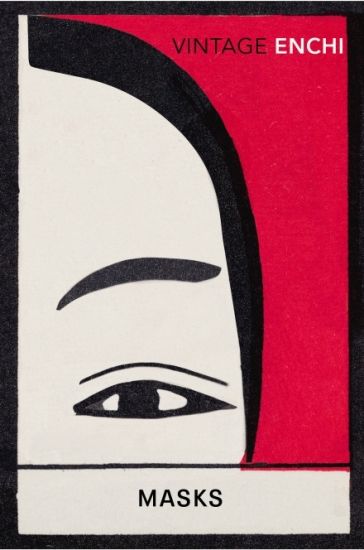
Masks

Masks

Fumiko Enchi

Vintage Classics
2019
pokkari
Published for the first time in the UK, one of Japan's greatest modern female writers Ibuki loves widow Yasuko who is young, charming and sparkling with intelligence as well as beauty. His friend, Mikamé, desires her too but that is not the difficulty. What troubles Ibuki is the curious bond that has grown between Yasuko and her mother-in-law, Mieko, a handsome, cultivated yet jealous woman in her fifties, who is manipulating the relationship between Yasuko and the two men who love her.