Kirjojen hintavertailu. Mukana 11 244 527 kirjaa ja 12 kauppaa.

Kirjahaku

Etsi kirjoja tekijän nimen, kirjan nimen tai ISBN:n perusteella.

1000 tulosta hakusanalla G. Douglas Atkins

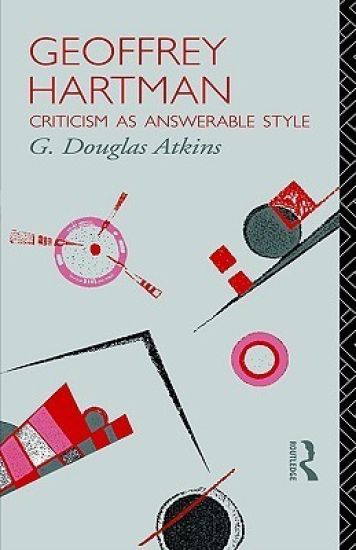
Geoffrey Hartman

Geoffrey Hartman

G. Douglas Atkins

Routledge
1990
sidottu
`The critic explicitly acknowledges his dependence on prior words that make his word a kind of answer. He calls to other texts "that they might answer him."'Geoffrey Hartman is the first book devoted to an exploration of the `intellectual poetry' of the critic who, whether or not he `represents the future of the profession', is a unique and major voice in twentieth-century criticism.Professor Atkins explains clearly Hartman's key ideas and places his work in the contexts of Romanticism and Judaism on which he has written extensively. In Geoffrey Hartman he provides a valuable introduction to a major critical voice who has called into question our assumptions about the distinction between commentary and imaginative literature.
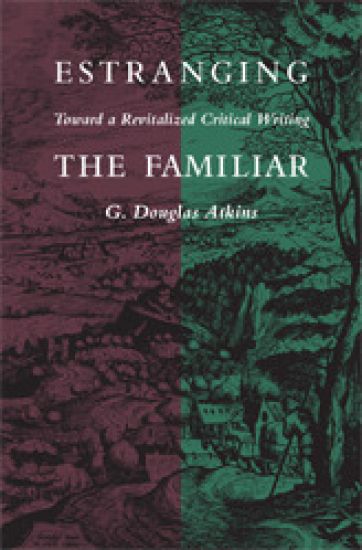
Estranging the Familiar

Estranging the Familiar

G. Douglas Atkins

University of Georgia Press
2008
pokkari
In Estranging the Familiar, G. Douglas Atkins addresses the often lamented state of scholarly and critical writing as he argues for a criticism that is at once theoretically informed and personal. The revitalized critical writing he advocates may entail—but is not limited to—a return to the essay, the form critical writing once took and the form that is now enjoying a resurgence of popularity and excellence.Atkins contends that to reach a general audience, criticism must move away from the impersonality of modern criticism and contemporary theory without embracing the old-fashioned essay. "The venerable familiar essay may remain the basis," Atkins writes, "but its conventional openness, receptivity, and capaciousness must extend to theory, philosophy, and the candor that seems to mark the tail-end of the twentieth century." In noting the timeliness, if not the necessity, of a return to the essay, Atkins also considers our culture's parallel "return to the personal." When the essay combines good writing with the concerns of the personal, Atkins says, it becomes a form of criticism that is readable, vital, and potentially attractive to a large readership.Atkins hopes critics will tap into the revitalized interest the essay now enjoys without ignoring the considerable insights and advances of contemporary theory. He argues that despite claims to the contrary there is no inherent incompatibility between the essay and modern theory. As Atkins considers various experiments in critical writing from Plato to the present, notably feminist interest in the personal and autobiographical, he contends that these attempts, although undeniably important, fall short of the desired goal when they emphasize the merely expressive and neglect the artful quality good writing can bring to personal criticism.The final third of the book consists of a series of experiments in critical writing that represent the author's own attempts to bridge the gap between theory and popular criticism, between an academic and a general audience. In essays that illustrate the rhetorical power of the form, Atkins describes the reciprocal relationship between his life experience and a reading of The Odyssey, explains the role that theory has played in his personal development, and chronicles his attempts to find a voice as a writer.
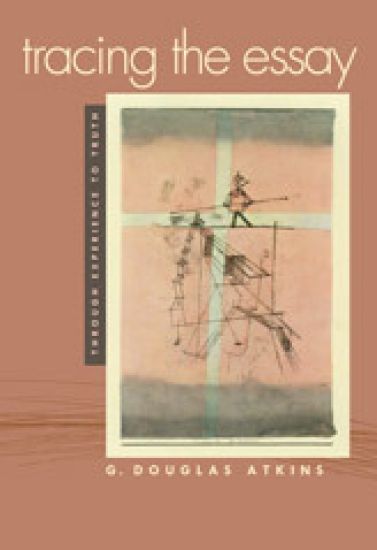
Tracing the Essay

Tracing the Essay

G. Douglas Atkins

University of Georgia Press
2005
pokkari
The essay, as a notably hard form of writing to pin down, has inspired some unflattering descriptions: It is a “greased pig,” for example, or a “pair of baggy pants into which nearly anything and everything can fit.” In Tracing the Essay, G. Douglas Atkins embraces the very qualities that have moved others to accord the essay second-class citizenship in the world of letters.Drawing from the work of Montaigne and Bacon and recent practitioners such as E. B. White and Cynthia Ozick, Atkins shows what the essay means—and how it comes to mean. The essay, related to assaying (attempting), mines experience for meaning, which it then carefully weighs. It is a via media creature, says Atkins, born of and embracing tension. It exists in places between experience and meaning, literature and philosophy, self and other, process and product, form and formlessness. Moreover, as a literary form the essay is inseparable from a way of life requiring wisdom, modesty, and honesty. “The essay was, historically,” notes Atkins, “the first form to take the experience of the individual and make it the stuff of literature.”Atkins also considers the essay’s basis in Renaissance (and Reformation) thinking and its participation in voyages of exploration and discovery of that age. Its concern is “home-cosmography,” to use a term from seventeenth-century writer William Habington. Responding to influential critiques of the essay’s supposed self-indulgence, lack of irony, and absence of form, Atkins argues that the essay exhibits a certain “sneakiness” as it proceeds in, through, and by means of the small and the mundane toward the spiritual and the revelatory.
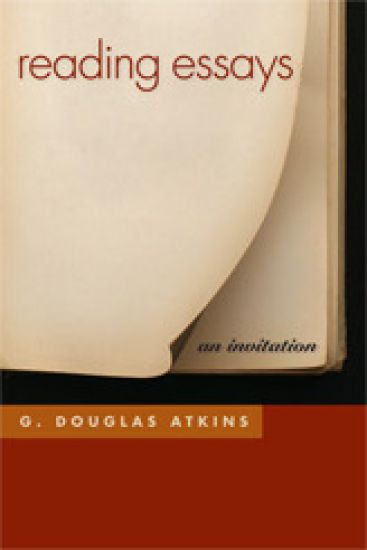
Reading Essays

Reading Essays

G. Douglas Atkins

University of Georgia Press
2008
pokkari
Approaches abound to help us beneficially, enjoyably read fiction, poetry, and drama. Here, for the first time, is a book that aims to do the same for the essay. G. Douglas Atkins performs sustained readings of more than twenty-five major essays, explaining how we can appreciate and understand what this currently resurgent literary form reveals about the “art of living.”Atkins’s readings cover a wide spectrum of writers in the English language—and his readings are themselves essays, gracefully written, engaged, and engaging. Atkins starts with the earliest British practitioners of the form, including Francis Bacon, John Dryden, Alexander Pope, and Samuel Johnson. Transcendentalist writers Henry David Thoreau and Ralph Waldo Emerson are included, as are works by Americans James Baldwin, Zora Neale Hurston, and E. B. White. Atkins also provides readings of a number of contemporary essayists, among them Annie Dillard, Scott Russell Sanders, and Cynthia Ozick.Many of the readings are of essays that Atkins has used successfully in the classroom, with undergraduate and graduate students, for many years. In his introduction Atkins offers practical advice on the specific demands essays make and the unique opportunities they offer, especially for college courses. The book ends with a note on the writing of essays, furthering the author’s contention that reading should not be separated from writing.Reading Essays continues in the tradition of such definitive texts as Understanding Poetry and Understanding Fiction. Throughout, Atkins reveals the joy, delight, grace, freedom, and wisdom of “the glorious essay.”
The Representation of Old Truths in T.S. Eliot's New Verse
Continuing his explorations of T. S. Eliot's most captivating yet difficult works, G. Douglas Atkins' new and insightful book takes on the question of Eliot and hermeneutics: understanding and being understood, putting-in-other-words, and, in Eliot's own words, 'restoring/ With a new verse the ancient rhyme.' This perspective opens new paths towards the elucidation of Ash-Wednesday and Four Quartets, in particular. Addressed to both the specialist and the non-specialist, the close, meditative readings that form the center of this engaging book mirror its subject, capturing an instance of the 'impossible union' of differences and opposites that lay at the heart of Eliot's Incarnational understanding.
Geoffrey Hartman

Geoffrey Hartman

G. Douglas Atkins

Routledge
2014
nidottu
`The critic explicitly acknowledges his dependence on prior words that make his word a kind of answer. He calls to other texts "that they might answer him."'Geoffrey Hartman is the first book devoted to an exploration of the `intellectual poetry' of the critic who, whether or not he `represents the future of the profession', is a unique and major voice in twentieth-century criticism.Professor Atkins explains clearly Hartman's key ideas and places his work in the contexts of Romanticism and Judaism on which he has written extensively. In Geoffrey Hartman he provides a valuable introduction to a major critical voice who has called into question our assumptions about the distinction between commentary and imaginative literature.
The Representation of Old Truths in T.S. Eliot's New Verse
Continuing his explorations of T. S. Eliot's most captivating yet difficult works, G. Douglas Atkins' new and insightful book takes on the question of Eliot and hermeneutics: understanding and being understood, putting-in-other-words, and, in Eliot's own words, 'restoring/ With a new verse the ancient rhyme.' This perspective opens new paths towards the elucidation of Ash-Wednesday and Four Quartets, in particular. Addressed to both the specialist and the non-specialist, the close, meditative readings that form the center of this engaging book mirror its subject, capturing an instance of the 'impossible union' of differences and opposites that lay at the heart of Eliot's Incarnational understanding.
T.S. Eliot and the Essay

T.S. Eliot and the Essay

G. Douglas Atkins

Baylor University Press
2010
sidottu
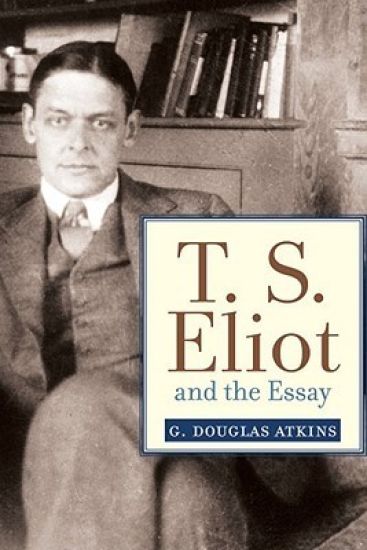
G. Douglas Atkins here offers an original consideration of T. S. Eliot's essay as a form of embodied thinking. A combination of literature and philosophy, the genre of the essay holds within itself a great tension--that between truth and creative prose. And, as Atkins explains, these conflicting forces of truth and creativity exist not only within the literary format itself but also within the writers and their relationships with the genre, making essay writing a wonderfully enriching ""impure art.""Exploring the similarities between Eliot's prose and poetry with the art of essay writing, Atkins discovers remarkably similar patterns of Incarnational thinking that emerge in each. In so doing, he establishes for the first time the essayistic nature of the great poem Four Quartets and provides an eloquent reflection on how the essay in all its impurity functions as Incarnational art, an embodiment of truth.
On Keats’s Practice and Poetics of Responsibility

On Keats’s Practice and Poetics of Responsibility

G. Douglas Atkins

Springer International Publishing AG
2016
sidottu
This accessible, informed, and engaging book offers fresh, new avenues into Keats’s poems and letters, including a valuable introduction to “the responsible poet.” Focusing on Keats’s sense of responsibility to truth, poetry, and the reader, G. Douglas Atkins, a noted T.S. Eliot critic, writes as an ama-teur. He reads the letters as literary texts, essayistic and dramatic; the Odes in comparison with Eliot’s treatment of similar subjects; “The Eve of St. Agnes” by adding to his respected earlier article on the poem an addendum outlining a bold new reading; “Lamia” by focusing on its complex and perplexing treatment of philosophy and imagination and revealing how Keats literally represents philosophy as functioning within poetry. Comparing Keats with Eliot, poet-philosopher, this book generates valuable insight into Keats’s successful and often sophisticated poetic treatment of ideas, accentuating the image of him as “the responsible poet.”
On Keats’s Practice and Poetics of Responsibility

On Keats’s Practice and Poetics of Responsibility

G. Douglas Atkins

Springer International Publishing AG
2018
nidottu
This accessible, informed, and engaging book offers fresh, new avenues into Keats’s poems and letters, including a valuable introduction to “the responsible poet.” Focusing on Keats’s sense of responsibility to truth, poetry, and the reader, G. Douglas Atkins, a noted T.S. Eliot critic, writes as an ama-teur. He reads the letters as literary texts, essayistic and dramatic; the Odes in comparison with Eliot’s treatment of similar subjects; “The Eve of St. Agnes” by adding to his respected earlier article on the poem an addendum outlining a bold new reading; “Lamia” by focusing on its complex and perplexing treatment of philosophy and imagination and revealing how Keats literally represents philosophy as functioning within poetry. Comparing Keats with Eliot, poet-philosopher, this book generates valuable insight into Keats’s successful and often sophisticated poetic treatment of ideas, accentuating the image of him as “the responsible poet.”
Memoirs of Senator James G.Douglas (1887-1954): Concerned Citizen
Senator James G. Douglas, a Dublin business and and a Quaker and Irish nationalist, was active in the Irish White Cross, 1920-22. Appointed by Michael Collins as a member of the committee which prepared drafts for the first Irish constitution in 1922. He was a member of Seanad Eireann in 1922-36, 1938-43 and 1944-54. These memoirs relate his involvement in the events of 1916-26. He casts fresh light on some events - revealing for example his secret meetings with De Valera in the closing stages of the Civil War.