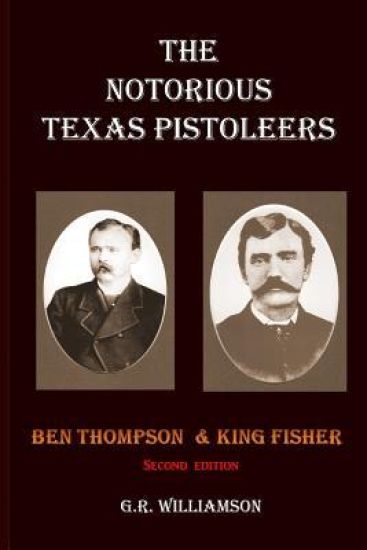
The Notorious Texas Pistoleers - Ben Thompson & King Fisher (Second Edition) Known as two of the best pistol fighters of their day, Ben Thompson and John King Fisher have remained an enigma in the chronicles of the Western Frontier. While other gun fighters have achieved notoriety through the stories told in the pulp magazines and newspapers of the day, these two men have been largely ignored. Both were credited with killing a string of men during their lifetime and the mere mention of their names was usually enough to sober up a drunken opponent or cause a sober man to contemplate his own epitaph. These men were not cold-blooded murders, but rather stand-up gun fighters that faced their adversaries in the winner-take-all shootout. The Notorious Texas Pistoleers tells their story in vivid detail and relates the true account of their deaths in a mystery shrouded ambush in a San Antonio saloon on a chilly March night in 1884 "They called King Fisher and Ben Thompson bad men, but they wasn't bad men; they just wouldn't stand for no foolishness, and they never killed anyone unless they bothered them." Tom Sullivan, deputy sheriff in Medina County, Texas
Gambling played a major role in the lives of the men that drove the western movement of Americans across the continent during the nineteenth century. Games of chance were dear to the hearts of most of the men of the American West, even including some preachers. It's true that a large percentage of the people that populated the American West frequently gambled but only a small amount of them were actually professional gamblers. Heralded by some, despised by many, the professional gamblers were often solitary individuals driven by a passion to win - sometimes at all costs. Some came from a background of the well-heeled upper class while most came from meager origins desperate to improve their lot in life. Along the way, they were praised as being "knights of the green cloth" or ridiculed with such pejorative terms as "tinhorns" or "blacklegs." Wherever there were men with money there was gambling - and most of it was crooked. Whether it was rigged, fixed, double-dealt, cold-decked, braced or otherwise manipulated - very little was left to luck and skill. Notorious Gamblers tells the true story of the Old West gamblers and how they used "tricks" to cheat the other players. Along the way you will meet Wyatt Earp, Bat Masterson, Doc Holiday, Luke Short, and the rest of the major frontier gamblers. "I always liked to set a lot of silver on the table in front of me all the time. That's the main reason my table always got the biggest play. It was like flies after molasses syrup." - Long John Dunn
Without a doubt, George Devol was the most notorious of the Mississippi riverboat gamblers. He mastered the fine art of card manipulation at an early age and by the time he reached twenty he was an accomplished card sharp. Devol could stack a deck, deal seconds or from the bottom of the deck. Though he had large hands, he could nimbly palm cards or insert cards with ease. He knew all the tricks to skin wealthy plantation owners, merchants, businessmen, soldiers, and even ministers who traveled on the busy waterways of the nineteenth century.At the same time, Devol was a maestro at working the short cons, particularly 3 card Monte. He and his partners raked in millions from fleeced suckers over the course of his forty years as a crooked gambler.George Devol - Notorious Riverboat Gambler, Card Sharp & Scam Artist tells his story in vivid detail based on solid historical research. Then, Devol tells his own story through his meandering, semi-autobiography, Forty Years a Gambler on the Mississippi, he published in 1896 at the age of 67 when he retired from gambling. In a series of 179 memoirs, he recounts the major events of his gambling life. Though heavily embellished, his accounts divulge his cheating technics and his philosophy about skinning his victims. Allowing for his penchant for self-aggrandizement, the memoirs are a hoot to read. George Devol's book is included with all of his stories appearing exactly as he published them in 1896, with all the spelling and grammatical mistakes intact. The steamboat scoundrel was a major character in the history of the Old West and his story is told in a humorous, entertaining style and is the first book to cover his entire saga.
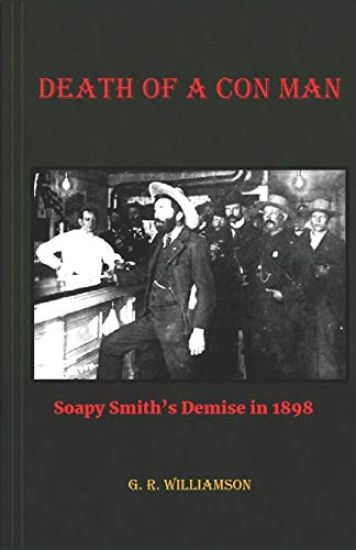
Death of a Con Man -Soapy Smith's Demise in 1898No other scoundrel could match "Soapy" Smith's utter audacity and unrelenting pursuit of skinning a sucker. Jefferson Randolph Smith II was a genius at running a scam, at organizing a gang of confederates, and at paying off authorities. Smith presented himself as a man of wisdom, a philosopher, a philanthropist, a supporter of law and order, and above all else, an American patriot. He had the inherent ability to look a man in the eye and lie like every word was etched in stone. But, on July 8 1898, Soapy was killed in a shootout in Skagway, Alaska. At the time, newspapers attributed a man, Frank Reid, with putting the fatal bullet through Soapy's heart. Now, 100 years later, historical research has shown that was not the case. Death of a Con Man is a concise, accurate account of the truth behind the myth.Entertaining, as well as informative, the story of the most notorious con man is told with many vintage photographs and illustrations.
One of the most mysterious of the petticoat dealers that roamed the Old West was the voluptuous Lottie Deno. She was a dazzling beauty, wore the finest clothes, and conducted herself as a refined Southern belle. Yet, she told no one her real name; "Lottie Deno" was a nickname given to her by other gamblers. She raked in big winnings night after nights-she traveled with a leather-bound trunk that was stuffed with cash.Using all of her feminine wiles, she orchestrated the killing of an ex- paramour, she stood toe to toe in a fight with "Big Nose" Kate over Doc Holliday, and she coolly counted her winnings at a table where two of the players blazed away with pistols-killing both men.This then, is her incredibly true story, Lottie Deno - Mysterious Hell Cat of the West.
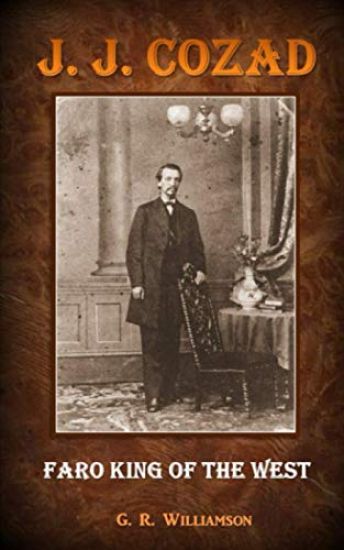
The gambler, John Jackson Cozad, was a dreamer, a visionary, a land developer, and above all else, a paradox. He raked in fortunes at the faro tables across the West-yet he aspired to develop a vice-less community devoid of saloons, gambling halls, and bawdy houses.He was a major winner at the faro tables in all the elaborate saloons and gambling halls, so much so, that he was soon banned from playing when his identity was revealed. He made all of the gambling hunts in North America, as well as South America. To avoid detection, he changed his name frequently-a trait that he used throughout his life. It was by changing his name, as well as his wife and sons, that he avoided being hung for killing a man in Nebraska.This book is a historically accurate account of J J Jackson's life, detailing his latter life in Atlantic City, New Jersey where he operated an arcade on the Atlantic Boardwalk. His two sons (using aliases) went on to become respected citizens-one a Philadelphia physician and the other the renown and highly acclaimed artist, Robert Henri.
"We're all bound for hell, you and I. We signed a pact with Lucifer when we first set foot in a saloon. There's no turning back for us " "Blind Bob" SorrowsWhen the notorious faro dealer, Peyton Bonner, wins a Fort Worth hotel in a Denver poker game, he returns to Texas to claim his ownership. After being shot up at the train station, he is forced to face the demons of his past.Refusing to be interviewed by the press or photographed, the reporters and the pulp writers fabricated their own stories about Peyton Bonner. With each man he killed defending himself at his faro tables, they continued to replay their made up stories to the point that it was deemed the "absolute truth."Tired of the rat-hole hotels, near starvation in the Dakotas, and facing death from a ravaging fever in Leadville, Peyton wants out of the perilous life as a frontier gambler. But, will the ghosts of his past let him.Western Writers of America Review: G.R. Williamson has certainly given life to a great Western character in the mysterious traveling gambler, Peyton Bonner. The book is an excellent read... I believe the author has penned one of the finest opening scenes that I have ever read in a book.-R.G. YohoReview Rating: 5 Stars Reviewed By Trudi LoPreto for Readers' Favorite Hell Bound by G.R. Williamson has all the makings for a perfect Western adventure story. I was taken back to the late 1800s to meet Peyton, Sarah, Marie, Doc Thomas, and brothers, Homer and Shawn; and what would a good Western be without the bad guys, Gussie Albright and his crew. I found it impossible to put the book down because I just had to find out if Peyton lives or gets shot; what happens to Sarah and Marie, and will there be justice served on Gussie? If you are a fan of the Western genre, Hell Bound will not disappoint I really enjoyed this book - it would make a wonderful TV movie. Don't pass up Hell Bound; it is a riveting Western winner.
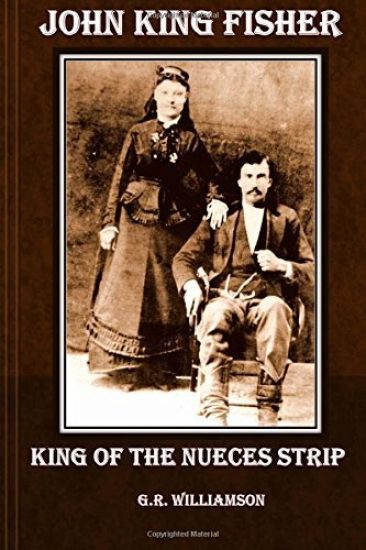
John King Fisher - King of the Nueces Strip From a Stock Marshal to cattle rustler to Deputy Sheriff, King Fisher was the undisputed ruler of the rough border brasada inhabited by outlaws of every description known as the "Nueces Strip." Even the famed Texas Rangers were fearful of his grip: IT IS A REIGN OF TERROR FROM THE MEN WHO INFEST THIS REGION. ...THE WHITE CITIZENS ARE ALL FRIENDS OF KING FISHER. THERE IS A REGULARLY ORGANIZED BAND OF DESPERADOES FROM GOLIAD TO THE HEADWATERS OF THE NUECES. THIS BAND IS MADE UP OF MEN WHO HAVE COMMITTED CRIMES IN OTHER STATES AND FLED FOR REFUGE HERE, WHERE THEY GO TO ROBBING FOR A LIVING. Flamboyant, he was described as wearing "a tres piedras sombrero, with a solid gold coiled rattler for the band and gold tassels. His shirt was of that heavy Mexico City silk, opened at the throat; and a silk, red bandanna was knotted around his neck." His pistols were nickel-plated Colt .45's and he knew how to use them, killing over a dozen men during his life as a bandit chieftain, later turned lawman. Known as one of the best pistol fighters of his day, John King Fisher has remained an enigma in the chronicles of the Western Frontier. While other gun fighters have achieved notoriety through the stories told in the pulp magazines and newspapers of the day, John King Fisher has been largely ignored. Fisher was credited with killing a string of men during his lifetime and the mere mention of his name was usually enough to sober up a drunken opponent or cause a sober man to contemplate his own epitaph. Oddly enough, Fisher was not a cold-blooded murder, but rather stand-up gun fighter that faced his adversaries in a winner-take-all shootout. Thoroughly researched and documented, this is John King Fisher's astounding true story. Readers' Favorite - 5-star review
The Vaudeville Theater Ambush of 1884 went down in history as one of the most famous gunfights in San Antonio, but the killing that night of Ben Thompson and John King Fisher, two of the most notorious pistoleers of the day, became something of a mystery. The two men entered the theatre just before midnight on March 11, and less than an hour later, both lay dead, shot down in what for all accounts was a true massacre. The responsible gunmen never were prosecuted for their crimes, and Thompson and Fisher--a mere mention of either man's name was enough to put the fear of death in any opponent--have been widely ignored since. Now, historian G.R. Williamson brings to light the mystery and the myths surrounding these men and their infamous deaths in Texas Pistoleers.
Now in it's fourth edition and thoroughly updated to ensure all content is mapped to the new 2018 NMC standards, this book is a practical and readable guide to undertaking a research project plan or a literature review for final year assessment. The book guides readers from start to finish, beginning with choosing a nursing topic and developing questions about it, then accessing and critically reviewing research literature, considering ethical issues, proposing research where applicable, and finally, writing up and completing the literature review or research proposal. The authors also explore how to translate evidence into practice and how this can improve day to day decision-making, as well as feeding into assessments.
Mapped to the 2018 NMC Standards and written directly for nursing students, this practical and straightforward book covers everything you need to know when conducting a literature or research project plan. Why do you need this book? - A clear and straightforward guide to support you throughout your final year assessment - Updated to include additional types of assessment including service improvement project plans - Takes you step-by-step through the process, from choosing a topic and research question, using and critiquing research, all the way to writing up and completing your project - Case studies and activities hone the critical thinking and decision-making skills you will need to secure top marks
Mapped to the 2018 NMC Standards and written directly for nursing students, this practical and straightforward book covers everything you need to know when conducting a literature or research project plan. Why do you need this book? - A clear and straightforward guide to support you throughout your final year assessment - Updated to include additional types of assessment including service improvement project plans - Takes you step-by-step through the process, from choosing a topic and research question, using and critiquing research, all the way to writing up and completing your project - Case studies and activities hone the critical thinking and decision-making skills you will need to secure top marks
A wide variety of factors impact on the scope of nursing practice, including government policies, organisational structures, the media, education, future healthcare directions and service users themselves. It is an NMC requirement that nurses understand these factors in order to deliver quality care. This book provides a clear and practical introduction to these contexts for the new nursing student. The new edition (formerly 'Nursing in Contemporary Healthcare Practice') has been revised to cover the organisational structures that students will find themselves working in, the various bodies involved in healthcare policy and the big issues in current and future healthcare delivery.
Action Research is becoming more popular in nursing and healthcare. It is used by practitioners who want to better understand and improve the quality of their work, and by students who need to do a research project for their course. An Action Research approach enables evidence-based care and links research directly to practice, making it the ideal method for a researcher in these fields. This book introduces readers to Action Research by presenting its key concepts and backing these up with practical examples throughout, often drawn from the authors' own extensive experience. Topics include: - Action research to advance patient care - Collaborative working - Ethics - Participatory Action Research - Writing up and disseminating projects Williamson, Bellman, and Webster - leading figures in the field - provide practical advice for using Action Research in healthcare settings, with patients and alongside other practitioners. Their book presents a flexible approach that can be adapted to researchers' real needs.
Action Research is becoming more popular in nursing and healthcare. It is used by practitioners who want to better understand and improve the quality of their work, and by students who need to do a research project for their course. An Action Research approach enables evidence-based care and links research directly to practice, making it the ideal method for a researcher in these fields. This book introduces readers to Action Research by presenting its key concepts and backing these up with practical examples throughout, often drawn from the authors' own extensive experience. Topics include: - Action research to advance patient care - Collaborative working - Ethics - Participatory Action Research - Writing up and disseminating projects Williamson, Bellman, and Webster - leading figures in the field - provide practical advice for using Action Research in healthcare settings, with patients and alongside other practitioners. Their book presents a flexible approach that can be adapted to researchers' real needs.
Gambling played a major role in the lives of the men that drove the western movement of Americans across the continent during the nineteenth century. Wherever there were men with money there was gambling. Saloons and gambling halls had a large array of games to entice customers to take a chance of walking out a winner - a very little chance. The soft slap of cards, the click of dice, and the rattle of a roulette wheel greeted players as they walked into the top saloons of the 1880's. But what were the games of that era? How were they played and why are most of the games not found in casinos today? Ante up and find out in this concise, compact book that takes you inside the frontier gambling saloons and gambling halls. Card games, dice games, and wheel games are vividly described with plenty of vintage photographs to illustrate how the games were played.