Kirjojen hintavertailu. Mukana 12 390 323 kirjaa ja 12 kauppaa.

Kirjahaku

Etsi kirjoja tekijän nimen, kirjan nimen tai ISBN:n perusteella.

1000 tulosta hakusanalla G.Bruce Doern; Richard Levesque

The National Research Council in the Innovation Policy Era

The National Research Council in the Innovation Policy Era

G.Bruce Doern; Richard Levesque

University of Toronto Press
2002
sidottu
In this first in-depth examination of the governance of the National Research Council of Canada (NRC) in over twenty-five years, G. Bruce Doern and Richard Levesque show how the agency's history is interwoven with the evolution of Canada's economic and industrial development and with the fostering of science at Canada's universities, in industry, and within the federal government. Using a policy and institutional approach, the authors demonstrate the ways in which the NRC has had to simultaneously absorb significant budgetary and personnel cuts and become, in its own structure and operations, an innovating institution that helps support and facilitate an innovating Canadian economy - one increasingly characterized by knowledge-based industries. By reconfiguring itself in terms of its institutional mix of hierarchies, networks, and markets, the NRC has had to confront and change its own traditions, yet maintain itself as a complex government agency that still values research for its own sake as a public good.
Rules and Unruliness

Rules and Unruliness

G. Bruce Doern; Michael J. Prince; Richard J. Schultz

McGill-Queen's University Press
2014
sidottu
A critical examination of Canadian regulatory governance and politics over the past fifty years, Rules and Unruliness builds on the theory and practice of rule-making to show why government "unruliness" - the inability to form rules and implement structures for compliance - is endemic and increasing. Analyzing regulatory politics and governance in Canada from the beginning of Pierre Trudeau's era to Stephen Harper's government, the authors present a compelling argument that current regulation of the economy, business, and markets are no longer adequate to protect Canadians. They examine rules embedded in public spending programs and rules regarding political parties and parliamentary government. They also look at regulatory capitalism to elucidate how Canada and most other advanced economies can be characterized by co-governance and co-regulation between governments, corporations, and business interest groups. Bringing together literature on public policy, regulation, and democracy, Rules and Unruliness is the first major study to show how and why increasing unruliness affects not only the regulation of economic affairs, but also the social welfare state, law and order, parliamentary democracy, and the changing face of global capitalism.
Rules and Unruliness

Rules and Unruliness

G. Bruce Doern; Michael J. Prince; Richard J. Schultz

McGill-Queen's University Press
2015
nidottu
A critical examination of Canadian regulatory governance and politics over the past fifty years, Rules and Unruliness builds on the theory and practice of rule-making to show why government "unruliness" - the inability to form rules and implement structures for compliance - is endemic and increasing. Analyzing regulatory politics and governance in Canada from the beginning of Pierre Trudeau's era to Stephen Harper's government, the authors present a compelling argument that current regulation of the economy, business, and markets are no longer adequate to protect Canadians. They examine rules embedded in public spending programs and rules regarding political parties and parliamentary government. They also look at regulatory capitalism to elucidate how Canada and most other advanced economies can be characterized by co-governance and co-regulation between governments, corporations, and business interest groups. Bringing together literature on public policy, regulation, and democracy, Rules and Unruliness is the first major study to show how and why increasing unruliness affects not only the regulation of economic affairs, but also the social welfare state, law and order, parliamentary democracy, and the changing face of global capitalism.
Power Switch

Power Switch

G.Bruce Doern; Monica Gattinger

University of Toronto Press
2003
sidottu
In the energy sector of Canadian economic and political life, power has a double meaning. It is quintessentially about the generation of power and physical energy. However, it is also about political power, the energy of the economy, and thus the overall governance of Canada. Power Switch offers a critical examination of the changing nature of energy regulatory governance, with a particular focus on Canada in the larger contexts of the George W. Bush administration's aggressive energy policies and within North American energy markets. Focusing on the key institutions and complex regimes of regulation, Bruce Doern and Monica Gattinger look at specific regulatory bodies such as the National Energy Board, the Alberta Energy and Utilities Board, and the Ontario Energy Board. They also examine the complex systems of rule making that develop as traditional energy regulation interacts and often collides with environmental and climate change regulation, such as the Kyoto Protocol on reducing greenhouse gas emissions. Power Switch is one of the first accounts in many years of Canada's overall energy regulatory system.
Power Switch

Power Switch

G.Bruce Doern; Monica Gattinger

University of Toronto Press
2003
pokkari
In the energy sector of Canadian economic and political life, power has a double meaning. It is quintessentially about the generation of power and physical energy. However, it is also about political power, the energy of the economy, and thus the overall governance of Canada. Power Switch offers a critical examination of the changing nature of energy regulatory governance, with a particular focus on Canada in the larger contexts of the George W. Bush administration's aggressive energy policies and within North American energy markets. Focusing on the key institutions and complex regimes of regulation, Bruce Doern and Monica Gattinger look at specific regulatory bodies such as the National Energy Board, the Alberta Energy and Utilities Board, and the Ontario Energy Board. They also examine the complex systems of rule making that develop as traditional energy regulation interacts and often collides with environmental and climate change regulation, such as the Kyoto Protocol on reducing greenhouse gas emissions. Power Switch is one of the first accounts in many years of Canada's overall energy regulatory system.
Strategic Science in the Public Interest

Strategic Science in the Public Interest

G.Bruce Doern; Jeff Kinder

University of Toronto Press
2007
sidottu
The past twenty years have seen considerable shifts and struggles in 'government science' - that is, in the way the state funds, supports, regulates, conducts and uses scientific and technological activity. Focusing on federal labs and agencies, Strategic Science in the Public Interest explores how these labs have been located within, and often buried by, the larger commercially-focused federal innovation agenda. G. Bruce Doern and Jeffrey S. Kinder examine four labs whose mandates deal with the Alberta oil sands, environmental technologies, wildlife research, and mining and metals, respectively. The authors use these cases to explain why a better middle-level approach to analysis is needed for strategic public interest-centred government science. They illustrate the importance of understanding the variety, as well as the similarity, of federal science and technology labs and agencies, and of instituting policies that reflect this diversity. The growing importance of Related Science Activities (RSA) is also explored, as well as the core trade-offs between commercial and public goods science in their mandates and their internal capacities.
Three Bio-Realms

Three Bio-Realms

G.Bruce Doern; Michael J. Prince

University of Toronto Press
2012
pokkari
Biotechnology has become one of the most important issues in public policy and governance, altering the boundaries between the public and the private, the economic and the social, and further complicating the divide between what is scientifically possible and ethically preferred. Given the importance of biotechnology in shaping relations between the state, science, the economy, and the citizenry, a book that explores the Canadian biotechnology regime and its place in our democracy is timelier than ever. Three Bio-Realms provides the first integrated examination of the thirty-year story of the democratic governance of biotechnology in Canada. G. Bruce Doern and Michael J. Prince, two recognized specialists in governance innovation and social policy, look at particular ‘network-based’ factors that seek to promote and to regulate biotechnology inside the state as well as at broader levels. Unmatched by any other book in its historical scope and range, Three Bio-Realms is sure to be read for years to come.
Three Bio-Realms

Three Bio-Realms

G.Bruce Doern; Michael J. Prince

University of Toronto Press
2012
sidottu
Biotechnology has become one of the most important issues in public policy and governance, altering the boundaries between the public and the private, the economic and the social, and further complicating the divide between what is scientifically possible and ethically preferred. Given the importance of biotechnology in shaping relations between the state, science, the economy, and the citizenry, a book that explores the Canadian biotechnology regime and its place in our democracy is timelier than ever. Three Bio-Realms provides the first integrated examination of the thirty-year story of the democratic governance of biotechnology in Canada. G. Bruce Doern and Michael J. Prince, two recognized specialists in governance innovation and social policy, look at particular ‘network-based’ factors that seek to promote and to regulate biotechnology inside the state as well as at broader levels. Unmatched by any other book in its historical scope and range, Three Bio-Realms is sure to be read for years to come.
Keeping Canada Running

Keeping Canada Running

G. Bruce Doern; Christopher Stoney; Robert Hilton

McGill-Queen's University Press
2021
sidottu
The federal government's promises to "build back better" and "build back green" highlight opportunities to reimagine Canadian infrastructure. In this groundbreaking study, authors Bruce Doern, Christopher Stoney, and Robert Hilton provide the first comprehensive overview of Canadian infrastructure policy, examining the impact and implications of the COVID-19 pandemic and rapid technological change as Canada looks to recover and rebuild.Covering more than fifty years across many sectors, the authors identify numerous challenges that have contributed to Canada's growing infrastructure deficit and suboptimal outcomes including political interference in the choice of infrastructure projects; challenges for multilevel governance such as distortion of local priorities, blurred accountability, and unsustainable maintenance costs for municipalities; the growing reliance on public-private partnerships that limit transparency and public scrutiny; and increased corruption associated with infrastructure projects.Transforming infrastructure is notoriously difficult yet vital at a time of rapid technological change. It is estimated that 75 percent of the infrastructure that will exist in 2050 does not exist today. This makes it crucial that Canada invest in future-proof infrastructure with the capacity to facilitate economic growth and the expansion of urban centres, mitigate and adapt to the impacts of climate change, and ensure resilience in response to crises and disasters. Keeping Canada Running offers a timely assessment of these issues, Canada's COVID-19 response, and the potential contribution of the newly launched Canadian Infrastructure Bank.
The Politics of Energy

The Politics of Energy

G. Bruce Doern; Glen Toner

Routledge
2019
sidottu
Originally published in 1985. This in-depth analysis of federal energy policy and politics in the oil and gas sector critically evaluates the National Energy Program, one of the most controversial and wide-ranging policy initiatives in Canadian history - an import case study. Bridging Canadian politics and public policy, the book gives an historical overview of the development of energy policy since 1945, examining the shifts in the balance of power between public and private energy interests. It presents the NEP’s positive and negative impacts on energy policy and the nature of political power.
The Politics of Energy

The Politics of Energy

G. Bruce Doern; Glen Toner

Routledge
2021
nidottu
Originally published in 1985. This in-depth analysis of federal energy policy and politics in the oil and gas sector critically evaluates the National Energy Program, one of the most controversial and wide-ranging policy initiatives in Canadian history - an import case study. Bridging Canadian politics and public policy, the book gives an historical overview of the development of energy policy since 1945, examining the shifts in the balance of power between public and private energy interests. It presents the NEP’s positive and negative impacts on energy policy and the nature of political power.
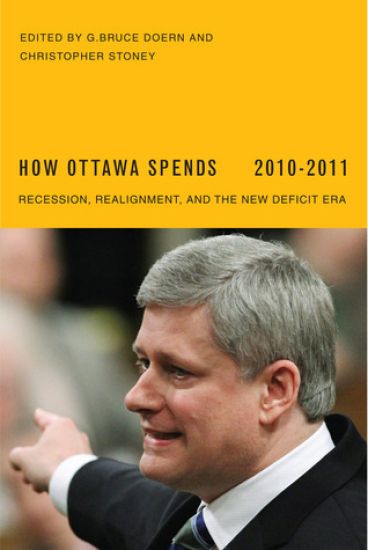
How Ottawa Spends, 2010-2011

How Ottawa Spends, 2010-2011

G. Bruce Doern; Christopher Stoney

McGill-Queen's University Press
2010
nidottu
Continuing the excellent standards and traditions of timely scholarship, the 2010-2011 edition of "How Ottawa Spends" critically examines national politics, priorities, and policies with emphasis on federal economic and social spending. Given the political and budgetary challenges posed by the recession, this year's instalment pays close attention to the growing fiscal deficit. Informed authors from across Canada examine recession-related policy fields, including the Canadian Banking system, new industrial policy pressures such as the automotive industry bailout, policies in science, technology, and innovation, and suggestions about how to resist the United States' 'buy America' trade policies. The essays in this volume also consider Canada's national, regional, and political divisiveness, the impact of the dynamic Obama Administration on Canadian domestic affairs, and governance during a time of minority government.
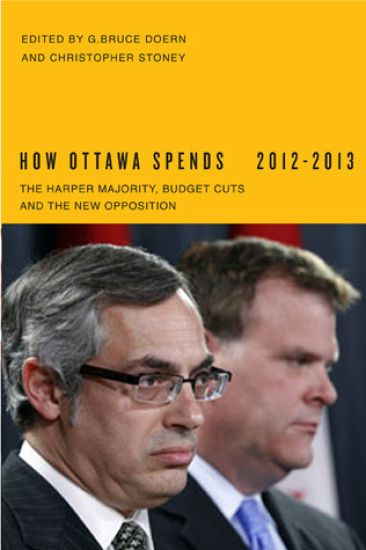
How Ottawa Spends, 2012-2013

How Ottawa Spends, 2012-2013

G. Bruce Doern; Christopher Stoney

McGill-Queen's University Press
2012
nidottu
Continuing its tradition of current, exemplary scholarship, the 2012-13 edition of How Ottawa Spends casts a critical eye at national politics, priorities, and policies, with an emphasis on the Conservative majority's mandated austerity measures and budget-cutting strategies. Leading scholars from across Canada examine a new era of majority government and a transformed political opposition both in Parliament and in provincial politics. Several closely linked political, policy, and spending realms are examined, including corporate tax reform, Conservative Party social policy, regional economic development, science and technology investments, Canada-US perimeter security and trade agreements, the rise and fall of regulatory regimes, and Canadian health care. Related governance issues such as federal infrastructure program impacts, the Harper government's Economic Action Plan impacts in Ontario, and community colleges in the federal innovation agenda, are also discussed in detail.
Canadian Public Budgeting in the Age of Crises

Canadian Public Budgeting in the Age of Crises

G. Bruce Doern; Allan M. Maslove; Michael J. Prince

McGill-Queen's University Press
2013
sidottu
In the aftermath of the 2008 financial crunch, a pending era of budgetary austerity looms over Canada. Canadian Public Budgeting in the Age of Crises provides a roadmap through the difficult fiscal decisions that have characterized contemporary federal politics across four decades. The authors provide an accessible and comprehensive overview of the constraints that have affected budgetary outcomes in the recent past and that will affect the near future, with analysis spanning micro, macro, social, environmental, and intergenerational domains. They examine the current Harper government's Conservative era, but also look at public budgeting under Chretien, Mulroney, and Trudeau. Set in the crucial context of macroeconomic policy shifts and in a global comparative context, Canadian Public Budgeting in the Age of Crises broadens and deepens our understanding of government spending, borrowing, and taxing. Budgetary domains - complex realms of fiscal content, choice, and governance - are introduced and balanced against an analysis of these domains with pertinent and up-to-date discussions on institutional influences, dominant actors, and shifting power imbalances.