Kirjojen hintavertailu. Mukana 11 244 527 kirjaa ja 12 kauppaa.

Kirjahaku

Etsi kirjoja tekijän nimen, kirjan nimen tai ISBN:n perusteella.

122 tulosta hakusanalla Gallarotti Giulio M.

Cosmopolitan Power in International Relations

Cosmopolitan Power in International Relations

Gallarotti Giulio M.

Cambridge University Press
2010
sidottu
How can nations optimize their power in the modern world system? Realist theory has underscored the importance of hard power as the ultimate path to national strength. In this vision, nations require the muscle and strategies to compel compliance and achieve their full power potential. But in fact, changes in world politics have increasingly encouraged national leaders to complement traditional power resources with more enlightened strategies oriented around the use of soft power resources. The resources to compel compliance have to be increasingly integrated with the resources to cultivate compliance. Only through this integration of hard and soft power can nations truly achieve their greatest strength in modern world politics, and this realization carries important implications for competing paradigms of international relations. The idea of power optimization can only be delivered through the integration of the three leading paradigms of international relations: Realism, Neoliberalism, and Constructivism.
Cosmopolitan Power in International Relations

Cosmopolitan Power in International Relations

Giulio M. Gallarotti

Cambridge University Press
2010
pokkari
How can nations optimize their power in the modern world system? Realist theory has underscored the importance of hard power as the ultimate path to national strength. In this vision, nations require the muscle and strategies to compel compliance and achieve their full power potential. But in fact, changes in world politics have increasingly encouraged national leaders to complement traditional power resources with more enlightened strategies oriented around the use of soft power resources. The resources to compel compliance have to be increasingly integrated with the resources to cultivate compliance. Only through this integration of hard and soft power can nations truly achieve their greatest strength in modern world politics, and this realization carries important implications for competing paradigms of international relations. The idea of power optimization can only be delivered through the integration of the three leading paradigms of international relations: Realism, Neoliberalism, and Constructivism.

A History of International Monetary Diplomacy, 1867 to the Present
This book is about how the rise of democracy has transformed economics over the past 150 years. As voting was expanded to the masses in the late 19th century, political leaders faced emergent pressures to deliver prosperity to their newly enfranchised populations. This led to the rise of the guardian state: a state whose prime directive was to protect economic growth and employment. Domestic economic goals now became sacrosanct, and if that meant a failure on the international stage to construct solutions to problems in monetary relations, so be it.The book traces the history of international monetary diplomacy during this long period to show how the guardian state has manifested itself, and how it has shaped the course of international monetary relations. Each of the most important international monetary conferences in history is scrutinized with respect to how nations sought to protect the prosperity within their national economies. The historical narratives give a bird’s-eye view into how domestic political priorities have intruded on and shaped economic relations among nations.The book clearly demonstrates the advantages of an interdisciplinary understanding of how politics shapes economics. It will be invaluable reading for scholars and students of international economics, politics and economic history.
A History of International Monetary Diplomacy, 1867 to the Present
This book is about how the rise of democracy has transformed economics over the past 150 years. As voting was expanded to the masses in the late 19th century, political leaders faced emergent pressures to deliver prosperity to their newly enfranchised populations. This led to the rise of the guardian state: a state whose prime directive was to protect economic growth and employment. Domestic economic goals now became sacrosanct, and if that meant a failure on the international stage to construct solutions to problems in monetary relations, so be it.The book traces the history of international monetary diplomacy during this long period to show how the guardian state has manifested itself, and how it has shaped the course of international monetary relations. Each of the most important international monetary conferences in history is scrutinized with respect to how nations sought to protect the prosperity within their national economies. The historical narratives give a bird’s-eye view into how domestic political priorities have intruded on and shaped economic relations among nations.The book clearly demonstrates the advantages of an interdisciplinary understanding of how politics shapes economics. It will be invaluable reading for scholars and students of international economics, politics and economic history.
The Anatomy of an International Monetary Regime

The Anatomy of an International Monetary Regime

Guilio M. Gallarotti

Oxford University Press Inc
1995
sidottu
This book is a historical analysis of the gold standard from 1880-1914 focusing on the origins and workings of the gold standard as an international system. The system functioned smoothly until the onset of the First World War, when the foundations began to weaken. By the end of the 1920s the gold standard had been abandoned by most countries until the disastrous attempt to revive it in the 1930s. This book is comprehensive and definitive.
Multilayer Network Science

Multilayer Network Science

Oriol Artime; Barbara Benigni; Giulia Bertagnolli; Valeria d'Andrea; Riccardo Gallotti; Arsham Ghavasieh; Sebastian Raimondo; Manlio De Domenico

Cambridge University Press
2022
pokkari
Networks are convenient mathematical models to represent the structure of complex systems, from cells to societies. In the last decade, multilayer network science – the branch of the field dealing with units interacting in multiple distinct ways, simultaneously – was demonstrated to be an effective modeling and analytical framework for a wide spectrum of empirical systems, from biopolymers networks (such as interactome and metabolomes) to neuronal networks (such as connectomes), from social networks to urban and transportation networks. In this Element, a decade after one of the most seminal papers on this topic, the authors review the most salient features of multilayer network science, covering both theoretical aspects and direct applications to real-world coupled/interdependent systems, from the point of view of multilayer structure, dynamics and function. The authors discuss potential frontiers for this topic and the corresponding challenges in the field for the next future.
Nonlinear Evolution and Chaotic Phenomena

Nonlinear Evolution and Chaotic Phenomena

Giovanni Gallavotti; Paul F. Zweifel

Springer-Verlag New York Inc.
2011
nidottu
This volume represents the proceedings of a NATO Advanced Study Institute held at Noto, Sicily June 8-19, 1987. The director was Giovanni Gallavotti, Roma, with co-directors Marcello Anile, Catania and P. F. Zweifel, Virginia Tech. Other members of the scientific organizing committee included Mitchell Feigenbaum, Rockefeller University and David Ruelle, IHES. The attendance at the school consisted of 23 invited speakers and approximately 80 "students", the term student being in quotation marks because many of them were of post-doctoral or even professorial status, although there were also a goodly number of actual graduate students in attendance also. Because of the disparate background of these "students", it was felt advisable to include at the conference special tutorials each afternoon, in which the contents of the morning's lectures were reviewed and clarified as necessary. These tutorials, organized by Gallavotti, involved various of the speakers, organizers, and other senior members of the school, and contributed in no little way to the overall success of the school. The organizers of the school would like to take this opportunity to thank all of those who assisted in these sessions, and to assure them that the results were definitely worth the effort. Also contributing to the success of the school were a number of contributed papers, presented during the course of the afternoon tutorials. Three of those papers are included in these proceedings; they are the papers of DiFrancesco; Gallimbeni, Miari and Sertorio (presented by Sertorio); and Vittot.
Tutto quello che avremmo voluto sapere sul SUICIDIO

Tutto quello che avremmo voluto sapere sul SUICIDIO

Eugenio Gallavotti; Mario Savino

Lulu.com
2020
nidottu
Libro vincitore del primo premio "Pergola Arte Firenze" sezione Saggistica. Gli autori sono speciali: Eugenio Gallavotti e un giornalista che nel 2002 ha conosciuto il momento piu buio della sua vita, Mario Savino e lo psichiatra che ha favorito il suo percorso ulteriore. A doverosa distanza di anni, hanno voluto trasmettere ai lettori la loro storia personale e le loro esperienze, forti anche delle ultime scoperte scientifiche che hanno squarciato il velo sull'identikit del potenziale suicida. Un pamphlet che fa anche giustizia di stigmi e luoghi comuni. Un pamphlet di speranza per milioni di persone che soffrono di depressione e per i loro amici e familiari.
Everything we always wanted to know about SUICIDE

Everything we always wanted to know about SUICIDE

Eugenio Gallavotti; Mario Savino

Lulu.com
2020
nidottu
Winner of the first prize "Pergola Arte" in Florence, essay section.The authors are special: Eugenio Gallavotti is a journalist who met the darkest moment of his life (in 2002), Mario Savino is the psychiatrist who saved his life. After many years, they wanted to pass on to their readers their personal stories and their experiences, also thanks to the latest scientific discoveries about the identikit of potential suicide. A pamphlet that also does justice to so many cliches, still repurposed even by press, for example when they write "incomprehensible gesture" or "mysterious" in the titles of articles referring to a suicide. There is no mystery: in the vast majority of cases, suicide is simply the most dramatic epilogue of a widespread disease, depressive disorder, sometimes underestimated / not recognized even by sufferers.
Nonequilibrium and Irreversibility

Nonequilibrium and Irreversibility

Giovanni Gallavotti

Springer International Publishing AG
2025
nidottu
This 2nd edition of the book focuses on the properties of stationary states in chaotic systems of particles or fluids, setting aside the theory of how these states are achieved. The second edition has been thoroughly revised and includes numerous corrections. It incorporates recent findings, with particular emphasis on the equivalence between irreversible and reversible equations. The ongoing debate over reversibility and irreversible behavior is frequently discussed. The book seeks to unify the study of stationary nonequilibrium states with that of equilibrium states, using the paradigm offered by the simplest chaotic systems, specifically Anosov systems. The book begins by exploring the time-invariant distributions relevant to physics. A distinctive feature of this work is its historical approach. To clarify foundational issues, the author analyzes the works of pioneering figures like Boltzmann, Clausius, and Maxwell, including translated excerpts of key historical documents. Additionally, the author establishes a close connection between the treatment of irreversible phenomena in statistical mechanics and the theory of chaotic systems, particularly at and beyond the onset of turbulence, as developed by Sinai, Ruelle, and Bowen (SRB) and others. Arguments are presented to strongly support the perspective that stationary states, whether in equilibrium or not, can be described in a unified framework. The book offers extensive coverage of contemporary research, presented in sufficient detail to give advanced students a sense of the ongoing research directions in this dynamic field. Proofs of theorems are generally limited to heuristic outlines, favoring the presentation of concepts and providing references for further study, thereby avoiding an overload of technical detail in the main text.
Nonequilibrium and Irreversibility

Nonequilibrium and Irreversibility

Giovanni Gallavotti

Springer International Publishing AG
2014
sidottu
This book concentrates on the properties of the stationary states in chaotic systems of particles or fluids, leaving aside the theory of the way they can be reached. The stationary states of particles or of fluids (understood as probability distributions on microscopic configurations or on the fields describing continua) have received important new ideas and data from numerical simulations and reviews are needed. The starting point is to find out which time invariant distributions come into play in physics. A special feature of this book is the historical approach. To identify the problems the author analyzes the papers of the founding fathers Boltzmann, Clausius and Maxwell including translations of the relevant (parts of) historical documents. He also establishes a close link between treatment of irreversible phenomena in statistical mechanics and the theory of chaotic systems at and beyond the onset of turbulence as developed by Sinai, Ruelle, Bowen (SRB) and others: the author gives arguments intending to support strongly the viewpoint that stationary states in or out of equilibrium can be described in a unified way. In this book it is the "chaotic hypothesis", which can be seen as an extension of the classical ergodic hypothesis to non equilibrium phenomena, that plays the central role. It is shown that SRB - often considered as a kind of mathematical playground with no impact on physical reality - has indeed a sound physical interpretation; an observation which to many might be new and a very welcome insight. Following this, many consequences of the chaotic hypothesis are analyzed in chapter 3 - 4 and in chapter 5 a few applications are proposed. Chapter 6 is historical: carefully analyzing the old literature on the subject, especially ergodic theory and its relevance for statistical mechanics; an approach which gives the book a very personal touch. The book contains an extensive coverage of current research (partly from the authors and his coauthorspublications) presented in enough detail so that advanced students may get the flavor of a direction of research in a field which is still very much alive and progressing. Proofs of theorems are usually limited to heuristic sketches privileging the presentation of the ideas and providing references that the reader can follow, so that in this way an overload of this text with technical details could be avoided.
Nonequilibrium and Irreversibility

Nonequilibrium and Irreversibility

Giovanni Gallavotti

Springer International Publishing AG
2016
nidottu
This book concentrates on the properties of the stationary states in chaotic systems of particles or fluids, leaving aside the theory of the way they can be reached. The stationary states of particles or of fluids (understood as probability distributions on microscopic configurations or on the fields describing continua) have received important new ideas and data from numerical simulations and reviews are needed. The starting point is to find out which time invariant distributions come into play in physics. A special feature of this book is the historical approach. To identify the problems the author analyzes the papers of the founding fathers Boltzmann, Clausius and Maxwell including translations of the relevant (parts of) historical documents. He also establishes a close link between treatment of irreversible phenomena in statistical mechanics and the theory of chaotic systems at and beyond the onset of turbulence as developed by Sinai, Ruelle, Bowen (SRB) and others: the author gives arguments intending to support strongly the viewpoint that stationary states in or out of equilibrium can be described in a unified way. In this book it is the "chaotic hypothesis", which can be seen as an extension of the classical ergodic hypothesis to non equilibrium phenomena, that plays the central role. It is shown that SRB - often considered as a kind of mathematical playground with no impact on physical reality - has indeed a sound physical interpretation; an observation which to many might be new and a very welcome insight. Following this, many consequences of the chaotic hypothesis are analyzed in chapter 3 - 4 and in chapter 5 a few applications are proposed. Chapter 6 is historical: carefully analyzing the old literature on the subject, especially ergodic theory and its relevance for statistical mechanics; an approach which gives the book a very personal touch. The book contains an extensive coverage of current research (partly from the authors and his coauthorspublications) presented in enough detail so that advanced students may get the flavor of a direction of research in a field which is still very much alive and progressing. Proofs of theorems are usually limited to heuristic sketches privileging the presentation of the ideas and providing references that the reader can follow, so that in this way an overload of this text with technical details could be avoided.
Aspects of Ergodic, Qualitative and Statistical Theory of Motion

Aspects of Ergodic, Qualitative and Statistical Theory of Motion

Giovanni Gallavotti; Federico Bonetto; Guido Gentile

Springer-Verlag Berlin and Heidelberg GmbH Co. K
2004
sidottu
Intended for beginners in ergodic theory, this book addresses students as well as researchers in mathematical physics. The main novelty is the systematic treatment of characteristic problems in ergodic theory by a unified method in terms of convergent power series and renormalization group methods, in particular. Basic concepts of ergodicity, like Gibbs states, are developed and applied to, e.g., Asonov systems or KAM Theory. Many examples illustrate the ideas and, in addition, a substantial number of interesting topics are treated in the form of guided problems.
Foundations of Fluid Dynamics

Foundations of Fluid Dynamics

Giovanni Gallavotti

Springer-Verlag Berlin and Heidelberg GmbH Co. K
2001
sidottu
The imagination is struck by the substantial conceptual identity between the problems met in the theoretical study of physical phenomena. It is absolutely unexpected and surprising, whether one studies equilibrium statistical me­ chanics, or quantum field theory, or solid state physics, or celestial mechanics, harmonic analysis, elasticity, general relativity or fluid mechanics and chaos in turbulence. So when in 1988 I was made chair of Fluid Mechanics at the Universita La Sapienza, not out of recognition of work I did on the subject (there was none) but, rather, to avoid my teaching mechanics, from which I could have a strong cultural influence on mathematical physics in Rome, I was not excessively worried, although I was clearly in the wrong place. The subject is wide, hence in the last decade I could do nothing else but go through books and libraries looking for something that was within the range of the methods and experiences of my past work. The first great surprise was to realize that the mathematical theory of fluids is in an even more primitive state than I was aware of. Nevertheless it still seems to me that a detailed analysis of the mathematical problems is essential for anyone who wishes to do research into fluids. Therefore, I dedicated (Chap. 3) all the space necessary to a complete exposition of the theories of Leray, of Scheffer and of Caffarelli, Kohn and Nirenberg, taken directly from the original works.
Statistical Mechanics

Statistical Mechanics

Giovanni Gallavotti

Springer-Verlag Berlin and Heidelberg GmbH Co. K
1999
sidottu
This clear book presents a critical and modern analysis of the conceptual foundations of statistical mechanics as laid down in Boltzmann's works. The author emphasises the relation between microscopic reversibility and macroscopic irreversibility, explaining fundamental concepts in detail.
Aspects of Ergodic, Qualitative and Statistical Theory of Motion

Aspects of Ergodic, Qualitative and Statistical Theory of Motion

Giovanni Gallavotti; Federico Bonetto; Guido Gentile

Springer-Verlag Berlin and Heidelberg GmbH Co. K
2010
nidottu
Intended for beginners in ergodic theory, this book addresses students as well as researchers in mathematical physics. The main novelty is the systematic treatment of characteristic problems in ergodic theory by a unified method in terms of convergent power series and renormalization group methods, in particular. Basic concepts of ergodicity, like Gibbs states, are developed and applied to, e.g., Asonov systems or KAM Theory. Many examples illustrate the ideas and, in addition, a substantial number of interesting topics are treated in the form of guided problems.
Foundations of Fluid Dynamics

Foundations of Fluid Dynamics

Giovanni Gallavotti

Springer-Verlag Berlin and Heidelberg GmbH Co. K
2010
nidottu
The imagination is struck by the substantial conceptual identity between the problems met in the theoretical study of physical phenomena. It is absolutely unexpected and surprising, whether one studies equilibrium statistical me­ chanics, or quantum field theory, or solid state physics, or celestial mechanics, harmonic analysis, elasticity, general relativity or fluid mechanics and chaos in turbulence. So when in 1988 I was made chair of Fluid Mechanics at the Universita La Sapienza, not out of recognition of work I did on the subject (there was none) but, rather, to avoid my teaching mechanics, from which I could have a strong cultural influence on mathematical physics in Rome, I was not excessively worried, although I was clearly in the wrong place. The subject is wide, hence in the last decade I could do nothing else but go through books and libraries looking for something that was within the range of the methods and experiences of my past work. The first great surprise was to realize that the mathematical theory of fluids is in an even more primitive state than I was aware of. Nevertheless it still seems to me that a detailed analysis of the mathematical problems is essential for anyone who wishes to do research into fluids. Therefore, I dedicated (Chap. 3) all the space necessary to a complete exposition of the theories of Leray, of Scheffer and of Caffarelli, Kohn and Nirenberg, taken directly from the original works.
Statistical Mechanics

Statistical Mechanics

Giovanni Gallavotti

Springer-Verlag Berlin and Heidelberg GmbH Co. K
2010
nidottu
This clear book presents a critical and modern analysis of the conceptual foundations of statistical mechanics as laid down in Boltzmann's works. The author emphasises the relation between microscopic reversibility and macroscopic irreversibility, explaining fundamental concepts in detail.
The Elements of Mechanics

The Elements of Mechanics

Giovanni Gallavotti

Springer-Verlag Berlin and Heidelberg GmbH Co. K
2013
nidottu
The word "elements" in the title of this book does not convey the implica­ tion that its contents are "elementary" in the sense of "easy": it mainly means that no prerequisites are required, with the exception of some basic background in classical physics and calculus. It also signifies "devoted to the foundations". In fact, the arguments chosen are all very classical, and the formal or technical developments of this century are absent, as well as a detailed treatment of such problems as the theory of the planetary motions and other very concrete mechanical problems. This second meaning, however, is the result of the necessity of finishing this work in a reasonable amount of time rather than an a priori choice. Therefore a detailed review of the "few" results of ergodic theory, of the "many" results of statistical mechanics, of the classical theory of fields (elasticity and waves), and of quantum mechanics are also totally absent; they could constitute the subject of two additional volumes on mechanics. This book grew out of several courses on meccanica razionaie, i.e., essentially, theoretical mechanics, which I gave at the University of Rome during the years 1975-1978.
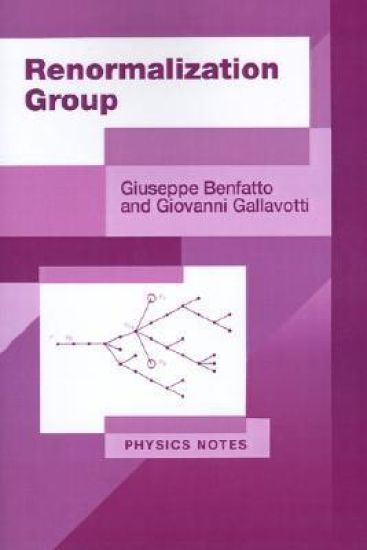
Renormalization Group

Renormalization Group

Giuseppe Benfatto; Giovanni Gallavotti

Princeton University Press
1995
pokkari
Scaling and self-similarity ideas and methods in theoretical physics have, in the last twenty-five years, coalesced into renormalization-group methods. This book analyzes, from a single perspective, some of the most important applications: the critical-point theory in classical statistical mechanics, the scalar quantum field theories in two and three space-time dimensions, and Tomonaga's theory of the ground state of one-dimensional Fermi systems. The dimension dependence is discussed together with the related existence of anomalies (in Tomonaga's theory and in 4 -e dimensions for the critical point). The theory of Bose condensation at zero temperature in three space dimensions is also considered. Attention is focused on results that can in principle be formally established from a mathematical point of view. The 4 -e dimensions theory, Bose condensation, as well as a few other statements are exceptions to this rule, because no complete treatment is yet available. However, the truly mathematical details are intentionally omitted and only referred to. This is done with the purpose of stressing the unifying conceptual structure rather than the technical differences or subtleties.