Kirjojen hintavertailu. Mukana 11 213 693 kirjaa ja 12 kauppaa.

Kirjahaku

Etsi kirjoja tekijän nimen, kirjan nimen tai ISBN:n perusteella.

1000 tulosta hakusanalla Gary B Agee

That We May Be One

That We May Be One

Gary B Agee

WILLIAM B EERDMANS PUBLISHING CO
2022
pokkari
Transcending divisions and healing the broken Body of Christ. Disunity is a reality within churches today. Left unaddressed, political disagreements and racial inequities can fester into misunderstanding, resentment, and anger. But often the act of addressing this discord prompts further animosity, widening fissures into gaping fault lines between fellow members of the same community. Gary Agee, a pastor well-versed in leading diverse congregations, reflects here on the roots of division within the church and the virtues and practices that can promote the restoration of unity. With disarming honesty and humility, Agee offers sage advice gleaned from Scripture and years of practical experience to show how we might fulfill Jesus's prayer on behalf of the church: "That all of them may be one, Father, just as you are in me and I am in you. . . . That they may be one as we are one." At the end of each chapter, Agee includes exercises, discussion questions, and suggested practices, providing a concrete path to unity through dialogue and action.
Daniel Rudd

Daniel Rudd

Gary B Agee

Liturgical Press
2017
pokkari
In May of 1890, The Christian Solider, an African American newspaper, identified the Catholic journalist and activist Daniel Arthur Rudd as the “greatest negro Catholic in America.” Yet many Catholics today are unaware of Rudd's efforts to bring about positive social change during the early decades of the Jim Crow era. In Daniel Rudd: Calling a Church to Justice, Gary Agee offers a compelling look at the life and work of this visionary who found inspiration in his Catholic faith to fight for the principles of liberty and justice. Born into slavery, Rudd achieved success early on as the publisher of the American Catholic Tribune, one of the most successful black newspapers of its era, and as the founder of the National Black Catholic Congress.Even as Rudd urged his fellow black Catholics to maintain their spiritual home within the fold of the Catholic Church, he called on that same church to live up what he believed to be her cardinal teaching, "the Fatherhood of God and Brotherhood of Man." Rudd’s hopeful spirit lives on today in the important work of the National Black Catholic Congress, as it carries forward his pursuit of social justice.
A Cry for Justice

A Cry for Justice

Gary B. Agee

University of Arkansas Press
2017
nidottu
Daniel A. Rudd, born a slave in Bardstown, Kentucky, grew up to achieve much in the years following the Civil War. His Catholic faith, passion for activism, and talent for writing led him to increasingly influential positions in many places. One of his important early accomplishments was the publication of the American Catholic Tribune, which Rudd referred to as ""the only Catholic journal owned and published by colored men."" At its zenith, the Tribune, run out of Detroit and Cincinnati, where Rudd lived, had ten thousand subscribers, making it one of the most successful black newspapers in the country. Rudd was also active in the leadership of the Afro-American Press Association, and he was a founding member of the Catholic Press Association. By 1889, Rudd was one of the nation's best-known black Catholics. His work was endorsed by a number of high-ranking church officials in Europe as well as in the United States, and he was one of the founders of the Lay Catholic Congress movement. Later, his travels took him to Bolivar County, Mississippi, and eventually on to Forrest City, Arkansas, where he worked for the well-known black farmer and businessperson, Scott Bond, and eventually co-wrote Bond's biography.
The Last Testament of Bill Bonanno

The Last Testament of Bill Bonanno

Gary B Abromovitz; Bill Bonanno

HarperPaperbacks
2011
nidottu
An eye-opening look at life--and death--inside the Mafia, The Last Testament of Bill Bonanno is a stunning document written by the son of notorious crime boss Joe Bonanno. Published at the author's request after his death, The Last Testament of Bill Bonanno provides highly confidential secrets about the inner workings of La Cosa Nostra--offering a behind-closed-doors look at the secret Commission meetings of the '30s through '60s and clandestine details of the Mafia's most venerable rituals, techniques, and indoctrination ceremonies...plus pages of never-before-seen photos. Bonanno's Last Testament stands alongside Talese's Honor Thy Father, Pileggi's Wiseguys, Maas's The Valachi Papers and Underboss, The Good Rat by Jimmy Breslin, and T.J. English's Havana Nocturne as an essential work of contemporary crime history--a must-read for fans of The Sopranos and The Godfather.
The Unknown American Revolution: The Unruly Birth of Democracy and the Struggle to Create America
An exploration of the ideas and radical sentiments that prompted the American Revolution cites uprisings within every facet of American society, arguing that the war was a people's revolution and civil war, as well as an insurrection against colonial control. By the author of Red, White, and Black. Reprint. 25,000 first printing.
The Maze of Banking

The Maze of Banking

Gary B. Gorton

Oxford University Press Inc
2015
sidottu
Financial crises are devastating in human and economic terms. To avoid the next one, it is important to understand the recent financial crisis of 2007-2008 and the financial eras which preceded it. Gary Gorton has been studying financial crises since his 1983 PhD thesis, "Banking Panics." The Maze of Banking contains a collection of his academic papers on the subjects of banks, banking, and financial crises. The papers in this volume span almost 175 years of U.S. banking history, from pre-U.S. Civil War private bank notes issued during the U.S. Free Banking Era (1837-1863); followed by the U.S. National Banking Era (1863-1914) before there was a central bank; through loan sales, securitization, and the financial crisis of 2007-2008. Banking changed profoundly during these 175 years, yet it did not change in fundamental ways. The forms of money changed, resulting in associated changes in the information structure of the economy. Bank debt evolved as an instrument for storing value, smoothing consumption, and transactions, but its fundamental nature did not change. In all its forms, it is vulnerable to bank runs without government intervention. These papers provide the framework for understanding how the financial crisis of 2007-2008 developed and what can be done to promote a stabile banking industry and prevent future economic crises.
Freedom by Degrees

Freedom by Degrees

Gary B. Nash; Jean R. Soderlund

Oxford University Press Inc
1991
sidottu
This book shows how slavery ended within a single generation at the end of the eighteenth century in the important colony/state of Pennsylvania. The authors have made a study of the slaveholders themselves in order to understand the process by which most slaves were given freedom without legislative or judicial efforts and without compensation to their masters. The book also traces a number of individual cases which show the varying processes by which slaves brought pressure for emancipation. This book represents a major milestone in our understanding of slavery and how it was effectively abolished.
Slapped by the Invisible Hand

Slapped by the Invisible Hand

Gary B. Gorton

Oxford University Press Inc
2010
sidottu
Originally written for a conference of the Federal Reserve, Gary Gorton's "The Panic of 2007" garnered enormous attention and is considered by many to be the most convincing take on the recent economic meltdown. Now, in Slapped by the Invisible Hand, Gorton builds upon this seminal work, explaining how the securitized banking system, the nexus of financial markets and instruments unknown to most people, stands at the heart of the financial crisis. The securitized banking system is, in fact, a real banking system, allowing institutional investors and firms to make large, short-term deposits. But, as any banking system, it was vulnerable to a panic. Indeed the events starting in August 2007 can best be understood as a panic-a wholesale panic, rather than a retail panic-involving financial firms "running" on other financial firms, resulting in the system becoming insolvent. As the financial crisis unfolded, Gorton was working inside an institution that played a central role in the collapse; thus this book presents the unparalleled perspective of a top scholar who was also a central insider.
Misunderstanding Financial Crises

Misunderstanding Financial Crises

Gary B. Gorton

Oxford University Press Inc
2012
sidottu
Prior to the financial crisis of 2007-2008, economists thought that no such crisis could or would ever happen again in the United States, that financial events of such magnitude were a thing of the distant past. In fact, observers of that distant past--the period from the half century prior to the Civil War up to the passage of deposit insurance during the Great Depression, which was marked by repeated financial crises--note that while legislation immediately after crises reacted to their effects, economists and policymakers continually failed to grasp the true lessons to be learned. Gary Gorton, considered by many to be the authority on the financial crisis of our time, holds that economists fundamentally misunderstand financial crises--what they are, why they occur, and why there were none in the U.S. between 1934 and 2007. In Misunderstanding Financial Crises, he illustrates that financial crises are inherent to the production of bank debt, which is used to conduct transactions, and that unless the government designs intelligent regulation, crises will continue. Economists, he writes, looked from a certain point of view and missed everything that was important: the evolution of capital markets and the banking system, the existence of new financial instruments, and the size of certain money markets like the sale and repurchase market. Delving into how such a massive intellectual failure could have happened, Gorton offers a back-to-basics elucidation of financial crises, and shows how they are not rare, idiosyncratic, unfortunate events caused by a coincidence of unconnected factors. By looking back to the "Quiet Period " from 1934 to 2007 when there were no systemic crises, and to the "Panic of 2007-2008, " he brings together such issues as bank debt and liquidity, credit booms and manias, and moral hazard and too-big-too-fail, to illustrate the costs of bank failure and the true causes of financial crises. He argues that the successful regulation that prevented crises did not adequately keep pace with innovation in the financial sector, due in large part to economists' misunderstandings. He then looks forward to offer both a better way for economists to conceive of markets, as well as a description of the regulation necessary to address the historical threat of financial crises.
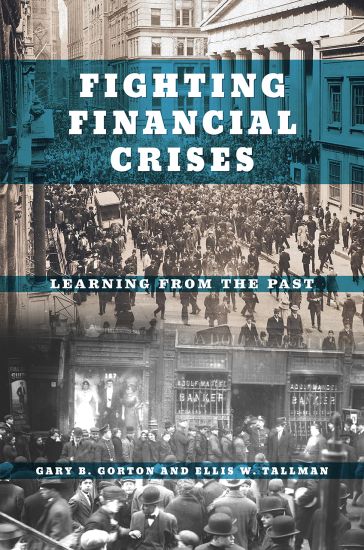
Fighting Financial Crises

Fighting Financial Crises

Gary B. Gorton; Ellis W. Tallman

University of Chicago Press
2018
sidottu
If you’ve got some money in the bank, chances are you’ve never seriously worried about not being able to withdraw it. But there was a time in the United States, an era that ended just over a hundred years ago, in which bank customers had to pay close attention to whether the banking system would remain solvent, knowing they might have to rush to retrieve their savings before the bank collapsed. During the National Banking Era (1863–1914), before the establishment of the Federal Reserve, widespread banking panics were indeed rather common. Yet these pre-Fed banking panics, as Gary B. Gorton and Ellis W. Tallman show, bear striking similarities to our recent financial crisis. In both cases, something happened to make depositors—whether individual customers or corporate investors—“act differently” and find reason to question the value of their bank debt. Fighting Financial Crises thus turns to the past for a fuller understanding of our uncertain present, investigating how panics during the National Banking Era played out and how they were eventually quelled and prevented. Gorton and Tallman open with a survey of the period’s “information environment,” tracing the development of national bank notes, checks, and clearing houses to show how the key to keeping order was to disseminate information very carefully. Identifying the most effective responses based on the framework of the National Banking Era, they then consider the Fed’s and the SEC’s reactions to the recent crisis, building an informative new perspective on how the modern economy works.
Fighting Financial Crises

Fighting Financial Crises

Gary B. Gorton; Ellis W. Tallman

University of Chicago Press
2021
nidottu
If you’ve got money in the bank, chances are you’ve never seriously worried about not being able to withdraw it. But there was a time in the United States, an era that ended just over a hundred years ago, when bank customers had to pay close attention to the solvency of the banking system, knowing they might have to rush to retrieve their savings before the bank collapsed. During the National Banking Era (1863–1913), before the establishment of the Federal Reserve, widespread banking panics were indeed rather common. Yet these pre-Fed banking panics, as Gary B. Gorton and Ellis W. Tallman show, bear striking similarities to our recent financial crisis. Fighting Financial Crises thus turns to the past to better understand our uncertain present, investigating how panics during the National Banking Era played out and how they were eventually quelled and prevented. The authors then consider the Fed’s and the SEC’s reactions to the recent crisis, building an informative new perspective on how the modern economy works.
The Music of the Stanley Brothers

The Music of the Stanley Brothers

Gary B. Reid; Neil V. Rosenberg

University of Illinois Press
2014
nidottu
The Music of the Stanley Brothers brings together forty years of passionate research by scholar and record label owner Gary B. Reid. A leading authority on Carter and Ralph Stanley, Reid augments his own vast knowledge of their music with interviews, documents ranging from books to folios sold by the brothers at shows, and the words of Ralph Stanley, former band members, guest musicians, session producers, songwriters, and bluegrass experts. The result is a reference that illuminates the Stanleys' art and history. It is all here: dates and locations; the roster of players on well-known and obscure sessions alike; master/matrix and catalog/release numbers, with reissue information; a full discography sorting out the Stanleys' complex recording history; the stories behind the music; and exquisitely informed biographical notes that place events in the context of the brothers' careers and lives. Monumental and indispensable, The Music of the Stanley Brothers provides fans and scholars alike with a guide for immersion in the long career and breathtaking repertoire of two legendary American musicians.
Our Beloved Friend

Our Beloved Friend

Gary B. Nash; Emily M. Teipe

Pennsylvania State University Press
2022
sidottu
Born into one of the wealthiest families in Philadelphia and raised and educated in that vital center of eighteenth-century American Quakerism, Anne Emlen Mifflin was a progressive force in early America. This detailed and engaging biography, which features Mifflin’s collected writings and selected correspondence, revives her legacy.Anne grew up directly across the street from the Pennsylvania statehouse, where the Continental Congress was leading the War of Independence. A Quaker minister whose busy pen, agile mind, and untiring moral energy produced an extensive corpus of writings, Anne was an ardent abolitionist and social reformer decades before the establishment of women’s anti-slavery societies. And at a time when most Americans never ventured beyond their own village, hamlet, or farm, Anne journeyed thousands of miles. She traveled to settlements of Friends on the frontier and met with Native Americans in the rough country of northwestern Pennsylvania, New York, and Canada. Our Beloved Friend provides a unique window onto the lives of Quakers during the pre-Revolutionary era, the establishment of the New Republic, and the War of 1812.
Our Beloved Friend

Our Beloved Friend

Gary B. Nash; Emily M. Teipe

Pennsylvania State University Press
2024
pokkari
Born into one of the wealthiest families in Philadelphia and raised and educated in that vital center of eighteenth-century American Quakerism, Anne Emlen Mifflin was a progressive force in early America. This detailed and engaging biography, which features Mifflin’s collected writings and selected correspondence, revives her legacy.Anne grew up directly across the street from the Pennsylvania statehouse, where the Continental Congress was leading the War of Independence. A Quaker minister whose busy pen, agile mind, and untiring moral energy produced an extensive corpus of writings, Anne was an ardent abolitionist and social reformer decades before the establishment of women’s anti-slavery societies. And at a time when most Americans never ventured beyond their own village, hamlet, or farm, Anne journeyed thousands of miles. She traveled to settlements of Friends on the frontier and met with Native Americans in the rough country of northwestern Pennsylvania, New York, and Canada. Our Beloved Friend provides a unique window onto the lives of Quakers during the pre-Revolutionary era, the establishment of the New Republic, and the War of 1812.
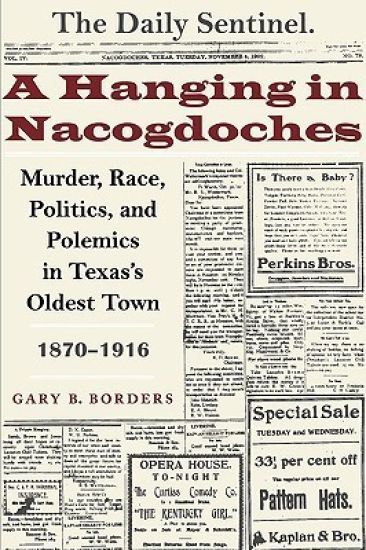
A Hanging in Nacogdoches

A Hanging in Nacogdoches

Gary B. Borders

University of Texas Press
2006
pokkari
On October 17, 1902, in Nacogdoches, Texas, a black man named James Buchanan was tried without representation, condemned, and executed for the murder of a white family-all in the course of three hours. Two white men played pivotal roles in these events: Bill Haltom, a leading local Democrat and the editor of the Nacogdoches Sentinel, who condemned lynching but defended lynch mobs, and A. J. Spradley, a Populist sheriff who, with the aid of hundreds of state militiamen, barely managed to keep the mob from burning Buchanan alive, only to escort him to the gallows following his abbreviated trial. Each man's story serves to illuminate a part of the path that led to the terrible parody of justice which lies at the heart of A Hanging in Nacogdoches.The turn of the twentieth century was a time of dramatic change for the people of East Texas. Frightened by the Populist Party's attempts to unite poor blacks and whites in a struggle for economic justice, white Democrats defended their power base by exploiting racial tensions in a battle that ultimately resulted in the complete disenfranchisement of the black population of East Texas. In telling the story of a single lynching, Gary Borders dramatically illustrates the way politics and race combined to bring horrific violence to small southern towns like Nacogdoches.
Toward a Theory of Cultural Linguistics

Toward a Theory of Cultural Linguistics

Gary B. Palmer

University of Texas Press
1996
pokkari
Imagery, broadly defined as all that people may construe in cognitive models pertaining to vision, hearing, touch, taste, smell, and feeling states, precedes and shapes human language. In this pathfinding book, Gary B. Palmer restores imagery to a central place in studies of language and culture by bringing together the insights of cognitive linguistics and anthropology to form a new theory of cultural linguistics.Palmer begins by showing how cognitive grammar complements the traditional anthropological approaches of Boasian linguistics, ethnosemantics, and the ethnography of speaking. He then applies his cultural theory to a wealth of case studies, including Bedouin lamentations, spatial organization in Coeur d'Alene place names and anatomical terms, Kuna narrative sequence, honorifics in Japanese sales language, the domain of ancestral spirits in Proto-Bantu noun-classifiers, Chinese counterfactuals, the non-arbitrariness of Spanish verb forms, and perspective schemas in English discourse.This pioneering approach suggests innovative solutions to old problems in anthropology and new directions for research. It will be important reading for everyone interested in anthropology, linguistics, cognitive science, and philosophy.
The Liberty Bell

The Liberty Bell

Gary B. Nash

Yale University Press
2011
pokkari
The distinguished historian Gary B. Nash recasts the legacy of one of America’s most enduring icons of freedom Each year, more than two million visitors line up near Philadelphia’s Independence Hall and wait to gaze upon a flawed mass of metal forged more than two and a half centuries ago. Since its original casting in England in 1751, the Liberty Bell has survived a precarious journey on the road to becoming a symbol of the American identity, and in this masterful work, Gary B. Nash reveals how and why this voiceless bell continues to speak such volumes about our nation.A serious cultural history rooted in detailed research, Nash’s book explores the impetus behind the bell’s creation, as well as its evolutions in meaning through successive generations. With attention to Pennsylvania’s Quaker roots, he analyzes the biblical passage from Leviticus that provided the bell’s inscription and the valiant efforts of Philadelphia’s unheralded brass founders who attempted to recast the bell after it cracked upon delivery from London’s venerable Whitechapel Foundry. Nash fills in much-needed context surrounding the bell’s role in announcing the Declaration of Independence and recounts the lesser-known histories of its seven later trips around the nation, when it served as a reminder of America’s indomitable spirit in times of conflict. Drawing upon fascinating primary source documents, Nash’s book continues a remarkable dialogue about a symbol of American patriotism second only in importance to the Stars and Stripes.
Autism

Autism

Gary B. Mesibov; Lynn W. Adams; Laura G. Klinger

Kluwer Academic/Plenum Publishers
1998
sidottu
This volume is designed to provide a comprehensive overview of autism for the many educated and thoughtful parents, professionals, and other concerned citizens with an interest in these important issues. It has grown out of our assumption that there are many people interested in our field who want the most up-to-date information available without having to locate and read through the growing literature in this area. From our university bases, we are fortunate in having access to state-of-the-art information about autism and related develop­ mental disorders. Our goal in this volume is to synthesize this information and present it comprehensively and objectively. This volume is the culmination of 2 years of hard work identifying, organizing, writing, rewriting, and editing the most up-to-date information available about people with autism, their families, and the state-of-the-art about the nature, causes, underlying mechanisms, diagnosis, and treatment of autism. We hope it will help the many friends, colleagues, families, and interested citizens who have expressed their interest in a publication of this kind. v Acknowledgments A project ofthis scope could not have been completed without the help of many fine friends and colleagues, too numerous to name. As with all of our professional activities we are indebted to our TEACCH colleagues and the many families and professionals we know in North Carolina, around the United States, and throughout the world for their interest, support, insights, and generosity in sharing their ideas and observations. We hope that our final product reflects their many superb contributions.
Autism

Autism

Gary B. Mesibov; Lynn W. Adams; Laura G. Klinger

Kluwer Academic/Plenum Publishers
1998
nidottu
This volume is designed to provide a comprehensive overview of autism for the many educated and thoughtful parents, professionals, and other concerned citizens with an interest in these important issues. It has grown out of our assumption that there are many people interested in our field who want the most up-to-date information available without having to locate and read through the growing literature in this area. From our university bases, we are fortunate in having access to state-of-the-art information about autism and related develop­ mental disorders. Our goal in this volume is to synthesize this information and present it comprehensively and objectively. This volume is the culmination of 2 years of hard work identifying, organizing, writing, rewriting, and editing the most up-to-date information available about people with autism, their families, and the state-of-the-art about the nature, causes, underlying mechanisms, diagnosis, and treatment of autism. We hope it will help the many friends, colleagues, families, and interested citizens who have expressed their interest in a publication of this kind. v Acknowledgments A project ofthis scope could not have been completed without the help of many fine friends and colleagues, too numerous to name. As with all of our professional activities we are indebted to our TEACCH colleagues and the many families and professionals we know in North Carolina, around the United States, and throughout the world for their interest, support, insights, and generosity in sharing their ideas and observations. We hope that our final product reflects their many superb contributions.
Understanding Asperger Syndrome and High Functioning Autism

Understanding Asperger Syndrome and High Functioning Autism

Gary B. Mesibov; Victoria Shea; Lynn W. Adams

Kluwer Academic/Plenum Publishers
2001
sidottu
This volume is designed to provide an overview of Asperger’s Syndrome/High Functioning Autism for professionals, parents, and others concerned about these conditions. It is part of the library series that has been created for the many people interested in the field of autism spectrum disorders who want up-to-date, authoritative infor- tion without having to locate and read through the original sources. Our goal in this series is to review, synthesize, and organize the inf- mation so that it can be presented comprehensively and clearly. This volume is the culmination of over a decade of clinical work identifying, organizing, writing, and editing the most current infor- tion available about this high functioning group of people with autism spectrum disorders from current reputable sources. The book explores the history and emphasizes the diagnosis, assessment, and treatment of these people and their families. We hope that we have done justice to this extensive literature so that it can be of use to these people th- selves as well as to their many friends, colleagues, and families, and to the interested citizens who are seeking more information about this intriguing area of inquiry.