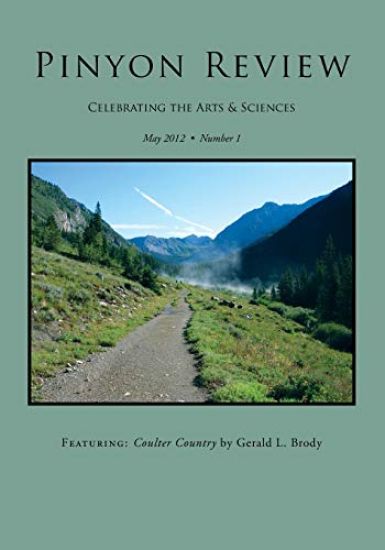
Pinyon Review, May 2012, Number 1Celebrating the Arts and SciencesThe Fool on the Hill by Gary Lee EntsmingerThree Poems by Dabney StuartCoulter Country by Gerald L. BrodyThree Paintings by Susan E. ElliottTwo Poems by Ken FontenotTwo Poems by Francine Marie TolfBook Review by Cy Dillon: Nine Acres, by Nathaniel PerryTwo Poems by Don ThompsonTwo Poems by Diane M. MooreFractals: The Geometry of Nature by Larry FoggTwo Poems by Luci ShawHeroes and Villains by Jack Starr
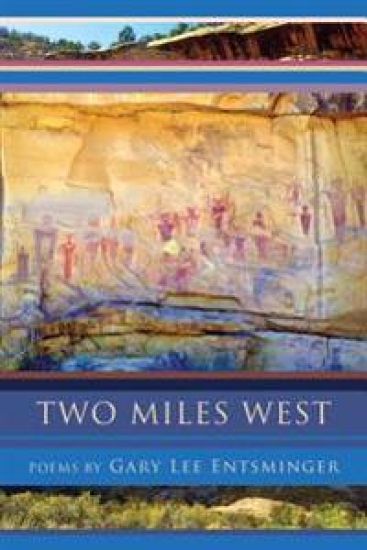
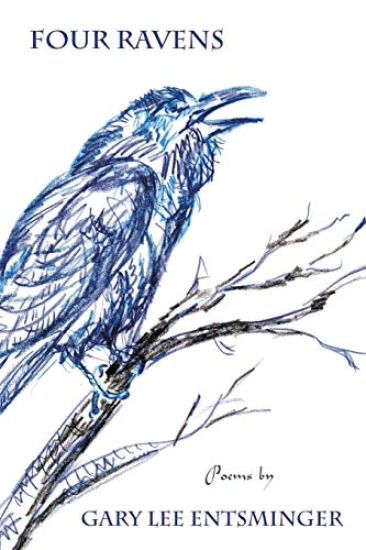
"Without pretense, with the clarity of William Stafford, these poems embrace a wide-ranging reach in subject matter expressed lyrically with original juxtapositions of ideas and words. The voice in these poems pays homage to the past, the present."--Michael Miller, author of Waking in the Dark"Entsminger shares poems about his youth in Virginia, his journeys, and his present life in the mountains of southwestern Colorado. These poems attest to the author's awareness of the fleeting nature of experience: 'Summer of '74 he traveled with the band / wore tee shirt and blue jeans like the other guys / climbed scaffold to place speakers in the Wall of Sound / happy for the job yet already beginning to understand / none of this would happen again' "Time moves in only one direction. Yet, from an early memory of looking down on "the small town / tucked below / steepled and shimmering / with all you didn't know / in the distance" to a more recent one where men 'in the evening sat on the porch / once it was cool enough / and watched the breeze and shade /easing summer heat with conversation' the poems in Four Ravens offer a sense of having come full circle--from experience to memory to all we can know of a life."--Neil Harrison, author of Where the Waters Take You"Clearly marked, deeply anchored poems--like a good guide, Entsminger makes sure you don't fall from the stones across the currents. You'll stop to look the way you've come, like the woman in 'Before Crossing, ' to reorient and prepare for what's ahead. One poem has it exactly right: 'Stories that determine us.' As in Nancy Willard's work, questions are asked, the answers to which surprise, delight, and help to 'develop a soul.' Accompanied by masterly musical diction, so the words' tunes embed. So much to say (everyone should have an Aunt Jean ); to quote ('it was always the two of us / under the grand piano I was never alone / Mom was always playing')--Rilke must be smiling, too (see his 'Memories of a Childhood' ). A last regret: Frost, who is said to have put a gun on the kitchen table between his kids and told them to choose between their mom and him, won't read 'Counter Intuitive, ' a poem that should be framed on many a kitchen wall for many a family."--Stuart Friebert, author of Decanting: Selected & New Poems
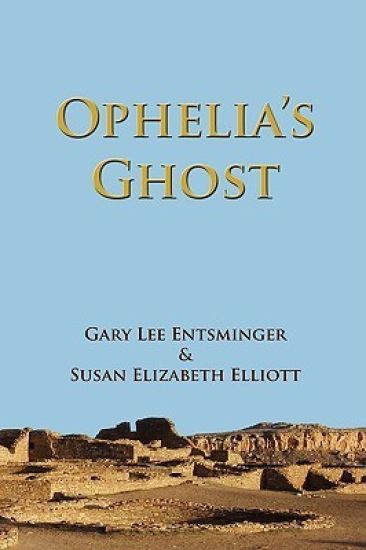
Eva Hail, an anthropologist in her mid-30s, disappears from her campsite. She is researching the Anasazi abandonment of the 14th century, weaving together astronomy, ancient religions, and the Art of Memory. Eva's belongings are left behind, and there are no signs of violence. Joe Hill, a local tracker, is asked to look for her, aided only by her field notebook. Joe's daughter is playing Ophelia in Hamlet, which introduces the questions Shakespearean scholars have debated since 1598. Can we know if we've truly seen a ghost? Can witnesses or experiments validate reality? Joe is haunted by his memories: his father left before Joe was born; his mother, an herbal healer, died five years ago; his wife, a dancer, abandoned him. Set in 1958 in the American Southwest, Ophelia's Ghost explores key themes of this period: UFOs, the space race, Einstein's relativity, parallel universes, and structural anthropology. Joe's search to find Eva uncovers mysteries of the past, present, and future.
The Art of Memory has been used for mental and spiritual training by ancient orators (e.g., Cicero), Christian figures (e.g., Thomas Aquinas), and modern practitioners (e.g., Dominic O'Brien) since before the time of Christ. This powerful memory technique can also be used to remember other kinds of information (lists, speeches, important dates, etc.). At its essence, the Art of Memory involves placing symbolic images at designated locations along a journey.IN THIS BOOK, YOU'LL FIND: Step-by-step instructions to memorize 30 parables using the Art of Memory.30 full-page paintings plus diagrams to help you visualize your memory journey.Each parable distilled into a concise, elegant poem. Parables cross-referenced in Matthew, Mark, Luke, and Thomas.A history of the Art of Memory and Jesus' parables.Techniques for remembering chapters and verse references.JESUS taught in figurative language. He compared the kingdom of heaven to leaven.He indicated how people should live in the kingdom by telling vivid and sometimes puzzling parables. Some of these parables suggest reversals of expectations.Very small things, like mustard seeds, can grow into majestic and great products. All of the parables contain tangible and vivid images. These images make them memorable.BY LEARNING JESUS' PARABLES BY HEART, you will become acquainted with Jesus' parables in a deeper way. By practicing the Art of Memory, you will grow to see remembering not as a tiresome and time-consuming task but as a relaxing pleasure. See your memories for what they are-treasures and enduring gifts
WriteItNow 4 is the ideal writing software for novice and experienced writers. "Making the Most of WriteItNow 4" is your key to effective, efficient use of the software.WITH state-of-the-art writing tools (chapter, scene, character, location, event, note, and idea editors, spell checker, and thesaurus), creativity-promoting features (idea generators, graphs, prompts, add-ons), and classy formatting/export options, WriteItNow 4 takes you from first idea to final manuscript with ease.MAKING THE MOST OF WRITEITNOW 4 enables you to optimize your writing experience. You'll quickly learn how to use WriteItNow's essential tools and features. You'll get advice from established authors, while being encouraged to let your personal writing style come out. Step-by-step examples of all major features show you WriteItNow in action.INSTEAD of squandering your time surfing software and learning by trial and error, let Making the Most of WriteItNow 4 be your guide and enhance your writing experience.IN THIS BOOK, you'll learn how to: (1) Write and store complete novels; (2) Edit and rearrange chapters with a Story Board; (3) Create background details and personalities for characters and graph their relationships; (4) Establish reasonable Writing Targets; (5) Fine tune your writing with word counts, readability tools, a crossword capable theasurus, and numerous Web Tools; (6) Create Web, File, and Research links; (7) Use, Create, and Edit Prompts Sets; (8) Generate characters and background notes; (9) Manage reference and submission data; (10) Prepare manuscripts for submission or publication; (11) Navigate WriteItNow menus, dialogs, Tree and Tab views; and (12) Import stories into WriteItNow that you've started in another program.
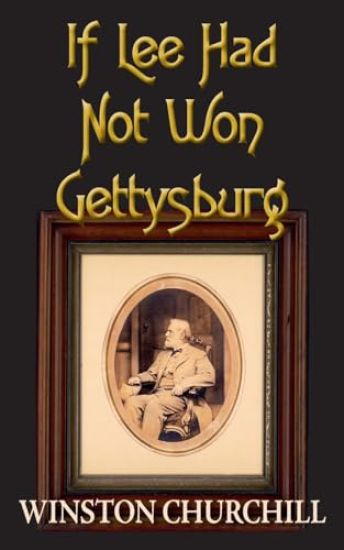
In December 1930, Sir Winston Churchill, at age 56, wrote his version of what might have been, If Lee Had Not Won the Battle of Gettysburg. He started with the postulation that Lee had been successful at Gettysburg and proceeded from there. The period between the World Wars, Winston sat at his desk to write his tale of a victorious Confederate States of America. He began with the fictional postulation General Lee had indeed been successful at Gettysburg which led to Southern Independence, an unusual approach. Winston carried it through 1914 and hinted of events in the upcoming 1940s.
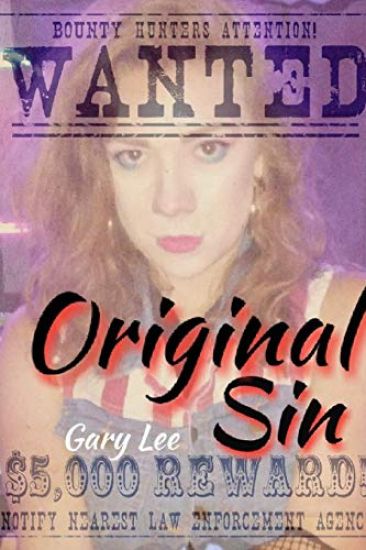
Two years after leaving Modesto, a new Wanted Poster prompts Destiny Owens to finally return. However, this time there's much more than just the thrill of the hunt and a hefty bounty at stake. Her new target: Sheriff Johnny Lawrence! He's been framed for murder...or has he? The ultimate battle between Good and Good may be at hand as Destiny is Hell-bent on tracking her dear friend down and discovering the grisly truth. But is she really prepared to face the challenge? And how will she cope with a second helping of the emotion and nostalgia Modesto once brought down on her? It's a sequel and a prequel all rolled into one as Destiny must now face her past like never before!
Contemporary members of Congress routinely use the media to advance their professional goals. Today, virtually every aspect of their professional legislative life unfolds in front of cameras and microphones and, increasingly, online. The Public Congress explores how the media moved from being a peripheral to a central force in U.S. congressional politics. The authors show that understanding why this happened allows us to see the constellation of forces that combined over the last fifty years to transform the American political order. Malecha and Reagan’s keen analysis links the new "public" Congress and the forces that are shaping political parties, the Presidency, interest groups, and the media. They conclude by asking whether the kind of discourse that this "new media" environment fosters encourages Congress to make its distinctive deliberative contribution to the American polity. This text brings historical depth as well as coverage of the most current cutting edge trends in new media environment and provides an exhaustive treatment of how the U.S. Congress uses the media in the governing process today.
Contemporary members of Congress routinely use the media to advance their professional goals. Today, virtually every aspect of their professional legislative life unfolds in front of cameras and microphones and, increasingly, online. The Public Congress explores how the media moved from being a peripheral to a central force in U.S. congressional politics. The authors show that understanding why this happened allows us to see the constellation of forces that combined over the last fifty years to transform the American political order. Malecha and Reagan’s keen analysis links the new "public" Congress and the forces that are shaping political parties, the Presidency, interest groups, and the media. They conclude by asking whether the kind of discourse that this "new media" environment fosters encourages Congress to make its distinctive deliberative contribution to the American polity. This text brings historical depth as well as coverage of the most current cutting edge trends in new media environment and provides an exhaustive treatment of how the U.S. Congress uses the media in the governing process today.
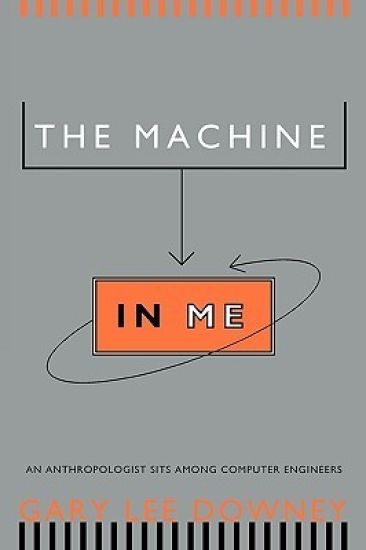
Gary Lee Downey investigates the body/machine interface in his remarkable ethnography of computer engineers. Drawing on interviews, observations and personal interaction with engineers, he documents the everyday power of technology's dominant image in our society, a force widely regarded as monolithically progressive. The Machine in Me will lead the reader to understand how deeply connected we are to The Machine and how beneficial it would be for us to really understand ourselves and machines as partially configured of the other--we as part machine, machines as part human. In this way, we can begin to see both the power and limitations of technology.
Gary Lee Downey investigates the body/machine interface in his remarkable ethnography of computer engineers. Drawing on interviews, observations and personal interaction with engineers, he documents the everyday power of technology's dominant image in our society, a force widely regarded as monolithically progressive. The Machine in Me will lead the reader to understand how deeply connected we are to The Machine and how beneficial it would be for us to really understand ourselves and machines as partially configured of the other--we as part machine, machines as part human. In this way, we can begin to see both the power and limitations of technology.