Kirjojen hintavertailu. Mukana 12 450 783 kirjaa ja 12 kauppaa.

Kirjahaku

Etsi kirjoja tekijän nimen, kirjan nimen tai ISBN:n perusteella.

1000 tulosta hakusanalla Gary Saul Morson

Narrative and Freedom

Narrative and Freedom

Gary Saul Morson

Yale University Press
1996
pokkari
In this important and controversial book, one of our leading literary theorists presents a major philosophical statement about the meaning of literature and the shape of literary texts. Drawing on works by the Russian writers Dostoevsky, Tolstoy, and Chekhov, by other writers as diverse as Sophocles, Cervantes, and George Eliot, by thinkers as varied as William James, Mikhail Bakhtin, and Stephen Jay Gould, and from philosophy, the Bible, television, and much more, Gary Saul Morson examines the relation of time to narrative form and to an ethical dimension of the literary experience.Morson asserts that the way we think about the world and narrate events is often in contradiction to the truly eventful and open nature of daily life. Literature, history, and the sciences frequently present experience as if contingency, chance, and the possibility of diverse futures were all illusory. As a result, people draw conclusions or accept ideologies without sufficiently examining their consequences or alternatives. However, says Morson, there is another way to read and construct texts. He explains that most narratives are developed through foreshadowing and "backshadowing" (foreshadowing ascribed after the fact), which tend to reduce the multiplicity of possibilities in each moment. But other literary works try to convey temporal openness through a device he calls "sideshadowing." Sideshadowing suggests that to understand an event is to grasp what else might have happened. Time is not a line but a shifting set of fields of possibility. Morson argues that this view of time and narrative encourages intellectual pluralism, helps to liberate us from the false certainties of dogmatism, creates a healthy skepticism of present orthodoxies, and makes us aware that there are moral choices available to us.
"Anna Karenina" in Our Time

"Anna Karenina" in Our Time

Gary Saul Morson

Yale University Press
2007
sidottu
In this invigorating new assessment of Anna Karenina, Gary Saul Morson overturns traditional interpretations of the classic novel and shows why readers have misunderstood Tolstoy’s characters and intentions. Morson argues that Tolstoy’s ideas are far more radical than has been thought: his masterpiece challenges deeply held conceptions of romantic love, the process of social reform, modernization, and the nature of good and evil. By investigating the ethical, philosophical, and social issues with which Tolstoy grappled, Morson finds in Anna Karenina powerful connections with the concerns of today. He proposes that Tolstoy’s effort to see the world more wisely can deeply inform our own search for wisdom in the present day. The book offers brilliant analyses of Anna, Karenin, Dolly, Levin, and other characters, with a particularly subtle portrait of Anna’s extremism and self-deception. Morson probes Tolstoy’s important insights (evil is often the result of negligence; goodness derives from small, everyday deeds) and completes the volume with an irresistible, original list of One Hundred and Sixty-Three Tolstoyan Conclusions.
The Words of Others

The Words of Others

Gary Saul Morson

Yale University Press
2011
sidottu
In this lively gambol through the history of quotations and quotation books, Gary Saul Morson traces our enduring fascination with the words of others. Ranging from the remote past to the present, he explores the formation, development, and significance of quotations, while exploring the "verbal museums" in which they have been collected and displayed--commonplace books, treasuries, and anthologies. In his trademark clear, witty, and provocative style, Morson invites readers to share his delight in the shortest literary genre. The author defines what makes a quote quotable, as well as the (unexpected) differences between quotation and misquotation. He describes how quotations form, transform, and may eventually become idioms. How much of language itself is the residue of former quotations? Weaving in hundreds of intriguing quotations, common and unusual, Morson explores how the words of others constitute essential elements in the formation of a culture and of the self within that culture. In so doing, he provides a demonstration of that very process, captured in the pages of this extraordinary new book.
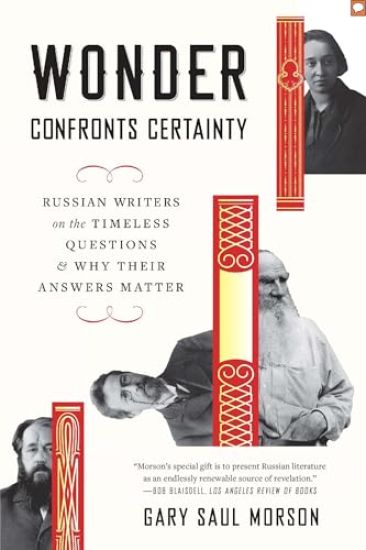
Wonder Confronts Certainty

Wonder Confronts Certainty

Gary Saul Morson

HARVARD UNIVERSITY PRESS
2025
nidottu
An Air Mail Editor’s Pick A Spectator Book of the Year “[A] masterly panorama of classic Russian literature and its hinterland of ideas.”—Wall Street Journal “Wise and authoritative…As the best Russian literature teaches, the emancipation of the human will from all limits and restraints is the path of individual and collective perdition. We should all be grateful to Gary Saul Morson for drawing out that indispensable insight with such lucidity, erudition, and grace.” —Daniel J. Mahoney, New Criterion “Wonder Confronts Certainty is Gary Saul Morson's magnum opus.” —Joseph Epstein, Washington Free BeaconSince the age of Tolstoy, Dostoevsky, and Chekhov, Russian literature has posed questions about good and evil, moral responsibility, and human freedom with a clarity and intensity found nowhere else. In this wide-ranging meditation, Gary Saul Morson delineates intellectual debates that have coursed through two centuries of Russian writing, as the greatest thinkers of the empire and then the Soviet Union enchanted readers with their idealism, philosophical insight, and revolutionary fervor. Morson describes the Russian literary tradition as an argument between a radical intelligentsia that uncompromisingly followed ideology down the paths of revolution and violence, and writers who probed ever more deeply into the human condition. Exploring apologia for bloodshed, Morson adapts Mikhail Bakhtin’s concept of the non-alibi—the idea that one cannot escape or displace responsibility for one’s actions. And, throughout, Morson isolates a characteristic theme of Russian culture: how the aspiration to relieve profound suffering can lead to either heartfelt empathy or bloodthirsty tyranny. What emerges is a contest between unyielding dogmatism and open-minded dialogue, between heady certainty and a humble sense of wonder at the world’s elusive complexity—a thought-provoking journey into inescapable questions.
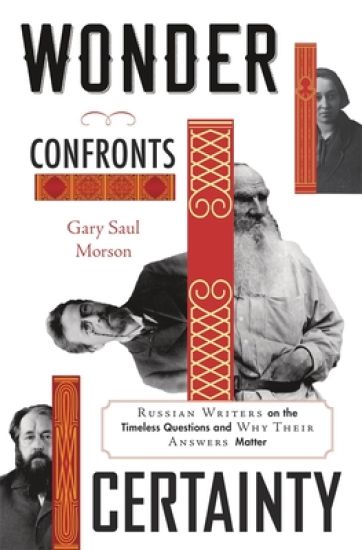
Wonder Confronts Certainty

Wonder Confronts Certainty

Gary Saul Morson

HARVARD UNIVERSITY PRESS
2023
sidottu
A noted literary scholar traverses the Russian canon, exploring how realists, idealists, and revolutionaries debated good and evil, moral responsibility, and freedom.Since the age of Tolstoy, Dostoevsky, and Chekhov, Russian literature has posed questions about good and evil, moral responsibility, and human freedom with a clarity and intensity found nowhere else. In this wide-ranging meditation, Gary Saul Morson delineates intellectual debates that have coursed through two centuries of Russian writing, as the greatest thinkers of the empire and then the Soviet Union enchanted readers with their idealism, philosophical insight, and revolutionary fervor.Morson describes the Russian literary tradition as an argument between a radical intelligentsia that uncompromisingly followed ideology down the paths of revolution and violence, and writers who probed ever more deeply into the human condition. The debate concerned what Russians called “the accursed questions”: If there is no God, are good and evil merely human constructs? Should we look for life’s essence in ordinary or extreme conditions? Are individual minds best understood in terms of an overarching theory or, as Tolstoy thought, by tracing the “tiny alternations of consciousness”? Exploring apologia for bloodshed, Morson adapts Mikhail Bakhtin’s concept of the non-alibi—the idea that one cannot escape or displace responsibility for one’s actions. And, throughout, Morson isolates a characteristic theme of Russian culture: how the aspiration to relieve profound suffering can lead to either heartfelt empathy or bloodthirsty tyranny.What emerges is a contest between unyielding dogmatism and open-minded dialogue, between heady certainty and a humble sense of wonder at the world’s elusive complexity—a thought-provoking journey into inescapable questions.
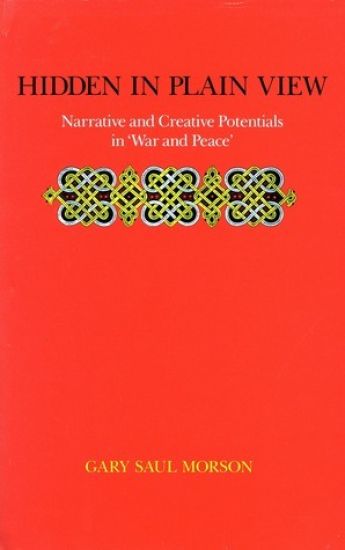
Hidden in Plain View

Hidden in Plain View

Gary Saul Morson

Stanford University Press
1988
pokkari
For decades, the formal peculiarities of War and Peace disturbed Russian and Western critics, who attributed both the anomalous structure and the literary power of the book to Tolstoy's "primitive," unruly genius. Using that critical history as a starting point, this volume recaptures the overwhelming sense of strangeness felt by the work's first readers and thereby illuminates Tolstoy's theoretical and narratological concerns. The author demonstrates that the formal peculiarities of War and Peace were deliberate, designed to elude what Tolstoy regarded as the falsifying constraints of all narratives, both novelistic and historical. Developing and challenging the ideas of Mikhail Bakhtin, Morson explores Tolstoy's account of the work's composition in light of various myths of the creative process. He proposes a theory of "creation by potential" that incorporates Tolstoy's main concerns: the "openness" of each historical moment; the role of chance in history and within narrative patterns; and the efficacy of ordinary events, "hidden in plain view," in shaping history and individual psychology. In his reading of Tolstoy, he demonstrates how we read literary works within the "penumbral text" of associated theories of creativity.
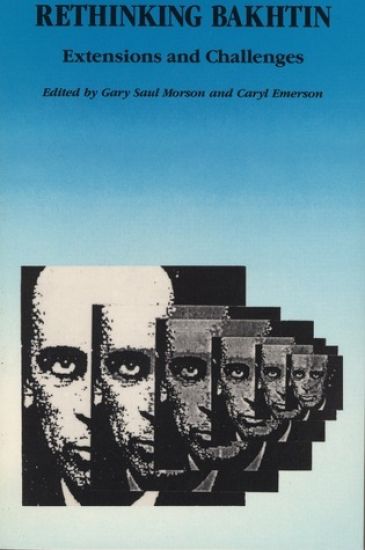
Rethinking Bakhtin

Rethinking Bakhtin

Gary Saul Morson

Northwestern University Press
1989
nidottu
The essays in Rethinking Bakhtin: Extensions and Challenges extend Bakhtin's concepts in important new directions and challenge Bakhtin's own use of his most cherished ideas. Four sets of paired essays explore the theory of parody, the relation of de Man's poetics to Bakhtin's dialogics, Bakhtin's approach to Tolstoy and ideological literature generally, and the dangers of dialogue, not only in practice but also as an ideal.
Prosaics and Other Provocations

Prosaics and Other Provocations

Gary Saul Morson

Academic Studies Press
2013
sidottu
Gary Saul Morson’s ideas about life and literature have long inspired, annoyed, and provoked specialists and general readers. His work on “prosaics” (his coinage) argues that life’s defining events are not grand but ordinary, and that the world’s fundamental state is mess. Viewing time as a “field of possibilities,” he maintains that contingency and freedom are real. To represent open time, some masterpieces have developed an alternative to structure and require a “prosaics of process.” Morson’s curmudgeonly alter ego, Alicia Chudo, invents the discipline of “misanthropology,” which explores human vices from voyeurism to violence. Reflecting on his legendarily popular courses, Morson argues that what literature teaches better than anything else is empathy. Himself an aphorist, Morson offers a witty approach to literature’s shortest genres and to quotation in general.
Prosaics and Other Provocations

Prosaics and Other Provocations

Gary Saul Morson

Academic Studies Press
2018
pokkari
This far-ranging study develops Morson’s concept of “prosaics,” which stresses the importance of ordinary events and the novel’s unique ability to portray them. Arguing that time is open and contingency real, Morson develops a “prosaics of process” showing how some masterpieces have found an alternative to structure. His well-known pseudonym Alicia Chudo, the inventor of “misanthropology,” explores the disturbing philosophical content of laughter, disgust, and even empathy. Northwestern University’s most popular professor, Morson attributes declining student interest in literature to current teaching methods. He argues in favor of showing how literature fosters empathy with people unlike ourselves. Ever playful, Morson explores the relation of games to wit, which expresses the power of the mind to triumph over contingency in the social world.
Cents and Sensibility

Cents and Sensibility

Gary Saul Morson; Morton Schapiro

PRINCETON UNIVERSITY PRESS
2017
sidottu
A provocative and inspiring case for a more humanistic economics Economists often act as if their methods explain all human behavior. But in Cents and Sensibility, an eminent literary critic and a leading economist make the case that the humanities, especially the study of literature, offer economists ways to make their models more realistic, their predictions more accurate, and their policies more effective and just. Gary Saul Morson and Morton Schapiro trace the connection between Adam Smith's great classic, The Wealth of Nations, and his less celebrated book on The Theory of Moral Sentiments, and contend that a few decades later Jane Austen invented her groundbreaking method of novelistic narration in order to give life to the empathy that Smith believed essential to humanity. Morson and Schapiro argue that Smith's heirs include Austen, Anton Chekhov, and Leo Tolstoy as well as John Maynard Keynes and Milton Friedman. Economists need a richer appreciation of behavior, ethics, culture, and narrative--all of which the great writers teach better than anyone. Cents and Sensibility demonstrates the benefits of a freewheeling dialogue between economics and the humanities by addressing a wide range of problems drawn from the economics of higher education, the economics of the family, and the development of poor nations. It offers new insights about everything from the manipulation of college rankings to why some countries grow faster than others. At the same time, the book shows how looking at real-world problems can revitalize the study of literature itself. Original, provocative, and inspiring, Cents and Sensibility brings economics back to its place in the human conversation.
Cents and Sensibility

Cents and Sensibility

Gary Saul Morson; Morton Schapiro

Princeton University Press
2018
pokkari
In Cents and Sensibility, an eminent literary critic and a leading economist make the case that the humanities—especially the study of literature—offer economists ways to make their models more realistic, their predictions more accurate, and their policies more effective and just. Arguing that Adam Smith’s heirs include Austen, Chekhov, and Tolstoy as much as Keynes and Friedman, Gary Saul Morson and Morton Schapiro trace the connection between Adam Smith’s great classic, The Wealth of Nations, and his less celebrated book on ethics, The Theory of Moral Sentiments. The authors contend that a few decades later, Jane Austen invented her groundbreaking method of novelistic narration in order to give life to the empathy that Smith believed essential to humanity. More than anyone, the great writers can offer economists something they need—a richer appreciation of behavior, ethics, culture, and narrative. Original, provocative, and inspiring, Cents and Sensibility demonstrates the benefits of a dialogue between economics and the humanities and also shows how looking at real-world problems can revitalize the study of literature itself. Featuring a new preface, this book brings economics back to its place in the human conversation.
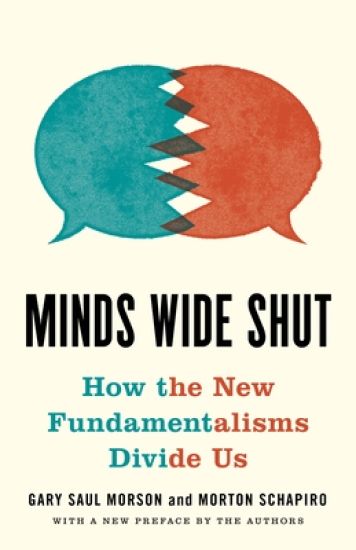
Minds Wide Shut

Minds Wide Shut

Gary Saul Morson; Morton Schapiro

PRINCETON UNIVERSITY PRESS
2021
sidottu
A timely exploration of intellectual dogmatism in politics, economics, religion, and literature—and what can be done to fight itPolarization may be pushing democracy to the breaking point. But few have explored the larger, interconnected forces that have set the stage for this crisis: namely, a rise in styles of thought, across a range of fields, that literary scholar Gary Saul Morson and economist Morton Schapiro call “fundamentalist.” In Minds Wide Shut, Morson and Schapiro examine how rigid adherence to ideological thinking has altered politics, economics, religion, and literature in ways that are mutually reinforcing and antithetical to the open-mindedness and readiness to compromise that animate democracy. In response, they propose alternatives that would again make serious dialogue possible.Fundamentalist thinking, Morson and Schapiro argue, is not limited to any one camp. It flourishes across the political spectrum, giving rise to dueling monologues of shouting and abuse between those who are certain that they can’t be wrong, that truth and justice are all on their side, and that there is nothing to learn from their opponents, who must be evil or deluded. But things don’t have to be this way. Drawing on thinkers and writers from across the humanities and social sciences, Morson and Schapiro show how we might begin to return to meaningful dialogue through case-based reasoning, objective analyses, lessons drawn from literature, and more.The result is a powerful invitation to leave behind simplification, rigidity, and extremism—and to move toward a future of greater open-mindedness, moderation, and, perhaps, even wisdom.
Minds Wide Shut

Minds Wide Shut

Gary Saul Morson; Morton Schapiro

PRINCETON UNIVERSITY PRESS
2023
pokkari
A timely exploration of intellectual dogmatism in politics, economics, religion, and literature—and what can be done to fight itPolarization may be pushing democracy to the breaking point. But few have explored the larger, interconnected forces that have set the stage for this crisis: namely, a rise in styles of thought, across a range of fields, that literary scholar Gary Saul Morson and economist Morton Schapiro call “fundamentalist.” In Minds Wide Shut, Morson and Schapiro examine how rigid adherence to ideological thinking has altered politics, economics, religion, and literature in ways that are mutually reinforcing and antithetical to the open-mindedness and readiness to compromise that animate democracy. In response, they propose alternatives that would again make serious dialogue possible.Fundamentalist thinking, Morson and Schapiro argue, is not limited to any one camp. It flourishes across the political spectrum, giving rise to dueling monologues of shouting and abuse between those who are certain that they can’t be wrong, that truth and justice are all on their side, and that there is nothing to learn from their opponents, who must be evil or deluded. But things don’t have to be this way. Drawing on thinkers and writers from across the humanities and social sciences, Morson and Schapiro show how we might begin to return to meaningful dialogue through case-based reasoning, objective analyses, lessons drawn from literature, and more.The result is a powerful invitation to leave behind simplification, rigidity, and extremism—and to move toward a future of greater open-mindedness, moderation, and, perhaps, even wisdom.
Tattered Banners

Tattered Banners

Paul Rodzianko; Gary Saul Morson

Paul Dry Books, Inc
2018
nidottu
Remembering life under the Romanovs"With his eye for detail, his taste for anecdote, and his sheer delight in the process of living, Rodzianko has created a delightful, if often sad, work."--Gary Saul Morson, from his new foreword for this first American edition"Capacious, powerful, and subtle--a forgotten work with real claims to historic interest and aesthetic value . . . It is Paradise Lost as told by Dostoevsky."--Washington Independent Review of BooksBorn into Russian aristocracy at the end of the 19th Century, Paul Rodzianko led a life rich in love, challenged by war, and inspired by great jumping horses. With humor and infectious joy, he recounts the adventures of his charmed childhood--playing with his cousins at the Winter Palace, riding horses at his family's many country estates, and, most spectacularly, serving as a page in the court of Tsar Nicolas II.Then, on August 1, 1914, Russia and Germany declare war on each other, and, Rodzianko writes, "The hurricane descended and swept our world away." Serving in the Chevalier Guards, he fights first against the Germans and then, after the Revolution, against the Reds in Siberia. He writes movingly about WWI and the Russian Civil War: the initial excitement about going to war and the grim realities, the frustrating shortages of munitions and the failures of the railroads, the shocking execution of the Romanovs, and the brutal deaths of millions of young men.Tattered Banners is an evocative and haunting account of a time and people that have continued to intrigue us for more than a century.
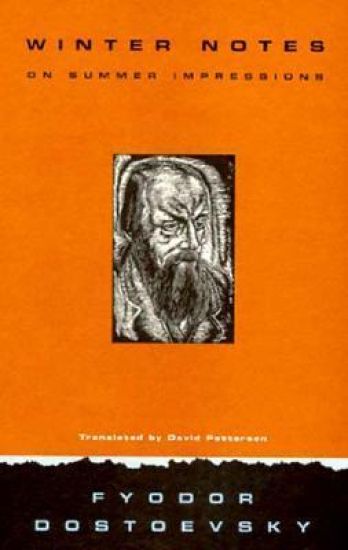
Winter Notes on Summer Impressions

Winter Notes on Summer Impressions

F.M. Dostoevsky; Gary Saul Morson

Northwestern University Press
1997
nidottu
In June 1862 Fyodor Dostoevsky left Petersburg on his first excursion to Western Europe. Ostensibly a trip to consult Western specialists about his epilepsy, Dostoevsky also wished to see firsthand the source of the Western ideas he believed were corrupting Russia. Over the course of his journey he visited a number of major cities, including Berlin, Paris, London, Florence, Milan and Vienna. He recorded his impressions of everthing he saw, and published them as ""Winter Notes on Summer Impressions"" in the February 1863 issue of ""Vremya"" (""Time""), the periodical he edited.
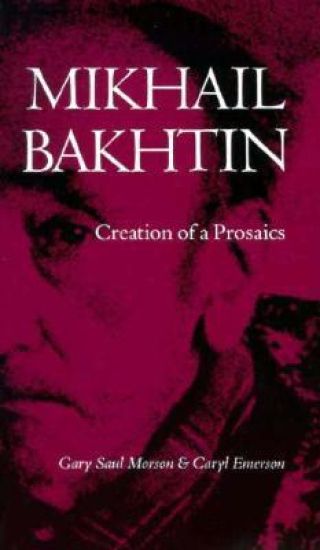
Mikhail Bakhtin

Mikhail Bakhtin

Morson Gary Saul; Emerson Caryl

Stanford University Press
1990
pokkari
Books about thinkers require a kind of unity that their thought may not possess. This cautionary statement is especially applicable to Mikhail Bakhtin, whose intellectual development displays a diversity of insights that cannot be easily integrated or accurately described in terms of a single overriding concern. Indeed, in a career spanning some sixty years, he experienced both dramatic and gradual changes in his thinking, returned to abandoned insights that he then developed in unexpected ways, and worked through new ideas only loosely related to his earlier concerns Small wonder, then, that Bakhtin should have speculated on the relations among received notions of biography, unity, innovation, and the creative process. Unity—with respect not only to individuals but also to art, culture, and the world generally—is usually understood as conformity to an underlying structure or an overarching scheme. Bakhtin believed that this idea of unity contradicts the possibility of true creativity. For if everything conforms to a preexisting pattern, then genuine development is reduced to mere discovery, to a mere uncovering of something that, in a strong sense, is already there. And yet Bakhtin accepted that some concept of unity was essential. Without it, the world ceases to make sense and creativity again disappears, this time replaced by the purely aleatory. There would again be no possibility of anything meaningfully new. The grim truth of these two extremes was expressed well by Borges: an inescapable labyrinth could consist of an infinite number of turns or of no turns at all. Bakhtin attempted to rethink the concept of unity in order to allow for the possibility of genuine creativity. The goal, in his words, was a "nonmonologic unity," in which real change (or "surprisingness") is an essential component of the creative process. As it happens, such change was characteristic of Bakhtin's own thought, which seems to have developed by continually diverging from his initial intentions. Although it would not necessarily follow that the development of Bakhtin's thought corresponded to his ideas about unity and creativity, we believe that in this case his ideas on nonmonologic unity are useful in understanding his own thought—as well as that of other thinkers whose careers are comparably varied and productive.
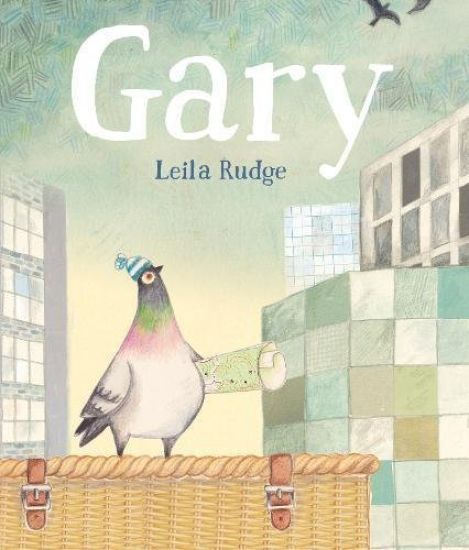
Gary

Gary

Leila Rudge

Walker Books Ltd
2017
nidottu
Gary, a grounded racing pigeon, dreams of exploring the world – until the day he falls into an adventure of his very own.A story of perseverance and being comfortable in your own skin, perfect for anyone who has ever felt like the odd one out, this is the story one pigeon's big adventure. Most of the time, Gary is just like the other racing pigeons, eating and sleeping and dreaming of adventure. There’s just one thing that separates him from the ordinary pigeons: he can’t fly. When his friends set off in their travel basket, Gary expects to stay at home, organizing his scrapbook of travel mementos and imagining far-off places. But when he accidentally falls into the travel basket and ends up a very long way from home, he discovers that flying might not be the only way to have adventures...