Kirjojen hintavertailu. Mukana 11 244 527 kirjaa ja 12 kauppaa.

Kirjahaku

Etsi kirjoja tekijän nimen, kirjan nimen tai ISBN:n perusteella.

3 tulosta hakusanalla Gavroglu Kostas

Fritz London

Fritz London

Gavroglu Kostas

Cambridge University Press
2005
pokkari
Fritz London was one of the twentieth century's key figures in the development of theoretical physics. A quiet and self-effacing man, he was one of the founders of quantum chemistry, and was the first to give a phenomenological explanation of superconductivity. This thoroughly researched biography gives a detailed account of London's life and work in Munich, Berlin, Oxford, Paris, and finally in the United States. Covering a fascinating period in the development of theoretical physics, and containing an appraisal of London's work by the late John Bardeen, this book will be of great interest to physicists, chemists, and to anyone interested in the history of science.
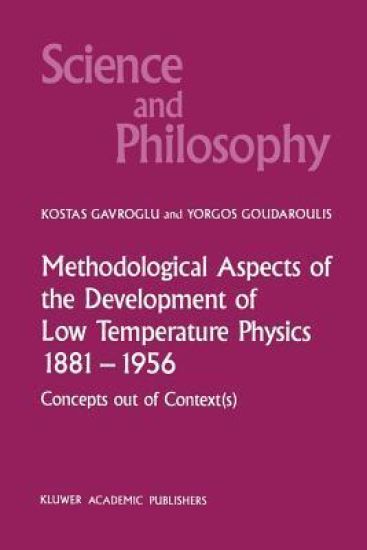
Methodological Aspects of the Development of Low Temperature Physics 1881–1956

Methodological Aspects of the Development of Low Temperature Physics 1881–1956

K. Gavroglu; Yorgos Goudaroulis

Kluwer Academic Publishers
1988
sidottu
This book is primarily about the methodological questions involved in attempts to understand two of the most peculiar phenomena in physics, both occurring at the lowest of temperatures. Superconductivity (the disappearance of electrical resistance) and superfluidity (the total absence of viscosity in liquid helium) are not merely peculiar in their own right. Being the only macroscopic quantum phenomena they also manifest a sudden and dramatic change even in those properties which have been amply used within the classical framework and which were thought to be fully understood after the advent of quantum theory. A few years ago we set ourselves the task of carrying out a methodological study of the "most peculiar" phenomena in physics and trying to understand the process by which an observed (rather than predicted) new phenomenon gets "translated" into a physical problem. We thought the best way of deciding which phenomena to choose was to rely on our intuitive notion about the "degrees of peculiarity" developed, no doubt, during the past ten years of active research in theoretical atomic and elementary particle physics. While the merits of the different candidates were compared, we were amazed to realize that neither the phenomena of the very small nor those of the very large could compete with the phenomena of the very cold. These were truly remarkable phenomena if for no other reason than for the difficulties encountered in merely describing them.
Methodological Aspects of the Development of Low Temperature Physics 1881–1956
This book is primarily about the methodological questions involved in attempts to understand two of the most peculiar phenomena in physics, both occurring at the lowest of temperatures. Superconductivity (the disappearance of electrical resistance) and superfluidity (the total absence of viscosity in liquid helium) are not merely peculiar in their own right. Being the only macroscopic quantum phenomena they also manifest a sudden and dramatic change even in those properties which have been amply used within the classical framework and which were thought to be fully understood after the advent of quantum theory. A few years ago we set ourselves the task of carrying out a methodological study of the "most peculiar" phenomena in physics and trying to understand the process by which an observed (rather than predicted) new phenomenon gets "translated" into a physical problem. We thought the best way of deciding which phenomena to choose was to rely on our intuitive notion about the "degrees of peculiarity" developed, no doubt, during the past ten years of active research in theoretical atomic and elementary particle physics. While the merits of the different candidates were compared, we were amazed to realize that neither the phenomena of the very small nor those of the very large could compete with the phenomena of the very cold. These were truly remarkable phenomena if for no other reason than for the difficulties encountered in merely describing them.