Kirjojen hintavertailu. Mukana 11 242 695 kirjaa ja 12 kauppaa.

Kirjahaku

Etsi kirjoja tekijän nimen, kirjan nimen tai ISBN:n perusteella.

1000 tulosta hakusanalla Geoffrey Bennington; Jacques Derrida

Jacques Derrida

Jacques Derrida

Geoffrey Bennington; Jacques Derrida

University of Chicago Press
1999
nidottu
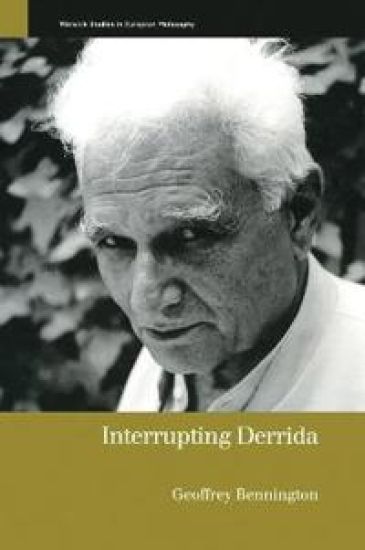
Geoffrey Bennington sets out here to write a systematic account of the thought of Jacques Derrida. Responding to Bennington's text at every turn is Derrida's own, excerpts from his life and thought that resist circumscription. Together these texts, as a dialogue and a contest, constitute a critical introduction to one of the leading philosophers of the 20th century. Bennington's account of Derrida leads the reader through the philosopher's work on language and writing, and through more mysterious themes of signature, sexual difference, law, and affirmation. Seeking to escape this systematic rendering - in fact, to prove it impossible - Derrida interweaves Bennington's text with surprising and disruptive "periphrases": reflections on his mother's death agony, commentaries on St. Augustine's "Confessions", memories of childhood, remarks on Judaism, and references to his collaborator's efforts.
Interrupting Derrida

Interrupting Derrida

Geoffrey Bennington

Routledge
2000
nidottu
One of the most significant contemporary thinkers in continental philosophy, Jacques Derrida’s work continues to attract heated commentary among philosophers, literary critics, social and cultural theorists, architects and artists. This major new work by world renowned Derrida scholar and translator, Geoffrey Bennington, presents incisive new readings of both Derrida and interpretations of his work.Part one sets out Derrida’s work as a whole and examines its relevance to, and ‘interruption’ of, the traditional domains of ethics, politics and literature. The second part of the book presents compelling insights into some important motifs in Derrida’s work, such as death, friendship, psychoanalysis, time and endings. The final section introduces trenchant appraisals of other influential accounts of Derrida’s work. This influential and original contribution to the literature on Derrida is marked by a commitment to clarity and accuracy, but also by a refusal to simplify Derrida’s often difficult thought.
Not Half No End

Not Half No End

Geoffrey Bennington

Edinburgh University Press
2010
sidottu
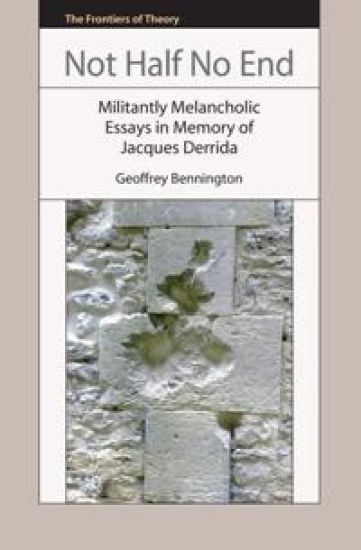
This book gathers essays written by Geoffrey Bennington since the death of his friend Jacques Derrida in 2004. All continue the ongoing work of elucidating difficult and complex thought, often enough with reference to Derrida's persistent interrogation of the concepts of life and death, mourning and melancholia, and what he sometimes calls 'half-mourning'. Not Half No End relates this 'ethical' interruption of mourning to the persistent but still ill-understood motif of interrupted teleology, which, it is argued here, is definitive of deconstruction in general. This suspension or interruption of the end (which is none other than differance 'itself') has all manner of consequences for our thinking, and for how we attempt to categorize that thinking (as epistemological, ethical, political or aesthetic, for example). Not Half No End moves through all these domains, and the whole of Derrida's rich and varied corpus, in a weave of styles - from the expository and analytic to the autobiographical and confessional - in the ongoing process of deconstruction. Key Features * New collection of essays by major theorist * Expanded readings of late texts by Derrida * Research monograph on mourning and melancholy * First consideration of the legacy of Derrida by a co-author
Not Half No End

Not Half No End

Geoffrey Bennington

Edinburgh University Press
2011
nidottu
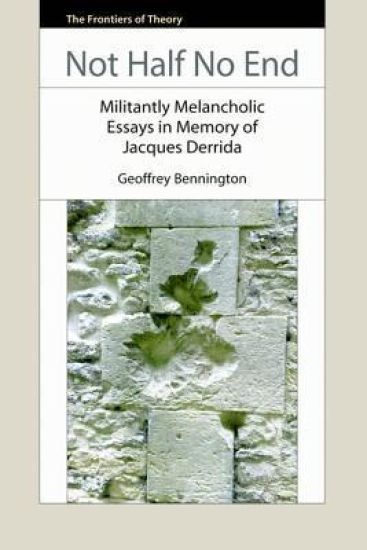
This book, newly available in paperback, gathers essays written by Geoffrey Bennington since the death of his friend Jacques Derrida in 2004. All continue the ongoing work of elucidating difficult and complex thought, often enough with reference to Derrida's persistent interrogation of the concepts of life and death, mourning and melancholia, and what he sometimes calls 'half-mourning'. Not Half No End relates this 'ethical' interruption of mourning to the persistent but still ill-understood motif of interrupted teleology, which, it is argued here, is definitive of deconstruction in general. This suspension or interruption of the end (which is none other than differance 'itself') has all manner of consequences for our thinking, and for how we attempt to categorize that thinking (as epistemological, ethical, political or aesthetic, for example). Not Half No End moves through all these domains, and the whole of Derrida's rich and varied corpus, in a weave of styles - from the expository and analytic to the autobiographical and confessional - in the ongoing process of deconstruction. Key Features * New collection of essays by major theorist * Expanded readings of late texts by Derrida * Research monograph on mourning and melancholy * First consideration of the legacy of Derrida by a co-author
Scatter 1

Scatter 1

Geoffrey Bennington

Fordham University Press
2016
sidottu
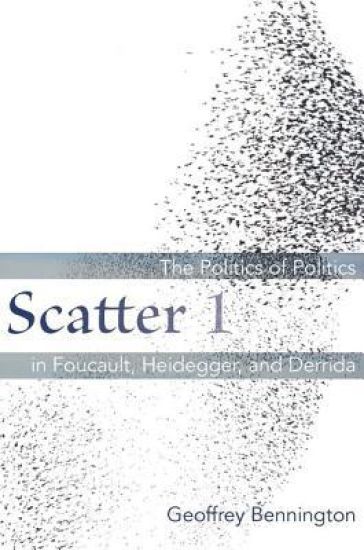
What if political rhetoric is unavoidable, an irreducible part of politics itself? In contrast to the familiar denunciations of political horse-trading, grandstanding, and corporate manipulation from those lamenting the crisis in liberal democracy, this book argues that the "politics of politics," usually associated with rhetoric and sophistry, is, like it or not, part of politics from the start. Denunciations of the sorry state of current politics draw on a dogmatism and moralism that share an essentially metaphysical and Platonic ground. Failure to deconstruct that ground generates a philosophically and politically debilitating selfrighteousness that this book attempts to understand and undermine. After a detailed analysis of Foucault's influential late concept of parrhesia, which is shown to be both philosophically and politically insufficient, close readings of Heidegger, Kierkegaard, and Derrida trace complex relations between sophistry, rhetoric, and philosophy; truth and untruth; decision; madness and stupidity in an exploration of the possibility of developing an affirmative thinking of politics that is not mortgaged to the metaphysics of presence. It is suggested that Heidegger's complex accounts of truth and decision must indeed be read in close conjunction with his notorious Nazi commitments but nevertheless contain essential insights that many strident responses to those commitments ignore or repress. Those insights are here developed—via an ambitious account of Derrida's often misunderstood interruption of teleology—into a deconstructive retrieval of the concept of dignity. This lucid and often witty account of a crucial set of developments in twentieth-century thought prepares the way for a more general re-reading of the possibilities of political philosophy that will be undertaken in Volume 2 of this work, under the sign of an essential scatter that defines the political as such.
Scatter 1

Scatter 1

Geoffrey Bennington

Fordham University Press
2016
pokkari
What if political rhetoric is unavoidable, an irreducible part of politics itself? In contrast to the familiar denunciations of political horse-trading, grandstanding, and corporate manipulation from those lamenting the crisis in liberal democracy, this book argues that the "politics of politics," usually associated with rhetoric and sophistry, is, like it or not, part of politics from the start. Denunciations of the sorry state of current politics draw on a dogmatism and moralism that share an essentially metaphysical and Platonic ground. Failure to deconstruct that ground generates a philosophically and politically debilitating selfrighteousness that this book attempts to understand and undermine. After a detailed analysis of Foucault's influential late concept of parrhesia, which is shown to be both philosophically and politically insufficient, close readings of Heidegger, Kierkegaard, and Derrida trace complex relations between sophistry, rhetoric, and philosophy; truth and untruth; decision; madness and stupidity in an exploration of the possibility of developing an affirmative thinking of politics that is not mortgaged to the metaphysics of presence. It is suggested that Heidegger's complex accounts of truth and decision must indeed be read in close conjunction with his notorious Nazi commitments but nevertheless contain essential insights that many strident responses to those commitments ignore or repress. Those insights are here developed—via an ambitious account of Derrida's often misunderstood interruption of teleology—into a deconstructive retrieval of the concept of dignity. This lucid and often witty account of a crucial set of developments in twentieth-century thought prepares the way for a more general re-reading of the possibilities of political philosophy that will be undertaken in Volume 2 of this work, under the sign of an essential scatter that defines the political as such.
Kant on the Frontier

Kant on the Frontier

Geoffrey Bennington

Fordham University Press
2017
sidottu
Frontier: the border between two countries; the limits of civilization; the bounds of established knowledge; a new field of activity. At a time when all borders, boundaries, margins, and limits are being—often violently—challenged, erased, or reinforced, we must rethink the concept of frontier itself. But is there even such a concept? Through an original and imaginative reading of Kant, Geoffrey Bennington casts doubt upon the conceptual coherence of borders. The frontier is the very element of Kant's thought yet the permanent frustration of his conceptuality. Bennington brings out the frontier's complex, abyssal, fractal structure that leaves a residue of violence in every frontier and complicates Kant's most rational arguments in the direction of cosmopolitanism and perpetual peace. Neither a critique of Kant nor a return to Kant, this book proposes a new reflection on philosophical reading, for which thinking the frontier is both essential and a recurrent, fruitful, interruption.
Kant on the Frontier

Kant on the Frontier

Geoffrey Bennington

Fordham University Press
2017
pokkari
Frontier: the border between two countries; the limits of civilization; the bounds of established knowledge; a new field of activity. At a time when all borders, boundaries, margins, and limits are being—often violently—challenged, erased, or reinforced, we must rethink the concept of frontier itself. But is there even such a concept? Through an original and imaginative reading of Kant, Geoffrey Bennington casts doubt upon the conceptual coherence of borders. The frontier is the very element of Kant's thought yet the permanent frustration of his conceptuality. Bennington brings out the frontier's complex, abyssal, fractal structure that leaves a residue of violence in every frontier and complicates Kant's most rational arguments in the direction of cosmopolitanism and perpetual peace. Neither a critique of Kant nor a return to Kant, this book proposes a new reflection on philosophical reading, for which thinking the frontier is both essential and a recurrent, fruitful, interruption.
Scatter 2

Scatter 2

Geoffrey Bennington

FORDHAM UNIVERSITY PRESS
2021
sidottu
This book deconstructs the whole lineage of political philosophy, showing the ways democracy abuts and regularly undermines the sovereignist tradition across a range of texts from the Iliad to contemporary philosophy. Politics is an object of perennial difficulty for philosophy—as recalcitrant to philosophical mastery as is philosophy's traditional adversary, poetry. That difficulty makes it an attractive topic for any deconstructive approach to the tradition from which we inherit our language and our concepts. Scatter 2 pursues that deconstruction, often starting with, and sometimes departing from, the work of Jacques Derrida by attending to the concepts of sovereignty on the one hand and democracy on the other. The book begins by following the fate of a line from Homer's Iliad, where Odysseus asserts that "the rule of many is no good thing, let there be one ruler, one king." The line, Bennington shows, is quoted, misquoted, and progressively Christianized by Aristotle, Philo Judaeus, Suetonius, the early Church Fathers, Aquinas, Dante, Ockham, Marsilius of Padua, Jean Bodin, Etienne de la Boétie, up to Carl Schmitt and Erik Peterson, and even one of the defendants at the Nuremberg trials, before being discussed by Derrida himself. In the book's second half, Bennington begins again with Plato and Aristotle and tracks the concept of democracy as it regularly abuts and undermines that sovereignist tradition. In detailed readings of Hobbes and Rousseau, Bennington develops a notion of "proto-democracy" as a possible name for the scatter that underlies and drives the political as such and that will always prevent politics from achieving its aim of bringing itself to an end.
Scatter 2

Scatter 2

Geoffrey Bennington

Fordham University Press
2021
pokkari
This book deconstructs the whole lineage of political philosophy, showing the ways democracy abuts and regularly undermines the sovereignist tradition across a range of texts from the Iliad to contemporary philosophy. Politics is an object of perennial difficulty for philosophy—as recalcitrant to philosophical mastery as is philosophy's traditional adversary, poetry. That difficulty makes it an attractive topic for any deconstructive approach to the tradition from which we inherit our language and our concepts. Scatter 2 pursues that deconstruction, often starting with, and sometimes departing from, the work of Jacques Derrida by attending to the concepts of sovereignty on the one hand and democracy on the other. The book begins by following the fate of a line from Homer's Iliad, where Odysseus asserts that "the rule of many is no good thing, let there be one ruler, one king." The line, Bennington shows, is quoted, misquoted, and progressively Christianized by Aristotle, Philo Judaeus, Suetonius, the early Church Fathers, Aquinas, Dante, Ockham, Marsilius of Padua, Jean Bodin, Etienne de la Boétie, up to Carl Schmitt and Erik Peterson, and even one of the defendants at the Nuremberg trials, before being discussed by Derrida himself. In the book's second half, Bennington begins again with Plato and Aristotle and tracks the concept of democracy as it regularly abuts and undermines that sovereignist tradition. In detailed readings of Hobbes and Rousseau, Bennington develops a notion of "proto-democracy" as a possible name for the scatter that underlies and drives the political as such and that will always prevent politics from achieving its aim of bringing itself to an end.
Legislations

Legislations

Geoffrey Bennington

Verso Books
1994
nidottu
Written by Jacques Derrida's leading English-language translator and collaborator, this invigorating and intelligent volume displays the continuing power and versatility of deconstruction, presenting it as the most important intellectual movement of our time. Geoffrey Bennington develops a devastating critique of many attempts to clarify or criticize deconstructive thought, and elaborates its potential through original readings of, amongst others, Rousseau, Kant, Hegel, Freud, De Man and Lyotard. While he is principally concerned with a defence of deconstruction in fields where it has long since demonstrated its critical prowess, Bennington also emphasizes its political dimension. Deconstruction is a political thinking, he argues, because it entails an irreducible opening to alterity (if only in the form of reading); and this opening, where the other always might arrive as an event on the frontier of my experience, is a place for legislation.
Late Lyotard

Late Lyotard

Geoffrey Bennington

Createspace Independent Publishing Platform
2008
nidottu
A kind of sequel to my earlier monograph Lyotard: Writing the Event. That book attempted a general presentation of Lyotard's thought up to, and a little beyond, his 'book of philosophy' Le diff rend (1983), in a context where the English-speaking reception of Lyotard was dominated by discussion of 'post-modernism'. Since 1988, many more translations have appeared, but more importantly, Lyotard continued to produce a good deal of work up to his death in 1998. This work was in many ways surprising enough to make me reconsider some of the positions taken in Writing the Event, and the essays gathered here are all in different ways attempts to register that surprise and to record that reconsideration.
The Marrano Specter

The Marrano Specter

Peggy Kamuf; Geoffrey Bennington

FORDHAM UNIVERSITY PRESS
2017
sidottu
The Marrano Specter pursues the reciprocal influence between Jacques Derrida and Hispanism. On the one hand, Derrida's work has engendered a robust conversation among philosophers and critics in Spain and Latin America, where his work circulates in excellent translation, and where many of the terms and problems he addresses take on a distinctive meaning: nationalism and cosmopolitanism; spectrality and hauntology; the relation of subjectivity and truth; the university; disciplinarity; institutionality. Perhaps more remarkably, the influence is in a profound sense reciprocal: across his writings, Derrida grapples with the theme of marranismo, the phenomenon of Sephardic crypto-Judaism. Derrida's marranismo is a means of taking apart traditional accounts of identity; a way for Derrida to reflect on the status of the secret; a philosophical nexus where language, nationalism, and truth-telling meet and clash in productive ways; and a way of elaborating a critique of modern biopolitics. It is much more than a simple marker of his work's Hispanic identity, but it is also, and irreducibly, that. The essays collected in The Marrano Specter cut across the grain of traditional Hispanism, but also of the humanistic disciplines broadly conceived. Their vantage point—the theoretical, philosophically inflected critique of disciplinary practices—poses uncomfortable, often unfamiliar questions for both hispanophone studies and the broader theoretical humanities.
The Marrano Specter

The Marrano Specter

Peggy Kamuf; Geoffrey Bennington

Fordham University Press
2017
pokkari
The Marrano Specter pursues the reciprocal influence between Jacques Derrida and Hispanism. On the one hand, Derrida's work has engendered a robust conversation among philosophers and critics in Spain and Latin America, where his work circulates in excellent translation, and where many of the terms and problems he addresses take on a distinctive meaning: nationalism and cosmopolitanism; spectrality and hauntology; the relation of subjectivity and truth; the university; disciplinarity; institutionality. Perhaps more remarkably, the influence is in a profound sense reciprocal: across his writings, Derrida grapples with the theme of marranismo, the phenomenon of Sephardic crypto-Judaism. Derrida's marranismo is a means of taking apart traditional accounts of identity; a way for Derrida to reflect on the status of the secret; a philosophical nexus where language, nationalism, and truth-telling meet and clash in productive ways; and a way of elaborating a critique of modern biopolitics. It is much more than a simple marker of his work's Hispanic identity, but it is also, and irreducibly, that. The essays collected in The Marrano Specter cut across the grain of traditional Hispanism, but also of the humanistic disciplines broadly conceived. Their vantage point—the theoretical, philosophically inflected critique of disciplinary practices—poses uncomfortable, often unfamiliar questions for both hispanophone studies and the broader theoretical humanities.