Kirjojen hintavertailu. Mukana 11 244 527 kirjaa ja 12 kauppaa.

Kirjahaku

Etsi kirjoja tekijän nimen, kirjan nimen tai ISBN:n perusteella.

1000 tulosta hakusanalla Geoffrey Lindop; Nancy Lindop

Geoffrey Chaucer's The Canterbury Tales

Geoffrey Chaucer's The Canterbury Tales

Oxford University Press Inc
2007
nidottu
The ten essays selected for this book illuminate the central themes of the most frequently taught Canterbury Tales. These texts are appropriate for undergraduates and general readers and were edited carefully to ensure that references and allusions are explained in footnotes. Theoretical excursus and critical jousting have been either simplified or omitted entirely. At the end of each essay is an annotated list of further readings. The volumes editor is one of the most distinguished active Chaucerian scholars in the world.
Geoffrey Chaucer

Geoffrey Chaucer

Oxford University Press
1869
sidottu
By their choice of poems and by the personal and critical reactions they express in their prefaces, the editors offer insights into their own work as well as provide a passionate introduction to some of the greatest poets of our literature.
Geoffrey of Aspall, Part 1

Geoffrey of Aspall, Part 1

Oxford University Press
2017
sidottu
Geoffrey of Aspall, who died in 1287 and was master of Arts by 1262, was active at Oxford in the years 1255 to1265. He wrote commentaries on several Aristotelian works, and was certainly a major protagonist of the introduction of Aristotelian learning to Oxford. In particular, he produced a very extensive question-style commentary on Aristotle's Physics, which contains important discussions of the fundamental topics of Aristotle's natural philosophy, like matter, form, natural agency, causes, change, the infinite and the continuum, time, the eternity of the world, self-movers. Aspall's Physics commentary shows the influence of Grosseteste's metaphysics of light and of Roger Bacon's view on the physical role of intentional species, as well as a strong inclination to ontological realism. Aspall's commentary on Aristotle's Physics is edited here in two volumes, which together form the first critical edition of this work. The Latin text is accompanied by a facing English translation, and the text is extensively cross-referenced and provided with scholarly apparatus. The detailed introduction guides the reader through the intricacies of the textual transmission of Aspall's commentary, and also presents the main topics discussed in this commentary. The appendix to the edition makes available alternative versions of some sections of Aspall's commentary.
Geoffrey of Aspall, Part 2

Geoffrey of Aspall, Part 2

Oxford University Press
2017
sidottu
Geoffrey of Aspall, who died in 1287 and was master of Arts by 1262, was active at Oxford in the years 1255 to1265. He wrote commentaries on several Aristotelian works, and was certainly a major protagonist of the introduction of Aristotelian learning to Oxford. In particular, he produced a very extensive question-style commentary on Aristotle's Physics, which contains important discussions of the fundamental topics of Aristotle's natural philosophy, like matter, form, natural agency, causes, change, the infinite and the continuum, time, the eternity of the world, self-movers. Aspall's Physics commentary shows the influence of Grosseteste's metaphysics of light and of Roger Bacon's view on the physical role of intentional species, as well as a strong inclination to ontological realism. Aspall's commentary on Aristotle's Physics is edited here in two volumes, which together form the first critical edition of this work. The Latin text is accompanied by a facing English translation, and the text is extensively cross-referenced and provided with scholarly apparatus. The detailed introduction guides the reader through the intricacies of the textual transmission of Aspall's commentary, and also presents the main topics discussed in this commentary. The appendix to the edition makes available alternative versions of some sections of Aspall's commentary.
Geoffrey of Burton: Life and Miracles of St Modwenna
Geoffrey of Burton's Life and Miracles of St Modwenna (BHL 2097) is among the most substantial pieces of twelfth-century English hagiographic writing not previously to have appeared in print. It was produced by the abbot of Burton, where Modwenna's bones supposedly lay, in the period 1118-50, and consists of two parts of unequal length: the vita or Life proper, and the collection of miracle stories. The first part, forming about four-fifths of the total text, was based on an earlier Life by the Irish author Conchubranus, which Geoffrey revised and modified in style and substance. His creative rewriting of the Life throws much light on the Latinity, religious attitudes, and historical consciousness of an early twelfth-century Benedictine author. The second and shorter part of the text is made up of accounts of the miraculous cures and punishments connected with Modwenna's shrine at Burton. Geoffrey composed these stories on the basis of oral traditions and his own experience and they constitute a valuable source for the social and religious history of this part of England in the Norman period.
Geoffrey Chaucer

Geoffrey Chaucer

David Wallace

Oxford University Press
2019
nidottu
Originally writing over 600 years ago, Geoffrey Chaucer is today enjoying a global renaissance. Why do poets, translators, and audiences from so many cultures, from the mountains of Iran to the islands of Japan, find Chaucer so inspiring? In part this is down to the character and sheer inventiveness of Chaucer's work. At the time Chaucer's writings were not just literary adventures, but also a means of convincing the world that poetry and science, tragedy and astrology, could all be explored through the English language. French was still England's aristocratic language of choice when Chaucer was born; Latin was used for university education, theological discussion, and for burying the dead. Could a hybrid tongue such as English ever generate great writing to compare with French and Latin? Chaucer, miraculously, believed that it could, through gradual expansion of expressiveness and scientific precision. He was never paid to do this; he was valued, rather, as a capable civil servant, regulating the export of wool and the building of seating for royal tournaments. Such experiences, however, fed his writing, leading him to achieve a range of social registers, from noble tragedy to barnyard farce, unrivalled for centuries. His tale-telling geography is vast, his fascination with varieties of religious belief endless, and his desire to voice female experience especially remarkable. Many Chaucerian poets and performers, today, are women. In this Very Short Introduction David Wallace introduces the life, performance, and poetry of Chaucer, and analyses his astonishing and enduring appeal. Previously published in hardback as Geoffrey Chaucer: A New Introduction ABOUT THE SERIES: The Very Short Introductions series from Oxford University Press contains hundreds of titles in almost every subject area. These pocket-sized books are the perfect way to get ahead in a new subject quickly. Our expert authors combine facts, analysis, perspective, new ideas, and enthusiasm to make interesting and challenging topics highly readable.
Geoffrey Hill

Geoffrey Hill

Oxford University Press
2012
sidottu
A collection of new essays on the remarkable work produced by the poet Geoffrey Hill since the mid-1990s. Hill is widely recognised as the finest living English poet and the quality of his recent publications has been matched by the pace at which he produces quantities of profound and startlingly original verse. This book brings together work on Hill by figures as diverse as Rowan Williams and Christopher Ricks, along with penetrating treatments of these late writings by younger scholars, in order to provide a series of fresh perspectives on some of the finest and most challenging poetry now being written. It explores topics including physicality, death, confession, and recusancy, and also contains a large-scale bibliography of Hill's writings, which will be invaluable to all those seeking to read more widely in the work of this fascinating and exceptional figure.
Geoffrey Chaucer Hath a Blog

Geoffrey Chaucer Hath a Blog

B. Bryant

Palgrave Macmillan
2010
sidottu
This text presents all of the most memorable posts of the medievalist internet phenomenon 'Geoffrey Chaucer Hath a Blog', along with essays on the genesis of the blog itself, the role of blogs in medieval scholarship, and the unique pleasures of studying a time period full of plagues, schisms, and assizes.
Geoffrey Chaucer Hath a Blog

Geoffrey Chaucer Hath a Blog

B. Bryant

Palgrave Macmillan
2010
nidottu
This text presents all of the most memorable posts of the medievalist internet phenomenon 'Geoffrey Chaucer Hath a Blog', along with essays on the genesis of the blog itself, the role of blogs in medieval scholarship, and the unique pleasures of studying a time period full of plagues, schisms, and assizes.
Geoffrey Chaucer: The General Prologue to the Canterbury Tales
Taught in schools and universities around the world, and the constant subject of books, essays, and articles down the years, "The General Prologue to the Canterbury Tales" has long been central to the English literary canon. Jodi-Anne George provides a detailed introduction to the most important critical debates surrounding "The General Prologue". The extracts and essays included here date from early as 1368, when Eustace Deschamps paid the first recorded tribute to Chaucer's genius, and move chronologically through to the late 1990s. The selections address the opinions of early editors of Chaucer as well as the continuing interest in the poet by other writers throughout the ages. Sociological, gender-based, historical, and structural readings of "The Prologue" are also represented.
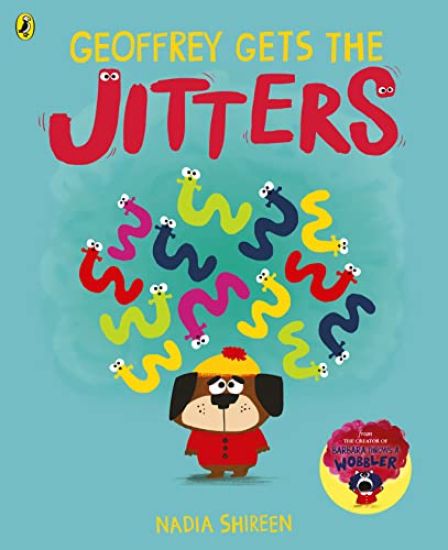
Geoffrey Gets the Jitters

Geoffrey Gets the Jitters

Nadia Shireen

Penguin Random House Children's UK
2023
nidottu
Selected for the UKLA Book Awards Shortlist for 2025.Shortlisted for the Oscar’s Book Prize, 2024.From the creator of Barbara Throws a Wobbler - the ultimate story to chase (and laugh) your worries away‘A wise and comical look at anxiety and how to banish it ... With funny pictures and a guide to different kinds of worries, this is soothing for all ages’ - The TimesGeoffrey's got the jitters! It started last night when he was thinking about school - a funny, wiggly feeling in his tummy that grew and grew. But when Geoffrey's tummy jitters started talking to him - that's when he knew they were out of control. Geoffrey had to do something...Through a laugh-out-loud story and loveable character, Nadia Shireen shows how to understand and dispel anxieties, one jitter at a time.Selected as one of The Sunday Times Best Children's Book of the Year. Selected for Book Trust’s Great Book Guide 2024-2025
Geoffrey Chaucer

Geoffrey Chaucer

John Norton-Smith

Routledge
2019
sidottu
Originally published in 1974. This book discusses those aspects of Chaucer’s art which are concerned with the problem of specific form. These aspects have been concentrated on by the author for Chaucer’s major poems and some of his so-called minor poems in separate chapters. It offers a critical evaluation of some specific literary achievements of one of the most important authors of the medieval period. The author extensively compares Chaucer's poetic technique to contemporary French poets and preceding poetic structure.