Kirjahaku
Etsi kirjoja tekijän nimen, kirjan nimen tai ISBN:n perusteella.
1000 tulosta hakusanalla Geoffrey M. Stephenson
First Published in 1998. This is Volume I in the Sociology of Behaviour and Psychology series. This work was first written as a Ph..D. thesis and submitted to the University of Nottingham under the title 'Conscience and Psychopathy: an investigation into the nature and development of the conscience'. It explores the problems of definition and assessment as well as outlining the results of the assessments made from listening to forty tape-recorded interviews: twenty with subjects diagnosed as psychopaths and twenty with normal subjects, acting as a control group.
Conscience in Recovery from Alcohol Addiction
Yordan Kalev Zhekov; Geoffrey M Stephenson
Resource Publications (CA)
2013
sidottu
Under cloudless blue skies, the Oakwood Cemetery Annex in Montgomery, Alabama hosts the largest Commonwealth War Graves Commission cemetery in the United States. Most of the graves contain young RAF trainee pilots killed during their flying training at nearby Maxwell and Gunter airfields during the Second World War. However, there is another grave, located at the edge of the plot, not from the early 1940s but, from 1954\. The grave marks the final resting place of a 44-year-old senior RAF officer, Air Commodore Geoffrey Stephenson CBE. It begs the questions who was he and why is he buried there? This book sets out to answer both these questions. As a result, this is the remarkable story of not only Stephenson’s life but the people, planes and places that would leave an indelible mark on a seasoned fighter pilot. After growing up in Lincolnshire and Ireland, 18-year-old Stephenson joined the RAF in 1928 alongside Douglas Bader who would become a life-long friend. After leaving Cranwell, the pair both joined 23 Squadron. In the 1930s, Stephenson rose through the ranks to command 19 Squadron, a Duxford-based Spitfire unit, that would see his baptism of fire over Dunkirk in late May 1940\. Following the downing of a Junkers Ju 87 Stuka, Stephenson was himself shot down and crash landed on the beach at Sangatte. After a brief period on the run in France and Belgium, Stephenson was taken into captivity, spending the next five years as a prisoner of war, ending up at the iconic Colditz Castle where, ironically, he was reunited with his old friend Bader. Upon his release in April 1945, Stephenson quickly resumed his RAF career commanding, instructing, and flying the latest jet fighters, both at home and overseas. He was aide-de-camp to two monarchs, including escorting a young Queen Elizabeth II during her 1953 Coronation Review. However, his already eventful career would take a tragic turn. In 1954, Stephenson flew to the United States to review their latest acquisitions, which included a flight in the supersonic F-100 Super Sabre. It would be his last flight. Nevertheless, Stephenson’s legacy lives on at his former base at Duxford in the guise of the Imperial War Museum’s immaculately restored Spitfire Mk.I N3200\. This was the very aircraft in which he force-landed on 26 May 1940\. Recovered from the French beach, N3200 was painstakingly rebuilt and returned to flying condition. Today, N3200 is often referred to as a ‘National Treasure’. This is the biography of a remarkable pilot, husband and father, revealing the planes he flew, the places he visited, and the incredible people he met along the way.
The Psychology of Criminal Justice integrates aspects of psychology's contributions to criminology and to socio-legal studies within a single narrative framework. It does this by describing the interpersonal and group dynamics of decision-making at key stages in the processing of accused persons from the time an alleged offence is committed to the moment sentence is passed. The book bears directly on many current debates concerning the ability of the criminal justice system to deliver reliable verdicts. It recognizes the interdependence of decision makers in the system and addresses questions at an appropriately social-psychological level. The book examines systematically and critically the dynamics of criminal decision-making, the response of victims, the assumptions, attitudes and behavior of police officers, the conduct of court proceedings, the performance of witnesses, the strengths and weaknesses of juries, and the sentencing of magistrates and judges. Discussions of law and morality, the attribution of blame in court and in everyday life, and the achievement of justice in interpersonal and organizational contexts, provide a definitive account of the social psychology of law in the context of criminal justice. Problems with our adversarial system of justice have led to the establishment of a Royal Commission on Criminal Justice. It is commonplace to seek a scapegoat in the behavior of one or other protagonist in the system - especially the police. It will become clear to readers of this book that breakdowns of the system are a product of persuasive interpersonal and intergroup processes of organization, reaching well beyond the behavior of any one agent.
Partial Differential Equations For Scientists And Engineers
Geoffrey Stephenson
Imperial College Press
1996
nidottu
Partial differential equations form an essential part of the core mathematics syllabus for undergraduate scientists and engineers. The origins and applications of such equations occur in a variety of different fields, ranging from fluid dynamics, electromagnetism, heat conduction and diffusion, to quantum mechanics, wave propagation and general relativity.This volume introduces the important methods used in the solution of partial differential equations. Written primarily for second-year and final-year students taking physics and engineering courses, it will also be of value to mathematicians studying mathematical methods as part of their course. The text, which assumes only that the reader has followed a good basic first-year ancillary mathematics course, is self-contained and is an unabridged republication of the third edition published by Longman in 1985.
The Social Psychology of Bargaining
Ian Morley; Geoffrey Stephenson
Psychology Press Ltd
2015
sidottu
Originally published in 1977, this book deals with the social psychological factors which influence the process of bargaining. It examines the structure behind the process, by which it can be analysed and better understood. Particular attention is paid to the character of negotiations in which agreements are obtained.
The Social Psychology of Bargaining
Ian Morley; Geoffrey Stephenson
Psychology Press Ltd
2017
nidottu
Originally published in 1977, this book deals with the social psychological factors which influence the process of bargaining. It examines the structure behind the process, by which it can be analysed and better understood. Particular attention is paid to the character of negotiations in which agreements are obtained.
Chef, restaurateur, and Food Network Iron Chef Geoffrey Zakarian knows that the pantry is the backbone of any kitchen and the place from which every great meal starts. Forget exotic condiments and specialty foods. With a working base of 50 readily available ingredients, from oats and honey to almonds and canned chickpeas, you will always have the makings of a delicious home-cooked meal. Whether cooking in his world-class restaurants, on "Iron Chef," or judging the offerings on "Chopped," Geoffrey knows every great meal starts with a trip to the pantry first for inspiration. In "The Perfect Pantry," Geoffrey shows you how to use your pantry to jumpstart any meal. When you bring home your fresh produce and proteins, you'll have 150 recipes at the ready, and many of these can be made with pantry ingredients alone. You'll see a simple can of beans as a Smoky Black Bean Bisque or coconut milk as Spicy Coconut Tempura Shrimp. Standard back-of-the-cupboard fare like almonds become crispy crust on a broiled pork chop; peanut butter lends itself beautifully to a spicy slaw, cider vinegar gives great flavor to a chicken main as well as to donuts, and mustard transforms a a pot roast. Throughout, you'll find quick but ingenious tips for each of the 50 ingredients, like how to use Earl Grey teabags to infuse ice cubes or a syrup for French toast. "The Perfect Pantry" makes it so easy for your everyday staples to lead, rather than support, the creation of extraordinary meals. Geoffrey gives you the shopping list you need, as well as the road map for making the most of what you have on hand.
1948 Archbold Cape York Expedition: Daily Journal G. M. Tate
Geoffrey M. 1898-1964 Tate; American Museum of Natural History D; American Museum of Natural History
Hassell Street Press
2021
nidottu
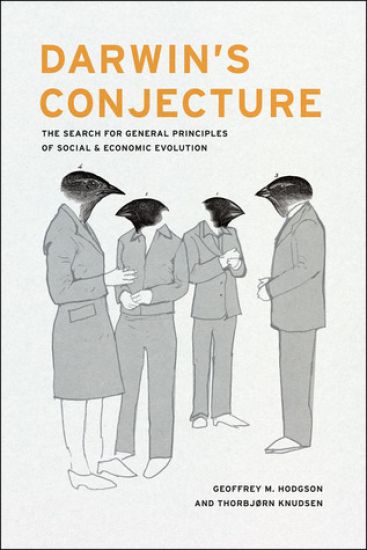
Of paramount importance to the natural sciences, the principles of Darwinism, which involve variation, inheritance, and selection, are increasingly of interest to social scientists as well. But no one has provided a truly rigorous account of how the principles apply to the evolution of human society - until now. In "Darwin's Conjecture", Geoffrey Hodgson and Thorbjorn Knudsen reveal how the British naturalist's core concepts apply to a wide range of phenomena, including business practices, legal systems, technology, and even science itself. They also critique some prominent objections to applying Darwin to social science, arguing that ultimately Darwinism functions as a general theoretical framework for stimulating further inquiry. Social scientists who adopt a Darwinian approach, they contend, can then use it to frame and help develop new explanatory theories and predictive models. This truly groundbreaking work at long last makes the powerful conceptual tools of Darwin available to the social sciences and will be welcomed by scholars and students from a range of disciplines.
Of paramount importance to the natural sciences, the principles of Darwinism, which involve variation, inheritance, and selection, are increasingly of interest to social scientists as well. But no one has provided a truly rigorous account of how the principles apply to the evolution of human society - until now. In "Darwin's Conjecture", Geoffrey M. Hodgson and Thorbjorn Knudsen reveal how the British naturalist's core concepts apply to a wide range of phenomena, including business practices, legal systems, technology, and even science itself. They also critique some prominent objections to the application of Darwinism to social science, arguing that ultimately Darwinism functions as a general theoretical framework for stimulating further inquiry. Social scientists who adopt a Darwinian approach, they contend, can then use it to frame and help develop new explanatory theories and predictive models. This truly pathbreaking work at long last makes the powerful conceptual tools of Darwin available to the social sciences and will be welcomed by scholars and students from a range of disciplines.
The Left is in crisis. Despite global economic turbulence, left-wing political parties in many countries have failed to make progress in part because they have grown too ideologically fragmented. Today, the term Left is associated with state intervention and public ownership, but this has little in common with the original meaning of the term. What caused what we mean by the Left to change, and how has that hindered progress? With Wrong-Turnings, Geoffrey M. Hodgson tracks changes in the meaning of the Left and offers suggestions for how the Left might reclaim some of its core values. The term Left originated during the French Revolution, when revolutionaries sought to abolish the monarchy and privilege and to introduce a new society based on liberty, equality, fraternity, and universal rights. Over time, however, the meaning radically changed, especially through the influence of socialism and collectivism. Hodgson argues that the Left must rediscover its roots in the Enlightenment and readopt Enlightenment values it has abandoned, such as those concerning democracy and universal human rights. Only then will it be prepared to address contemporary problems of inequality and the survival of democracy. Possible measures could include enhanced educational provisions, a guaranteed basic income, and a viable mechanism for fair distribution of wealth.Wrong-Turnings is a truly pathbreaking work from one of our most prolific and respected institutional theorists. It will change our understanding of how the left got lost.
From Pleasure Machines to Moral Communities
Geoffrey M. Hodgson
University of Chicago Press
2012
sidottu
Are humans at their core seekers of their own pleasure or cooperative members of society? Paradoxically, they are both. Pleasure seeking can take place only within the context of what works within a defined community, and central to any community are the evolved codes and principles guiding appropriate behavior or morality. The complex interaction of morality and self-interest is at the heart of Geoffrey M. Hodgson's approach to evolutionary economics, which is designed to bring about a better understanding of human behavior. In "From Pleasure Machines to Moral Communities", Hodgson casts a critical eye on neoclassical individualism, its foundations and flaws, and turns to recent insights from research on the evolutionary bases of human behavior. He focuses his attention on the evolution of morality, its meaning, why it came about, and how it influences human attitudes and behavior. This more nuanced understanding sets the stage for a fascinating investigation of its implications for a range of pressing issues drawn from diverse environments, including the business world and crucial policy realms like health care and ecology. This book provides a valuable complement to Hodgson's earlier work with Thorbjorn Knudsen on evolutionary economics in Darwin's Conjecture, extending the evolutionary outlook to include moral and policy-related issues.
Recent events in Eastern Europe have underlined the limitations of Marxian economic and political theory. In this collection of essays Hodgson subjects Marxian economic theory to critical examination and shows which elements retain their modern relevance. After analysing the contribution of Sraffa, and indicating its critical potential and theoretical limitations, Hodgson points to a new synthesis embracing Marx, Keynes and Veblen.
This book proposes a new theory of change in American higher education that explains the resilience of colleges and universities, and demonstrates how they adapt to new social and economic conditions. It argues that the demands for new educational missions, new sources of capital to finance innovation, and new organizational and governance models lead to the creation of institutional diversity. Using the theory of “accretive change” to predict future changes, this volume asserts that the rise of artificial intelligence and new investment models within the field of social entrepreneurship will shape the next wave of universities and educational institutions.
This edition contains two of Frances Burney's comedies: "The Witlings", (1778-80) which satirizes the bluestockings; and "The Woman Hater" (1800-02), which explores social pretension and gender conflict.
Since the fall of the Berlin Wall we have been told that no alternative to Western capitalism is possible or desirable. This book challenges this view with two arguments. First, the above premise ignores the enormous variety within capitalism itself. Second, there are enormous forces of transformation within contemporary capitalisms, associated with moves towards a more knowledge-intensive economy. These forces challenge the traditional bases of contract and employment, and could lead to a quite different socio-economic system. Without proposing a static blueprint, this book explores this possible scenario.