
Kirjahaku
Etsi kirjoja tekijän nimen, kirjan nimen tai ISBN:n perusteella.
1000 tulosta hakusanalla Georg Asmussen
Unver nderter Nachdruck der Originalausgabe von 1924.

Unver nderter Nachdruck der Originalausgabe von 1924.


Georg Asmussen beschreibt in seinem Roman anschaulich das Leben und die typischen Charakterzüge der Einheimischen an der Ostseeküste. Durch die fesselnde Darstellung der Naturgewalten an dieser Küste spürt der Leser die Überlegenheit der Natur gegenüber dem Menschen sehr deutlich. Zu Unrecht wird ja häufig vergessen, dass nicht nur die Nordseeküste immer wieder von Sturmfluten heimgesucht wird, sondern auch die Ostseeküste von ihnen nicht verschont bleibt. Besonderen Schrecken rief hier die Sturmflut vom 13. November 1872 hervor, die schwerste Sturmflut, die die Ostsee seit Menschengedenken erlebt hatte. Und nirgendwo sonst wird diese Sturmflut so packend geschildert. Ein Buch, das für jeden Urlauber an der gesamten Ostseeküste Reiselektüre sein sollte!
"Wenige k nnen Menschen und ihre Kulturen einerseits und Naturgewalten in ihrer zerst rerischen Dynamik andererseits deskriptiv so lebendig, so anschaulich erfassen, wie Geog Asmussen, der gro e norddeutsche Schriftsteller. Hamburger wissen, dass der Sohn aus rmlichen Verh ltnissen nicht nur Schriftsteller, sondern auch ein weltgewandter Manager und Ingenieur war." Redaktion Gr ls-Verlag (Edition Werke der Weltliteratur)
"Wenige k nnen Menschen und ihre Kulturen einerseits und Naturgewalten in ihrer zerst rerischen Dynamik andererseits deskriptiv so lebendig, so anschaulich erfassen, wie Geog Asmussen, der gro e norddeutsche Schriftsteller. Hamburger wissen, dass der Sohn aus rmlichen Verh ltnissen nicht nur Schriftsteller, sondern auch ein weltgewandter Manager und Ingenieur war." Redaktion Gr ls-Verlag (Edition Werke der Weltliteratur)






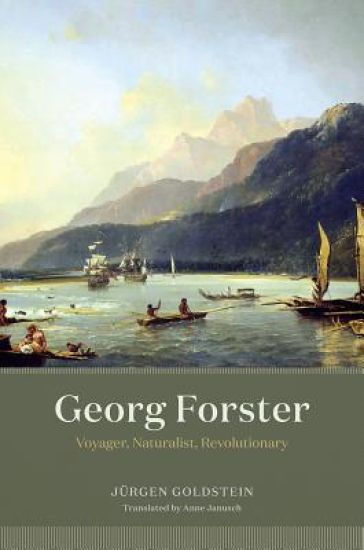
“Marvelous. . . . Wonderfully imaginative. . . . Sparkling.”—Wall Street Journal “Stunning. . . . Read this book: in equal measure it will give you hope and trouble your dreams.”—Laura Dassow Walls, author of Henry David Thoreau: A Life and Passage to Cosmos: Alexander von Humboldt’s Shaping of America Georg Forster (1754–94) was in many ways self-taught and rarely had two cents to rub together, but he became one of the most dynamic figures of the Enlightenment: a brilliant writer, naturalist, explorer, illustrator, translator—and a revolutionary. Granted the extraordinary opportunity to sail around the world as part of Captain James Cook’s fabled crew, Forster touched icebergs, walked the beaches of Tahiti, visited far-flung foreign nations, lived with purported cannibals, and crossed oceans and the equator. Forster recounted the journey in his 1777 book A Voyage Round the World, a work of travel and science that not only established Forster as one of the most accomplished stylists of the time—and led some to credit him as the inventor of the literary travel narrative—but also influenced other German trailblazers of scientific and literary writing, most notably Alexander von Humboldt. A superb essayist, Forster made lasting contributions to our scientific—and especially botanical and ornithological—knowledge of the South Seas. Having witnessed more egalitarian societies in the southern hemisphere, Forster returned after more than three years at sea to a monarchist Europe entering the era of revolution. When, following the French Revolution of 1789, French forces occupied the German city of Mainz, Forster became a leading political actor in the founding of the Republic of Mainz—the first democratic state on German soil. In an age of Kantian reason, Forster privileged experience. He claimed a deep connection between nature and reason, nature and politics, nature and revolution. His politics was radical in its understanding of revolution as a natural phenomenon, and in this often overlooked way his many facets—as voyager, naturalist, and revolutionary—were intertwined. Yet, in the constellation of the Enlightenment’s trailblazing naturalists, scientists, political thinkers, and writers, Forster’s star remains relatively dim today: the Republic of Mainz was crushed, and Forster died in exile in Paris. This book is the source of illumination that Forster’s journey so greatly deserves. Tracing the arc of this unheralded polymath’s short life, Georg Forster explores both his contributions to literature and science and the enduring relationship between nature and politics that threaded through his extraordinary four decades.

Georg Simmel is one of the most original German thinkers of the twentieth century and is considered a founding architect of the modern discipline of sociology. Ranging over fundamental questions of the relationship of self and society, his influential writings on money, modernity, and the metropolis continue to provoke debate today. Fascinated by the relationship between culture, society, and economic life, Simmel took an interest in myriad phenomena of aesthetics and the arts. A friend of writers and artists such as Auguste Rodin, Rainer Maria Rilke, and Stefan George, he wrote dozens of pieces engaging with topics such as the work of Michelangelo, Rembrandt, and Rodin, Japanese art, naturalism and symbolism, Goethe, "art for art's sake", art exhibitions, and the aesthetics of the picture frame. This is the first collection to bring together Simmel's finest writing on art and aesthetics, and many of the items appear in English in this volume for the first time. The more than forty essays show the protean breadth of Simmel's reflections, covering landscape painting, portraiture, sculpture, poetry, theater, form, style, and representation. An extensive introduction by Austin Harrington gives an overview of Simmel's themes and elucidates the significance of his work for the many theorists who would be inspired by his ideas. Something of an outsider to the formal academic world of his day, Simmel wrote creatively with the flair of an essayist. This expansive collection of translations, many of them prepared by the editor, preserves the narrative ease of Simmel's prose and will be a vital source for readers with an interest in Simmel's trailblazing ideas in modern European philosophy, sociology, and cultural theory.

Georg Simmel is one of the most original German thinkers of the twentieth century and is considered a founding architect of the modern discipline of sociology. Ranging over fundamental questions of the relationship of self and society, his influential writings on money, modernity, and the metropolis continue to provoke debate today. Fascinated by the relationship between culture, society, and economic life, Simmel took an interest in myriad phenomena of aesthetics and the arts. A friend of writers and artists such as Auguste Rodin, Rainer Maria Rilke, and Stefan George, he wrote dozens of pieces engaging with topics such as the work of Michelangelo, Rembrandt, and Rodin, Japanese art, naturalism and symbolism, Goethe, "art for art's sake", art exhibitions, and the aesthetics of the picture frame. This is the first collection to bring together Simmel's finest writing on art and aesthetics, and many of the items appear in English in this volume for the first time. The more than forty essays show the protean breadth of Simmel's reflections, covering landscape painting, portraiture, sculpture, poetry, theater, form, style, and representation. An extensive introduction by Austin Harrington gives an overview of Simmel's themes and elucidates the significance of his work for the many theorists who would be inspired by his ideas. Something of an outsider to the formal academic world of his day, Simmel wrote creatively with the flair of an essayist. This expansive collection of translations, many of them prepared by the editor, preserves the narrative ease of Simmel's prose and will be a vital source for readers with an interest in Simmel's trailblazing ideas in modern European philosophy, sociology, and cultural theory.

Georg Simmel on Individuality and Social Forms
Georg Simmel
University of Chicago Press
1972
nidottu
"Of those who created the intellectual capital used to launch the enterprise of professional sociology, Georg Simmel was perhaps the most original and fecund. In search of a subject matter for sociology that would distinguish it from all other social sciences and humanistic disciplines, he charted a new field for discovery and proceeded to explore a world of novel topics in works that have guided and anticipated the thinking of generations of sociologists. Such distinctive concepts of contemporary sociology as social distance, marginality, urbanism as a way of life, role-playing, social behavior as exchange, conflict as an integrating process, dyadic encounter, circular interaction, reference groups as perspectives, and sociological ambivalence embody ideas which Simmel adumbrated more than six decades ago."—Donald N. Levine Half of the material included in this edition of Simmel's writings represents new translations. This includes Simmel's important, lengthy, and previously untranslated "Group Expansion and Development of Individuality," as well as three selections from his most neglected work, Philosophy of Money; in addition, the introduction to Probleme der Geschichtsphilosophie, chapter one of the Lebensanschauung, and three essays are translated for the first time.