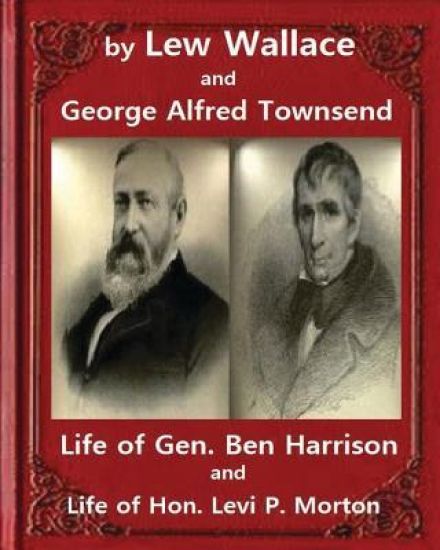
Levi Parsons Morton (May 16, 1824 - May 16, 1920) was a Representative from New York and the 22nd Vice President of the United States (1889-93). He later served as the 31st Governor of New York.Morton was born in Shoreham, Addison County, Vermont. His parents were the Reverend Daniel Oliver Morton (1788-1852), a Congregationalist minister of old New England stock, and Lucretia Parsons (1789-1862). His older brother, David Oliver Morton (1815-59), was Mayor of Toledo, Ohio, from 1849 to 1850. He left school early and worked as a clerk in a general store in Enfield, Massachusetts, taught school in Boscawen, New Hampshire, engaged in mercantile pursuits in Hanover, New Hampshire, moved to Boston, entered the dry-goods business in New York City, and engaged in banking there. He was an unsuccessful candidate for election in 1876 to the 45th Congress, but he was appointed by President Rutherford B. Hayes to be an honorary commissioner to the Paris Exhibition of 1878. Benjamin Harrison (August 20, 1833 - March 13, 1901) was the 23rd President of the United States (1889-93); he was the grandson of the ninth President, William Henry Harrison. Before ascending to the presidency, Harrison established himself as a prominent local attorney, Presbyterian church leader and politician in Indianapolis, Indiana. During the American Civil War, he served the Union as a colonel and on February 14, 1865 was confirmed by the U.S. Senate as a brevet brigadier general of volunteers to rank from January 23, 1865. After the war, he unsuccessfully ran for the governorship of Indiana. He was later elected to the U.S. Senate by the Indiana legislature. A Republican, Harrison was elected to the presidency in 1888, defeating the Democratic incumbent Grover Cleveland. Hallmarks of his administration included unprecedented economic legislation, including the McKinley Tariff, which imposed historic protective trade rates, and the Sherman Antitrust Act; Harrison facilitated the creation of the National Forests through an amendment to the Land Revision Act of 1891. He also substantially strengthened and modernized the Navy, and conducted an active foreign policy. He proposed, in vain, federal education funding as well as voting rights enforcement for African Americans during his administration. Due in large part to surplus revenues from the tariffs, federal spending reached one billion dollars for the first time during his term. The spending issue in part led to the defeat of the Republicans in the 1890 mid-term elections. Harrison was defeated by Cleveland in his bid for re-election in 1892, due to the growing unpopularity of the high tariff and high federal spending. He then returned to private life in Indianapolis but later represented the Republic of Venezuela in an international case against the United Kingdom. In 1900, he traveled to Europe as part of the case and, after a brief stay, returned to Indianapolis. He died the following year of complications from influenza. Although many have praised Harrison's commitment to African Americans' voting rights, scholars and historians generally regard his administration as below-average, and rank him in the bottom half among U.S. presidents. George Alfred Townsend (January 30, 1841 - April 15, 1914), was a noted war correspondent during the American Civil War, and a later novelist. Townsend wrote under the pen name "Gath", which was derived by adding an "H" to his initials, and inspired by the biblical passage II Samuel 1:20, "Tell it not in Gath, publish it not in the streets of Askalon." Lewis "Lew" Wallace (April 10, 1827 - February 15, 1905) was an American lawyer, Union general in the American Civil War, governor of the New Mexico Territory,
The youngest correspondent to cover the Civil War and a pioneer in newspaper syndication, George Alfred Townsend came from modest circumstances. Using the pen name of GATH, he rose to fame and fortune after the war, and his career brought him into contact with sitting presidents and luminaries such as Mark Twain. Though almost forgotten today in the canon of Maryland authors, GATH left a lasting legacy of literature and a most unique monument. He created a lavish summer estate near Boonsboro, Maryland, named Gapland--now called Gathland. He also famously erected the War Correspondents Memorial Arch, a monument to fellow wartime journalists. Today, GATH's estate is preserved and interpreted by a state park and its museums. His commanding arch remains a bold reminder of the creative genius of George Alfred Townsend.
"I wish most heartily that something would happen," Harry Parkhurst, a midshipman of some sixteen years of age, said to his chum, Dick Balderson, as they leaned on the rail of her majesty's gunboat Serpent, and looked gloomily at the turbid stream that rolled past the ship as she lay at anchor. "One day is just like another-one is in a state of perspiration from morning till night, and from night till morning. There seems to be always a mist upon the water; and if it were not that we get up steam every three or four days and run out for twenty-four hours for a breath of fresh air, I believe that we should be all eaten up with fever in no time. Of course, they are always talking of Malay pirates up the river kicking up a row; but it never seems to come off."
There are few difficulties that cannot be surmounted by patience, resolution, and pluck, and great as are the obstacles that nature and the Russian government oppose to an escape from the prisons of Siberia, such evasions have occasionally been successfully carried out, and that under far less advantageous circumstances than those under which the hero of this story undertook the venture.
From the hour the author stood by the dead face of Abraham Lincoln, in the Executive Mansion at Washington, he has had the idea of writing a romance upon the conspiracy of Booth. Like many such literary projects nursed by a journalist, this one had not only to be postponed, but finally to become a portion of a broader story, because too many of the actors in the tragedy still lived, and the mere crime presented no elevated moral to justify its embellishment. Considering it, however, as one of a series of cumulative acts of violence committed upon or from the soil of Maryland during the conflict of Emancipation, the author felt not only an epic propriety to be in the theme. -- George Alfred Townsend Gapland, Md., 1886