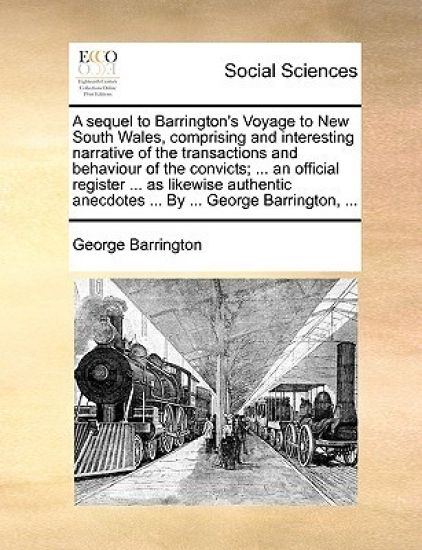
The 18th century was a wealth of knowledge, exploration and rapidly growing technology and expanding record-keeping made possible by advances in the printing press. In its determination to preserve the century of revolution, Gale initiated a revolution of its own: digitization of epic proportions to preserve these invaluable works in the largest archive of its kind. Now for the first time these high-quality digital copies of original 18th century manuscripts are available in print, making them highly accessible to libraries, undergraduate students, and independent scholars.Rich in titles on English life and social history, this collection spans the world as it was known to eighteenth-century historians and explorers. Titles include a wealth of travel accounts and diaries, histories of nations from throughout the world, and maps and charts of a world that was still being discovered. Students of the War of American Independence will find fascinating accounts from the British side of conflict. ++++The below data was compiled from various identification fields in the bibliographic record of this title. This data is provided as an additional tool in helping to insure edition identification: ++++British LibraryT142277The titlepage is engraved. Drop-head title on p.18: 'A voyage to New South Wales'. 'A sequel to Barrington's Voyage to New South Wales' was published in 1801.London: printed by C. Lowndes, and sold by H. D. Symonds, 1800] 2],120p., plate; 12
The 18th century was a wealth of knowledge, exploration and rapidly growing technology and expanding record-keeping made possible by advances in the printing press. In its determination to preserve the century of revolution, Gale initiated a revolution of its own: digitization of epic proportions to preserve these invaluable works in the largest archive of its kind. Now for the first time these high-quality digital copies of original 18th century manuscripts are available in print, making them highly accessible to libraries, undergraduate students, and independent scholars.Delve into what it was like to live during the eighteenth century by reading the first-hand accounts of everyday people, including city dwellers and farmers, businessmen and bankers, artisans and merchants, artists and their patrons, politicians and their constituents. Original texts make the American, French, and Industrial revolutions vividly contemporary.++++The below data was compiled from various identification fields in the bibliographic record of this title. This data is provided as an additional tool in helping to insure edition identification: ++++British LibraryT149156London: printed for the proprietor; sold by H. D. Symonds, 1795. 9],14-140p.; 8
The 18th century was a wealth of knowledge, exploration and rapidly growing technology and expanding record-keeping made possible by advances in the printing press. In its determination to preserve the century of revolution, Gale initiated a revolution of its own: digitization of epic proportions to preserve these invaluable works in the largest archive of its kind. Now for the first time these high-quality digital copies of original 18th century manuscripts are available in print, making them highly accessible to libraries, undergraduate students, and independent scholars.This collection reveals the history of English common law and Empire law in a vastly changing world of British expansion. Dominating the legal field is the Commentaries of the Law of England by Sir William Blackstone, which first appeared in 1765. Reference works such as almanacs and catalogues continue to educate us by revealing the day-to-day workings of society.++++The below data was compiled from various identification fields in the bibliographic record of this title. This data is provided as an additional tool in helping to insure edition identification: ++++British LibraryT073567Other editions of this work were published in 1790 and 1791 with the title: 'The genuine life and trial of George Barrington'.London: printed for J. Bird; and Simmonds, 1790?]. 40p., plate: port.; 8
The 18th century was a wealth of knowledge, exploration and rapidly growing technology and expanding record-keeping made possible by advances in the printing press. In its determination to preserve the century of revolution, Gale initiated a revolution of its own: digitization of epic proportions to preserve these invaluable works in the largest archive of its kind. Now for the first time these high-quality digital copies of original 18th century manuscripts are available in print, making them highly accessible to libraries, undergraduate students, and independent scholars.Delve into what it was like to live during the eighteenth century by reading the first-hand accounts of everyday people, including city dwellers and farmers, businessmen and bankers, artisans and merchants, artists and their patrons, politicians and their constituents. Original texts make the American, French, and Industrial revolutions vividly contemporary.++++The below data was compiled from various identification fields in the bibliographic record of this title. This data is provided as an additional tool in helping to insure edition identification: ++++British LibraryT149294Drop-head title: 'A voyage to New South Wales. Part II.' - With three final leaves: 'An official register of the crimes .. of the convicts in New South-Wales'. With a half-title.London: printed and published by C. Lowndes; and sold by H. D. Symonds, 1800. viii, 1],6-110, 6]p.: ill., table; 8
Described by the London Chronicle as 'the genteelest thief ever remembered at the Old Bailey', during the 1770s the dandy, actor and pickpocket George Barrington acquired infamy throughout Great Britain. His prosecution and conviction in 1790 merely served to intensify popular interest and ensured that when in 1802 the account of his transportation to Australia was published, reading audiences responded with hearty enthusiasm. After prefacing his volume with a concise and useful history of New South Wales, the author regales readers with tales of murder, theft, punishment and retribution. These bloody episodes, combined with engaging, albeit prejudiced, notes on the indigenous population, found favour with European readers and twenty years of serialisations, new editions and translations followed. Punctuated by quirky vignettes and unusual coloured plates, Barrington's narrative continues to entertain and inform anyone with an interest in British colonial, maritime or criminal history.
Title: The Frauds and Cheats of London detected ... With wood cuts, etc.Publisher: British Library, Historical Print EditionsThe British Library is the national library of the United Kingdom. It is one of the world's largest research libraries holding over 150 million items in all known languages and formats: books, journals, newspapers, sound recordings, patents, maps, stamps, prints and much more. Its collections include around 14 million books, along with substantial additional collections of manuscripts and historical items dating back as far as 300 BC.The FICTION & PROSE LITERATURE collection includes books from the British Library digitised by Microsoft. The collection provides readers with a perspective of the world from some of the 18th and 19th century's most talented writers. Written for a range of audiences, these works are a treasure for any curious reader looking to see the world through the eyes of ages past. Beyond the main body of works the collection also includes song-books, comedy, and works of satire. ++++The below data was compiled from various identification fields in the bibliographic record of this title. This data is provided as an additional tool in helping to insure edition identification: ++++ British Library Barrington, George; 1802. 80 p.; 12 . 10350.bbb.31.

![[A Voyage to Botany Bay.] a Voyage to New South Wales; With a Description of the Country; The Manners, Customs, Religion, Andc. of the Natives, in the Vicinity of Botany Bay.](/covers/9781241430214.jpg)
![[A Voyage to Botany Bay.] a Voyage to New South Wales; With a Description of the Country; The Manners, Customs, Religion, Andc. of the Natives, in the Vicinity of Botany Bay.](/covers/9781241431228.jpg)