Kirjahaku
Etsi kirjoja tekijän nimen, kirjan nimen tai ISBN:n perusteella.
1000 tulosta hakusanalla George Burton Adams

The History of England From the Norman Conquest to the Death of John
George Burton Adams
Anson Street Press
2025
pokkari

The History of England From the Norman Conquest to the Death of John
George Burton Adams
Anson Street Press
2025
sidottu
Explore the tumultuous period of English history from the Norman Conquest to the death of John with "The History of England From the Norman Conquest to the Death of John, 1066-1216," by George Burton Adams. This meticulously researched work delves into the pivotal years between 1066 and 1216, a transformative era shaping Great Britain. Uncover the key events, figures, and social changes that defined medieval England following the Norman invasion. From the establishment of Norman rule to the reign of King John, this book offers a comprehensive overview of the political landscape, societal structures, and cultural developments of the time. Journey through the reigns of kings and the evolution of English society during this formative period. A valuable resource for anyone interested in medieval history and the roots of Great Britain.This work has been selected by scholars as being culturally important, and is part of the knowledge base of civilization as we know it.This work is in the public domain in the United States of America, and possibly other nations. Within the United States, you may freely copy and distribute this work, as no entity (individual or corporate) has a copyright on the body of the work.Scholars believe, and we concur, that this work is important enough to be preserved, reproduced, and made generally available to the public. We appreciate your support of the preservation process, and thank you for being an important part of keeping this knowledge alive and relevant.


The History Of England From The Norman Conquest To The Death Of John 1066 to 1216
George Burton Adams
KESSINGER PUBLISHING, LLC
2010
sidottu
The Growth of the French Nation
George Burton Adams
British Library, Historical Print Editions
2011
pokkari
Title: The Growth of the French Nation.Publisher: British Library, Historical Print EditionsThe British Library is the national library of the United Kingdom. It is one of the world's largest research libraries holding over 150 million items in all known languages and formats: books, journals, newspapers, sound recordings, patents, maps, stamps, prints and much more. Its collections include around 14 million books, along with substantial additional collections of manuscripts and historical items dating back as far as 300 BC.The HISTORY OF EUROPE collection includes books from the British Library digitised by Microsoft. This collection includes works chronicling the development of Western civilisation to the modern age. Highlights include the development of language, political and educational systems, philosophy, science, and the arts. The selection documents periods of civil war, migration, shifts in power, Muslim expansion into Central Europe, complex feudal loyalties, the aristocracy of new nations, and European expansion into the New World. ++++The below data was compiled from various identification fields in the bibliographic record of this title. This data is provided as an additional tool in helping to insure edition identification: ++++ British Library Adams, George Burton; 1896. 350 p.; 8 . 9220.cc.13.
The Growth of the French Nation
George Burton Adams
British Library, Historical Print Editions
2011
pokkari
Title: The Growth of the French Nation.Publisher: British Library, Historical Print EditionsThe British Library is the national library of the United Kingdom. It is one of the world's largest research libraries holding over 150 million items in all known languages and formats: books, journals, newspapers, sound recordings, patents, maps, stamps, prints and much more. Its collections include around 14 million books, along with substantial additional collections of manuscripts and historical items dating back as far as 300 BC.The HISTORY OF EUROPE collection includes books from the British Library digitised by Microsoft. This collection includes works chronicling the development of Western civilisation to the modern age. Highlights include the development of language, political and educational systems, philosophy, science, and the arts. The selection documents periods of civil war, migration, shifts in power, Muslim expansion into Central Europe, complex feudal loyalties, the aristocracy of new nations, and European expansion into the New World. ++++The below data was compiled from various identification fields in the bibliographic record of this title. This data is provided as an additional tool in helping to insure edition identification: ++++ British Library Adams, George Burton; 1896. 350 p.; 8 . 9200.de.8.
Civilization During the Middle Ages Especially in Relation to Modern Civilization
George Burton Adams
KESSINGER PUBLISHING CO
2004
pokkari

History Of England From The Norman Conquest To The Death Of John 1066 to 1216
George Burton Adams
KESSINGER PUBLISHING CO
2004
pokkari
The Origin Of The English Constitution (1912)
George Burton Adams
KESSINGER PUBLISHING, LLC
2008
nidottu

Civilization During the Middle Ages Especially in Relation to Modern Civilization
George Burton Adams
Literary Licensing, LLC
2014
nidottu
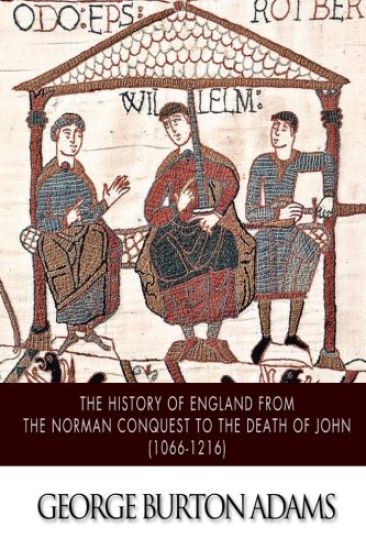
The History of England from the Norman Conquest to the Death of John (1066-1216)
George Burton Adams
Createspace Independent Publishing Platform
2014
nidottu
"We, conquered by William, have liberated the Conqueror's land". So reads the memorial to the British war dead at Bayeaux, Normandy. Commemorating those who gave their lives to free France in 1944, it also serves to remind people of an earlier conflict. For the English, the Norman conquest remains deeply embedded in the national psyche. As the last contested military invasion to have succeeded in conquering this proud island nation, the date of 1066 is the one every citizen can remember. For them, William will forever be the "Conqueror", the last invader to beat them in an open fight. For others, notably the French, he is the "Bastard", a reference not only to his lineage. William's conquest of the island arguably made him the most important figure in shaping the course of English history, but modern caricatures of this vitally important medieval figure are largely based on ignorance. William is a fascinating and complex figure, in many ways the quintessential warrior king of this period. Inheriting the Duchy of Normandy while still an infant and forced to fight for his domain almost ceaselessly during his early years, William went on to conquer and rule England, five times larger and three times wealthier. In doing so, he demonstrated sophisticated political and diplomatic skill, military prowess and administrative acumen. Although he lived by the sword, he was a devout man who had only one wife, to whom he remained faithful. However, peering back nearly 1,000 years to understand William does not just require a suspension of 21st century values and prejudices, because the evidence itself is far from complete. The historical record includes chronicles and documents, most notably the Anglo-Saxon Chronicle, the famous Domesday Book and the Bayeux tapestry, leaving scholars to attempt the meticulous and painstaking process of piecing together the narrative of his life and determining what William and the Normans might actually have been like. At the same time, those scholars are the first to admit the limitations of these abilities, since the few people who could write in medieval England and Normandy often had important agendas and prejudices of their own, or they were recording events decades after they occurred.

The History of England from the Norman Conquest to the Death of John 1066-1216
George Burton Adams
Createspace Independent Publishing Platform
2015
nidottu
Council and Courts in Anglo-Norman England (1926)
George Burton Adams
Lawbook Exchange, Ltd.
2019
sidottu


The History of England from the Norman Conquest to the Death of John
George Burton Adams
Hansebooks
2018
nidottu