Kirjojen hintavertailu. Mukana 11 244 527 kirjaa ja 12 kauppaa.

Kirjahaku

Etsi kirjoja tekijän nimen, kirjan nimen tai ISBN:n perusteella.

1000 tulosta hakusanalla George C. Thornton III; Rose A. Mueller-Hanson; Deborah E. Rupp

Developing Organizational Simulations

Developing Organizational Simulations

George C. Thornton III; Rose A. Mueller-Hanson; Deborah E. Rupp

Routledge
2017
sidottu
This second edition of Developing Organizational Simulations provides a concise source of information on effective and practical methods for constructing simulation exercises for the assessment of psychological characteristics relevant to effectiveness in work organizations. Incorporating new additions such as the multiple ways technology can be used in the design, delivery, scoring, and evaluating of simulation exercises, as well as the delivery of feedback based on the results, this book is user-friendly with practical how-to guidance, including many graphics, boxes, and examples. This book is ideal for practitioners, consultants, HR specialists, students, and researchers in need of guidance developing organizational simulations for personnel selection, promotion, diagnosis, training, or research. It is also suited for courses, workshops, and training programs in testing and measurement, personnel selection, training and development, and research methodology.
Developing Organizational Simulations

Developing Organizational Simulations

George C. Thornton III; Rose A. Mueller-Hanson; Deborah E. Rupp

Routledge
2017
nidottu
This second edition of Developing Organizational Simulations provides a concise source of information on effective and practical methods for constructing simulation exercises for the assessment of psychological characteristics relevant to effectiveness in work organizations. Incorporating new additions such as the multiple ways technology can be used in the design, delivery, scoring, and evaluating of simulation exercises, as well as the delivery of feedback based on the results, this book is user-friendly with practical how-to guidance, including many graphics, boxes, and examples. This book is ideal for practitioners, consultants, HR specialists, students, and researchers in need of guidance developing organizational simulations for personnel selection, promotion, diagnosis, training, or research. It is also suited for courses, workshops, and training programs in testing and measurement, personnel selection, training and development, and research methodology.
Assessment Centres and Global Talent Management

Assessment Centres and Global Talent Management

George C. Thornton Iii

TAYLOR FRANCIS LTD
2024
nidottu
Globalization, innovation, market share, identifying visionary leaders and, particularly, talent management ...are just some of the issues that benefit from using assessment and development centres. Assessment Centres and Global Talent Management focuses on topics that influence the design of the assessment centre in terms of the competencies being assessed, the exercises that are used and the nature of the event, so that they can deliver what is required; often to change organizational culture and values. Practical examples and case studies are sprinkled throughout the book as international contributors explore cross-cultural implications, and consider how the design, development and use of assessment centres should be adapted to different cultures. Some of the world's leading researchers and practitioners outline their research into new applications for assessment centre methods, showing how they have used it to design and implement specific assessment and development centres. This is a book from which practitioners can see how science informs good practice, and scholars will find the 32 chapters a rich source of ideas for conducting research into emerging issues in the field.
Assessment Centres and Global Talent Management

Assessment Centres and Global Talent Management

George C. Thornton Iii

Ashgate Publishing Limited
2011
sidottu
Globalization, innovation, market share, identifying visionary leaders and, particularly, talent management ...are just some of the issues that benefit from using assessment and development centres. Assessment Centres and Global Talent Management focuses on topics that influence the design of the assessment centre in terms of the competencies being assessed, the exercises that are used and the nature of the event, so that they can deliver what is required; often to change organizational culture and values. Practical examples and case studies are sprinkled throughout the book as international contributors explore cross-cultural implications, and consider how the design, development and use of assessment centres should be adapted to different cultures. Some of the world's leading researchers and practitioners outline their research into new applications for assessment centre methods, showing how they have used it to design and implement specific assessment and development centres. This is a book from which practitioners can see how science informs good practice, and scholars will find the 32 chapters a rich source of ideas for conducting research into emerging issues in the field.
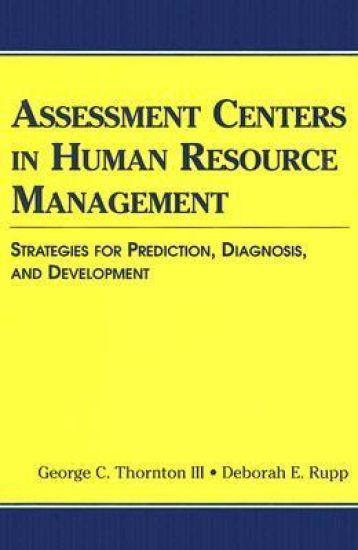
Assessment Centers in Human Resource Management

Assessment Centers in Human Resource Management

George C. Thornton III; Deborah E. Rupp

Psychology Press
2005
sidottu
The theme permeating this book on assessment centers is "continuity and change", describing what has remained the same and what has changed in the 50-year history of the assessment center method. One of the important changes explored is the evolution of the goals of assessment center programs and the ways in which assessment centers and their component parts have been used. Assessment Centers in Human Resource Management clearly differentiates between assessment centers used for prediction, diagnoses, and development.In addition, this book explores:assessment centers and human resource management;court cases involving assessment centers;innovations in assessment center operations;cross-cultural considerations including diversity of the workforce; andassessor training.The target audience for the text includes students who are learning about assessment centers, practitioners including human resource managers and consultants who may be considering the implementation of assessment centers, and academicians who are researching the method and wish to understand current issues.
Assessment Centers in Human Resource Management

Assessment Centers in Human Resource Management

George C. Thornton III; Deborah E. Rupp

Psychology Press
2005
nidottu
The theme permeating this book on assessment centers is "continuity and change", describing what has remained the same and what has changed in the 50-year history of the assessment center method. One of the important changes explored is the evolution of the goals of assessment center programs and the ways in which assessment centers and their component parts have been used. Assessment Centers in Human Resource Management clearly differentiates between assessment centers used for prediction, diagnoses, and development.In addition, this book explores:assessment centers and human resource management;court cases involving assessment centers;innovations in assessment center operations;cross-cultural considerations including diversity of the workforce; andassessor training.The target audience for the text includes students who are learning about assessment centers, practitioners including human resource managers and consultants who may be considering the implementation of assessment centers, and academicians who are researching the method and wish to understand current issues.
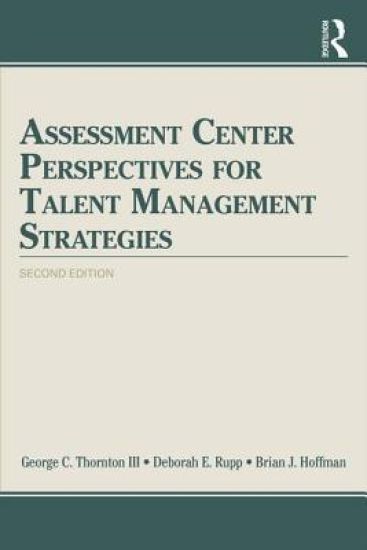
Assessment Center Perspectives for Talent Management Strategies

Assessment Center Perspectives for Talent Management Strategies

George C. Thornton III; Deborah E. Rupp; Brian J. Hoffman

Routledge
2014
sidottu
Written by three leading scholars with vast experience in the science and practice of assessment centers (ACs), this is the first volume to comprehensively integrate variations of the assessment center method with alternative talent management strategies. A useful reference guide, it examines the many ways in which organizations can apply the assessment center method to achieve their talent management goals. It provides balanced and in-depth coverage of theory, research, and practice pertaining to the dimension-, task-, and multifaceted-perspectives on the AC method. Ideal for researchers, practitioners, and students alike, and well suited for courses in testing and measurement, personnel selection, HR planning and staffing, training and development, and organizational change, Assessment Center Perspectives for Talent Management Strategies is a complete and up-to-date account of the assessment center method.
Assessment Center Perspectives for Talent Management Strategies

Assessment Center Perspectives for Talent Management Strategies

George C. Thornton III; Deborah E. Rupp; Brian J. Hoffman

Routledge
2014
nidottu
Written by three leading scholars with vast experience in the science and practice of assessment centers (ACs), this is the first volume to comprehensively integrate variations of the assessment center method with alternative talent management strategies. A useful reference guide, it examines the many ways in which organizations can apply the assessment center method to achieve their talent management goals. It provides balanced and in-depth coverage of theory, research, and practice pertaining to the dimension-, task-, and multifaceted-perspectives on the AC method. Ideal for researchers, practitioners, and students alike, and well suited for courses in testing and measurement, personnel selection, HR planning and staffing, training and development, and organizational change, Assessment Center Perspectives for Talent Management Strategies is a complete and up-to-date account of the assessment center method.
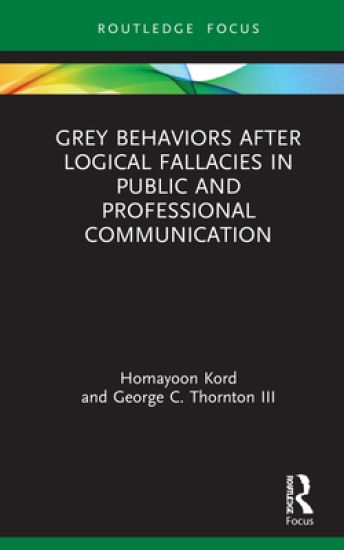
Grey Behaviors after Logical Fallacies in Public and Professional Communication

Grey Behaviors after Logical Fallacies in Public and Professional Communication

Homayoon Kord; George C. Thornton III

Taylor Francis Ltd
2021
sidottu
This practical guide enables readers to recognize, assess, and defend against gray behaviors—attempts to persuade listeners using fallacious arguments. It provides valuable tools for communicating successfully in a wide variety of public and professional contexts.The book examines 20 wide-ranging logical fallacies, cognitive errors, and rhetorical devices that may take place in persuasive communication, and discusses how to assess and respond the behavior of a speaker who may be disingenuously attempting to manipulate the listener—or who may simply be mistaken. Drawing upon research and insights from communication, psychology, business management, and human resources, it considers fallacies in reasoning not just as abstract formulas, but as a feature of communication encounters such as negotiations, interviews, public debates, and personal conversations. Each form of fallacious reasoning is exemplified by dialogues in both professional settings (such as interviewing and personnel assessment), as well as everyday interactions in public discourse. The book then provides self-assessment tests to ensure the reader can evaluate the grey behavior in these encounters.This book provides research-based skills and insights that will benefit students and professionals in fields ranging from communication, politics, management, human resources, organizational psychology, journalism, and anyone else looking to develop critical interaction skills.
Grey Behaviors after Logical Fallacies in Public and Professional Communication

Grey Behaviors after Logical Fallacies in Public and Professional Communication

Homayoon Kord; George C. Thornton III

TAYLOR FRANCIS LTD
2023
nidottu
This practical guide enables readers to recognize, assess, and defend against gray behaviors—attempts to persuade listeners using fallacious arguments. It provides valuable tools for communicating successfully in a wide variety of public and professional contexts.The book examines 20 wide-ranging logical fallacies, cognitive errors, and rhetorical devices that may take place in persuasive communication, and discusses how to assess and respond the behavior of a speaker who may be disingenuously attempting to manipulate the listener—or who may simply be mistaken. Drawing upon research and insights from communication, psychology, business management, and human resources, it considers fallacies in reasoning not just as abstract formulas, but as a feature of communication encounters such as negotiations, interviews, public debates, and personal conversations. Each form of fallacious reasoning is exemplified by dialogues in both professional settings (such as interviewing and personnel assessment), as well as everyday interactions in public discourse. The book then provides self-assessment tests to ensure the reader can evaluate the grey behavior in these encounters.This book provides research-based skills and insights that will benefit students and professionals in fields ranging from communication, politics, management, human resources, organizational psychology, journalism, and anyone else looking to develop critical interaction skills.
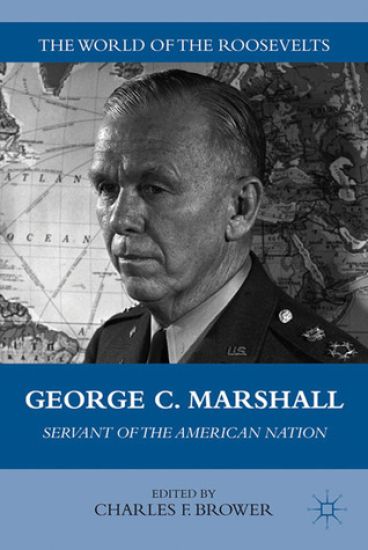
George C. Marshall

George C. Marshall

Palgrave Macmillan
2011
sidottu
Bringing together a who's who of Marshall scholars, this volume examines the major roles assumed by Marshall over his five-decade career - soldier; statesman and peacemaker; and leader and manager - to illuminate key issues and themes surrounding the man and his era.
Methods of Early Golf Architecture: The Selected Writings of C.B. Macdonald, George C. Thomas, Robert Hunter

Methods of Early Golf Architecture: The Selected Writings of C.B. Macdonald, George C. Thomas, Robert Hunter

George C. Thomas; Robert Hunter; C. B. MacDonald

Coventry House Publishing
2013
nidottu
Methods of Early Golf Architecture features selected writings from premier architects C.B. Macdonald, George C. Thomas, and Robert Hunter. With precision and detail, these visionaries discuss each element of golf course design, and no detail is left untouched. Methods of Early Golf Architecture Includes: - Characteristics of a Golf Architect - Psychology of Design - Deciding Where to Build - The Design Process - Utilizing Natural Features - Teeing Grounds - Through the Green - Hazards - Greens and Greenkeeping - Ideal Holes - The Construction Process - Overseeing Construction Characteristics of a Golf Architect"A golf architect must be a student of agriculture, understand nature, have a knowledge of soils, knowledge of implements, drainage, and above all the particular character of the layout which tantalizes a lover of the game and holds him spellbound." - C.B. Macdonald Psychology of Design "How deadly dull are two or three holes of the same character when they follow each other A drive and pitch followed by a drive and pitch is a good deal like serving a watery pudding after a watery soup." - Robert Hunter The Design Process "The ability to create is to consider all the problems of a golf course. The architect must visualize the effect his work will produce from all angles of the game." - George C. Thomas Utilizing Natural Features "Now and then one finds a hole of real distinction which nature herself has modeled, and to add anything artificial would be a crime." - Robert Hunter
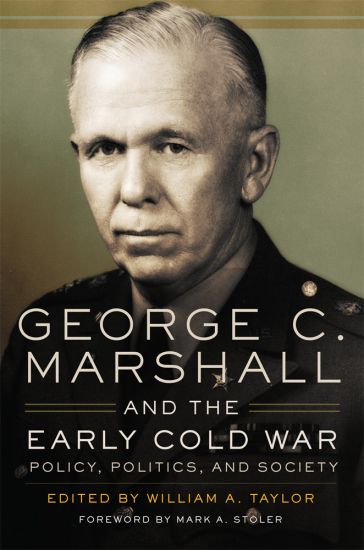
George C. Marshall and the Early Cold War

George C. Marshall and the Early Cold War

Mark A. Stoler

University of Oklahoma Press
2020
nidottu
Though best known for his central part in the American war effort from 1939 to 1945, George C. Marshall's critical role in the early Cold War was probably at least as important in shaping the policies and politics of the postwar western world - and in cementing his place as a pivotal figure in twentieth-century American history. This book places Marshall squarely at the center of the story of the American century by examining his tenure in key policymaking positions during this period, including army chief of staff, special presidential envoy to China, secretary of state, and secretary of defense, among others.George C. Marshall and the Early Cold War brings together a diverse and accomplished group of scholars - including military, diplomatic, and institutional historians - to explore how Marshall, Time magazine's 'Man of the Year' in both 1943 and 1947 and the 1953 Nobel Peace Prize winner, molded debates on all the major issues of his day, such as universal military training, China's civil war, an independent air force, the National Security Act of 1947, nuclear weapons, European Recovery Program, North Atlantic Treaty, Korean War, and racial integration of the U.S. military. With a focus on Marshall's public service at the intersection of American policy, politics, and society, the authors provide a comprehensive historical account of his central role in shaping America during a tumultuous yet formative period in the nation's history. Their work fills a void in the scholarship of American military history and American history generally, providing context for the consideration of broader questions about American power and the place of the military within American society.
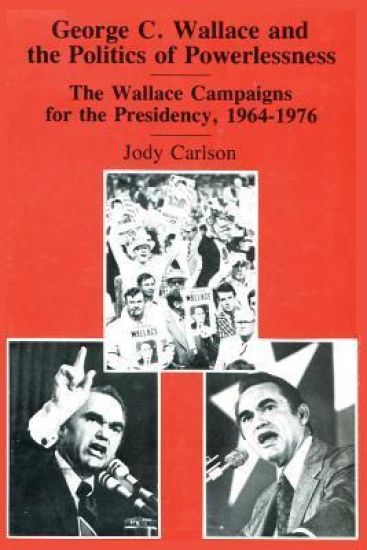
George C. Wallace and the Politics of Powerlessness

George C. Wallace and the Politics of Powerlessness

Jody Carlson

Transaction Publishers
1980
sidottu
This is the only complete study of the Wallace phenomenon. It covers all of the presidential campaigns and views wallace from a variety of vantage ints: historical context, content anal-ysis of speeches, and analysis of elec-tion data, including voting statistics and attitudinal patterns of supporters. Poli-tics of Powerlessness examines na-tionwide support for George C. Wal-lace in the presidential campaigns of 1964, 1968, 1972, and 1976. A number of election and candidate preference surveys are used as sources of data on supporters. An understanding of Wal-lace's appeal is provided through an examination of themes noted through-out his speeches and an analysis of his political history from biographical sources, personal interviews, and newspaper accounts of the time. The picture of Wallace that emerges is one of a man who saw himself as a crusader for his supporters' interests, while de-liberately heightening and intensifying their feelings of powerlessness as a means of getting votes.Carlson shows that Wallace voters were not marginal. They did not reflect a loss of status, nor were they simply outside the mainstream of political life. They were very much like major party voters, with the exception of their feel-ings of political powerlessness that me about by increased government ..rticipation in state politics. This work informed not only by a careful anal-ysis, but by interviews with Wallace, many of his followers, and people active in his campaigns. The work has the additional advantage of having follow-up analyses and interviews as, late as 1978. In this sense, it represents not only a scholarly analysis of the Wallace phenomenon, but the most up-to-date analysis as well.
George C. Miles Correspondence, 1953-1975

George C. Miles Correspondence, 1953-1975

Eric P Newman

Hassell Street Press
2021
nidottu
This work has been selected by scholars as being culturally important and is part of the knowledge base of civilization as we know it.This work is in the public domain in the United States of America, and possibly other nations. Within the United States, you may freely copy and distribute this work, as no entity (individual or corporate) has a copyright on the body of the work.Scholars believe, and we concur, that this work is important enough to be preserved, reproduced, and made generally available to the public. To ensure a quality reading experience, this work has been proofread and republished using a format that seamlessly blends the original graphical elements with text in an easy-to-read typeface.We appreciate your support of the preservation process, and thank you for being an important part of keeping this knowledge alive and relevant.