Kirjojen hintavertailu. Mukana 11 244 527 kirjaa ja 12 kauppaa.

Kirjahaku

Etsi kirjoja tekijän nimen, kirjan nimen tai ISBN:n perusteella.

1000 tulosta hakusanalla George Pattison; Kate Kirkpatrick

The Mystical Sources of Existentialist Thought

The Mystical Sources of Existentialist Thought

George Pattison; Kate Kirkpatrick

Routledge
2020
nidottu
At the time when existentialism was a dominant intellectual and cultural force, a number of commentators observed that some of the language of existential philosophy, not least its interpretation of human existence in terms of nothingness, evoked the language of so-called mystical writers. This book takes on this observation and explores the evidence for the influence of mysticism on the philosophy of existentialism. It begins by delving into definitions of mysticism and existentialism, and then traces the elements of mysticism present in German and French thought during the late nineteenth and early twentieth centuries. The book goes on to make original contributions to the study of figures including Kierkegaard, Buber, Heidegger, Beauvoir, Sartre, Marcel, Camus, Weil, Bataille, Berdyaev, and Tillich, linking their existentialist philosophy back to some of the key concerns of the mystical tradition.Providing a unique insight into how these two areas have overlapped and interacted, this study is vital reading for any academic with an interest in twentieth-century philosophy, theology and religious studies.
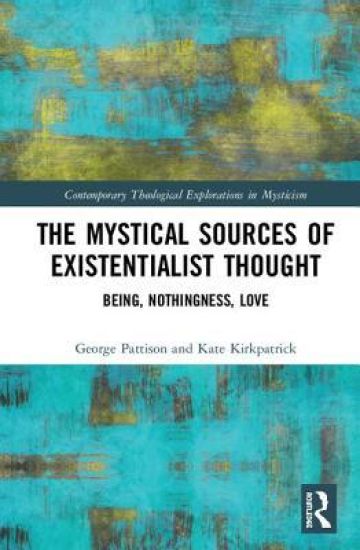
The Mystical Sources of Existentialist Thought

The Mystical Sources of Existentialist Thought

George Pattison; Kate Kirkpatrick

Routledge
2018
sidottu
At the time when existentialism was a dominant intellectual and cultural force, a number of commentators observed that some of the language of existential philosophy, not least its interpretation of human existence in terms of nothingness, evoked the language of so-called mystical writers. This book takes on this observation and explores the evidence for the influence of mysticism on the philosophy of existentialism. It begins by delving into definitions of mysticism and existentialism, and then traces the elements of mysticism present in German and French thought during the late nineteenth and early twentieth centuries. The book goes on to make original contributions to the study of figures including Kierkegaard, Buber, Heidegger, Beauvoir, Sartre, Marcel, Camus, Weil, Bataille, Berdyaev, and Tillich, linking their existentialist philosophy back to some of the key concerns of the mystical tradition.Providing a unique insight into how these two areas have overlapped and interacted, this study is vital reading for any academic with an interest in twentieth-century philosophy, theology and religious studies.
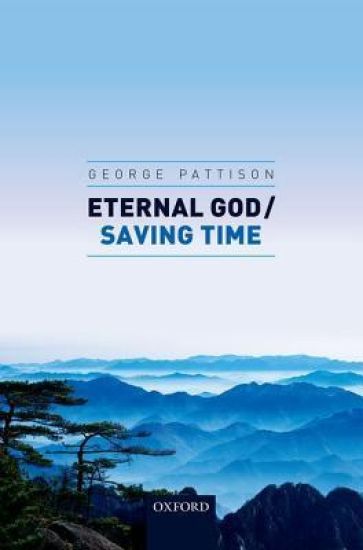
Eternal God / Saving Time

Eternal God / Saving Time

George Pattison

Oxford University Press
2015
sidottu
Starting from the assumption that 'time is the horizon of the meaning of Being' (Heidegger), Eternal God/ Saving Time attempts to discover what the central religious idea of eternity or of God as 'the Eternal' might mean today. Negotiating ideas of divine timelessness and sempiternity (everlastingness) as well as the attempts of some philosophers to develop the idea of a temporal God, Professor George Pattison surveys a range of positions from analytic philosophy and from the continental tradition from Spinoza through Hegel to the present. Intellectual and cultural forces have tended to separate time and eternity, and both philosophical and theological examples of this tendency are examined. Nevertheless, starting from the experience of life in time, some modern thinkers have developed a new approach to the Eternal as what grounds or gives time. This leads through ideas of novelty, utopia, hope, promise, and call to the projection of a creative and transformative memory-remembering the future-that affirms human solidarity and mutual responsibility. Even if this cannot be made good in terms of knowledge, it offers a basis for hope, prayer, and commitment and these options are explored through a range of Christian, Jewish, Greek, and secular thinkers. This development re-envisages the idea of redemption, away from the Augustinian view that time is what we need to be rescued from and towards the idea that time itself might save us from all that is destructive and tyrannical in time's rule over human life.
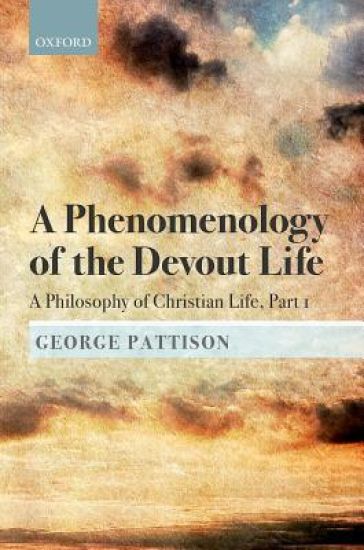
A Phenomenology of the Devout Life

A Phenomenology of the Devout Life

George Pattison

Oxford University Press
2018
sidottu
A Phenomenology of the Devout Life is the first part of a three-part work, A Philosophy of Christian Life. Rather than approaching Christianity through its doctrinal statements, as philosophers of religion have often done, the book starts by offering a phenomenological description of the devout life as that is set out in the teaching of Francois de Sales and related authors. This is because for most Christians practice and life-commitments are more fundamental than formal doctrinal beliefs. Although George Pattison will address the metaphysical truth-claims of Christianity in Part three, the guiding argument is that it is the Christian way of life that best reveals what these beliefs really are. As the work is a philosophical study, it does not presuppose the truth of Christianity but assumes only that there is a humanly accessible meaning to the intention to live a devout life, pleasing to God. This can be said to find expression in a certain view of selfhood that emphasizes the dimensions of feeling and will rather than intellect and that culminates in the experience of the annihilation of self. This is a model of selfhood deeply opposed to contemporary models that privilege autonomous agency and the devout life is therefore presented as offering a corrective to extreme versions of the contemporary view.
A Rhetorics of the Word

A Rhetorics of the Word

George Pattison

Oxford University Press
2019
sidottu
A Rhetorics of the Word is the second volume of a three-part philosophy of Christian life. It approaches Christian life as expressive of a divine calling or vocation. The word Church (ekklesia) and the role of naming in baptism indicate the fundamental place of calling in Christian life. However, ideas of vocation are difficult to access in a world shaped by the experience of disenchantment. The difficulties of articulating vocation are explored with reference to Weber, Heidegger, and Kierkegaard. These are further connected to a general crisis of language, manifesting in the degradation of political discourse (Arendt) and the impact of new communications technology on human discourse. This impact can be seen as reinforcing an occlusion of language in favour of rationality already evidenced in the philosophical tradition and technocratic management. New possibilities for thinking vocation are pursued through the biblical prophets (with emphasis on Buber's and Rosenzweig's reinterpretation of the call of Moses), Saint John, and Russian philosophies of language (Florensky to Bakhtin). Vocation emerges as bound up with the possibility of being name-bearers, enabling a mutuality of call and response. This is then evidenced further in ethics and poetics, where Levinas and Hermann Broch (The Death of Virgil) become major points of reference. In conclusion, the themes of calling and the name are seen to shape the possibility of love-the subject of the final part of the philosophy of Christian life: A Metaphysics of Love.
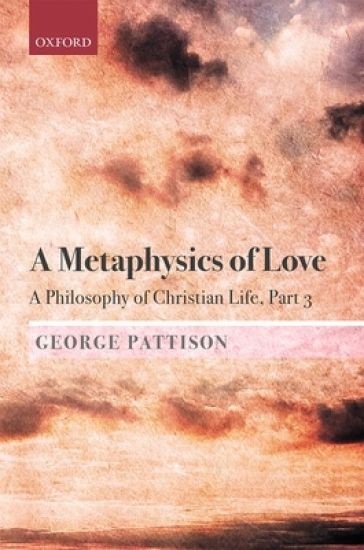
A Metaphysics of Love

A Metaphysics of Love

George Pattison

Oxford University Press
2021
sidottu
As the third part of a philosophy of Christian life, A Metaphysics of Love builds on a view of Christian life as shaped by the dynamic of call, response, and promise. It argues that love is the ultimate content of this dynamic and considers how far this claim extends. Taking its bearings from Dante's vision of divine love as 'the power that moves the sun and other stars', this study explores the requirement that love is both human and cosmic, uniting being and beings. Cognizant of much recent philosophy's desire to overcome or move beyond a metaphysics of being, it examines some of the formal structures that make love possible, including language, time, social being, forgiveness, and ultimacy. Following on from the earlier volumes, extensive use is made of the idea of the poetic as the eminent mode of Christian witness, contextualized within the prose of everyday life. Heidegger provides fundamental philosophical orientation, whilst key features of love are brought to the fore through dialogue with Kierkegaard. Dante and Dostoevsky are frequent points of reference, in addition to a range of literary and religious sources, including the Scottish poet Edwin Muir. Leading scholar George Pattison concludes that the phenomenon of love requires us to articulate a metaphysics that involves both being and nothingness, thereby taking a critical position vis-à-vis both classical theism and existential atheism.
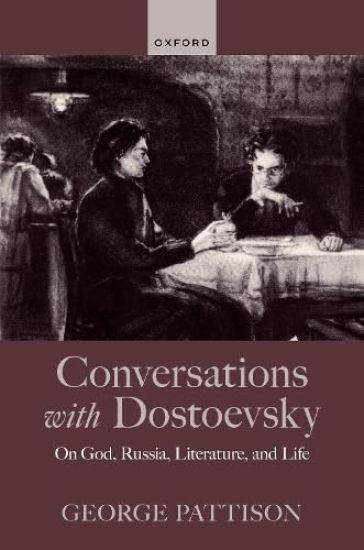
Conversations with Dostoevsky

Conversations with Dostoevsky

George Pattison

Oxford University Press
2024
sidottu
Conversations with Dostoevsky presents a series of fictional conversations taking place between November 2018 and Spring 2019 in the narrator's Glasgow apartment and elsewhere in the city. At the beginning of the conversations, the narrator has been reading Dostoevsky's story A Gentle Spirit, which concludes with a dramatic statement of protest atheism. This statement suggests that love is not possible in a purely mechanical universe in which all living beings are condemned to death and ultimate extinction. The conversations spell out Dostoevsky's response to this view and his advocacy of faith in God, Christ, and immortality. The themes discussed include suicide, truth and lies, guilt, determinism, literature, the Bible, Mary, Christ, Dostoevsky and film, 'the woman question', nationalism, war, the Church, the Jewish question, immortality, and God. In addition to conversations between the narrator and Dostoevsky, we drop in on a dinner party at which Dostoevsky is discussed from various points of view and in another conversation Dostoevsky is joined by the philosopher Vladimir Solovyov to discuss nationalism, the Church, and life. We also attend a seminar on 'Dostoevsky, Anti-Semitism, and Nazism', and visit Glasgow's Necropolis on Easter Eve. The conversations in the first part of the volume are accompanied by a series of commentaries in a second part, which contextualize the issues discussed in the conversations with references to his novels, journalism, letters, and notebooks as well as engaging the relevant critical literature.
Thinking about God in an Age of Technology

Thinking about God in an Age of Technology

George Pattison

Oxford University Press
2007
nidottu
Taking up the critique of theology found in the work of Heidegger, George Pattison argues for a model of thinking about God that would not be liable to the charge of `enframing' that Heidegger sees as characteristic of technological thinking. He constructs his case in relation to particular issues in bioethics, the place of theology in the university, the arts, and the contemporary experience of living in the city.
Thinking about God in an Age of Technology

Thinking about God in an Age of Technology

George Pattison

Oxford University Press
2005
sidottu
Taking up the critique of theology found in the work of Heidegger, George Pattison argues for a model of thinking about God that would not be liable to the charge of `enframing' that Heidegger sees as characteristic of technological thinking. He constructs his case in relation to particular issues in bioethics, the place of theology in the university, the arts, and the contemporary experience of living in the city.
God and Being

God and Being

George Pattison

Oxford University Press
2011
sidottu
Western theology has long regarded 'Being' as a category pre-eminently applicable to God, the supreme Being who is also the source of all existence. This idea was challenged in the later philosophy of Martin Heidegger and identified with the position he called 'ontotheology'. Heidegger's critique was repeated and radicalized in so-called postmodern thought, to the point that many theologians and philosophers of religion now want to talk instead of God as 'beyond Being' or 'without Being'. Against this background, God and Being attempts to look again at why the ideas of God and Being got associated in the first place and to investigate whether the critique of ontotheology really does require us to abandon this link. After exploring how this apparently abstract idea has informed Christian views of salvation and of the relationship between God and world, George Pattison examines how such categories as time, space, language, human relationships and embodiment affect our understanding of God and Being. Pattison concludes that whilst Heidegger's critique has considerable force, it remains legitimate to speak of God as Being under certain restricted conditions. The most important of these is that God is better conceived in terms of purely possible Being rather than (as in classic Christian theology) 'actual' Being. This leaves open possibilities of dialogue with, e.g., non-theistic religious traditions and with science that are foreclosed by traditional conceptions. Ultimately, however, all basic religious ideas must issue from and be seen to serve the requirements of embodied love.
God and Being

God and Being

George Pattison

Oxford University Press
2013
nidottu
Western theology has long regarded 'Being' as a category pre-eminently applicable to God, the supreme Being who is also the source of all existence. This idea was challenged in the later philosophy of Martin Heidegger and identified with the position he called 'ontotheology'. Heidegger's critique was repeated and radicalized in so-called postmodern thought, to the point that many theologians and philosophers of religion now want to talk instead of God as 'beyond Being' or 'without Being'. Against this background, God and Being attempts to look again at why the ideas of God and Being got associated in the first place and to investigate whether the critique of ontotheology really does require us to abandon this link. After exploring how this apparently abstract idea has informed Christian views of salvation and of the relationship between God and world, George Pattison examines how such categories as time, space, language, human relationships and embodiment affect our understanding of God and Being. Pattison concludes that whilst Heidegger's critique has considerable force, it remains legitimate to speak of God as Being under certain restricted conditions. The most important of these is that God is better conceived in terms of purely possible Being rather than (as in classic Christian theology) 'actual' Being. This leaves open possibilities of dialogue with, e.g., non-theistic religious traditions and with science that are foreclosed by traditional conceptions. Ultimately, however, all basic religious ideas must issue from and be seen to serve the requirements of embodied love.
Kierkegaard and the Quest for Unambiguous Life

Kierkegaard and the Quest for Unambiguous Life

George Pattison

Oxford University Press
2013
sidottu
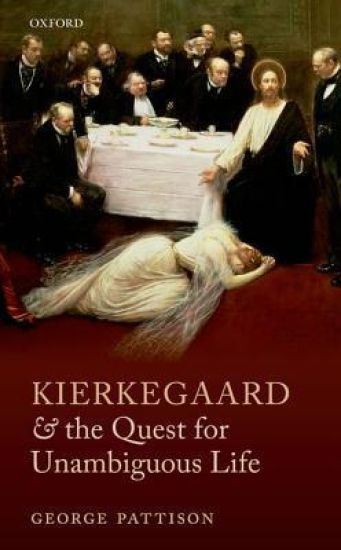
This book looks at Kierkegaard with a fresh perspective shaped by the history of ideas, framed by the terms romanticism and modernism. 'Modernism' here refers to the kind of intellectual and literary modernism associated with Georg Brandes, and such later nineteenth and early twentieth century figures as J. P. Jacobsen, Nietzsche, Dostoevsky, Ibsen (all often associated with Kierkegaard in early secondary literature), and the young Georg Lukacs. This movement, currently attracting increasing scholarly attention, fed into such varied currents of twentieth century thought as Bolshevism (as in Lukacs himself), fascism, and the early existentialism of, e.g., Shestov and the radical culture journal The Brenner (in which Kierkegaard featured regularly, and whose readers included Martin Heidegger). Each of these movements has, arguably, its own 'Romantic' aspect and Kierkegaard thus emerges as a figure who holds together or in whom are reflected both the aspirations and contradictions of early romanticism and its later nineteenth and twentieth century inheritors. Kierkegaard's specific 'staging' of his authorship in the contemporary life of Copenhagen, then undergoing a rapid transformation from being the backward capital of an absolutist monarchy to a modern, cosmopolitan city, provides a further focus for the volume. In this situation the early Romantic experience of nature as providing a source of healing and an experience of unambiguous life is transposed into a more complex and, ultimately, catastrophic register. In articulating these tensions, Kierkegaard's authorship provided a mirror to his age but also anticipated and influenced later generations who wrestled with their own versions of this situation.
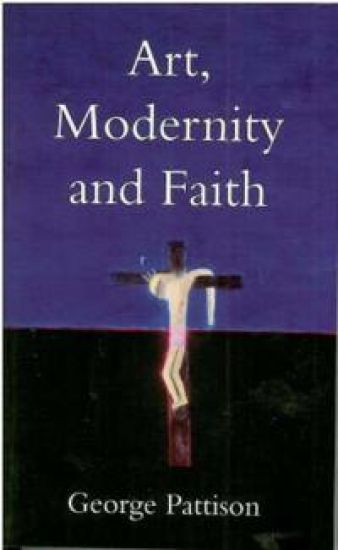
Art, Modernity and Faith

Art, Modernity and Faith

George Pattison

SCM Press
1998
nidottu
Leads the reader through a more or less historical narrative of the relationship between Christianity and the visual arts beginning with the deep-rooted fear of images in the Judaeo-Christian tradition. Shows how significant for religion art can be.
Kierkegaard

Kierkegaard

George Pattison

SCM PRESS
1999
nidottu
Soren Kierkegaard is often painted as the arch-individualist - someone who puts so much stress on the role of the single individual that he has nothing to say about social issues. This collection of essays not only refutes that caricature, it also reveals just how dynamic and challenging Kierkegaard's social thinking really is. Scholars from diverse disciplines show how Kierkegaard raises difficult questions about the nature of selfhood, the church, society, politics, love and justice - questions we cannot afford to ignore. Avoiding any kind of uncritical hero-worship, the contributors wrestle with Kierkegaard's writings and the challenges they pose to contemporary politics and ethics - not least those inspired by `postmodern' thinking. And the book opens with an indispensable introductory essay which charts the history of Kierkegaard interpretation in this area. Kierkegaard: The Self in Society dispels the myths which still surround the enigmatic Dane, and sets the agenda for future debate.
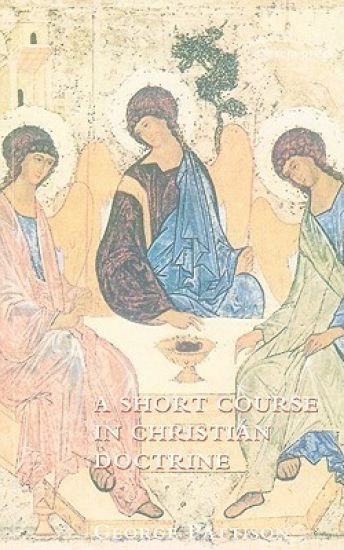
Short Course in Christian Doctrine

Short Course in Christian Doctrine

George Pattison

SCM Press
2005
nidottu
This publication sets out to offer an introduction to Christian doctrine, emphasizing that 'doctrine' refers primarily to a dynamic teaching process, rather than to a set of propositions about belief. The chief model for this process is the divine life itself, both in its inner Trinitarian movement and in its sacramental and historical self-expression in creation, incarnation and tradition. Drawing on Protestant, Catholic and Orthodox sources, as well as being in dialogue with such modern philosophers as Habermas and Heidegger, this Short Course also involves extensive discussions of homiletics, spirituality, the relationship between Christianity and culture, and perspectives for Christian approaches to ethical and political challeneges.
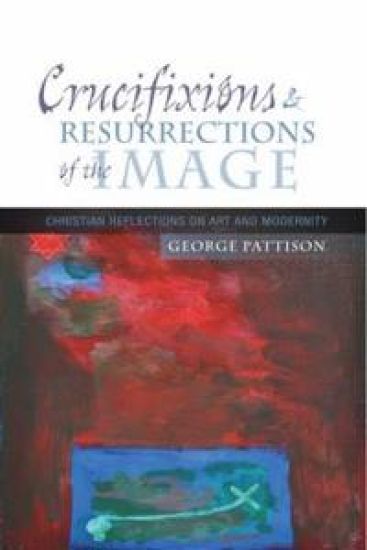
Crucifixions and Resurrections of the Image
George Pattison offers theological reflections on a range of works of art and films which have attracted wide discussion such as Anthony Gormley's 'Angel of the North'. Pattison takes seriously the modernist movement in art and constitutes an argument for its continuing relevance. The book centres on artists active in the mid- to late twentieth century, whose work reflects both the cultural and social crises of that era - Beuys, Rothko, Kiefer, Natkin and film directors such as Bergman and Tarkovksy. The studies are contextualized in broader reflections on modern art that suggest 'the death of God' as a motif that links theology and modern art itself. This enables a Christian theological engagement with works that often appear alien or even hostile to Christian faith. George Pattison takes the secular seriously in its own right, arguing that both secular art and theological reflection are often different but related responses to a common existential situation.
Routledge Philosophy Guidebook to the Later Heidegger
Martin Heidegger is one of the most controversial thinkers of the twentieth century. His writings are notoriously difficult: they both require and reward careful reading.The Later Heidegger introduces and accesses:* Heidegger's life and the background to his later works* The ideas and texts of some of his influential later works, including The Question concerning Technology, The Origin of the Work of Art, and What is Called Thinking?* Heidegger's continuing importance to philosophy and contemporary thought.
Routledge Philosophy Guidebook to the Later Heidegger
Martin Heidegger is one of the most controversial thinkers of the twentieth century. His writings are notoriously difficult: they both require and reward careful reading.The Later Heidegger introduces and accesses:* Heidegger's life and the background to his later works* The ideas and texts of some of his influential later works, including The Question concerning Technology, The Origin of the Work of Art, and What is Called Thinking?* Heidegger's continuing importance to philosophy and contemporary thought.