Kirjojen hintavertailu. Mukana 11 717 486 kirjaa ja 12 kauppaa.

Kirjahaku

Etsi kirjoja tekijän nimen, kirjan nimen tai ISBN:n perusteella.

1000 tulosta hakusanalla George W. Hilton

The Ma & Pa

The Ma & Pa

George W. Hilton

Johns Hopkins University Press
2000
pokkari
Affectionately known as the "Ma & Pa," the Maryland and Pennsylvania Railroad was one of the country's longest running and best known "archaic" railroads, holding on to steam locomotion and other outmoded technologies well into the twentieth century. Connecting Baltimore and York, the line had everything needed to endear itself to local residents and rail enthusiasts: picturesque equipment, marvelous scenery, antique passenger trains, handsome small-scale locomotives, and enough curves-476-for a railroad many times longer than its 77 miles. All this made the Ma & Pa one of the most popular prototypes for model railroaders, George Hilton notes, and thousands of miniature versions of the line became part of model railroads throughout the world. This new paperback edition of Hilton's classic history includes a new introduction and epilogue in which the author recalls the line's final years of service. He also comments on the continuing interest of modelers, enthusiasts, and all who fondly remember the Ma & Pa.
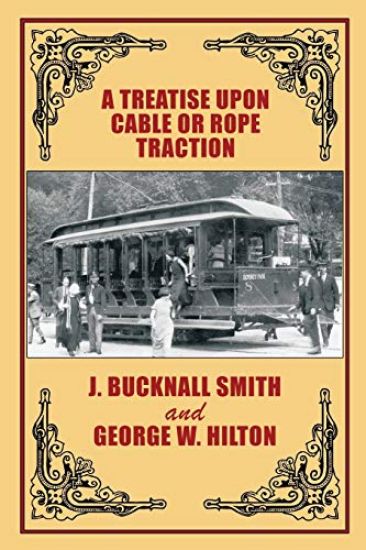
The Cable Car in America

The Cable Car in America

George W. Hilton

Stanford University Press
1997
pokkari
Enriched with almost 700 illustrations, this book has long been the definitive study of the American cable car, a widely touted form of urban transportation that operated in 29 cities across the United states. This once-promising technology proved inefficient, however, and cable cars were soon replaced by electric trolley cars. Today, they are only to be found as a tourist attraction traversing the steep hill of San Francisco.
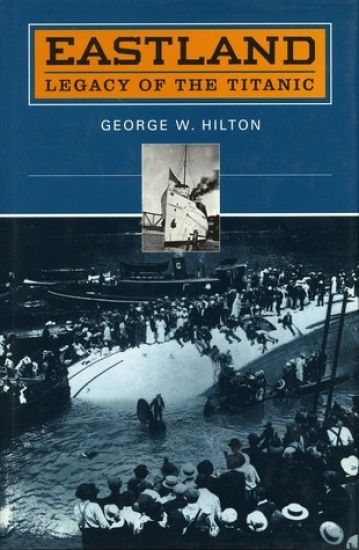
‘Eastland’

‘Eastland’

Hilton George W.

Stanford University Press
1997
pokkari
This is the first comprehensive account of the capsizing in 1915 of the steamer Eastland, an accident that killed more than 800 men, women, and children—the worst disaster of any kind in the history of Chicago and the worst in the history of the Great Lakes.Reviews"Hilton has written a comprehensive and exhaustive study of the worst disaster in Chicago's history. . . . Alterations and the addition of more lifeboats and rafts after the Titanic sank made the Eastland so unstable that it rolled over in the Chicago River. . . . The vessel's entire career is examined, and . . . the disaster itself is meticulously described and analyzed. Hilton also critically evaluates the subsequent civil and criminal court proceedings, raising a number of issues relating to marine safety regulations and the compensation of the victims' families."—Choice"Irony and tragedy combine in this account of America's worst marine disaster. . . . Hilton constructs a careful account of the events leading up to the calamity. The disaster itself is recounted minute by minute. . . . The numerous illustrations and period photographs, as well as numerous appendixes, make this a definitive account."—Library Journal"This is the book on the Eastland."—Inland Seas"It contains vivid accounts of drownings and rescues, heroism and cowardice."—Chicago Tribune
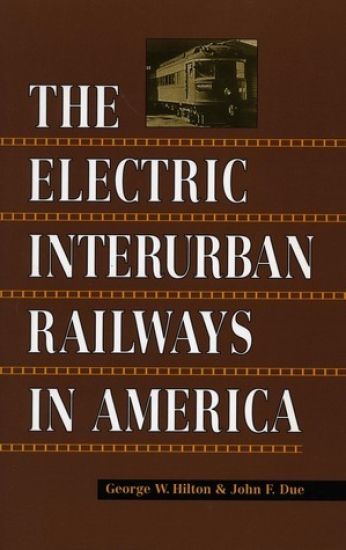
The Electric Interurban Railways in America

The Electric Interurban Railways in America

Hilton George W.; Due John F.

Stanford University Press
2000
pokkari
One of the most colorful yet neglected eras in American transportation history is re-created in this definitive history of the electric interurbans. Built with the idea of attracting short-distance passenger traffic and light freight, the interurbans were largely constructed in the early 1900s. The rise of the automobile and motor transport caused the industry to decline after World War I, and the depression virtually annihilated the industry by the middle 1930s. Part I describes interurban construction, technology, passenger and freight traffic, financial history, and final decline and abandonment. Part II presents individual histories (with route maps) of the more than 300 companies of the interurban industry. Reviews "A first-rate work of such detail and discernment that it might well serve as a model for all corporate biographies. . . . A wonderfully capable job of distillation." —Trains "Few economic, social, and business historians can afford to miss this definitive study." —Mississippi Valley Historical Review "All seekers after nostalgia will be interested in this encyclopedic volume on the days when the clang, clang of the trolley was the most exciting travel sound the suburbs knew." —Harper's Magazine "A fascinating and instructive chapter in the history of American transportation." —Journal of Economic History "The hint that behind the grand facade of scholarship lies an expanse of boyish enthusiasm is strengthened by a lovingly amassed and beautifully reproduced collection of 37 photographs." —The Nation
George W. Bush and the Redemptive Dream

George W. Bush and the Redemptive Dream

Dan P. McAdams

Oxford University Press Inc
2010
sidottu
George W. Bush remains a highly controversial figure, a man for whom millions of Americans have very strong feelings. Dan McAdams' book offers an astute psychological portrait of Bush, one of the first biographies to appear since he left office as well as the first to draw systematically from personality science to analyze his life. McAdams, an international leader in personality psychology and the narrative study of lives, focuses on several key events in Bush's life, such as the death of his sister at age 7, his commitment to sobriety on his 40th birthday, and his reaction to the terrorist attacks of September 11, and his decision to invade Iraq. He sheds light on Bush's life goals, the story he constructed to make sense of his life, and the psychological dynamics that account for his behavior. Although there are many popular biographies of George W. Bush, McAdams' is the first true psychological analysis based on established theories and the latest research. Short and focused, written in an engaging style, this book offers a truly penetrating look at our forty-third president.
George W. Brackenridge

George W. Brackenridge

Marilyn Mcadams Sibley

University of Texas Press
1973
nidottu
George W. Brackenridge (1832–1920) was a paradox to his fellow Texans. A Republican in a solidly Democratic state, a financier in a cattleman's country, a Prohibitionist in the goodtime town of San Antonio, he devoted his energies to making a fortune only to give it to philanthropic causes. Indiana born, Brackenridge came to Texas in 1853, but left the state during the Civil War to serve as U.S. Treasury agent and engage in the wartime cotton trade. Later he settled in San Antonio, where he founded a bank and invested in railroads, utilities, and other enterprises. Some of Brackenridge's contemporaries never forgave him for his Civil War career, but others knew him as a public-spirited citizen, educator, and advocate of civil rights. He cared little for what others thought of him. Yet, he confided once in a rare interview that his fondest ambition was to leave the world a better place for his having lived in it. To this end, he gave generously of himself and his means. His best-known benefaction is Brackenridge Park, which he gave to the city of San Antonio, but most of his contributions were in the field of education. As regent of the University of Texas for more than twenty-five years, he gave the institution its first dormitory, a large tract of land in Austin, and innumerable smaller gifts. He also offered to underwrite the expenses of the University when Governor James E. Ferguson vetoed the appropriation bill for 1917–1919. Other educational institutions to benefit from his largess were the public schools of San Antonio, a Negro college in Seguin, and the University of Texas Medical Branch at Galveston. In addition, he assisted individual students, especially women, through scholarships and loans. Believing that the betterment of humanity lay in education, Brackenridge arranged for the continuation of his philanthropies. By his will he created the George W. Brackenridge Foundation, the first of its kind in Texas and one of the first in the United States. Marilyn McAdams Sibley's study of George W. Brackenridge is the first biography of an important and, for his time, unusual Texan. It presents new material concerning the Mexican cotton trade during the Civil War, on the beginnings of banking in Texas, and on higher education in Texas.
George W. Bush, War Criminal?

George W. Bush, War Criminal?

Michael Haas

Praeger Publishers Inc
2008
sidottu
Eminent jurists, professional legal organizations, and human rights monitors in this country and around the world have declared that President George W. Bush may be prosecuted as a war criminal when he leaves office for his overt and systematic violations of such international law as the Geneva and Hague Conventions and such US law as the War Crimes Act, the Anti-Torture Act, and federal assault laws. George W. Bush, War Criminal? identifies and documents 269 specific war crimes under US and international law for which President Bush, senior officials and staff in his administration, and military officers under his command are liable to be prosecuted. Haas divides the 269 war crimes of the Bush administration into four classes: 6 war crimes committed in launching a war of aggression; 36 war crimes committed in the conduct of war; 175 war crimes committed in the treatment of prisoners; and 52 war crimes committed in postwar occupations. For each of the 269 war crimes of the Bush administration, Professor Haas gives chapter and verse in precise but non-technical language, including the specific acts deemed to be war crimes, the names of the officials deemed to be war criminals, and the exact language of the international or domestic laws violated by those officials. The author proceeds to consider the various US, international, and foreign tribunals in which the war crimes of Bush administration defendants may be tried under applicable bodies of law. He evaluates the real-world practicability of bringing cases against Bush and Bush officials in each of the possible venues. Finally, he weighs the legal, political, and humanitarian pros and cons of actually bringing Bush and Bush officials to trial for war crimes.
George W. Bush

George W. Bush

Clarke Rountree

Greenwood Press
2010
sidottu
This biography examines the life of George W. Bush—one of the most controversial U.S. presidents in recent history—before, during, and after his two terms in the White House. George W. Bush served as president of the United States through some of the most pivotal and memorable events in our nation's history, including the terrorist attacks of September 11, 2001; Hurricane Katrina; and the devastating economic downturn at the end of his second term. It is still too soon to decide how history will judge his administration. Despite suffering much ridicule and scorn for his linguistic gaffes, which became known as "Bushisms," the fact remains that this Yale graduate eventually rose to become a two-term Texas governor and a two-term U.S. president. George W. Bush: A Biography provides a comprehensive view of Bush's life, beginning with his childhood and education, then examining his life as a businessman; his governorships of Texas; his tumultuous, two-term presidency of the United States; and his life after leaving the White House.