Kirjojen hintavertailu. Mukana 11 244 527 kirjaa ja 12 kauppaa.

Kirjahaku

Etsi kirjoja tekijän nimen, kirjan nimen tai ISBN:n perusteella.

1000 tulosta hakusanalla Gerard A Maugin

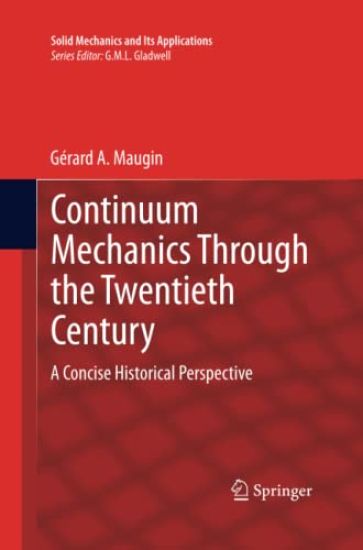
Continuum Mechanics Through the Twentieth Century
This overview of the development of continuum mechanics throughout the twentieth century is unique and ambitious. Utilizing a historical perspective, it combines an exposition on the technical progress made in the field and a marked interest in the role played by remarkable individuals and scientific schools and institutions on a rapidly evolving social background. It underlines the newly raised technical questions and their answers, and the ongoing reflections on the bases of continuum mechanics associated, or in competition, with other branches of the physical sciences, including thermodynamics. The emphasis is placed on the development of a more realistic modeling of deformable solids and the exploitation of new mathematical tools. The book presents a balanced appraisal of advances made in various parts of the world. The author contributes his technical expertise, personal recollections, and international experience to this general overview, which is very informative albeit concise.
Continuum Mechanics Through the Twentieth Century
This overview of the development of continuum mechanics throughout the twentieth century is unique and ambitious. Utilizing a historical perspective, it combines an exposition on the technical progress made in the field and a marked interest in the role played by remarkable individuals and scientific schools and institutions on a rapidly evolving social background. It underlines the newly raised technical questions and their answers, and the ongoing reflections on the bases of continuum mechanics associated, or in competition, with other branches of the physical sciences, including thermodynamics. The emphasis is placed on the development of a more realistic modeling of deformable solids and the exploitation of new mathematical tools. The book presents a balanced appraisal of advances made in various parts of the world. The author contributes his technical expertise, personal recollections, and international experience to this general overview, which is very informative albeit concise.
Thermomechanics Of Nonlinear Irreversible Behaviours, The

Thermomechanics Of Nonlinear Irreversible Behaviours, The

Gerard A Maugin

World Scientific Publishing Co Pte Ltd
1999
sidottu
In this invaluable book, macroscopic irreversible thermodynamics is presented in its realm and its splendor by appealing to the notion of internal variables of state. This applies to both fluids and solids with or without microstructures of mechanical or electromagnetic origin. This unmatched richness of essentially nonlinear behaviors is the result of the use of modern mathematical techniques such as convex analysis in a clear-cut framework which allows one to put under the umbrella of “irreversible thermodynamics” behaviors which until now have been commonly considered either not easily covered, or even impossible to incorporate into such a framework.The book is intended for all students and researchers whose main concern is the rational modeling of complex and/or new materials with physical and engineering applications, such as those accounting for coupled-field, hysteresis, fracture, nonlinear-diffusion, and phase-transformation phenomena.
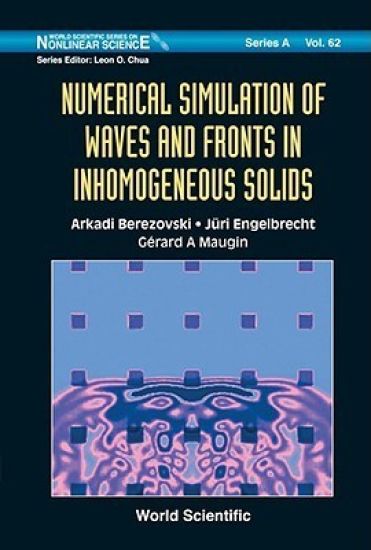
Numerical Simulation Of Waves And Fronts In Inhomogeneous Solids

Numerical Simulation Of Waves And Fronts In Inhomogeneous Solids

Gerard A Maugin; Juri Engelbrecht; Arkadi Berezovski

World Scientific Publishing Co Pte Ltd
2008
sidottu
This book shows the advanced methods of numerical simulation of waves and fronts propagation in inhomogeneous solids and introduces related important ideas associated with the application of numerical methods for these problems. Great care has been taken throughout the book to seek a balance between the thermomechanical analysis and numerical techniques. It is suitable for advanced undergraduate and graduate courses in continuum mechanics and engineering. Necessary prerequisites for this text are basic continuum mechanics and thermodynamics. Some elementary knowledge of numerical methods for partial differential equations is also preferable.
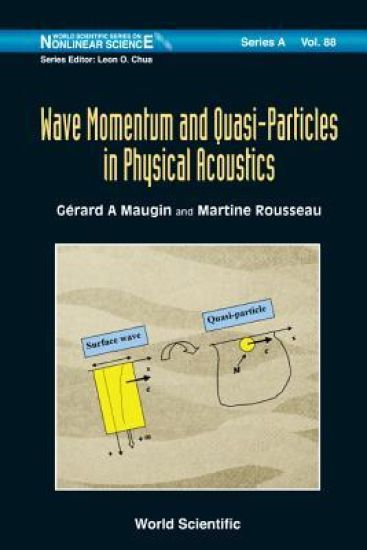
Wave Momentum And Quasi-particles In Physical Acoustics

Wave Momentum And Quasi-particles In Physical Acoustics

Gerard A Maugin; Martine Rousseau

World Scientific Publishing Co Pte Ltd
2015
sidottu
This unique volume presents an original approach to physical acoustics with additional emphasis on the most useful surface acoustic waves on solids. The study is based on foundational work of Léon Brillouin, and application of the celebrated invariance theorem of Emmy Noether to an element of volume that is representative of the wave motion.This approach provides an easy interpretation of typical wave motions of physical acoustics in bulk, at surfaces, and across interfaces, in the form of the motion of associated quasi-particles. This type of motion, Newtonian or not, depends on the wave motion considered, and on the original modeling of the continuum that supports it. After a thoughtful review of Brillouin's fundamental ideas related to radiative stresses, wave momentum and action, and the necessary reminder on modern nonlinear continuum thermomechanics, invariance theory and techniques of asymptotics, a variety of situations and models illustrates the power and richness of the approach and its strong potential in applications. Elasticity, piezoelectricity and new models of continua with nonlinearity, viscosity and some generalized features (microstructure, weak or strong nonlocality) or unusual situations (bounding surface with energy, elastic thin film glued on a surface waveguide), are considered, exhibiting thus the versatility of the approach.This original book offers an innovative vision and treatment of the problems of wave propagation in deformable solids. It opens up new horizons in the theoretical and applied facets of physical acoustics.
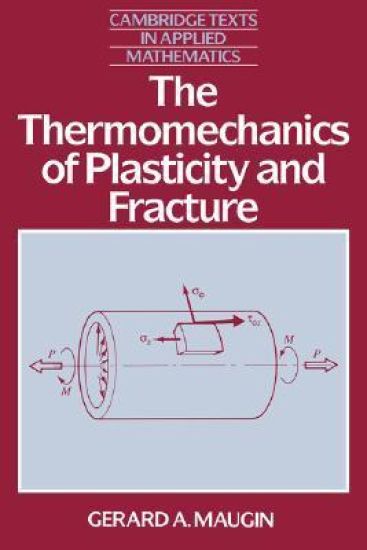
The Thermomechanics of Plasticity and Fracture

The Thermomechanics of Plasticity and Fracture

Gerard A. Maugin

Cambridge University Press
1992
sidottu
This book concentrates upon the mathematical theory of plasticity and fracture as opposed to the physical theory of these fields, and is presented in the thermomechanical framework. It follows the macroscopic, phenomenological approach which proposes equations abstracted from generally accepted experimental facts, studies the adequacy of the consequences drawn from these equations to those facts and then provides useful tools for designers and engineers. The material is drawn from the author's graduate course in Europe and the United States and may be used to form the basis for similar graduate courses on plasticity and fracture. Many worked examples are presented and each chapter concludes with problems for students. The book will thus undoubtedly establish itself as a core text for both students and researchers.
The Thermomechanics of Plasticity and Fracture

The Thermomechanics of Plasticity and Fracture

Gerard A. Maugin

Cambridge University Press
1992
pokkari
This book concentrates upon the mathematical theory of plasticity and fracture as opposed to the physical theory of these fields, and is presented in the thermomechanical framework. It follows the macroscopic, phenomenological approach which proposes equations abstracted from generally accepted experimental facts, studies the adequacy of the consequences drawn from these equations to those facts and then provides useful tools for designers and engineers. The material is drawn from the author’s graduate course in Europe and the United States and may be used to form the basis for similar graduate courses on plasticity and fracture. Many worked examples are presented and each chapter concludes with problems for students. The book will thus undoubtedly establish itself as a core text for both students and researchers.
Configurational Forces

Configurational Forces

Gerard A. Maugin

TAYLOR FRANCIS LTD
2024
nidottu
Exploring recent developments in continuum mechanics, Configurational Forces: Thermomechanics, Physics, Mathematics, and Numerics presents the general framework for configurational forces. It also covers a range of applications in engineering and condensed matter physics. The author presents the fundamentals of accepted standard continuum mechanics, before introducing Eshelby material stress, field theory, variational formulations, Noether’s theorem, and the resulting conservation laws. In the chapter on complex continua, he compares the classical perspective of B.D. Coleman and W. Noll with the viewpoint linked to abstract field theory. He then describes the important notion of local structural rearrangement and its relationship to Eshelby stress. After looking at the relevance of Eshelby stress in the thermodynamic description of singular interfaces, the text focuses on fracture problems, microstructured media, systems with mass exchanges, and electromagnetic deformable media. The concluding chapters discuss the exploitation of the canonical conservation law of momentum in nonlinear wave propagation, the application of canonical-momentum conservation law and material force in numerical schemes, and similarities of fluid mechanics and aerodynamics.Written by a long-time researcher in mechanical engineering, this book provides a detailed treatment of the theory of configurational forces—one of the latest and most fruitful advances in macroscopic field theories. Through many applications, it shows the depth and efficiency of this theory.
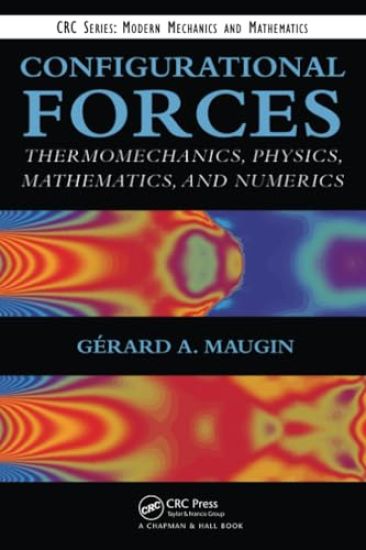
Configurational Forces

Configurational Forces

Gerard A. Maugin

Taylor Francis Inc
2010
sidottu
Exploring recent developments in continuum mechanics, Configurational Forces: Thermomechanics, Physics, Mathematics, and Numerics presents the general framework for configurational forces. It also covers a range of applications in engineering and condensed matter physics. The author presents the fundamentals of accepted standard continuum mechanics, before introducing Eshelby material stress, field theory, variational formulations, Noether’s theorem, and the resulting conservation laws. In the chapter on complex continua, he compares the classical perspective of B.D. Coleman and W. Noll with the viewpoint linked to abstract field theory. He then describes the important notion of local structural rearrangement and its relationship to Eshelby stress. After looking at the relevance of Eshelby stress in the thermodynamic description of singular interfaces, the text focuses on fracture problems, microstructured media, systems with mass exchanges, and electromagnetic deformable media. The concluding chapters discuss the exploitation of the canonical conservation law of momentum in nonlinear wave propagation, the application of canonical-momentum conservation law and material force in numerical schemes, and similarities of fluid mechanics and aerodynamics.Written by a long-time researcher in mechanical engineering, this book provides a detailed treatment of the theory of configurational forces—one of the latest and most fruitful advances in macroscopic field theories. Through many applications, it shows the depth and efficiency of this theory.
Continuum Mechanics Through the Eighteenth and Nineteenth Centuries

Continuum Mechanics Through the Eighteenth and Nineteenth Centuries

Gérard A. Maugin

Springer International Publishing AG
2014
sidottu
Conceived as a series of more or less autonomous essays, the present book critically exposes the initial developments of continuum thermo-mechanics in a post Newtonian period extending from the creative works of the Bernoullis to the First World war, i.e., roughly during first the “Age of reason” and next the “Birth of the modern world”. The emphasis is rightly placed on the original contributions from the “Continental” scientists (the Bernoulli family, Euler, d’Alembert, Lagrange, Cauchy, Piola, Duhamel, Neumann, Clebsch, Kirchhoff, Helmholtz, Saint-Venant, Boussinesq, the Cosserat brothers, Caratheodory) in competition with their British peers (Green, Kelvin, Stokes, Maxwell, Rayleigh, Love,..). It underlines the main breakthroughs as well as the secondary ones. It highlights the role of scientists who left essential prints in this history of scientific ideas. The book shows how the formidable developments that blossomed in the twentieth century (and perused in a previous book of the author in the same Springer Series: “Continuum Mechanics through the Twentieth Century”, Springer 2013) found rich compost in the constructive foundational achievements of the eighteenth and nineteenth centuries. The pre-WWI situation is well summarized by a thorough analysis of treatises (Appell, Hellinger) published at that time. English translations by the author of most critical texts in French or German are given to the benefit of the readers.
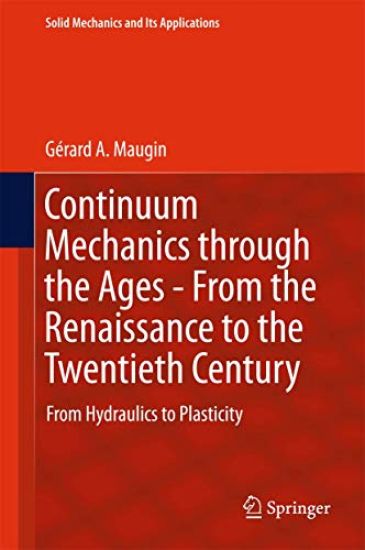
Continuum Mechanics through the Ages - From the Renaissance to the Twentieth Century
Mixing scientific, historic and socio-economic vision, this unique book complements two previously published volumes on the history of continuum mechanics from this distinguished author. In this volume, Gérard A. Maugin looks at the period from the renaissance to the twentieth century and he includes an appraisal of the ever enduring competition between molecular and continuum modelling views. Chapters trace early works in hydraulics and fluid mechanics not covered in the other volumes and the author investigates experimental approaches, essentially before the introduction of a true concept of stress tensor. The treatment of such topics as the viscoelasticity of solids and plasticity, fracture theory, and the role of geometry as a cornerstone of the field, are all explored. Readers will find a kind of socio-historical appraisal of the seminal contributions by our direct masters in the second half of the twentieth century. The analysis of the teaching and research texts by Duhem, Poincaré and Hilbert on continuum mechanics is key: these provide the most valuable documentary basis on which a revival of continuum mechanics and its formalization were offered in the late twentieth century. Altogether, the three volumes offer a generous conspectus of the developments of continuum mechanics between the sixteenth century and the dawn of the twenty-first century. Mechanical engineers, applied mathematicians and physicists alike will all be interested in this work which appeals to all curious scientists for whom continuum mechanics as a vividly evolving science still has its own mysteries.
Continuum Mechanics Through the Eighteenth and Nineteenth Centuries

Continuum Mechanics Through the Eighteenth and Nineteenth Centuries

Gérard A. Maugin

Springer International Publishing AG
2016
nidottu
Conceived as a series of more or less autonomous essays, the present book critically exposes the initial developments of continuum thermo-mechanics in a post Newtonian period extending from the creative works of the Bernoullis to the First World war, i.e., roughly during first the “Age of reason” and next the “Birth of the modern world”. The emphasis is rightly placed on the original contributions from the “Continental” scientists (the Bernoulli family, Euler, d’Alembert, Lagrange, Cauchy, Piola, Duhamel, Neumann, Clebsch, Kirchhoff, Helmholtz, Saint-Venant, Boussinesq, the Cosserat brothers, Caratheodory) in competition with their British peers (Green, Kelvin, Stokes, Maxwell, Rayleigh, Love,..). It underlines the main breakthroughs as well as the secondary ones. It highlights the role of scientists who left essential prints in this history of scientific ideas. The book shows how the formidable developments that blossomed in the twentieth century (and perused in a previous book of the author in the same Springer Series: “Continuum Mechanics through the Twentieth Century”, Springer 2013) found rich compost in the constructive foundational achievements of the eighteenth and nineteenth centuries. The pre-WWI situation is well summarized by a thorough analysis of treatises (Appell, Hellinger) published at that time. English translations by the author of most critical texts in French or German are given to the benefit of the readers.
Continuum Mechanics through the Ages - From the Renaissance to the Twentieth Century
Mixing scientific, historic and socio-economic vision, this unique book complements two previously published volumes on the history of continuum mechanics from this distinguished author. In this volume, Gérard A. Maugin looks at the period from the renaissance to the twentieth century and he includes an appraisal of the ever enduring competition between molecular and continuum modelling views. Chapters trace early works in hydraulics and fluid mechanics not covered in the other volumes and the author investigates experimental approaches, essentially before the introduction of a true concept of stress tensor. The treatment of such topics as the viscoelasticity of solids and plasticity, fracture theory, and the role of geometry as a cornerstone of the field, are all explored. Readers will find a kind of socio-historical appraisal of the seminal contributions by our direct masters in the second half of the twentieth century. The analysis of the teaching and research texts by Duhem, Poincaré and Hilbert on continuum mechanics is key: these provide the most valuable documentary basis on which a revival of continuum mechanics and its formalization were offered in the late twentieth century. Altogether, the three volumes offer a generous conspectus of the developments of continuum mechanics between the sixteenth century and the dawn of the twenty-first century. Mechanical engineers, applied mathematicians and physicists alike will all be interested in this work which appeals to all curious scientists for whom continuum mechanics as a vividly evolving science still has its own mysteries.
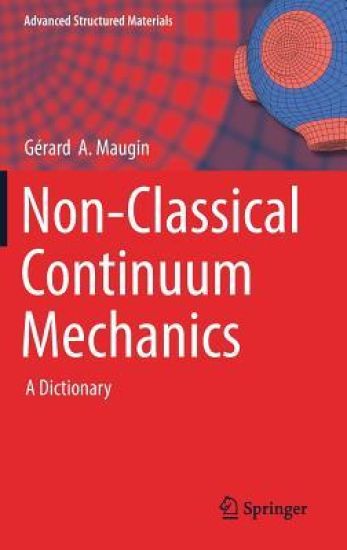
Non-Classical Continuum Mechanics

Non-Classical Continuum Mechanics

Gérard A. Maugin

Springer Verlag, Singapore
2016
sidottu
This dictionary offers clear and reliable explanations of over 100 keywords covering the entire field of non-classical continuum mechanics and generalized mechanics, including the theory of elasticity, heat conduction, thermodynamic and electromagnetic continua, as well as applied mathematics. Every entry includes the historical background and the underlying theory, basic equations and typical applications. The reference list for each entry provides a link to the original articles and the most important in-depth theoretical works. Last but not least, every entry is followed by a cross-reference to other related subject entries in the dictionary.
Non-Classical Continuum Mechanics

Non-Classical Continuum Mechanics

Gérard A. Maugin

Springer Verlag, Singapore
2018
nidottu
This dictionary offers clear and reliable explanations of over 100 keywords covering the entire field of non-classical continuum mechanics and generalized mechanics, including the theory of elasticity, heat conduction, thermodynamic and electromagnetic continua, as well as applied mathematics. Every entry includes the historical background and the underlying theory, basic equations and typical applications. The reference list for each entry provides a link to the original articles and the most important in-depth theoretical works. Last but not least, every entry is followed by a cross-reference to other related subject entries in the dictionary.
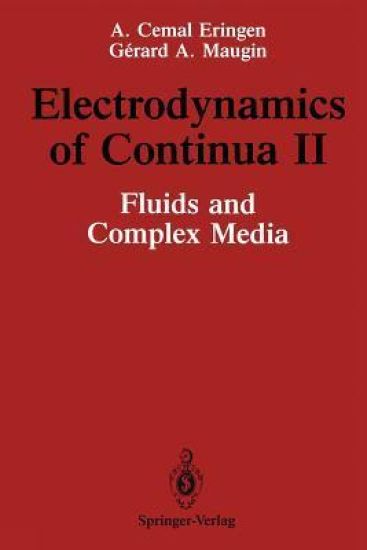
Electrodynamics of Continua II

Electrodynamics of Continua II

A.Cemal Eringen; Gerard A. Maugin

Springer-Verlag New York Inc.
2011
nidottu
This is the second volume of a two-volume set presenting a unified approach to the electrodynamics of continua, based on the principles of contemporary continuum of physics. The first volume was devoted mainly to the development of the theory and applications to deformable solid media. This volume extends the developments of the first volume to richer and newer grounds. It contains discussions on fluid media, magnetohydrodynamics, eletrohydrodynamics and media with more complicated structures. With the discussion, in the last two chapters, of memory-dependent materials and non-local E-M theory, the authors account for the nonlocal effects arising from motions and fields of material points at past times and at spatially distant points. This discussion is included here to stimulate further research in these important fields, which are presently in development stages. The second volume is self-contained and can be studied without the help of volume I. A section summarizing the constitutive equations and the underlying physical ideas, which were presented in more detail in the first volume, is included. This volume may be used as a basis for several graduate courses in engineering schools, applied mathematics and physics departments. It also contains fresh ideas and will stimulate further research in the directions the authors outline.
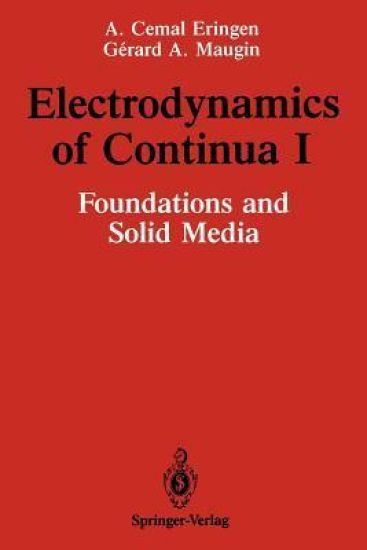
Electrodynamics of Continua I

Electrodynamics of Continua I

A. Cemal Eringen; Gerard A. Maugin

Springer-Verlag New York Inc.
2011
nidottu
The electrodynamics of continua is a branch ofthe physical sciences concerned with the interaction of electromagnetic fields with deformable bodies. De­ formable bodies are considered to be continua endowed with continuous distributions of mass and charge. The theory of electromagnetic continua is concerned with the determination of deformations, motions, stress, and elec­ tromagnetic fields developed in bodies upon the applications of external loads. External loads may be of mechanical origin (e.g., forces, couples, constraints placed on the surface of the body, and initial and boundary conditions arising from thermal and other changes) and/or electromagnetic origin (e.g., electric, magnetic, and current fields). Because bodies of different constitutions respond to external stimuli in a different way, it is imperative to characterize properly the response functions relevant to a given class of continua. This is done by means of the constitutive theory. For example, an elastic dielectric responds to electromagnetic fields in a totally different way than a magnetic fluid. The present book is intended to present a unified approach to the subject matter, based on the principles of contemporary continuum physics.
Lettre Du Père Gérard À Mathurin Heurtaud, Laboureur Et Conseiller Municipal
Lettre du pere Gerard a Mathurin Heurtaud, laboureur et conseiller municipal, relativement a l'election du delegue de sa commune charge de nommer les senateurs / E. BoursinDate de l'edition originale: 1875Sujet de l'ouvrage: France -- 1870-1940 (3e Republique)Ce livre est la reproduction fidele d'une oeuvre publiee avant 1920 et fait partie d'une collection de livres reimprimes a la demande editee par Hachette Livre, dans le cadre d'un partenariat avec la Bibliotheque nationale de France, offrant l'opportunite d'acceder a des ouvrages anciens et souvent rares issus des fonds patrimoniaux de la BnF.Les oeuvres faisant partie de cette collection ont ete numerisees par la BnF et sont presentes sur Gallica, sa bibliotheque numerique.En entreprenant de redonner vie a ces ouvrages au travers d'une collection de livres reimprimes a la demande, nous leur donnons la possibilite de rencontrer un public elargi et participons a la transmission de connaissances et de savoirs parfois difficilement accessibles.Nous avons cherche a concilier la reproduction fidele d'un livre ancien a partir de sa version numerisee avec le souci d'un confort de lecture optimal. Nous esperons que les ouvrages de cette nouvelle collection vous apporteront entiere satisfaction.Pour plus d'informations, rendez-vous sur www.hachettebnf.fr