Showcasing Lee Bae s renowned 'brushstrokes' series, this book includes previously unpublished artworks and a folio of perspectives on one of Korea s most important living artists. Lee Bae s monochromatic practice is a formal and immersive journey into the abyss of 'blackness.' Subtly blurring the lines between drawing, painting, sculpture, and installation, Lee has developed his abstract aesthetics across mediums and boundaries to imbue 'noncolor' with tangible depth and intensity. Charcoal, obtained by burning wood and used to revive fire, offers a powerful metaphor for the cycle of life that has further inspired him to expand his exploration to include the fourth dimension of time.
Providing a rare example of a national cinema that has managed to overturn the prevailing global paradigm of Hollywood dominance, South Korean films are nevertheless still haunted by the peninsula’s earlier colonial history. Focussing on a series of films produced during the administration of disgraced and then pardoned President Park Geun-hye (2013–2017), this book examines South Korea’s relationship with Japan and how this relationship continues to be negotiated through films and politics. Containing detailed discussion of significant and internationally renowned films including The Age of Shadows, The Handmaiden and the domestically popular, The Admiral: Roaring Currents, this informative text is a welcome addition to South Korean Film Studies that will also be valued for its examination of how film cycles operate in non-Hollywood cinema. Offering a perceptive look at an underexplored area, this book will be embraced by professionals and laypersons intrigued by South Korea and Japan’s frequently tense relationship.
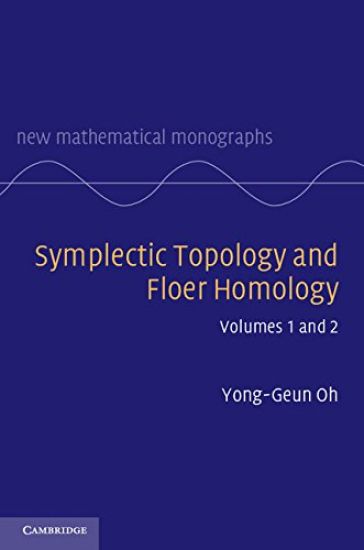
Published in two volumes, this is the first book to provide a thorough and systematic explanation of symplectic topology, and the analytical details and techniques used in applying the machinery arising from Floer theory as a whole. Volume 1 covers the basic materials of Hamiltonian dynamics and symplectic geometry and the analytic foundations of Gromov's pseudo-holomorphic curve theory. One novel aspect of this treatment is the uniform treatment of both closed and open cases and a complete proof of the boundary regularity theorem of weak solutions of pseudo-holomorphic curves with totally real boundary conditions. Volume 2 provides a comprehensive introduction to both Hamiltonian Floer theory and Lagrangian Floer theory, including many examples of their applications to various problems in symplectic topology. Symplectic Topology and Floer Homology is a comprehensive resource suitable for experts and newcomers alike.
A-infinity structure was introduced by Stasheff in the 1960s in his homotopy characterization of based loop space, which was the culmination of earlier works of Sugawara's homotopy characterization of H-spaces and loop spaces. At the beginning of the 1990s, a similar structure was introduced by Fukaya in his categorification of Floer homology in symplectic topology. This structure plays a fundamental role in the celebrated homological mirror symmetry proposal by Kontsevich and in more recent developments of symplectic topology.A detailed construction of A-infinity algebra structure attached to a closed Lagrangian submanifold is given in Fukaya, Oh, Ohta, and Ono's two-volume monograph Lagrangian Intersection Floer Theory (AMS-IP series 46 I & II), using the theory of Kuranishi structures—a theory that has been regarded as being not easily accessible to researchers in general. The present lecture note is provided by one of the main contributors to the Lagrangian Floer theory and is intended to provide a quick, reader-friendly explanation of the geometric part of the construction. Discussion of the Kuranishi structures is minimized, with more focus on the calculations and applications emphasizing the relevant homological algebra in the filtered context.The book starts with a quick explanation of Stasheff polytopes and their two realizations—one by the rooted metric ribbon trees and the other by the genus-zero moduli space of open Riemann surfaces—and an explanation of the A-infinity structure on the motivating example of the based loop space. It then provides a description of the moduli space of genus-zero bordered stable maps and continues with the construction of the (curved) A-infinity structure and its canonical models. Included in the explanation are the (Landau–Ginzburg) potential functions associated with compact Lagrangian submanifolds constructed by Fukaya, Oh, Ohta, and Ono. The book explains calculations of potential functions for toric fibers in detail and reviews several explicit calculations in the literature of potential functions with bulk as well as their applications to problems in symplectic topology via the critical point theory thereof. In the Appendix, the book also provides rapid summaries of various background materials such as the stable map topology, Kuranishi structures, and orbifold Lagrangian Floer theory.
Published in two volumes, this is the first book to provide a thorough and systematic explanation of symplectic topology, and the analytical details and techniques used in applying the machinery arising from Floer theory as a whole. Volume 1 covers the basic materials of Hamiltonian dynamics and symplectic geometry and the analytic foundations of Gromov's pseudoholomorphic curve theory. One novel aspect of this treatment is the uniform treatment of both closed and open cases and a complete proof of the boundary regularity theorem of weak solutions of pseudo-holomorphic curves with totally real boundary conditions. Volume 2 provides a comprehensive introduction to both Hamiltonian Floer theory and Lagrangian Floer theory. Symplectic Topology and Floer Homology is a comprehensive resource suitable for experts and newcomers alike.
Published in two volumes, this is the first book to provide a thorough and systematic explanation of symplectic topology, and the analytical details and techniques used in applying the machinery arising from Floer theory as a whole. Volume 2 provides a comprehensive introduction to both Hamiltonian Floer theory and Lagrangian Floer theory, including many examples of their applications to various problems in symplectic topology. The first volume covered the basic materials of Hamiltonian dynamics and symplectic geometry and the analytic foundations of Gromov's pseudoholomorphic curve theory. Symplectic Topology and Floer Homology is a comprehensive resource suitable for experts and newcomers alike.
Based on the popular SEOUL Magazine column ""Ask a Korean Dude,"" this work is an updated compilation of the Dude's wisdom and a glimpse into the inner psyches of the Korean populace, as well as a venue for sharing laughs and understanding. It is a tool by which you, the foreigner, may come to not only understand the distinctly curious aspects of Korea, but also appreciate the deeply running veins of traditional and modern culture interlaced into this complex--but actually rather simple--society.
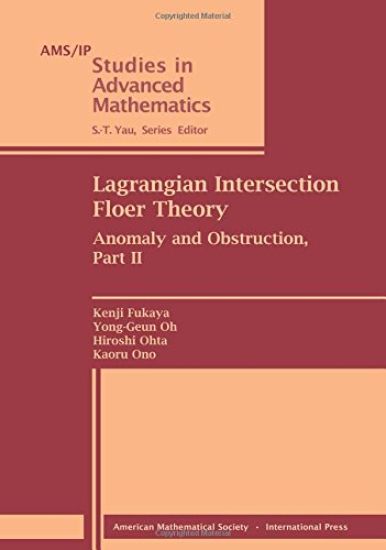
Examines the general Lagrangian Floer theory and on the accompanying homological algebra of filtered A?A?-algebras. In Volume I, general deformation theory of the Floer cohomology is developed in algebraic and geometric contexts. Volume II contains studies of two of the main points of the foundation of the theory: transversality and orientation.
Examines the general Lagrangian Floer theory and on the accompanying homological algebra of filtered A?A?-algebras. In Volume I, general deformation theory of the Floer cohomology is developed in algebraic and geometric contexts. Volume II contains studies of two of the main points of the foundation of the theory: transversality and orientation.
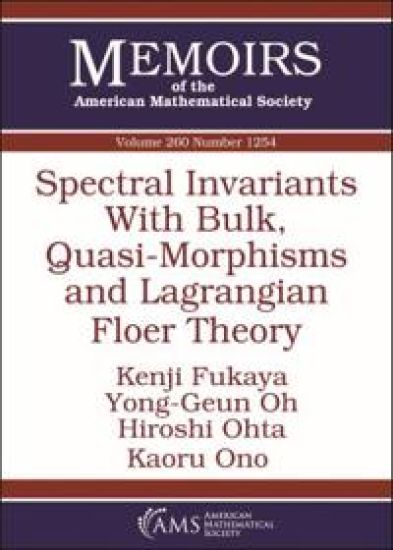
In this paper the authors first develop various enhancements of the theory of spectral invariants of Hamiltonian Floer homology and of Entov-Polterovich theory of spectral symplectic quasi-states and quasi-morphisms by incorporating bulk deformations, i.e., deformations by ambient cycles of symplectic manifolds, of the Floer homology and quantum cohomology. Essentially the same kind of construction is independently carried out by Usher in a slightly less general context. Then the authors explore various applications of these enhancements to the symplectic topology, especially new construction of symplectic quasi-states, quasi-morphisms and new Lagrangian intersection results on toric and non-toric manifolds.The most novel part of this paper is its use of open-closed Gromov-Witten-Floer theory and its variant involving closed orbits of periodic Hamiltonian system to connect spectral invariants (with bulk deformation), symplectic quasi-states, quasi-morphism to the Lagrangian Floer theory (with bulk deformation).The authors use this open-closed Gromov-Witten-Floer theory to produce new examples. Using the calculation of Lagrangian Floer cohomology with bulk, they produce examples of compact symplectic manifolds $(M,\omega)$ which admits uncountably many independent quasi-morphisms $\widetilde{{\rm Ham}}(M,\omega) \to {\mathbb{R}}$. They also obtain a new intersection result for the Lagrangian submanifold in $S^2 \times S^2$.
The Memoirs of the AMS is devoted to the publication of new research in all areas of pure and applied mathematics. The Memoirs is designed particularly to publish long papers of groups of cognate papers in book form, and is under the supervision of the Editorial Committee of the AMS journal Transactions of the American Mathematical Society. All papers are peer-reviewed.
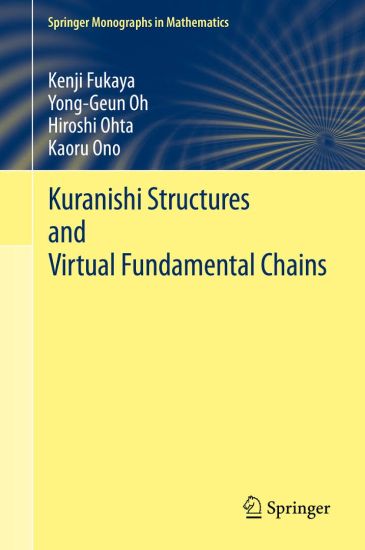
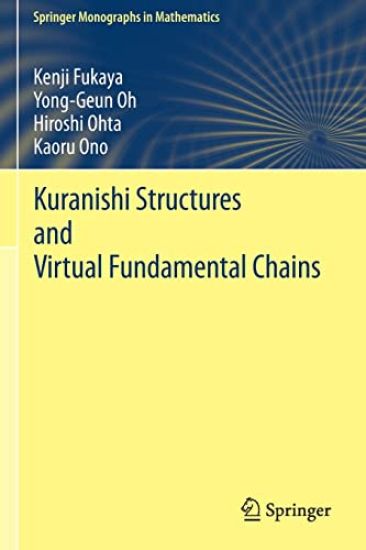
The package of Gromov’s pseudo-holomorphic curves is a major tool in global symplectic geometry and its applications, including mirror symmetry and Hamiltonian dynamics. The Kuranishi structure was introduced by two of the authors of the present volume in the mid-1990s to apply this machinery on general symplectic manifolds without assuming any specific restrictions. It was further amplified by this book’s authors in their monograph Lagrangian Intersection Floer Theory and in many other publications of theirs and others. Answering popular demand, the authors now present the current book, in which they provide a detailed, self-contained explanation of the theory of Kuranishi structures.Part I discusses the theory on a single space equipped with Kuranishi structure, called a K-space, and its relevant basic package. First, the definition of a K-space and maps to the standard manifold are provided. Definitions are given for fiber products, differentialforms, partitions of unity, and the notion of CF-perturbations on the K-space. Then, using CF-perturbations, the authors define the integration on K-space and the push-forward of differential forms, and generalize Stokes' formula and Fubini's theorem in this framework. Also, “virtual fundamental class” is defined, and its cobordism invariance is proved.Part II discusses the (compatible) system of K-spaces and the process of going from “geometry” to “homological algebra”. Thorough explanations of the extension of given perturbations on the boundary to the interior are presented. Also explained is the process of taking the “homotopy limit” needed to handle a system of infinitely many moduli spaces. Having in mind the future application of these chain level constructions beyond those already known, an axiomatic approach is taken by listing the properties of the system of the relevant moduli spaces and then a self-contained account of the construction of the associated algebraic structures is given. This axiomatic approach makes the exposition contained here independent of previously published construction of relevant structures.
The package of Gromov’s pseudo-holomorphic curves is a major tool in global symplectic geometry and its applications, including mirror symmetry and Hamiltonian dynamics. The Kuranishi structure was introduced by two of the authors of the present volume in the mid-1990s to apply this machinery on general symplectic manifolds without assuming any specific restrictions. It was further amplified by this book’s authors in their monograph Lagrangian Intersection Floer Theory and in many other publications of theirs and others. Answering popular demand, the authors now present the current book, in which they provide a detailed, self-contained explanation of the theory of Kuranishi structures.Part I discusses the theory on a single space equipped with Kuranishi structure, called a K-space, and its relevant basic package. First, the definition of a K-space and maps to the standard manifold are provided. Definitions are given for fiber products, differentialforms, partitions of unity, and the notion of CF-perturbations on the K-space. Then, using CF-perturbations, the authors define the integration on K-space and the push-forward of differential forms, and generalize Stokes' formula and Fubini's theorem in this framework. Also, “virtual fundamental class” is defined, and its cobordism invariance is proved.Part II discusses the (compatible) system of K-spaces and the process of going from “geometry” to “homological algebra”. Thorough explanations of the extension of given perturbations on the boundary to the interior are presented. Also explained is the process of taking the “homotopy limit” needed to handle a system of infinitely many moduli spaces. Having in mind the future application of these chain level constructions beyond those already known, an axiomatic approach is taken by listing the properties of the system of the relevant moduli spaces and then a self-contained account of the construction of the associated algebraic structures is given. This axiomatic approach makes the exposition contained here independent of previously published construction of relevant structures.