Kirjojen hintavertailu. Mukana 11 244 527 kirjaa ja 12 kauppaa.

Kirjahaku

Etsi kirjoja tekijän nimen, kirjan nimen tai ISBN:n perusteella.

1000 tulosta hakusanalla Giles Firmin

The Real Christian, or, a Treatise of Effectual Calling. ... To Which is Added, ... a few Words Concerning Socinianism, ... By Giles Firmin,
The 18th century was a wealth of knowledge, exploration and rapidly growing technology and expanding record-keeping made possible by advances in the printing press. In its determination to preserve the century of revolution, Gale initiated a revolution of its own: digitization of epic proportions to preserve these invaluable works in the largest archive of its kind. Now for the first time these high-quality digital copies of original 18th century manuscripts are available in print, making them highly accessible to libraries, undergraduate students, and independent scholars.The Age of Enlightenment profoundly enriched religious and philosophical understanding and continues to influence present-day thinking. Works collected here include masterpieces by David Hume, Immanuel Kant, and Jean-Jacques Rousseau, as well as religious sermons and moral debates on the issues of the day, such as the slave trade. The Age of Reason saw conflict between Protestantism and Catholicism transformed into one between faith and logic -- a debate that continues in the twenty-first century.++++The below data was compiled from various identification fields in the bibliographic record of this title. This data is provided as an additional tool in helping to insure edition identification: ++++British LibraryT095221Glasgow: printed by William Duncan, and sold at his shop, 1744. 32], vi,352p.; 8
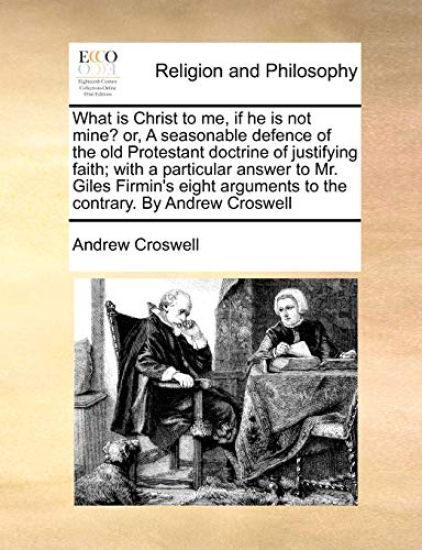
What is Christ to me, if he is not Mine? or, A Seasonable Defence of the old Protestant Doctrine of Justifying Faith; With a Particular Answer to Mr. Giles Firmin's Eight Arguments to the Contrary. By Andrew Croswell
The 18th century was a wealth of knowledge, exploration and rapidly growing technology and expanding record-keeping made possible by advances in the printing press. In its determination to preserve the century of revolution, Gale initiated a revolution of its own: digitization of epic proportions to preserve these invaluable works in the largest archive of its kind. Now for the first time these high-quality digital copies of original 18th century manuscripts are available in print, making them highly accessible to libraries, undergraduate students, and independent scholars.The Age of Enlightenment profoundly enriched religious and philosophical understanding and continues to influence present-day thinking. Works collected here include masterpieces by David Hume, Immanuel Kant, and Jean-Jacques Rousseau, as well as religious sermons and moral debates on the issues of the day, such as the slave trade. The Age of Reason saw conflict between Protestantism and Catholicism transformed into one between faith and logic -- a debate that continues in the twenty-first century.++++The below data was compiled from various identification fields in the bibliographic record of this title. This data is provided as an additional tool in helping to insure edition identification: ++++British LibraryW029701Booksellers' advertisements, p. 47-48].Boston: Printed and sold by Rogers and Fowle in Queen Street, next to the prison, 1745. 46, 2]p.; 4
Farming With Mary

Farming With Mary

Giles Heron

New Generation Publishing
2009
pokkari
"The story of strenuous voluntary work to restore a derelict hill farm - helping young people find the sense of achievement and self respect their school days often failed to provide.""Our starting point was the common failure of academic education to meet the deeper needs of many young people.""Our helpers were neither paid or employed. We didn't choose them: they found and chose us."Nothing was more magical than watching a full moon sailing in and out of clouds, while reclining in comfort on the last wagon load, swaying and jolting across the invisible fields somewhere below.""For us free range meant exactly that - we did far less to shut them in than to shut them out - from garden, from cars, from the kitchen.""Thrift expressed appreciation of the true worth of things and of life itself, leading to their use with respect and care."
Giles of Rome's On Ecclesiastical Power
Giles of Rome was the archbishop of Bourges and a loyal champion of Pope Boniface VIII during the Franco-papal crisis of 1296-1303. On Ecclesiastical Power was written at the height of the conflict between Pope Boniface VIII and King Philip IV of France and represents the earliest fully articulated and philosophically developed defense of the "hierocratic" ideology of the medieval papacy. Giles's theory that all government must be legitimized by the pope was based on scriptural, philosophical, patristic, and canonical sources, and his conclusion that the pope is the rightful ruler and final judge of the world-even in secular matters-is the definitive statement on papal power in the Middle Ages. This book offers a new and complete critical edition of the Latin text, based on a collation of five fourteenth-century manuscripts. It is accompanied by a literal English translation and a detailed introduction analyzing the context and content of the treatise. The book takes into account the hitherto unconsidered Cremona manuscript of On Ecclesiastical Power and will be indispensable to scholars and students of the history of political thought and international relations.
Giles Goat-Boy

Giles Goat-Boy

Barth John

Bantam Doubleday Dell Publishing Group
1987
pokkari
In this outrageously farcical adventure, hero George Giles sets out to conquer the terrible Wescac computer system that threatens to destroy his community in this brilliant "fantasy of theology, sociology, and sex" (Time).
Giles of Rome's De regimine principum

Giles of Rome's De regimine principum

Charles F. Briggs

Cambridge University Press
2008
pokkari
From the time of its composition (c.1280) for Philip the Fair of France until the early sixteenth century, Giles of Rome's mirror of princes, the De regimine principum, was read by both lay and clerical readers in the original Latin and in several vernacular translations, and served as model or source for several works of princely advice. This study examines the relationship between this didactic political text and its audience by focusing on the textual and material aspects of the surviving manuscript copies, as well as on the evidence of ownership and use found in them and in documentary and literary sources. Briggs argues that lay readers used De regimine for several purposes, including as an educational treatise and military manual, whereas clerics, who often first came into contact with it at university, glossed, constructed apparatus for, and modified the text to suit their needs in their later professional lives.
Giles of Rome's De regimine principum

Giles of Rome's De regimine principum

Charles F. Briggs

Cambridge University Press
1999
sidottu
From the time of its composition (c.1280) for Philip the Fair of France until the early sixteenth century, Giles of Rome’s mirror of princes, the De regimine principum, was read by both lay and clerical readers in the original Latin and in several vernacular translations, and served as model or source for several works of princely advice. This study examines the relationship between this didactic political text and its audience by focusing on the textual and material aspects of the surviving manuscript copies, as well as on the evidence of ownership and use found in them and in documentary and literary sources. Briggs argues that lay readers used De regimine for several purposes, including as an educational treatise and military manual, whereas clerics, who often first came into contact with it at university, glossed, constructed apparatus for, and modified the text to suit their needs in their later professional lives.
Giles Ashby Needs A Nanny

Giles Ashby Needs A Nanny

K Sterling

Sarah L. Zeigler
2023
pokkari
Sometimes, a simple field trip to the planetarium can be an act of bravery. In Giles Ashby's case, it could also be a second chance with his lifelong crush.Unbearably awkward and strangled by his anxiety disorder, Giles used surly snarls and abrupt remarks to keep everyone at a distance. As a result and surprising no one, he finds himself divorced and overwhelmed by the demands of parenting nine-year-old Milo -a shy, awkward clone of his father. Not wanting Milo to struggle through life the way he has, Giles enlists the help of Reid Marshall's new nanny agency.Of all the nannies in Manhattan... Reid had to send Giles's childhood crush, Riley Fitzgerald. Still smitten and as flustered as he was in middle school, Giles bungles every encounter with the "new" nanny. But sweet, clever, outgoing Riley is exactly what Milo needs.Riley thinks he knows what he's getting into when he accepts a position working for his childhood nemesis, but Milo steals his heart the moment they meet. And "Giles the Jerk" isn't as bad as Riley remembers. Or maybe Giles was never really all that bad... Riley finds himself swooning as Giles faces his fears in order to help Milo survive the fourth grade and win the science fair.But can Riley really trust his heart, when all his past relationships have been cursed? Could this time be any different? *Paperback includes additional illustrations, playlists, bonus chapters, and more