Kirjojen hintavertailu. Mukana 11 244 527 kirjaa ja 12 kauppaa.

Kirjahaku

Etsi kirjoja tekijän nimen, kirjan nimen tai ISBN:n perusteella.

1000 tulosta hakusanalla Gilles Pourtier

Si mes larmes coulaient dans tes yeux

Si mes larmes coulaient dans tes yeux

Gilles Pourtier

Poursuite editions
2021
sidottu
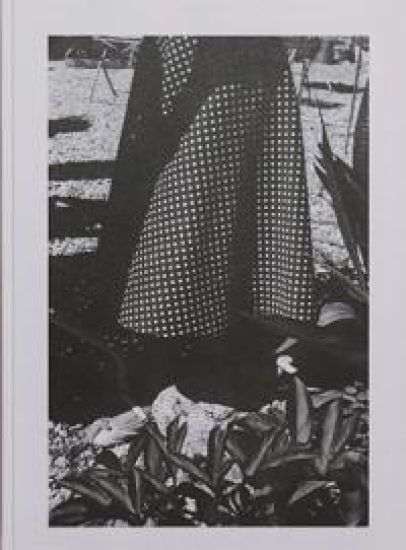
Six years after the birth of his first child, Gilles Pourtier delivers an intimate journey through the months that preceded him. Full-page black and white photographs function as clues to a transformation. They carry trivial memories and symbols, revealing, in filigree, the existential vertigo that prevails when one prepares to transmit life and therefore, the inevitability of death. They read like so many ultrasounds of this before, in which we meet children, adolescents and friends who are already parents. Gilles Pourtier frees himself from a painful story, that of a trying pregnancy. It is literally an introspective “echoing writing” that responds, in retrospect, to helpless empathy. This incommunicability is shared. t is expressed in the message he receives from the mother, as they are separated by a thousand kilometers: “If my tears flowed in your eyes” (si mes larmes coulaient dans tes yeux ) which he makes the starting point of the book.
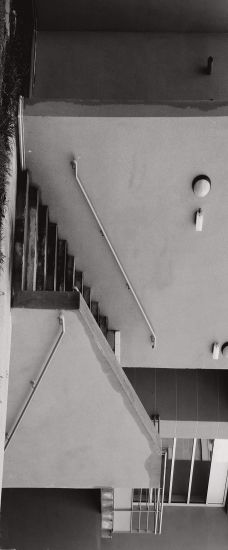
The Great Observation Box

The Great Observation Box

Gilles Pourtier

Poursuite editions
2019
nidottu
Gilles Pourtier was welcomed for a year at 3 bis, a contemporary art center located in the heart of the Montperrin psychiatric hospital in Aix-en-Provence. The large repair area is interested in this place of care and its serial architecture, examining the typological variations of the pavilions where the patients are accommodated. The photographs emphasize the repetitive nature and mass production of these buildings, bringing this industrial aesthetic closer to the issues of minimal art. Gilles Pourtier also develops a series of drawings titled Wunderblocks who questions the relationship between buildings and individuals. Multidisciplinarity, defended in this work crossing drawings, photographs, architecture, allows to bring a new look on the subject of psychiatry by focusing on the close relationship between pathologies and environments. The texts of Jean-Christophe Arcos (curator) and Philippe Prost (architect) support and enlighten this approach throughout the book. Gilles Pourtier took part in a one-year artist's residency at 3 bis, a contemporary art center located in Montperrin psychiatric hospital in Aix-en-Provence. The Great Observation Box focuses on this mental health institute and its serial architecture, examining the typological variations of the pavilions where patients are admitted. The photographs underline the repetitive nature and the mass production of these buildings, establishing a parallel between this industrial aesthetic and the issues of minimal art. Gilles Pourtier also developed a series of drawings entitled Wunderblocksthat matters the relationship between built environments and individuals. The multidisciplinary approach in this publication mixes drawings, photographs and architecture. It is a new perspective on the subject of psychiatry by observing the relationship between pathologies and environments. Throughout the book, the texts by Jean-Christophe Arcos (exhibition curator) and Philippe Prost (architect) complete and shed light on this process.
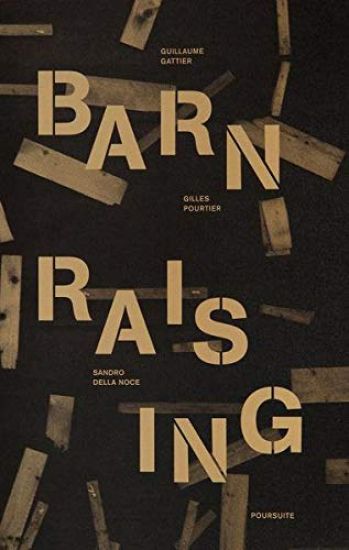
Barn Raising

Barn Raising

Gilles Pourtier; Sandro Della Noce

Poursuite editions
2017
nidottu
A North American tradition, the “Barn Raising” is a collective effort to assemble and hoist up the timber framing of a barn for a community member. Sandro Della Noce, Guillaume Gattier and Gilles Pourtier conducted a tour of the Gaspé Peninsula (Province of Quebec) with the aim of documenting the old barns that dot the landscape of this region. The barn is also perceived as a symbol, a prism through which a multiple reading of reality takes place: at once cultural, social, economic and artistic. Selecting from among all the specimens encountered, they created a record in the form of photographs. This project bears witness, on one hand, to the heritage of vernacular architecture, whose ruinous state nourishes romantic imaginations and provides space for mental projection, and on the other hand, to a vocabulary of shapes and volumes well anchored in our present actuality. Text by Brice Matthieussent
Gilles

Gilles

Pierre Drieu La Rochelle

BoD - Books on Demand
2024
pokkari
Gilles de Pierre Drieu La Rochelle est un roman autobiographique saisissant qui plonge le lecteur dans le tumulte de l'entre-deux-guerres. travers le parcours de son protagoniste ponyme, l'auteur dresse un portrait sans concession d'une g n ration d sabus e, en qu te de sens dans une Europe en pleine mutation. Gilles, alter ego de Drieu La Rochelle, incarne le d senchantement d'une jeunesse marqu e par la Grande Guerre. Dandy nihiliste, il erre dans un Paris d cadent, multipliant les aventures amoureuses et les exp riences intellectuelles. Sa qu te existentielle le m ne des cercles surr alistes aux mouvements politiques radicaux, refl tant les tourments d'une poque o les id ologies s'affrontent violemment. Le roman explore avec une lucidit gla ante la tentation du fascisme comme r ponse la crise morale et spirituelle de la soci t moderne. Drieu La Rochelle y d peint, sans complaisance, l' volution de son personnage vers un engagement politique extr me, offrant une r flexion profonde sur les m canismes qui peuvent conduire un individu embrasser des id aux totalitaires. Gilles s'inscrit naturellement dans les cat gories Litt rature fran aise du XXe si cle, Romans historiques et tudes politiques . L'auteur y d ploie un style incisif et une analyse psychologique fine pour dresser le tableau d'une poque charni re de l'histoire europ enne. Au-del de sa dimension politique, le roman offre une m ditation poignante sur la condition humaine, l'amour et la mort. La prose l gante de Drieu La Rochelle, empreinte de lyrisme et de d sespoir, fait de Gilles une oeuvre majeure de la litt rature fran aise, aussi fascinante que controvers e.
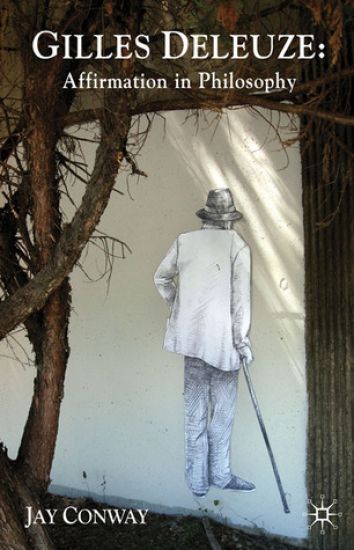
Gilles Deleuze: Affirmation in Philosophy

Gilles Deleuze: Affirmation in Philosophy

J. Conway

Palgrave Macmillan
2010
sidottu
Why does knowledge of philosophy presuppose knowledge of reality? What are the characters in Deleuze's theatre and philosophy? How are his famous metaphysical distinctions secondary to the concept of philosophy as practice and politics? These questions are answered through careful analysis and application of Deleuzian principles.
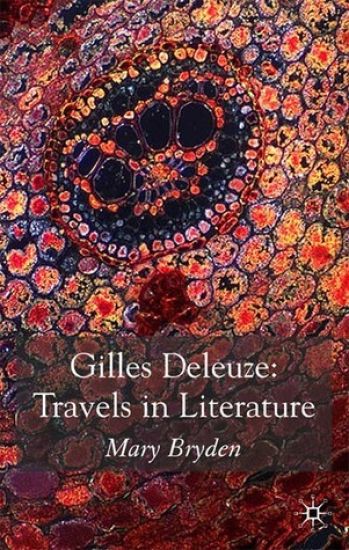
Gilles Deleuze: Travels in Literature

Gilles Deleuze: Travels in Literature

M. Bryden

Palgrave Macmillan
2006
sidottu
Deleuze's writing is permeated with references to literature. Despite asserting that he was not a literary critic, Deleuze provides exhilarating and original interactions with texts. This study offers in-depth encounters between Deleuze's thought and the writers who fascinated him, demonstrating the productivity of a Deleuzian frame of reference.
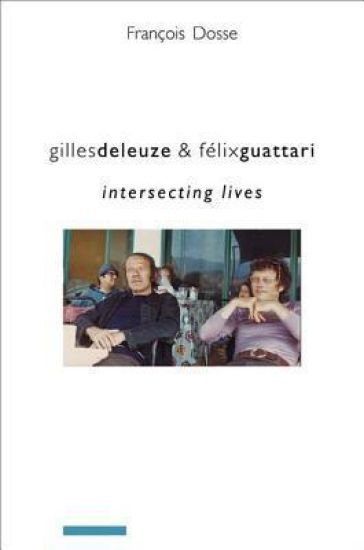
Gilles Deleuze and Félix Guattari

Gilles Deleuze and Félix Guattari

Francois Dosse

Columbia University Press
2010
sidottu
In May 1968, Gilles Deleuze was an established philosopher teaching at the innovative Vincennes University, just outside of Paris. Felix Guattari was a political militant and the director of an unusual psychiatric clinic at La Borde. Their meeting was quite unlikely, yet the two were introduced in an arranged encounter of epic consequence. From that moment on, Deleuze and Guattari engaged in a surprising, productive partnership, collaborating on several groundbreaking works, including Anti-Oedipus, What Is Philosophy? and A Thousand Plateaus. Francois Dosse, a prominent French intellectual known for his work on the Annales School, structuralism, and biographies of the pivotal intellectuals Paul Ricoeur, Pierre Chaunu, and Michel de Certeau, examines the prolific if improbable relationship between two men of distinct and differing sensibilities. Drawing on unpublished archives and hundreds of personal interviews, Dosse elucidates a collaboration that lasted more than two decades, underscoring the role that family and history--particularly the turbulent time of May 1968--play in their monumental work. He also takes the measure of Deleuze and Guattari's posthumous fortunes and the impact of their thought on intellectual, academic, and professional circles.
Gilles Deleuze and Félix Guattari

Gilles Deleuze and Félix Guattari

Francois Dosse

Columbia University Press
2011
pokkari
In May 1968, Gilles Deleuze was an established philosopher teaching at the innovative Vincennes University, just outside of Paris. Felix Guattari was a political militant and the director of an unusual psychiatric clinic at La Borde. Their meeting was quite unlikely, yet the two were introduced in an arranged encounter of epic consequence. From that moment on, Deleuze and Guattari engaged in a surprising, productive partnership, collaborating on several groundbreaking works, including Anti-Oedipus, What Is Philosophy? and A Thousand Plateaus. Francois Dosse, a prominent French intellectual known for his work on the Annales School, structuralism, and biographies of the pivotal intellectuals Paul Ricoeur, Pierre Chaunu, and Michel de Certeau, examines the prolific if improbable relationship between two men of distinct and differing sensibilities. Drawing on unpublished archives and hundreds of personal interviews, Dosse elucidates a collaboration that lasted more than two decades, underscoring the role that family and history--particularly the turbulent time of May 1968--play in their monumental work. He also takes the measure of Deleuze and Guattari's posthumous fortunes and the impact of their thought on intellectual, academic, and professional circles.
Gilles Deleuze

Gilles Deleuze

Claire Colebrook

Routledge
2001
sidottu
Why think? Not, according to Gilles Deleuze, in order to be clever, but because thinking transforms life. Why read literature? Not for pure entertainment, Deleuze tells us, but because literature can recreate the boundaries of life. With his emphasis on creation, the future and the enhancement of life, along with his crusade against 'common sense', Deleuze offers some of the most liberating, exhilarating ideas in twentieth-century thought. This book offers a way in to Deleuzean thought through such topics as: * 'becoming' * time and the flow of life * the ethics of thinking * 'major' and 'minor' literature * difference and repetition * desire, the image and ideology. Written with literature students in mind, this is the ideal guide for students wishing to think differently about life and literature and in this way to create their own new readings of literary texts.
Gilles Deleuze

Gilles Deleuze

Claire Colebrook

Routledge
2001
nidottu
Why think? Not, according to Gilles Deleuze, in order to be clever, but because thinking transforms life. Why read literature? Not for pure entertainment, Deleuze tells us, but because literature can recreate the boundaries of life. With his emphasis on creation, the future and the enhancement of life, along with his crusade against 'common sense', Deleuze offers some of the most liberating, exhilarating ideas in twentieth-century thought. This book offers a way in to Deleuzean thought through such topics as: * 'becoming' * time and the flow of life * the ethics of thinking * 'major' and 'minor' literature * difference and repetition * desire, the image and ideology. Written with literature students in mind, this is the ideal guide for students wishing to think differently about life and literature and in this way to create their own new readings of literary texts.
Gilles Deleuze

Gilles Deleuze

May Todd

Cambridge University Press
2005
pokkari
This book offers a readable and compelling introduction to the work of one of the twentieth century’s most important and elusive thinkers. Other books have tried to explain Deleuze in general terms. Todd May organizes his book around a central question at the heart of Deleuze’s philosophy: how might we live? The author then goes on to explain how Deleuze offers a view of the cosmos as a living thing that provides ways of conducting our lives that we may not have dreamed of. Through this approach the full range of Deleuze’s philosophy is covered. Offering a lucid account of a highly technical philosophy, Todd May’s introduction will be widely read amongst those in philosophy, political science, cultural studies and French studies.
Gilles Deleuze

Gilles Deleuze

Todd May

Cambridge University Press
2005
sidottu
This book offers a readable and compelling introduction to the work of one of the twentieth century’s most important and elusive thinkers. Other books have tried to explain Deleuze in general terms. Todd May organizes his book around a central question at the heart of Deleuze’s philosophy: how might we live? The author then goes on to explain how Deleuze offers a view of the cosmos as a living thing that provides ways of conducting our lives that we may not have dreamed of. Through this approach the full range of Deleuze’s philosophy is covered. Offering a lucid account of a highly technical philosophy, Todd May’s introduction will be widely read amongst those in philosophy, political science, cultural studies and French studies.
Gilles Deleuze

Gilles Deleuze

John Marks

Pluto Press
1998
pokkari
Gilles Deleuze is widely regarded as one of the major post-war proponents of Nietzschean thought in continental philosophy. Over a period of forty years, he presented what amounts to a philosophy of vitalism and multiplicity, bringing together concepts from thinkers as diverse as Nietzsche and Hume. In the first comprehensive English-language introduction to Deleuze, John Marks offers a lucid reading of a complex, abstract and often perplexing body of work. Marks examines Deleuze’s philosophical writings – as well as the political and aesthetic preoccupation which underpinned his thinking – and provides a rigourous and illuminating reading of Deleuze’s early studies of Hume, Nietzsche, Kant, Bergson and Spinoza, his collaborations with Felix Guattari, and the development of a distinctively ‘Deleuzian’ conceptual framework. Marks focuses on the philosophical friendship that developed between Deleuze and Foucault and considers the full range of Deleuze’s fascinating writings on literature, art and cinema. This is a clear and concise guide to the work of one of the twentieth century’s most influential thinkers.
Gilles Deleuze's Logic of Sense

Gilles Deleuze's Logic of Sense

James Williams

Edinburgh University Press
2008
sidottu
This book offers the first critical study of The Logic of Sense, Gilles Deleuze's most important work on language and ethics, as well as the main source for his vital philosophy of the event. Deleuze's philosophy has always promised a revolution in ethical theories and in our understanding of the relation between language, thought and action. This book develops a critical reading of Deleuze's work in order to convey the potential and risks of his new approaches to questions of how to live an intense life in response to the excitement and danger of events. This interpretation covers all aspects of Deleuze's book, including engagements with phenomenology, with analytic philosophy of language, with stoicism, with literary theory and with psychoanalysis. Its aim is to open new debates and develop current ones around Deleuze's work in philosophy, politics, literature, linguistics and sociology.
Gilles Deleuze's Logic of Sense

Gilles Deleuze's Logic of Sense

James Williams

Edinburgh University Press
2008
nidottu
This book offers the first critical study of The Logic of Sense, Gilles Deleuze's most important work on language and ethics, as well as the main source for his vital philosophy of the event. Deleuze's philosophy has always promised a revolution in ethical theories and in our understanding of the relation between language, thought and action. This book develops a critical reading of Deleuze's work in order to convey the potential and risks of his new approaches to questions of how to live an intense life in response to the excitement and danger of events. This interpretation covers all aspects of Deleuze's book, including engagements with phenomenology, with analytic philosophy of language, with stoicism, with literary theory and with psychoanalysis. Its aim is to open new debates and develop current ones around Deleuze's work in philosophy, politics, literature, linguistics and sociology.