
Kirjahaku
Etsi kirjoja tekijän nimen, kirjan nimen tai ISBN:n perusteella.
1000 tulosta hakusanalla Gilles Teneau



La résistance au changement organisationnel (Nouvelle édition)
Gilles Teneau
Dynamiques d'entreprises
2022
nidottu


La gestion des risques, un objet frontière
Nicolas Dufour; Gilles Teneau
Editions L'Harmattan
2022
nidottu
L'erreur humaine
Max-Pierre Moulin; Nicolas Dufour; Gilles Teneau
Perspectives organisationnelles
2022
nidottu

Gilles de Pierre Drieu La Rochelle est un roman autobiographique saisissant qui plonge le lecteur dans le tumulte de l'entre-deux-guerres. travers le parcours de son protagoniste ponyme, l'auteur dresse un portrait sans concession d'une g n ration d sabus e, en qu te de sens dans une Europe en pleine mutation. Gilles, alter ego de Drieu La Rochelle, incarne le d senchantement d'une jeunesse marqu e par la Grande Guerre. Dandy nihiliste, il erre dans un Paris d cadent, multipliant les aventures amoureuses et les exp riences intellectuelles. Sa qu te existentielle le m ne des cercles surr alistes aux mouvements politiques radicaux, refl tant les tourments d'une poque o les id ologies s'affrontent violemment. Le roman explore avec une lucidit gla ante la tentation du fascisme comme r ponse la crise morale et spirituelle de la soci t moderne. Drieu La Rochelle y d peint, sans complaisance, l' volution de son personnage vers un engagement politique extr me, offrant une r flexion profonde sur les m canismes qui peuvent conduire un individu embrasser des id aux totalitaires. Gilles s'inscrit naturellement dans les cat gories Litt rature fran aise du XXe si cle, Romans historiques et tudes politiques . L'auteur y d ploie un style incisif et une analyse psychologique fine pour dresser le tableau d'une poque charni re de l'histoire europ enne. Au-del de sa dimension politique, le roman offre une m ditation poignante sur la condition humaine, l'amour et la mort. La prose l gante de Drieu La Rochelle, empreinte de lyrisme et de d sespoir, fait de Gilles une oeuvre majeure de la litt rature fran aise, aussi fascinante que controvers e.


Why does knowledge of philosophy presuppose knowledge of reality? What are the characters in Deleuze's theatre and philosophy? How are his famous metaphysical distinctions secondary to the concept of philosophy as practice and politics? These questions are answered through careful analysis and application of Deleuzian principles.
Deleuze's writing is permeated with references to literature. Despite asserting that he was not a literary critic, Deleuze provides exhilarating and original interactions with texts. This study offers in-depth encounters between Deleuze's thought and the writers who fascinated him, demonstrating the productivity of a Deleuzian frame of reference.

In May 1968, Gilles Deleuze was an established philosopher teaching at the innovative Vincennes University, just outside of Paris. Felix Guattari was a political militant and the director of an unusual psychiatric clinic at La Borde. Their meeting was quite unlikely, yet the two were introduced in an arranged encounter of epic consequence. From that moment on, Deleuze and Guattari engaged in a surprising, productive partnership, collaborating on several groundbreaking works, including Anti-Oedipus, What Is Philosophy? and A Thousand Plateaus. Francois Dosse, a prominent French intellectual known for his work on the Annales School, structuralism, and biographies of the pivotal intellectuals Paul Ricoeur, Pierre Chaunu, and Michel de Certeau, examines the prolific if improbable relationship between two men of distinct and differing sensibilities. Drawing on unpublished archives and hundreds of personal interviews, Dosse elucidates a collaboration that lasted more than two decades, underscoring the role that family and history--particularly the turbulent time of May 1968--play in their monumental work. He also takes the measure of Deleuze and Guattari's posthumous fortunes and the impact of their thought on intellectual, academic, and professional circles.
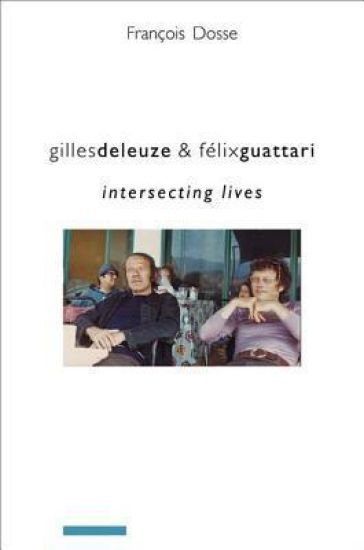
In May 1968, Gilles Deleuze was an established philosopher teaching at the innovative Vincennes University, just outside of Paris. Felix Guattari was a political militant and the director of an unusual psychiatric clinic at La Borde. Their meeting was quite unlikely, yet the two were introduced in an arranged encounter of epic consequence. From that moment on, Deleuze and Guattari engaged in a surprising, productive partnership, collaborating on several groundbreaking works, including Anti-Oedipus, What Is Philosophy? and A Thousand Plateaus. Francois Dosse, a prominent French intellectual known for his work on the Annales School, structuralism, and biographies of the pivotal intellectuals Paul Ricoeur, Pierre Chaunu, and Michel de Certeau, examines the prolific if improbable relationship between two men of distinct and differing sensibilities. Drawing on unpublished archives and hundreds of personal interviews, Dosse elucidates a collaboration that lasted more than two decades, underscoring the role that family and history--particularly the turbulent time of May 1968--play in their monumental work. He also takes the measure of Deleuze and Guattari's posthumous fortunes and the impact of their thought on intellectual, academic, and professional circles.


Why think? Not, according to Gilles Deleuze, in order to be clever, but because thinking transforms life. Why read literature? Not for pure entertainment, Deleuze tells us, but because literature can recreate the boundaries of life. With his emphasis on creation, the future and the enhancement of life, along with his crusade against 'common sense', Deleuze offers some of the most liberating, exhilarating ideas in twentieth-century thought. This book offers a way in to Deleuzean thought through such topics as: * 'becoming' * time and the flow of life * the ethics of thinking * 'major' and 'minor' literature * difference and repetition * desire, the image and ideology. Written with literature students in mind, this is the ideal guide for students wishing to think differently about life and literature and in this way to create their own new readings of literary texts.