Kirjojen hintavertailu. Mukana 12 390 323 kirjaa ja 12 kauppaa.

Kirjahaku

Etsi kirjoja tekijän nimen, kirjan nimen tai ISBN:n perusteella.

1000 tulosta hakusanalla Gillles Deleuze

Ero ja toisto

Ero ja toisto

Gillles Deleuze

TUTKIJALIITTO
2025
nidottu
Ero ja toisto on Gilles Deleuzen ensisijainen väitöskirja, joka tarkastettiin toukokuussa 1968 - keskellä Pariisin valtavia opiskelija- ja työläiskapinoita. Kirjan luettuaan muun muassa Michel Foucault kirjoitti siitä, että eräänä päivänä vuosisatamme tunnetaan kenties Deleuzen vuosisatana. Deleuze lähtee kirjassaan luomaan todellisen eron käsitettä, joka ei määrity suhteessa negaatioon tai ole vastinpari identiteetille ja representaatiolle. Tällaisen positiivisen eron käsitteellinen vastinpari on toisto, mutta ei toisto, joka toistaa aina vain samaa vaan joka alkaa synnyttää eroja. Deleuzen mukaan modernin ajattelun lähtökohta on juuri identiteetin ensisijaisuuteen perustuvan representaation maailman kriisi. Samuuteen ja representaatioon pohjaavan aristoteelis-porvarillisen kategoriakoneiston alta paljastuu lopulta olemisessa kuhisevat loputtomat prosessuaaliset erot, jatkuva eron eroaminen, eroavan syntyminen.
Gilles Deleuze: Affirmation in Philosophy

Gilles Deleuze: Affirmation in Philosophy

J. Conway

Palgrave Macmillan
2010
sidottu
Why does knowledge of philosophy presuppose knowledge of reality? What are the characters in Deleuze's theatre and philosophy? How are his famous metaphysical distinctions secondary to the concept of philosophy as practice and politics? These questions are answered through careful analysis and application of Deleuzian principles.
Gilles Deleuze: Travels in Literature

Gilles Deleuze: Travels in Literature

M. Bryden

Palgrave Macmillan
2006
sidottu
Deleuze's writing is permeated with references to literature. Despite asserting that he was not a literary critic, Deleuze provides exhilarating and original interactions with texts. This study offers in-depth encounters between Deleuze's thought and the writers who fascinated him, demonstrating the productivity of a Deleuzian frame of reference.
Gilles Deleuze and Félix Guattari

Gilles Deleuze and Félix Guattari

Francois Dosse

Columbia University Press
2010
sidottu
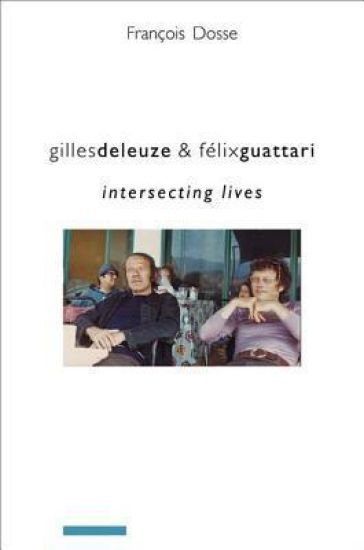
In May 1968, Gilles Deleuze was an established philosopher teaching at the innovative Vincennes University, just outside of Paris. Felix Guattari was a political militant and the director of an unusual psychiatric clinic at La Borde. Their meeting was quite unlikely, yet the two were introduced in an arranged encounter of epic consequence. From that moment on, Deleuze and Guattari engaged in a surprising, productive partnership, collaborating on several groundbreaking works, including Anti-Oedipus, What Is Philosophy? and A Thousand Plateaus. Francois Dosse, a prominent French intellectual known for his work on the Annales School, structuralism, and biographies of the pivotal intellectuals Paul Ricoeur, Pierre Chaunu, and Michel de Certeau, examines the prolific if improbable relationship between two men of distinct and differing sensibilities. Drawing on unpublished archives and hundreds of personal interviews, Dosse elucidates a collaboration that lasted more than two decades, underscoring the role that family and history--particularly the turbulent time of May 1968--play in their monumental work. He also takes the measure of Deleuze and Guattari's posthumous fortunes and the impact of their thought on intellectual, academic, and professional circles.
Gilles Deleuze and Félix Guattari

Gilles Deleuze and Félix Guattari

Francois Dosse

Columbia University Press
2011
pokkari
In May 1968, Gilles Deleuze was an established philosopher teaching at the innovative Vincennes University, just outside of Paris. Felix Guattari was a political militant and the director of an unusual psychiatric clinic at La Borde. Their meeting was quite unlikely, yet the two were introduced in an arranged encounter of epic consequence. From that moment on, Deleuze and Guattari engaged in a surprising, productive partnership, collaborating on several groundbreaking works, including Anti-Oedipus, What Is Philosophy? and A Thousand Plateaus. Francois Dosse, a prominent French intellectual known for his work on the Annales School, structuralism, and biographies of the pivotal intellectuals Paul Ricoeur, Pierre Chaunu, and Michel de Certeau, examines the prolific if improbable relationship between two men of distinct and differing sensibilities. Drawing on unpublished archives and hundreds of personal interviews, Dosse elucidates a collaboration that lasted more than two decades, underscoring the role that family and history--particularly the turbulent time of May 1968--play in their monumental work. He also takes the measure of Deleuze and Guattari's posthumous fortunes and the impact of their thought on intellectual, academic, and professional circles.
Gilles Deleuze

Gilles Deleuze

Claire Colebrook

Routledge
2001
sidottu
Why think? Not, according to Gilles Deleuze, in order to be clever, but because thinking transforms life. Why read literature? Not for pure entertainment, Deleuze tells us, but because literature can recreate the boundaries of life. With his emphasis on creation, the future and the enhancement of life, along with his crusade against 'common sense', Deleuze offers some of the most liberating, exhilarating ideas in twentieth-century thought. This book offers a way in to Deleuzean thought through such topics as: * 'becoming' * time and the flow of life * the ethics of thinking * 'major' and 'minor' literature * difference and repetition * desire, the image and ideology. Written with literature students in mind, this is the ideal guide for students wishing to think differently about life and literature and in this way to create their own new readings of literary texts.
Gilles Deleuze

Gilles Deleuze

Claire Colebrook

Routledge
2001
nidottu
Why think? Not, according to Gilles Deleuze, in order to be clever, but because thinking transforms life. Why read literature? Not for pure entertainment, Deleuze tells us, but because literature can recreate the boundaries of life. With his emphasis on creation, the future and the enhancement of life, along with his crusade against 'common sense', Deleuze offers some of the most liberating, exhilarating ideas in twentieth-century thought. This book offers a way in to Deleuzean thought through such topics as: * 'becoming' * time and the flow of life * the ethics of thinking * 'major' and 'minor' literature * difference and repetition * desire, the image and ideology. Written with literature students in mind, this is the ideal guide for students wishing to think differently about life and literature and in this way to create their own new readings of literary texts.
Gilles Deleuze

Gilles Deleuze

May Todd

Cambridge University Press
2005
pokkari
This book offers a readable and compelling introduction to the work of one of the twentieth century’s most important and elusive thinkers. Other books have tried to explain Deleuze in general terms. Todd May organizes his book around a central question at the heart of Deleuze’s philosophy: how might we live? The author then goes on to explain how Deleuze offers a view of the cosmos as a living thing that provides ways of conducting our lives that we may not have dreamed of. Through this approach the full range of Deleuze’s philosophy is covered. Offering a lucid account of a highly technical philosophy, Todd May’s introduction will be widely read amongst those in philosophy, political science, cultural studies and French studies.
Gilles Deleuze

Gilles Deleuze

Todd May

Cambridge University Press
2005
sidottu
This book offers a readable and compelling introduction to the work of one of the twentieth century’s most important and elusive thinkers. Other books have tried to explain Deleuze in general terms. Todd May organizes his book around a central question at the heart of Deleuze’s philosophy: how might we live? The author then goes on to explain how Deleuze offers a view of the cosmos as a living thing that provides ways of conducting our lives that we may not have dreamed of. Through this approach the full range of Deleuze’s philosophy is covered. Offering a lucid account of a highly technical philosophy, Todd May’s introduction will be widely read amongst those in philosophy, political science, cultural studies and French studies.
Gilles Deleuze

Gilles Deleuze

John Marks

Pluto Press
1998
pokkari
Gilles Deleuze is widely regarded as one of the major post-war proponents of Nietzschean thought in continental philosophy. Over a period of forty years, he presented what amounts to a philosophy of vitalism and multiplicity, bringing together concepts from thinkers as diverse as Nietzsche and Hume. In the first comprehensive English-language introduction to Deleuze, John Marks offers a lucid reading of a complex, abstract and often perplexing body of work. Marks examines Deleuze’s philosophical writings – as well as the political and aesthetic preoccupation which underpinned his thinking – and provides a rigourous and illuminating reading of Deleuze’s early studies of Hume, Nietzsche, Kant, Bergson and Spinoza, his collaborations with Felix Guattari, and the development of a distinctively ‘Deleuzian’ conceptual framework. Marks focuses on the philosophical friendship that developed between Deleuze and Foucault and considers the full range of Deleuze’s fascinating writings on literature, art and cinema. This is a clear and concise guide to the work of one of the twentieth century’s most influential thinkers.
Gilles Deleuze's Logic of Sense

Gilles Deleuze's Logic of Sense

James Williams

Edinburgh University Press
2008
sidottu
This book offers the first critical study of The Logic of Sense, Gilles Deleuze's most important work on language and ethics, as well as the main source for his vital philosophy of the event. Deleuze's philosophy has always promised a revolution in ethical theories and in our understanding of the relation between language, thought and action. This book develops a critical reading of Deleuze's work in order to convey the potential and risks of his new approaches to questions of how to live an intense life in response to the excitement and danger of events. This interpretation covers all aspects of Deleuze's book, including engagements with phenomenology, with analytic philosophy of language, with stoicism, with literary theory and with psychoanalysis. Its aim is to open new debates and develop current ones around Deleuze's work in philosophy, politics, literature, linguistics and sociology.
Gilles Deleuze's Logic of Sense

Gilles Deleuze's Logic of Sense

James Williams

Edinburgh University Press
2008
nidottu
This book offers the first critical study of The Logic of Sense, Gilles Deleuze's most important work on language and ethics, as well as the main source for his vital philosophy of the event. Deleuze's philosophy has always promised a revolution in ethical theories and in our understanding of the relation between language, thought and action. This book develops a critical reading of Deleuze's work in order to convey the potential and risks of his new approaches to questions of how to live an intense life in response to the excitement and danger of events. This interpretation covers all aspects of Deleuze's book, including engagements with phenomenology, with analytic philosophy of language, with stoicism, with literary theory and with psychoanalysis. Its aim is to open new debates and develop current ones around Deleuze's work in philosophy, politics, literature, linguistics and sociology.
Gilles Deleuze's Philosophy of Time

Gilles Deleuze's Philosophy of Time

James Williams

Edinburgh University Press
2011
sidottu
Throughout his career, Deleuze developed a series of original philosophies of time and applied them successfully to many different fields. Now James Williams presents Deleuze's philosophy of time as the central concept that connects his philosophy as a whole. Through this conceptual approach, the book covers all the main periods of Deleuze's philosophy: the early studies of Hume, Nietzsche, Kant, Bergson and Spinoza, the two great philosophical works, Difference and Repetition and Logic of Sense, the Capitalism and Schizophrenia works with Guattari, and the late influential studies of literature, film and painting. The result is an important reading of Deleuze and the first full interpretation of his philosophy of time.
Gilles Deleuze's Philosophy of Time

Gilles Deleuze's Philosophy of Time

James Williams

Edinburgh University Press
2011
nidottu
Throughout his career, Deleuze developed a series of original philosophies of time and applied them successfully to many different fields. Now James Williams presents Deleuze's philosophy of time as the central concept that connects his philosophy as a whole. Through this conceptual approach, the book covers all the main periods of Deleuze's philosophy: the early studies of Hume, Nietzsche, Kant, Bergson and Spinoza, the two great philosophical works, Difference and Repetition and Logic of Sense, the Capitalism and Schizophrenia works with Guattari, and the late influential studies of literature, film and painting. The result is an important reading of Deleuze and the first full interpretation of his philosophy of time.
Gilles Deleuze's Difference and Repetition

Gilles Deleuze's Difference and Repetition

James Williams

Edinburgh University Press
2013
sidottu
This is a revised, expanded and fully up-to-date critical introduction to Deleuze's most important work of philosophy. This is the first critical introduction to Difference and Repetition (first published in 1968): Gilles Deleuze's most important work of philosophy and one of the most significant texts of contemporary philosophy. By critically analysing of Deleuze's methods, principles and arguments, James Williams helps readers to engage with the revolutionary core of Deleuze's philosophy and take up positions for or against its most innovative and controversial ideas. The book will also help to extend Deleuze's work to philosophers working in the analytic tradition. New for this edition: significant new material on intensity, Deleuze and science and questions of action after Difference and Repetition, all of which feed into current debates about how Deleuzian philosophy relates to politics and ethics; guides students through the key debates and oppositions by engaging with latest interpretations of Deleuze by Levi Bryant, Anna Sauvagnargues, Daniel W. Smith, Henry Somers-Hall and Miguel de Beistegui; and, a final critical section introduces and gives brief descriptions of new works on Deleuze, contrasting the Williams reading with others.
Gilles Deleuze's Difference and Repetition

Gilles Deleuze's Difference and Repetition

James Williams

Edinburgh University Press
2013
nidottu
This is a revised, expanded and fully up-to-date critical introduction to Deleuze's most important work of philosophy. This is the first critical introduction to "Difference and Repetition" (first published in 1968): Gilles Deleuze's most important work of philosophy and one of the most significant texts of contemporary philosophy. By critically analysing of Deleuze's methods, principles and arguments, James Williams helps readers to engage with the revolutionary core of Deleuze's philosophy and take up positions for or against its most innovative and controversial ideas. The book will also help to extend Deleuze's work to philosophers working in the analytic tradition. New for this edition: significant new material on intensity, Deleuze and science and questions of action after Difference and Repetition, all of which feed into current debates about how Deleuzian philosophy relates to politics and ethics; guides students through the key debates and oppositions by engaging with latest interpretations of Deleuze by Levi Bryant, Anna Sauvagnargues, Daniel W. Smith, Henry Somers-Hall and Miguel de Beistegui; and, a final critical section introduces and gives brief descriptions of new works on Deleuze, contrasting the Williams reading with others.
Gilles Deleuze's ABCs

Gilles Deleuze's ABCs

Charles J. Stivale

Johns Hopkins University Press
2008
sidottu
Friendship, in its nature, purpose, and effects, has been an important concern of philosophy since antiquity. It was of particular significance in the life of Gilles Deleuze, one of the most original and influential philosophers of the late twentieth century. Taking L'Abecedaire de Gilles Deleuze-an eight-hour video interview that was intended to be aired only after Deleuze's death-as a key source, Charles J. Stivale examines the role of friendship as it appears in Deleuze's work and life. Stivale develops a zigzag methodology practiced by Deleuze himself to explore several concepts as they relate to friendship and to discern how friendship shifts, slips, and creates movement between Deleuze and specific friends. The first section of this study discusses the elements of creativity, pedagogy, and literature that appear implicitly and explicitly in his work. The second section focuses on Deleuze's friendships with Michel Foucault, Jacques Derrida, Claire Parnet, and Felix Guattari and reveals his conception of friendship as an ultimately impersonal form of intensity that goes beyond personal relationships. Stivale's analysis offers an intimate view into the thought of one of the greatest thinkers of our time.
Gilles Deleuze

Gilles Deleuze

Paola Marrati

Johns Hopkins University Press
2008
sidottu
In recent years, the recognition of Gilles Deleuze as one of the major philosophers of the twentieth century has heightened attention to his brilliant and complex writings on film. What is the place of Cinema 1 and Cinema 2 in the corpus of his philosophy? How and why does Deleuze consider cinema as a singular object of philosophical attention, a specific mode of thought? How does his philosophy of film combine and further his approaches to time, movement, and perception, and how does it produce an escape from subjectivity and a plunge into the immanence of images? How does it recode and utilize Henri Bergson's thought and Andre Bazin's film theory? What does it tell us about perceiving a world in images-indeed about our relation to the world? These are the central questions addressed in Paola Marrati's powerful and clear elucidation of Deleuze's philosophy of film. Humanities, film studies, and social science scholars will find this book a valuable contribution to the philosophical literature on cinema and its pertinence in contemporary life.
Gilles Deleuze

Gilles Deleuze

Michael Hardt

University of Minnesota Press
1993
nidottu
The key to understanding Deleuze's complete body of work."A coherent and systematic reading of a philosopher who has consistently courted the incoherent and systematic. What we must avoid are encounters with those who cultivate sad passions (the men of ressentiment in the Nietzschean formulation); and we must increase our power to compose new relationships with compatible bodies with whom we share a common notion. Hardt's exceptional book is one such joyful encounter." -Times Literary Supplement"An excellent book. The project of Gilles Deleuze is to situate Deleuze squarely in the camp of those who seek to deepen and transform our philsophical understanding and political situation. Hardt seems to me to be directly on target." -Substance"Both for its object and its method of study, here is a work that will mark the future of the field of Deleuzian studies." -Eric Alliez, Critique"Hardt's reading of Deleuze is complex and precise. He follows the intricacies of the argument and of the shifting positions with considerable skill, thus providing us with a study not only of the Deleuzian way of doing philosophy, but of Deleuzian reading-of the selectivity of its targets, of its agonistic approach to philosophy, through indirect attack on one main opponent. Reading Hardt reading Deleuze reading, we can understand, for instance, why Deleuze's exposition usually takes the form not of a dialectic but of a correlation, of a system of differences." -Radical Philosophy"How can we forget the dialectic? How an we affirm a constitutive ontology? Through its efforts to respond to these questions, Gilles Deleuze's philosophical apprenticeship presents the Bildungsroman of any contemporary philosophy that wants to break away from the destiny of modernity. Michael Hardt unravels the guiding thread of this philosophy of the future." -Antonio Negri"Hardt's interpretations are exceptionally well-grounded in the history of philosophical discourse, a discourse he exercises with discipline and rare insight. As the only major work on Deleuze in English, this book will undoubtedly set the standard for any future study of one of France's most important thinkers-and it is a very high standard, indeed." -Peggy Kamuf