Kirjojen hintavertailu. Mukana 11 627 463 kirjaa ja 12 kauppaa.

Kirjahaku

Etsi kirjoja tekijän nimen, kirjan nimen tai ISBN:n perusteella.

1000 tulosta hakusanalla Glen E. Spencer

Glen E. Friedman

Glen E. Friedman

Rizzoli International Publications
2014
sidottu
The definitive monograph of Glen E. Friedman, a pioneer of skate, punk, and hip-hop photography, including much never-before-published work. Glen E. Friedman is best known for his work capturing and promoting rebellion in his portraits of artists such as Fugazi, Black Flag, Ice-T, Dead Kennedys, Minor Threat, The Misfits, Bad Brains, Beastie Boys, Run-D.M.C., and Public Enemy, as well as classic skateboarding originators such as Tony Alva, Jay Adams, Alan Ollie Gelfand, Duane Peters, and Stacy Peralta, and a very young Tony Hawk. Designed in association with celebrated street and graphic artist Shepard Fairey, this monograph captures the most important and influential underground heroes of skateboarding, punk, and hip-hop cultures. My Rules is an unprecedented window into the three most significant countercultures of the last quarter of the twentieth century, and Friedman's photographs define those important movements that he helped shape. A remarkable chronicle and a primer about the origins of radical street cultures, My Rules is also a statement of artistic inspiration for those influenced by these countercultures.
What I See: The Black Flag Photographs Of Glen E. Friedman

What I See: The Black Flag Photographs Of Glen E. Friedman

Glen E Friedman; Chuck Dukowski

AKASHIC BOOKS,U.S.
2022
sidottu
A stunning collection of the most iconic photographs ever taken of Black Flag, along with never-before-seen shots and a foreword by Chuck Dukowski. 256 jam-packed pages, over 300 photographs, and over 70% of the photos have never been seen.What I See: The Black Flag Photographs of Glen E. Friedman is an incredible compilation of all of Friedman's most iconic and recognizable images (from 1980 to 1983), of this seminal American punk band, as well as over one hundred never-before-seen photos made during those phenomenal peak years in the group's history.The book includes a foreword by Chuck Dukowski, a cofounder and bass player of Black Flag. Friedman's own introduction to the book takes readers through his journey with the group, from the very first time he saw them play, to his perspectives on the music of the era, to the how, why, and what Black Flag were doing at the time. His words provide additional context to the imagery, explaining what drove him to create his art alongside the band.From the streets around Black Flag's single-room home base/office, rehearsing for their first album, handing out flyers, wheat-pasting posters, driving for hours to a show and returning the same night, house parties, clubs, to the big stage and the beach, Glen E. Friedman was there with his heart, soul, and most importantly his camera. In What I See, he shares with us and inspires us with these images that were made over an incredibly volatile three-year time span.
Sheaf Theory

Sheaf Theory

Glen E. Bredon

Springer-Verlag New York Inc.
1997
sidottu
This book is primarily concerned with the study of cohomology theories of general topological spaces with "general coefficient systems." Sheaves play several roles in this study. For example, they provide a suitable notion of "general coefficient systems." Moreover, they furnish us with a common method of defining various cohomology theories and of comparison between different cohomology theories. The parts of the theory of sheaves covered here are those areas impor­tant to algebraic topology. Sheaf theory is also important in other fields of mathematics, notably algebraic geometry, but that is outside the scope of the present book. Thus a more descriptive title for this book might have been Algebraic Topology from the Point of View of Sheaf Theory. Several innovations will be found in this book. Notably, the con­cept of the "tautness" of a subspace (an adaptation of an analogous no­tion of Spanier to sheaf-theoretic cohomology) is introduced and exploited throughout the book. The factthat sheaf-theoretic cohomology satisfies 1 the homotopy property is proved for general topological spaces. Also, relative cohomology is introduced into sheaf theory. Concerning relative cohomology, it should be noted that sheaf-theoretic cohomology is usually considered as a "single space" theory.
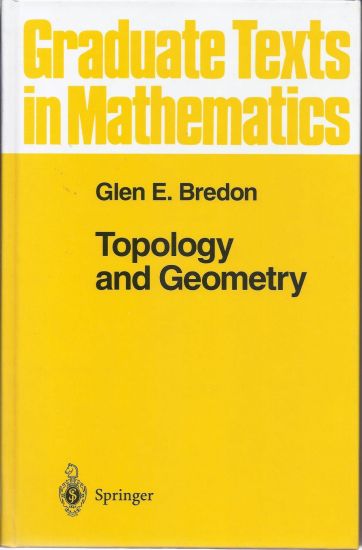
Topology and Geometry

Topology and Geometry

Glen E. Bredon

Springer-Verlag New York Inc.
1993
sidottu
The golden age of mathematics-that was not the age of Euclid, it is ours. C. J. KEYSER This time of writing is the hundredth anniversary of the publication (1892) of Poincare's first note on topology, which arguably marks the beginning of the subject of algebraic, or "combinatorial," topology. There was earlier scattered work by Euler, Listing (who coined the word "topology"), Mobius and his band, Riemann, Klein, and Betti. Indeed, even as early as 1679, Leibniz indicated the desirability of creating a geometry of the topological type. The establishment of topology (or "analysis situs" as it was often called at the time) as a coherent theory, however, belongs to Poincare. Curiously, the beginning of general topology, also called "point set topology," dates fourteen years later when Frechet published the first abstract treatment of the subject in 1906. Since the beginning of time, or at least the era of Archimedes, smooth manifolds (curves, surfaces, mechanical configurations, the universe) have been a central focus in mathematics. They have always been at the core of interest in topology. After the seminal work of Milnor, Smale, and many others, in the last half of this century, the topological aspects of smooth manifolds, as distinct from the differential geometric aspects, became a subject in its own right.
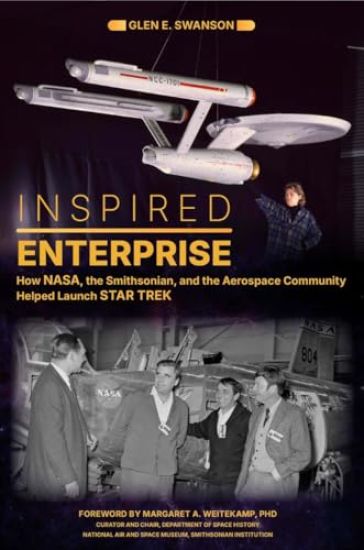
Inspired Enterprise

Inspired Enterprise

Glen E. Swanson; Margaret A. Weitekamp

SCHIFFER PUBLISHING LTD
2025
sidottu
Discover how NASA, the Smithsonian, and the aerospace community helped craft, legitimize, and popularize the beloved television show Star Trek. Star Trek creator Gene Roddenberry sought to create a work of science fiction that would immerse viewers not only through clever storylines and modern visual effects, but also by presenting the story in a scientific and technological context that felt believable. To this end, Roddenberry, a former WWII combat pilot, used his connections in the aerospace industry to seek out the latest and greatest technology. This book, authored by Glen E. Swanson, former chief historian at the NASA Johnson Space Center, uncovers the story of how NASA, the Smithsonian, and the aerospace industry helped craft, legitimize, and popularize the beloved television show Star Trek. Further context is provided through the discussion of additional factors behind the success of the show, including merchandising and syndication.
Applied Biological Psychology

Applied Biological Psychology

Glen E. Getz

Springer Publishing Co Inc
2014
nidottu
Written for graduate students and trainees in mental health, this is the only text to present neurobiology in the context of clinical issues rather than merely focusing on experimental approaches to biological psychology or structuring it along neurological systems. In clear, easily accessible language the text explains how the brain and nervous system are linked to mental disorders. It integrates information from many aspects of neurobiological research, including imaging, neuropsychology, and genetics in order to foster an in-depth understanding of the psychiatric presentation of disorders that mental health professionals encounter in their practices. To facilitate student learning and clarify the connection between neurobiological foundations and clinical presentation, the text includes case studies, cognitive data, imaging results, genetic testing results, and illustrations. It examines major psychological disorders from behavioral, emotional, biological, cognitive and neurophysiological perspectives as they relate to brain structure and the major systems. Special topic sections highlight ethical, research, and treatment concerns for mental health practitioners. Each chapter concludes with summations and review questions. Written for graduate level students in clinical, counseling, and school psychology programs, the text fulfills APA accreditation requirements for coursework in the biological bases of behavior. While the text's primary aim is to help students understand neurobiological information as an important component of a therapeutic framework, it also concisely addresses micro and macro anatomy as relates to neurobiology. Also included are such supplementary teaching materials as test questions and PowerPoint slides of illustrations. Key Features: Focuses on the connection between neurobiology and clinical presentation Presents complex information clearly and concisely Highlights special topics in neurobiology ethics, research, and treatment Integrates information from imaging, neuropsychology, and genetics testing Prepares graduate students in clinical, counseling, and school psychology for professional practice
Applied Biological Psychology

Applied Biological Psychology

Glen E. Getz

SPRINGER PUBLISHING CO INC
2025
nidottu
Learn how to apply neurobiology to real-world practice, moving beyond theory to understand brain-based behavior in depth. The second edition of Applied Biological Psychology explores neuroscientific discoveries like brain imaging, genetics, and cognitive studies to understand behaviors and their connections to psychiatric diagnoses. The first section of Applied Biological Psychology introduces students to foundational neuroscientific theory and research methods, while the second section reviews literature on mood disorders, anxiety disorders, traumatic brain injuries, and other diagnostic categories. The textbook includes case examples and discussions of special topics and ethics to enhance understanding and emphasizes differences and commonalities across diagnoses. Practical applications and ethical considerations in the second edition help bridge the gap between neuroscience theory and psychological practice. Purchase includes online access via most mobile devices or computers. New to the Second Edition: Simplifies complex concepts with easy-to-understand language. Explores psychiatric and medical diagnoses through a neurobiological lens. Reviews symptom criteria for various diagnoses. Presents treatment methods with neurobiological explanations that clarify effectiveness. Tests knowledge with review questions that reinforce learning and encourage self-assessment. Summarizes key points at the end of each chapter for quick review and retention. Key Features: Discover the latest neuroscience research, linking behaviors with neurobiological processes to better understand psychiatric disorders. Examine expanded discussions on genetics and the role of cultural factors in shaping mental health and neurobiology. Analyze real-world case examples that connect theory to practice and enhance critical thinking. Explore neurobiological and psychological impacts in a new chapter dedicated to topics in childhood maltreatment and trauma. Visualize concepts with updated and newly added color images and drawings that enhance comprehension and retention of the material.
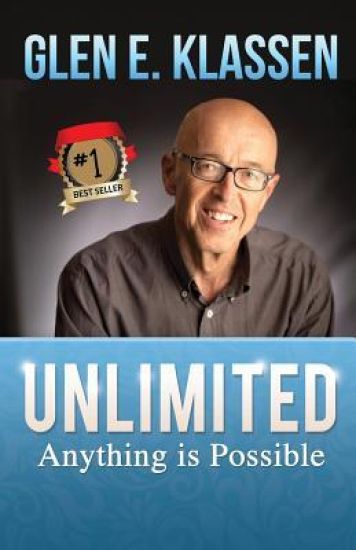
Unlimited: Anything Is Possible

Unlimited: Anything Is Possible

Glen E. Klassen

Evansing Publishing
2015
nidottu
Does your life seem like you are lurching from one crisis to another? Have you ever asked yourself how do I do this thing called life? Your life can be different. You can have a life that is remarkable and memorable. If you are in leadership then this is a book that will give you a framework to make decisions important to your success as a leader.You may be tempted to blame bad breaks and bad people for why your life hasn't turned out the way you wanted. We all have had events happen beyond our direct control. Even for those events we still have a choice in how we respond. Normally most events happen because of our unwise or unaware choices.This book is designed to create awareness and actions regarding key areas affecting our ability to make good decisions, so we can look back at our life with a sense of satisfaction and joy. Not only will you be able to do that, but those near and dear to you will as well.
CliffsNotes Praxis II

CliffsNotes Praxis II

Glen E. Moulton

John Wiley Sons Inc
2013
nidottu
Your complete guide to a higher score on Praxis II: Middle School Science The Praxis II Middle School Science (0439) exam is designed to measure the knowledge and competencies necessary for a beginning teacher of middle school science. The 2-hour Praxis II Middle School Science (0439) exam consists of three constructed-response essays and 90 multiple-choice questions divided into the following content categories: scientific methodology, basic principles of science, physical sciences, life sciences, earth/space sciences, and science/technology/society. In CliffsNotese Praxis II: Middle School Science , two practice tests with complete answers and explanations help you pinpoint areas for further study, while reviews and exercises address all of the test topics you'll encounter on exam day. Plus, proven test-taking strategies help you score higher. Two full-length practice tests Subject reviews of every topic covered on the test Practice questions for every subject review If you're an aspiring teacher looking to take the Praxis II Middle School Science exam, CliffsNotes is your ticket to scoring high at exam time.
CompTIA A+ Certification All-in-One For Dummies

CompTIA A+ Certification All-in-One For Dummies

Glen E. Clarke; Edward Tetz; Timothy L. Warner

John Wiley Sons Inc
2019
nidottu
Fully updated to cover the 2019 exam release! CompTIA's A+ certification is an essential certification to building a successful IT career. Test takers must pass both 90-question exams to be certified, and this book—plus online test bank—will help you reach your certification goal. The 9 minibooks map to the exam's objectives, and include new content on Windows 10, Scripting, Linux, and mobile devices. You’ll learn about how computers work, networking, computer repair and troubleshooting, security, permissions, and customer service. You'll also find test-taking advice and a review of the types of questions you'll see on the exam. Use the online test bank to test your knowledge and prepare for the examGet up to speed on operating system basicsFind out how to manage the operating systemDiscover maintenance and troubleshooting tips Inside is all the knowledge you need to pass the new A+ exam!
CompTIA PenTest+ Certification For Dummies

CompTIA PenTest+ Certification For Dummies

Glen E. Clarke

John Wiley Sons Inc
2020
nidottu
Prepare for the CompTIA PenTest+ certification CompTIA's PenTest+ Certification is an essential certification to building a successful penetration testing career. Test takers must pass an 85-question exam to be certified, and this book—plus the online test bank—will help you reach your certification goal. CompTIA PenTest+ Certification For Dummies includes a map to the exam’s objectives and helps you get up to speed on planning and scoping, information gathering and vulnerability identification, attacks and exploits, penetration testing tools and reporting, and communication skills. Pass the PenTest+ Certification exam and grow as a Pen Testing professionalLearn to demonstrate hands-on ability to Pen TestPractice with hundreds of study questions in a free online test bankFind test-taking advice and a review of the types of questions you'll see on the exam Get ready to acquire all the knowledge you need to pass the PenTest+ exam and start your career in this growing field in cybersecurity!
Topology and Geometry

Topology and Geometry

Glen E. Bredon

Springer-Verlag New York Inc.
2010
nidottu
The golden age of mathematics-that was not the age of Euclid, it is ours. C. J. KEYSER This time of writing is the hundredth anniversary of the publication (1892) of Poincare's first note on topology, which arguably marks the beginning of the subject of algebraic, or "combinatorial," topology. There was earlier scattered work by Euler, Listing (who coined the word "topology"), Mobius and his band, Riemann, Klein, and Betti. Indeed, even as early as 1679, Leibniz indicated the desirability of creating a geometry of the topological type. The establishment of topology (or "analysis situs" as it was often called at the time) as a coherent theory, however, belongs to Poincare. Curiously, the beginning of general topology, also called "point set topology," dates fourteen years later when Frechet published the first abstract treatment of the subject in 1906. Since the beginning of time, or at least the era of Archimedes, smooth manifolds (curves, surfaces, mechanical configurations, the universe) have been a central focus in mathematics. They have always been at the core of interest in topology. After the seminal work of Milnor, Smale, and many others, in the last half of this century, the topological aspects of smooth manifolds, as distinct from the differential geometric aspects, became a subject in its own right.

Sheaf Theory

Sheaf Theory

Glen E. Bredon

Springer-Verlag New York Inc.
2012
nidottu
This book is primarily concerned with the study of cohomology theories of general topological spaces with "general coefficient systems." Sheaves play several roles in this study. For example, they provide a suitable notion of "general coefficient systems." Moreover, they furnish us with a common method of defining various cohomology theories and of comparison between different cohomology theories. The parts of the theory of sheaves covered here are those areas impor­tant to algebraic topology. Sheaf theory is also important in other fields of mathematics, notably algebraic geometry, but that is outside the scope of the present book. Thus a more descriptive title for this book might have been Algebraic Topology from the Point of View of Sheaf Theory. Several innovations will be found in this book. Notably, the con­cept of the "tautness" of a subspace (an adaptation of an analogous no­tion of Spanier to sheaf-theoretic cohomology) is introduced and exploited throughout the book. The factthat sheaf-theoretic cohomology satisfies 1 the homotopy property is proved for general topological spaces. Also, relative cohomology is introduced into sheaf theory. Concerning relative cohomology, it should be noted that sheaf-theoretic cohomology is usually considered as a "single space" theory.